Modern enterprises are generating and processing more data than ever before. From business applications and cloud services to real-time analytics and AI-driven workloads, databases have become the foundation supporting critical digital operations.
Platforms such as Microsoft SQL Server, Oracle Database, and other enterprise database systems are responsible for managing massive amounts of structured information while maintaining fast response times, reliable transactions, and continuous availability.
However, database performance is not determined only by CPU power, memory capacity, or software optimization. The underlying storage infrastructure plays an equally important role.
As database workloads become more complex, traditional storage solutions are increasingly challenged by:
-
Higher transaction volumes
-
More concurrent user requests
-
Larger datasets
-
Real-time data processing requirements
When storage cannot deliver data quickly enough, even powerful processors may remain underutilized. Query response times increase, transaction processing slows down, and overall application performance can suffer.
This is why modern database environments are moving toward enterprise-grade storage solutions designed for:
-
High-speed data access
-
Consistent performance under heavy workloads
-
Long-term reliability
-
Future scalability
Enterprise NVMe SSDs are becoming a critical component in next-generation database infrastructure, helping organizations remove storage bottlenecks and build faster, more reliable data platforms.
Why Storage Performance Matters for Database Workloads
Database systems generate different types of storage workloads. Unlike simple file storage applications, databases require extremely responsive storage to handle frequent reads, writes, and random access operations.
A well-designed database storage architecture must consider the different roles of database components, including data files, transaction logs, and temporary processing areas.
-
Database Files: Faster Data Access Improves Query Performance
Database files store the core information required by applications, including:
-
Tables
-
Indexes
-
Application data
-
Metadata information
When users search information, generate reports, or access business applications, the database engine frequently reads data from storage.
For these operations, storage performance directly affects:
-
Query response time
-
Application responsiveness
-
User experience
Traditional storage devices may struggle when databases perform large numbers of random read operations simultaneously.
Enterprise SSD solutions improve this situation by providing:
-
Lower access latency
-
Higher random read performance
-
Faster data delivery to the database engine
-
Transaction Logs: Stable Write Performance Protects Data Operations
Transaction logs are one of the most important parts of database systems. They record changes before data is permanently written, helping maintain consistency and support recovery processes.
For example, in financial systems, e-commerce platforms, and enterprise applications, thousands of transactions may occur every second.
Transaction log storage requires:
-
Continuous write capability
-
Stable latency
-
High endurance
A storage device that performs well only during short benchmark tests may not provide consistent performance during long-term database operation.
This is why enterprise database environments focus on sustained performance rather than only peak speed.
Why Enterprise NVMe SSD Is Becoming Essential for Modern Databases
For many years, database systems were built around traditional storage architectures. Hard disk drives (HDDs) were widely used because of their large capacity and relatively low cost, while SATA SSDs later became a popular upgrade option due to their significantly better performance.
However, modern enterprise databases face very different challenges compared with traditional applications. Today’s systems must support thousands of concurrent users, real-time analytics, cloud applications, and increasingly complex data processing tasks. Under these conditions, storage performance is no longer only about maximum capacity. It is about how quickly and consistently data can be accessed.
From HDD to SATA SSD: Performance Improvements and Remaining Limitations
HDD technology relies on mechanical components, including spinning platters and moving read/write heads. While HDDs remain useful for large-scale archival storage, their mechanical design creates higher latency and limits random access performance.
For database workloads that involve frequent small data requests, such as index searches, transaction processing, and query execution, HDD latency can significantly impact application responsiveness.
SATA SSDs solve many of these problems by replacing mechanical storage with NAND flash memory. Compared with HDDs, SATA SSDs provide:
-
Lower access latency
-
Higher random read/write performance
-
Improved application response time
-
Better reliability due to the absence of moving parts
However, SATA SSDs still rely on the SATA interface and AHCI protocol, which were originally designed for hard disk technology. As database workloads continue to grow, SATA-based storage may become a performance limitation, especially in environments with high concurrency and intensive data processing requirements.
Why Enterprise NVMe SSD Provides a Better Foundation for Database Systems
Enterprise NVMe SSDs are designed specifically for modern high-performance computing environments. Instead of using the older SATA/AHCI architecture, NVMe SSDs communicate directly through PCIe lanes, allowing storage devices to process data more efficiently.
This architecture provides several advantages for database infrastructure.
-
Lower Latency for Faster Database Response
Latency is one of the most important factors affecting database performance. Even small delays in storage response can accumulate when thousands of database operations occur simultaneously.
NVMe technology reduces unnecessary communication layers between the storage device and the CPU. This shorter data path helps databases achieve:
-
Faster query execution
-
Lower transaction response time
-
Improved application performance
For applications such as online transaction processing (OLTP), financial platforms, and enterprise management systems, lower storage latency can directly improve user experience and operational efficiency.
-
Sustained Performance for 24/7 Enterprise Operations
Consumer SSDs are often optimized for short bursts of high performance. Enterprise database environments, however, require storage devices that can maintain stable performance over long periods.
A database server may continuously handle:
-
Transaction records
-
User requests
-
Data analytics workloads
-
Background database maintenance tasks
For these applications, consistent performance is more valuable than temporary peak speed.
Enterprise NVMe SSDs are designed with features such as higher endurance ratings, optimized firmware, advanced error correction, and power loss protection (PLP). These technologies help maintain data integrity and stable operation during continuous workloads.
-
Scalability for Future Data Growth
Enterprise databases are continuing to expand due to digital transformation, AI analytics, and increasing data generation from connected devices. A storage architecture that works today must also support future growth.
Enterprise NVMe SSDs provide a scalable foundation by offering:
-
Higher throughput for increasing workloads
-
Support for larger database environments
-
Better performance when multiple applications run simultaneously
-
Compatibility with next-generation server platforms
As businesses move toward AI-driven analytics and real-time decision-making, storage infrastructure needs to evolve from simply storing data to actively supporting data processing.
Building an Optimized Storage Architecture for Database Workloads
Choosing a high-performance SSD is only one part of database optimization. The way storage resources are organized also has a significant impact on system stability and performance.
Enterprise database systems usually contain different types of data with different storage requirements. Separating database components onto appropriate storage resources can help reduce storage contention and improve overall reliability.
| Database Component | Recommended Storage Characteristics | Primary Requirement |
| Database Files | High-performance NVMe SSD | Fast random read/write access and low latency |
| Transaction Logs | Enterprise SSD with high endurance | Stable continuous write performance |
| TempDB | Low-latency SSD storage | High IOPS for temporary processing |
For example, placing frequently accessed database files, transaction logs, and temporary processing data on the same storage device may create unnecessary competition for resources. During peak workloads, this can lead to performance fluctuations.
A properly designed storage architecture helps databases achieve:
-
More predictable performance
-
Improved system availability
-
Better resource utilization
-
Easier future expansion
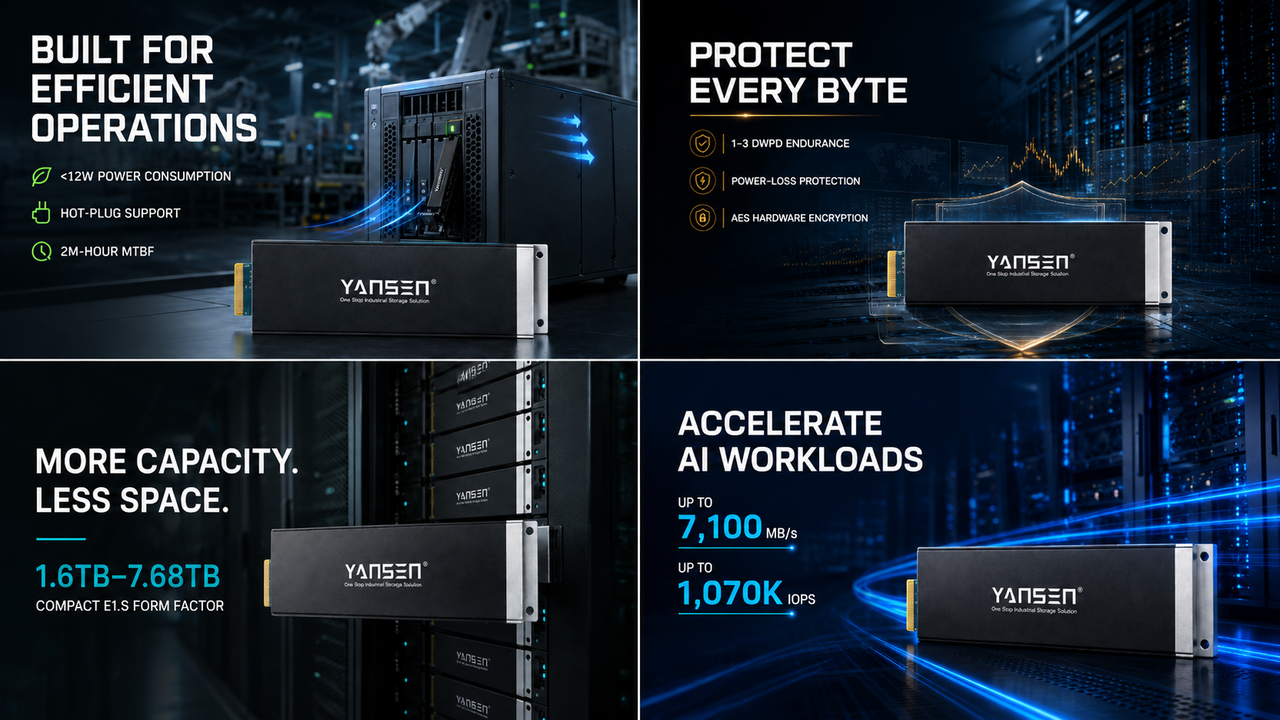
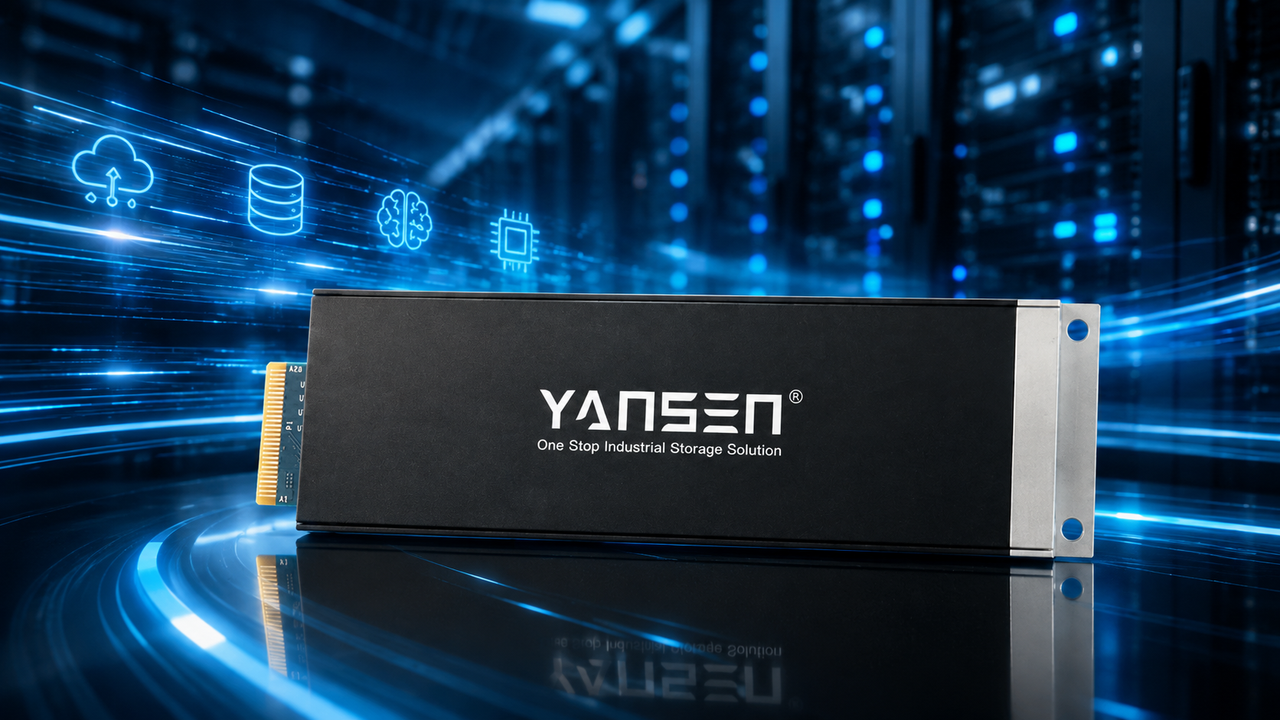
YANSEN E1.S Enterprise SSD: Designed for Next-Generation Database Infrastructure
As enterprise infrastructure continues to evolve, storage architecture must adapt to new requirements from cloud computing, artificial intelligence, and high-performance databases. Traditional storage solutions based on older form factors may face limitations in density, thermal management, and scalability when deployed in modern data centers.
The E1.S form factor, part of the Enterprise and Data Center Standard Form Factor (EDSFF) family, was developed specifically for next-generation server environments. Compared with traditional 2.5-inch enterprise SSDs, E1.S SSDs are optimized for higher storage density, improved airflow, and more efficient thermal management.
For enterprises building database platforms, AI infrastructure, or large-scale computing environments, E1.S provides a future-oriented storage option that balances performance, reliability, and deployment flexibility.
High-Speed NVMe Performance for Data-Intensive Applications
Modern databases increasingly handle workloads that require rapid data access and continuous processing. Whether it is real-time analytics, enterprise applications, or AI-assisted database operations, storage latency can directly influence overall system efficiency.
YANSEN E1.S Enterprise SSD adopts the NVMe PCIe architecture to provide:
-
High-speed data transfer capability
-
Low storage latency
-
Efficient parallel data processing
-
Stable performance under demanding workloads
This makes E1.S SSD suitable for applications such as:
-
Database acceleration
-
Enterprise application platforms
-
AI data pipelines
-
Cloud computing infrastructure
-
Big data analytics systems
Compared with traditional storage interfaces, NVMe allows enterprise servers to handle more intensive workloads by reducing storage communication bottlenecks and improving data accessibility.
Enterprise Reliability for 24/7 Mission-Critical Operations
For enterprise databases, performance alone is not enough. A storage failure can affect business continuity, data availability, and operational efficiency. Therefore, reliability is one of the most important considerations when selecting enterprise SSD solutions.
YANSEN E1.S Enterprise SSD is designed for mission-critical environments that require long-term stable operation. It focuses on key enterprise storage requirements, including:
-
High endurance for intensive write workloads
-
Stable performance during continuous operation
-
Data integrity protection mechanisms
-
Optimized firmware for enterprise applications
These capabilities help support demanding environments such as:
-
Enterprise database servers
-
Cloud service platforms
-
Industrial computing systems
-
AI infrastructure
In enterprise environments, storage devices are expected to operate reliably for years rather than simply deliver short-term benchmark performance. This is why factors such as endurance, error management, and firmware stability are critical during SSD selection.
Optimized Thermal Efficiency for High-Density Server Deployment
As data centers increase computing density, thermal management has become a major challenge. High-performance processors, GPUs, and storage devices generate significant heat, making airflow optimization essential for maintaining system stability.
Compared with traditional SSD designs, E1.S provides advantages in server thermal management through its optimized form factor. Its design allows better airflow integration and more efficient heat dissipation in dense server environments.
This helps enterprises maintain:
-
More stable operating temperatures
-
Consistent storage performance
-
Higher server utilization
-
Improved infrastructure efficiency
For AI servers, cloud platforms, and high-performance database systems, thermal efficiency is not only a hardware design consideration but also an important factor affecting long-term reliability.
Flexible Deployment for Future Enterprise Infrastructure
The role of enterprise storage is expanding beyond traditional database applications. As organizations adopt AI workloads, machine learning platforms, virtualization, and large-scale analytics, storage systems need to support a wider range of applications.
YANSEN E1.S Enterprise SSD is designed to support future infrastructure development, including:
-
AI computing platforms
-
Cloud infrastructure
-
Enterprise database environments
-
High-performance data analytics
-
Industrial computing applications
By combining NVMe performance, enterprise-grade reliability, and modern server compatibility, E1.S SSD provides a scalable storage foundation for organizations preparing for future data growth.
Beyond SQL Server: Enterprise SSD for Future Data-Driven Workloads
Although SQL Server represents a typical enterprise database application, modern businesses rely on many other data-intensive workloads, including artificial intelligence, machine learning, virtualization, and real-time analytics.
These applications share common requirements:
-
Large-scale data processing
-
Fast and consistent data access
-
Reliable long-term operation
-
Scalable storage architecture
As enterprises continue moving toward intelligent and data-driven operations, storage infrastructure will play an increasingly important role in overall system performance. Enterprise NVMe SSDs are becoming a key component for organizations that need to process, analyze, and protect growing volumes of critical data.
How to Choose the Right Enterprise SSD for Database Infrastructure
Selecting an enterprise SSD for database applications requires more than comparing sequential read and write speeds. In real-world deployments, database performance depends on multiple factors, including workload characteristics, endurance requirements, reliability features, and future scalability.
Before choosing an SSD solution, enterprise IT teams and system integrators should evaluate several key factors.
-
Understand the Database Workload Type
Different database workloads create different storage demands. A transactional database handling thousands of user requests per second requires different SSD characteristics compared with a data warehouse focused on large-scale analytics.
| Workload Type | Storage Requirement | Recommended SSD Characteristics |
| Online Transaction Processing (OLTP) | Frequent small data operations | Low latency, high random IOPS, stable write performance |
| Data Analytics | Large-scale data scanning and processing | High throughput and strong parallel performance |
| AI Database Applications | Large datasets and continuous data access | High capacity, low latency, enterprise endurance |
| Virtualized Database Environment | Multiple workloads sharing resources | Consistent performance under mixed workloads |
Understanding the actual workload is the first step toward selecting a storage solution that delivers practical value rather than only impressive benchmark numbers.
-
Pay Attention to Endurance and Data Protection
Enterprise databases often run continuously and generate large amounts of write operations. Unlike consumer applications where occasional performance peaks may be sufficient, enterprise systems require predictable performance over years of operation.
Important SSD specifications include:
-
DWPD (Drive Writes Per Day): Indicates how much data can be written to the SSD every day during its warranty period.
-
TBW (Terabytes Written): Represents the total amount of data that can be written during the SSD lifetime.
-
Power Loss Protection (PLP): Helps protect important data during unexpected power interruptions.
-
ECC and Firmware Optimization: Improve data accuracy and long-term stability.
For mission-critical database systems, these reliability features are often more valuable than peak benchmark performance.
-
Consider Future Infrastructure Expansion
Database environments rarely remain unchanged. As business data grows, companies may need to support more users, additional applications, AI analytics, and larger datasets.
A suitable enterprise SSD should provide enough scalability for future requirements, including:
-
Higher storage capacity options
-
Compatibility with next-generation servers
-
Support for high-performance computing environments
-
Long product lifecycle availability
This is especially important for enterprises that invest heavily in infrastructure deployment. Replacing storage hardware frequently can increase maintenance costs and create unnecessary system migration risks.
Why Enterprise Storage Is Becoming a Strategic Infrastructure Investment
In the past, storage was often considered a passive component responsible only for saving data. However, modern enterprise environments have changed this perspective.
Today, storage directly affects:
-
Application response time
-
Database transaction efficiency
-
AI workload performance
-
Business continuity
As organizations adopt cloud services, artificial intelligence, and real-time analytics, storage infrastructure has become a critical part of overall computing performance.
The future of enterprise computing will not depend on CPU, memory, or storage alone. Instead, it will rely on how efficiently these components work together to process increasingly complex workloads.
Conclusion: Building Faster and More Reliable Data Infrastructure
Modern database optimization is no longer limited to software configuration or server upgrades. The underlying storage architecture plays an equally important role in determining system performance, reliability, and scalability.
Enterprise NVMe SSD solutions, such as YANSEN E1.S Enterprise SSD, provide organizations with a powerful foundation for next-generation workloads by combining high-speed data access, enterprise reliability, and future-ready scalability.
For businesses managing critical databases, AI applications, cloud platforms, and industrial computing systems, choosing the right storage technology is not simply a hardware decision—it is a long-term investment in infrastructure performance and business continuity.
Explore YANSEN enterprise storage solutions designed for demanding database environments, AI workloads, and next-generation data infrastructure.
Frequently Asked Questions (FAQ)
-
Why is NVMe SSD better than SATA SSD for enterprise databases?
NVMe SSDs use the PCIe interface and NVMe protocol, which provide lower latency and higher parallel processing capability compared with SATA SSDs. For databases with high concurrency and intensive workloads, NVMe SSDs can improve query response time and transaction processing efficiency.
-
Is E1.S SSD suitable for SQL Server databases?
Yes. E1.S SSDs are designed for enterprise server environments and can support database workloads that require high performance, reliability, and continuous operation. They are suitable for SQL Server, cloud databases, analytics platforms, and other data-intensive applications.
-
What is the difference between consumer SSD and enterprise SSD?
Enterprise SSDs are designed for continuous workloads and mission-critical applications. Compared with consumer SSDs, enterprise SSDs typically provide higher endurance, optimized firmware, stronger data protection features, and better stability under long-term operation.
-
Why does database storage need Power Loss Protection (PLP)?
During unexpected power failures, data stored in SSD cache may be lost or corrupted. PLP technology helps ensure that important data is safely written to NAND flash memory, improving database reliability and data integrity.
-
What applications can benefit from YANSEN E1.S Enterprise SSD?
YANSEN E1.S Enterprise SSD is designed for demanding applications including enterprise databases, AI infrastructure, cloud computing platforms, big data analytics, and industrial computing systems that require high-speed, reliable storage.