Introduction: Why Enterprise SSDs Depend on the Trio of Core Technologies
Enterprise-grade SSDs aren’t just high-performance storage devices; they are the cornerstone of modern data infrastructure, expected to operate 24/7 under extreme loads, deliver microsecond-level latency, and guarantee zero data loss — even in the event of sudden power failure. Compared to consumer SSDs, enterprise drives require vastly superior endurance (e.g., higher DWPD/TBW ratings), greater Mean Time Between Failures (MTBF), and consistent IOPS under heavy workloads.

What enables this leap in capability? The answer lies in a symbiotic trio of components:
- The controller— the “brain” managing data flow, error correction, and performance optimization.
- 3D NAND flash memory— the “warehouse” that stores data reliably at high density and endurance.
- Supercapacitors (PLP)— the “emergency system” that kicks in during unexpected power loss, preserving in-flight data.
This article will analyze how each of these components functions independently and together to create enterprise SSDs that meet mission-critical standards.
1. Controller: The Brain of Enterprise SSDs
1.1 Data Flow Management & FTL Mapping
At the heart of every SSD lies the Flash Translation Layer (FTL), an abstraction layer that maps logical block addresses from the host to physical addresses on NAND. In enterprise SSDs, this function is optimized with multi-level page and block management algorithms, reducing write amplification and increasing endurance.
Enterprise SSD controllers — like Marvell Bravera SC5 or Phison PS5026-E26 — support 16 to 20 NAND channels, enabling massive parallelism and queue depths suitable for data center traffic.
1.2 Error Correction & ECC Engines
Enterprise SSDs rely on LDPC (Low-Density Parity Check) and RAID-like error correction engines to manage the inherent instability of high-density NAND. Controllers dynamically adapt error correction strength based on wear level and temperature — critical for QLC or upcoming PLC NAND deployments.
For instance, the IBM FlashCore Module leverages FPGA-based controllers to offload ECC processing, improving latency while managing vast amounts of AI and big data workloads.
1.3 Performance & QoS Management
Advanced enterprise controllers offer Quality of Service (QoS) assurance, guaranteeing consistent performance across variable workloads. Features include:
- Hardware-accelerated AES-256 encryptionand CRC integrity checks
- Multi-core CPUsonboard the controller for parallel I/O request handling
- Thermal throttling control algorithmsto prevent overheating-induced throttling
2. 3D NAND: The Data Warehouse Revolution
2.1 From 2D to 3D: What Changed?
Initially, flash memory stored data on a flat (2D) plane. But as node sizes shrank, interference and durability issues mounted. The solution? 3D NAND — a vertically stacked memory cell structure now exceeding 300 layers in commercial products from Micron and Samsung.
Benefits include:
- Higher density (up to 1 TB per die)
- Better power efficiency
- Improved endurance (when paired with smart firmware)
2.2 Types of NAND & Their Trade-offs
|
NAND Type |
Bits per Cell |
P/E Cycles (Typical) |
Performance |
Use Case |
|
SLC |
1 |
100,000+ |
Highest |
Military, aerospace |
|
MLC |
2 |
10,000 |
High |
Finance, databases |
|
TLC |
3 |
3,000 |
Moderate |
General enterprise |
|
QLC |
4 |
1,000 |
Lower |
Cold storage, AI logs |
|
PLC |
5 |
<500 (experimental) |
TBD |
Archival, still R&D |
Enterprise-grade TLC offers enhanced endurance (3x consumer TLC) via tighter voltage thresholds and smarter garbage collection algorithms.
2.3 Challenges at the Cutting Edge
- Retention lossincreases with more bits per cell.
- Inter-cell interferencein stacked architectures needs countermeasures like vertical isolation and refined programming schemes.
- PLC NANDholds promise for ultra-high-capacity SSDs but demands next-gen ECC and controller architecture.
3. Supercapacitors: The Last Line of Defense
3.1 What Happens During Power Loss?
Imagine a data center SSD performing hundreds of thousands of IOPS. A sudden power loss mid-write can corrupt the FTL, lose in-flight data, or render the drive unrecoverable. This is where Power Loss Protection (PLP) comes in.
YANSEN’s enterprise SSDs integrate supercapacitors to provide the 50–100 milliseconds of power required to flush cached data to non-volatile NAND during an outage.
3.2 PLP Hardware Choices
- Tantalum Capacitors: Higher thermal stability, preferred in aerospace and defense.
- Lithium-ion Capacitors: More cost-effective, used in general enterprise applications.
3.3 Data Path Protection
Combined with non-volatile DRAM (NVDIMM) or persistent memory technologies like Intel Optane, supercapacitors ensure:
- Safe FTL metadata storage
- Cache write-back integrity
- Compliance with JEDEC JESD218PLP standards
4. Real-World Applications & Case Studies
4.1 Financial Institutions
Large banks rely on low-latency SSDs to process millions of daily transactions. For example, JP Morgan Chase uses Samsung’s PM1735 with ZNS (Zoned Namespace) and SR-IOV to segment workloads and ensure microsecond latency under peak loads.
4.2 AI Training Infrastructure
YANSEN’s enterprise SSDs are used in AI inference clusters requiring consistent bandwidth (e.g., 12GB/s sustained) and sub-100μs latency. QLC drives with strong ECC offer economical storage for Sora-like video model logs, where training datasets can exceed 100TB.

4.3 Edge & Industrial IoT
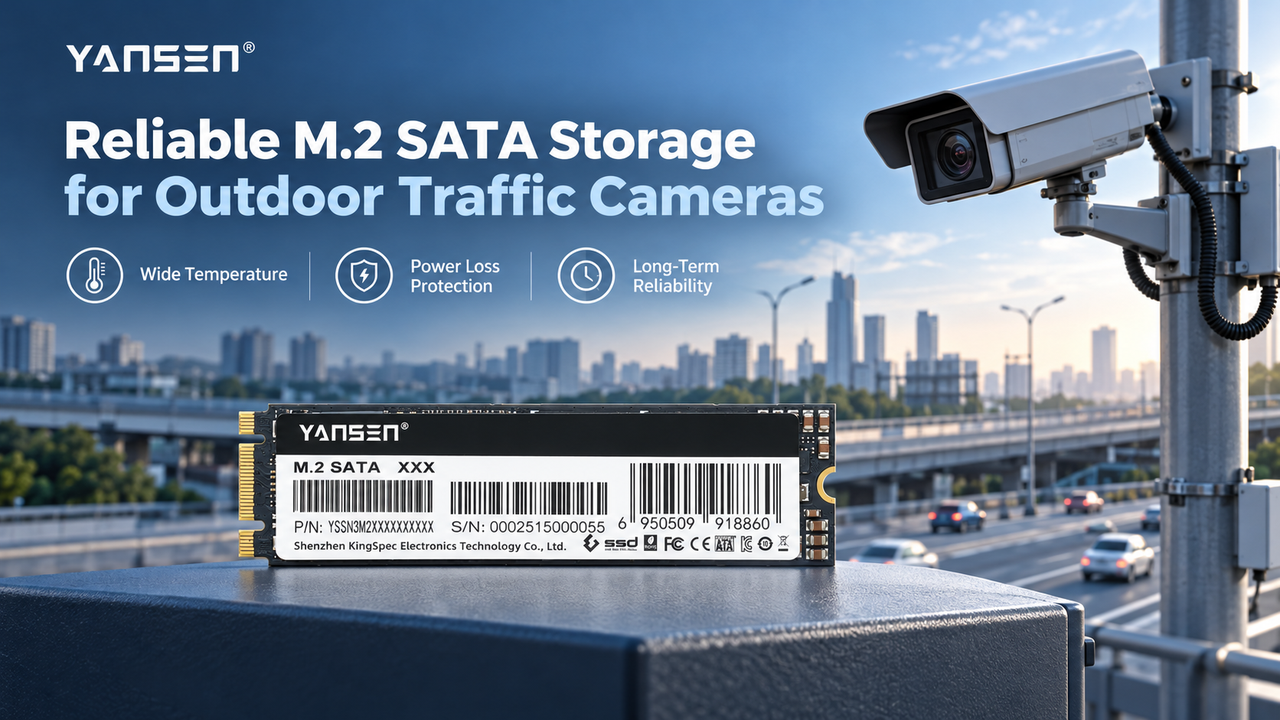
In automotive or energy sectors, data must be logged in harsh environments. YANSEN’s SSDs meet -40°C to +85°C wide temperature specs, include PLP, and maintain 99.999% uptime even in vibration-prone environments.
5. Component Collaboration: When 1 + 1 + 1 > 3
5.1 Performance Synergy
A PCIe Gen 5 controller requires high-speed NAND dies with 2400 MT/s interface to hit top-line specs. Without matched memory or thermal design (e.g., graphene heat spreaders), the performance bottlenecks fast.
5.2 Reliability Feedback Loop
The controller’s wear-leveling and error correction algorithms must adapt dynamically to NAND aging. Meanwhile, supercapacitor-backed DRAM flushing ensures these corrections are committed even during a blackout, preserving data consistency.
6. Future of Enterprise SSD Architecture
6.1 2025–2026 Trends
- CXL 2.0 adoptionwill blur boundaries between memory and storage.
- SmartSSD & Computational Storage: Bringing CPU tasks into the SSD controller.
- Wider adoption ofQLC for archival workloads, with Uber-level ECC.
6.2 R&D in Ultra-Endurance
- Experimental SSDs rated for -55°C to +125°C
- PLC NAND + AI-powered ECC engines
- PCM (Phase Change Memory)as a potential NAND alternative
7. FAQ: Enterprise SSD Technology
Q1: Why does an enterprise SSD need a supercapacitor?
A: Supercapacitors enable Power Loss Protection, ensuring all cached data is safely written to NAND during unexpected power failure — crucial in financial and industrial systems.
Q2: What makes enterprise SSD controllers different from consumer ones?
A: They support higher IOPS, multi-core processing, advanced ECC, hardware encryption, and power-loss protocols — optimized for always-on environments.
Q3: Is QLC reliable enough for enterprise workloads?
A: With modern ECC (e.g., LDPC + RAID) and PLP, QLC SSDs are now suitable for read-intensive workloads like AI training logs and archival storage.
Q4: How does 3D NAND improve SSD performance?
A: It increases capacity without shrinking cells, allowing for better endurance and performance due to vertical stacking and higher die density.
8. Conclusion
As data workloads grow more complex and AI-powered systems demand faster, more reliable storage, enterprise SSDs must evolve in both hardware and software. By harmonizing intelligent controllers, durable 3D NAND, and supercapacitor-based safety mechanisms, ssd manufacturer like YANSEN are redefining what enterprise storage means.
Whether you’re running autonomous vehicle fleets, managing financial systems, or training the next ChatGPT — the underlying storage must deliver speed, safety, and sustainability. And with the right blend of innovation, enterprise SSDs are more than ready for the challenge.