As technology continues to evolve, Solid-State Drives (SSDs) have become a pivotal part of enterprise and industrial applications. While both Enterprise SSDs and Industrial SSDs offer high performance and durability, their design and features differ significantly due to their intended usage environments. Understanding these differences is critical for businesses and industries looking to invest in reliable storage solutions. This article provides an in-depth comparison of enterprise and industrial SSDs, focusing on key factors such as IOPS, latency, endurance, and temperature adaptability.
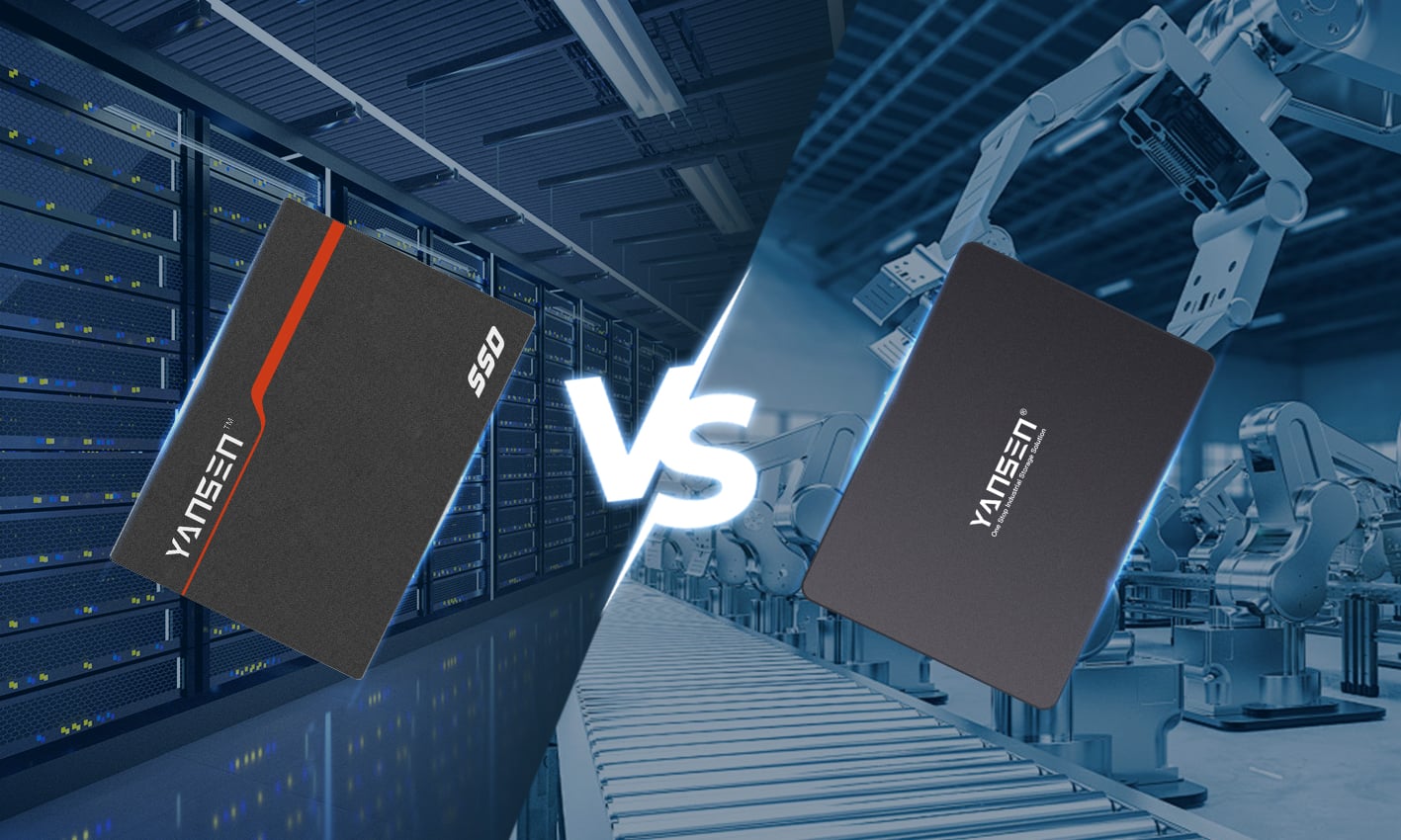
1. Enterprise SSD vs. Industrial SSD: A Detailed Comparison
1.1 IOPS (Input/Output Operations Per Second)
Enterprise SSDs are designed to deliver high IOPS, which translates into faster read and write speeds. They are ideal for environments where performance is critical, such as data centers and high-performance computing systems. For example, a cloud service provider or a financial database often requires millions of IOPS to handle simultaneous access by thousands of users.
On the other hand, Industrial SSDs provide moderate IOPS, which are sufficient for industrial applications like automation systems, data acquisition, and machine control. While these environments don’t demand ultra-high speed, they do require stability and the ability to handle consistent data processing over long periods, often in less-than-ideal conditions.
Key Difference:
- Enterprise SSDs: Fast IOPS, suited for high-speed data environments like serversand data centers.
- Industrial SSDs: Moderate IOPS, optimized for steady, reliable performance in industrial automationand control systems.
1.2 Latency and Response Time
Enterprise SSDs offer low latency and quick response times, ensuring near-instant access to data. This is crucial in mission-critical environments, such as e-commerce platforms or real-time analytics. A delay in data access could lead to downtime, impacting business operations.
In contrast, Industrial SSDs have slightly higher latency and response times. However, this is not necessarily a drawback, as industrial environments prioritize durability and reliability over speed. Devices in remote monitoring systems or factory automation must function reliably in harsh conditions rather than handling high-speed data transfers.
Key Difference:
- Enterprise SSDs: Low latency for real-time data access.
- Industrial SSDs: Higher tolerance for latency but prioritize stability in rugged environments.
2. Endurance: TBW, DWPD, and P/E Cycles
2.1 TBW (Total Bytes Written)
Total Bytes Written (TBW) is a critical indicator of an SSD’s lifespan. Enterprise SSDs typically have higher TBW ratings to meet the demands of write-intensive environments like data centers, where massive amounts of data are constantly processed. For example, enterprise SSDs are designed to handle significant daily workloads without compromising performance.
Industrial SSDs, though they have lower TBW than their enterprise counterparts, still offer significantly higher TBW compared to consumer-grade SSDs. This ensures that industrial control systems or surveillance networks can function reliably over extended periods, even in extreme conditions.
Key Difference:
- Enterprise SSDs: Higher TBW to support massive data writes in environments like serversand database systems.
- Industrial SSDs: Moderate TBW, sufficient for long-term reliability in harsh industrial environments.
2.2 DWPD (Drive Writes Per Day)
Drive Writes Per Day (DWPD) indicates how many times an SSD can be completely written to every day during its warranty period. Enterprise SSDs generally offer higher DWPD ratings, reflecting their ability to handle large amounts of data being written to the drive daily. High-frequency transactional databases, for example, may require SSDs capable of 3-5 DWPD to ensure long-term reliability.
Industrial SSDs have lower DWPD values, but they are designed to provide steady performance in environments with moderate write demands. These drives are often employed in remote data loggers or industrial computers, where constant, high-volume data writing is unnecessary.
Key Difference:
- Enterprise SSDs: High DWPD ratings for environments where frequent data writing is required.
- Industrial SSDs: Moderate DWPD ratings, ideal for long-lasting, steady performance in industrial setups.
2.3 P/E Cycles (Program/Erase Cycles)
P/E cycles measure the number of times data can be written to and erased from an SSD before it begins to degrade. Enterprise SSDs often feature more advanced wear-leveling algorithms and data protection techniques to prolong the lifespan of the SSD in high-demand environments.
Industrial SSDs, while not as optimized for frequent write/erase cycles as enterprise SSDs, are designed to withstand harsh conditions such as extreme temperatures, humidity, and vibrations. As a result, their P/E cycles focus on durability and stability, ensuring longevity in manufacturing plants, transportation systems, or aerospace applications.
Key Difference:
- Enterprise SSDs: Optimized for high P/E cycles in environments requiring frequent data updates.
- Industrial SSDs: Designed for reliable performance in extreme conditions, with a focus on longevity rather than high-speed P/E cycles.

3. Temperature Range: Adaptability in Extreme Conditions
Industrial SSDs are engineered to withstand extreme temperature fluctuations, often operating within a range of -40°C to +85°C. This makes them ideal for outdoor surveillance systems, military equipment, and remote monitoring devices. Their resilience ensures that data storage remains stable even in environments where temperature, humidity, and vibration levels are unpredictable.
In contrast, Enterprise SSDs are typically designed for more controlled environments, such as data centers and server rooms, where temperature and humidity are managed. While they do offer some temperature tolerance, their operational range is usually narrower than that of industrial SSDs.
Key Difference:
- Industrial SSDs: Wider operational temperature range for extreme industrial environments.
- Enterprise SSDs: Moderate temperature range, designed for temperature-controlled environmentslike data centers.
4. Data Protection and Encryption Technology
Both Enterprise and Industrial SSDs implement robust data protection and encryption features, but the focus differs based on usage. Enterprise SSDs often prioritize advanced encryption (like AES-256 and SED capabilities) to protect sensitive data in financial systems, e-commerce platforms, or government databases.
On the other hand, Industrial SSDs focus more on physical durability and data protection against power loss, temperature variations, and harsh conditions. ECC (Error Correction Code), power-loss protection, and wear-leveling algorithms ensure that data is preserved and remains intact, even in unpredictable industrial environments.
Key Difference:
- Enterprise SSDs: Focus on data encryptionand security for highly sensitive, critical information.
- Industrial SSDs: Emphasize data integrityand protection in physically demanding environments.
5. Life Cycle and Stability
5.1 Enterprise SSD Life Cycle
Enterprise SSDs are built with high-quality NAND flash and advanced controllers to support 24/7 operations in mission-critical applications. Their life cycles are typically longer, with features designed to support continuous data-heavy tasks like cloud computing, big data analytics, and AI training.
5.2 Industrial SSD Stability
Industrial SSDs are designed for stability rather than sheer performance. They offer shock and vibration resistance, wide temperature tolerance, and long operational life, even in remote locations or harsh manufacturing environments. This makes them ideal for industrial automation, transportation, and military applications.
Key Difference:
- Enterprise SSDs: Longer life cycles, optimized for high-intensity, continuous workloads.
- Industrial SSDs: Enhanced stability in challenging, extreme environments, prioritizing durability.
6. Application Scenarios: Enterprise vs. Industrial SSDs
6.1 Enterprise SSD Applications
Enterprise SSDs are used in data centers, cloud storage solutions, servers, and high-performance computing environments. These applications demand fast IOPS, high TBW, and advanced data protection, as any delay in data access or storage could lead to business disruptions.
6.2 Industrial SSD Applications
Industrial SSDs are widely used in industrial automation, intelligent manufacturing, transportation systems, and aerospace. These environments require SSDs that can withstand physical stress, temperature fluctuations, and continuous use in demanding conditions.
 7. Conclusion
Choosing between Enterprise SSDs and Industrial SSDs depends heavily on the intended application. Enterprise SSDs excel in high-speed, high-performance environments like data centers, while Industrial SSDs are designed for longevity and durability in harsh environments like manufacturing and military systems.
By understanding the key differences in IOPS, latency, endurance, and environmental adaptability, businesses can make informed decisions to select the right SSD solution for their specific needs.