In the era of digital transformation and Industry 4.0, Solid State Drives (SSDs) have become the backbone of everything—from high-precision CNC machines and AI-powered edge gateways to data centers handling mission-critical analytics.
Yet many engineers and procurement teams still struggle when facing terms like SLC, MLC, TLC and QLC. Choosing an industrial SSD is not as simple as comparing capacities or price; it requires a deep understanding of endurance, stability, controller quality, firmware optimization, and long-term reliability under harsh environments.
This guide breaks down NAND flash technology in simple, practical terms and offers a field-proven SSD selection framework, with real industrial scenarios and product recommendations inspired by Yansen, a certified National High-Tech Enterprise trusted by TCL, ASUS, Lenovo and global OEM partners.
1. Core Fundamentals — How SLC, MLC, TLC and QLC NAND Really Differ
At the heart of every SSD lies the NAND flash cell. The number of bits stored in each cell determines performance, endurance, and reliability.
1.1 How NAND Stores Data
A NAND cell stores electrons in a floating gate. The number of voltage levels defines how many bits can be represented.
1.2 Breakdown of NAND Types
1.2.1 SLC (Single-Level Cell) — 1 bit per cell
Only 2 voltage states (0 or 1)
Fastest, most stable, longest lifespan
Ideal for ultra-critical environments
Cost per GB is extremely high
1.2.2 MLC (Multi-Level Cell) — 2 bits per cell
4 voltage states
Good performance & endurance
Previously dominant in enterprise systems
Now gradually replaced by 3D industrial TLC
1.2.3 TLC (Triple-Level Cell) — 3 bits per cell
8 voltage states
Currently the mainstream industrial choice
Balanced cost, endurance, and performance
Widely used in industrial PCs, automation, vehicles, and edge AI systems
1.2.4 QLC (Quad-Level Cell) — 4 bits per cell
16 voltage states
Highest density, lowest cost
Endurance drops significantly
Suitable for read-intensive, cold data or archival workloads, not for continuous heavy writes
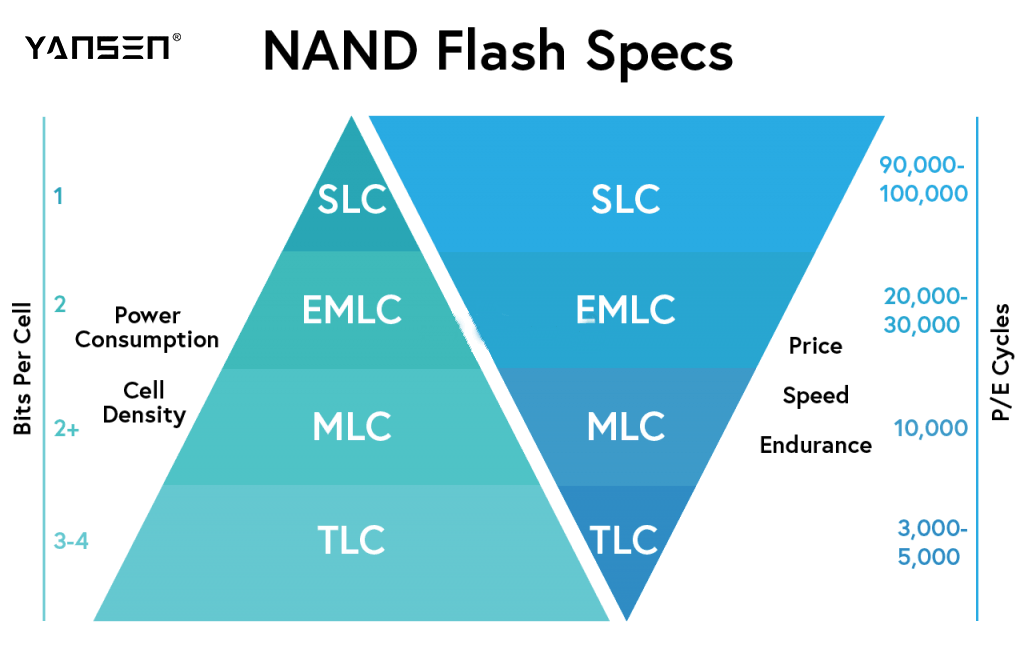
1.3 NAND Comparison Table
|
NAND Type |
Bits per Cell |
Voltage States |
P/E Cycles |
Strengths |
Limitations |
|
SLC |
1 |
2 |
~100,000 |
Fastest, extremely durable |
Very expensive |
|
MLC |
2 |
4 |
3,000–10,000 |
Strong endurance |
Not mainstream today |
|
TLC (Industrial/Enterprise-grade) |
3 |
8 |
1,000–3,000 |
Best balance for industrial use |
Lower endurance vs MLC |
|
QLC |
4 |
16 |
150–1,000+ |
Ultra-low cost, high capacity |
Weak endurance, slow sustained writes |
2. Real-World Industrial SSD Selection Guide
Selecting an industrial SSD is ultimately about the right match between workload and NAND type. Below is a practical roadmap used by many factories, integrators and industrial OEMs.
2.1 How to Choose Based on Application
2.1.1 SLC — When reliability is everything
Best for:
Military & aerospace systems
Financial transaction logging
Specialized automation with 24/7 real-time writes
Today, pure SLC is rare, so many industrial SSDs use pSLC mode, where TLC/QLC blocks run as 1-bit SLC to deliver higher endurance.
2.2.2 MLC — Legacy industrial systems
- Best for:
Older automation controllers
Industrial PCs with long product cycles
Still available in some industrial lines but is being replaced by advanced 3D TLC.
2.2.3 Industrial 3D TLC — The current sweet spot
- Best for:
PLCs, CNC machines, robotic systems
Edge computing, machine vision
Industrial AI inference
Harsh-environment systems needing -40°C to 85°C wide-temperature support
- Why it dominates today:
With optimized firmware, high-quality controllers and extra OP (Over-Provisioning), industrial TLC SSDs achieve endurance levels sufficient for almost all industrial workloads at a much more reasonable cost.
2.2.4 QLC — Not for system disks
- Best for:
Temperature-stable data centers
Cold storage
Surveillance video archiving
AI/ML datasets with low write frequency
- Avoid using QLC for:
OS drives
Heavy random writes
Harsh industrial environments
3. Industrial SSD Selection Matrix (With Yansen Product References)
|
Industrial Scenario |
Recommended NAND |
Capacity Range |
Key Requirements |
Suitable Yansen Solutions |
|
PLC / CNC / Automation Equipment |
Industrial 3D TLC |
480GB–1.92TB |
Wide-temp, vibration resistance, SATA for compatibility |
2.5” Industrial SATA SSD (-40°C to 85°C) |
|
Vehicle / Rail / Transportation Systems |
Industrial 3D TLC |
256GB–2TB |
Strong vibration resistance, wide-temp, power-loss protection |
M.2 2280 / mSATA Industrial Series |
|
Edge AI, Machine Vision, IoT Gateways |
High-performance 3D TLC |
1TB–7.68TB |
High IOPS, PCIe Gen3/4/5, optional heat spreader |
M.2 PCIe 4.0 NVMe Series |
|
Data Center Cold Storage / Archive |
QLC |
≥7.68TB |
Low TCO, high density |
High-Capacity Enterprise QLC SSD |
Yansen’s industrial-grade SSDs incorporate:
- Advanced controllers with enhanced ECC
- Static & dynamic wear-leveling
- Extended OP for industrial endurance
- Full wide-temperature support (-40°C to +85°C)
- Optional function such as PLP, write protection and AES 256 encryption
- Long-term supply & stable BOM,essential for industrial projects
Conclusion: The Right SSD Is a Long-Term Investment, Not a Cost Comparison
SLC, MLC, TLC and QLC are not “good vs bad” technologies—they are engineered for different priorities. In the industrial world, the best SSD must deliver:
High endurance & reliability
Stable supply chain
Robust controller + firmware
Thermal & vibration tolerance
Predictable lifetime under real workloads
For 90% of modern industrial applications, enterprise/industrial-grade 3D TLC represents the most stable and cost-effective choice—especially when paired with high-quality controllers and firmware optimization, as found in Yansen’s industrial SSD lineup.
If you’re upgrading factory equipment, building IoT gateways, deploying edge AI, or sourcing long-life SSD solutions, the safest path is to evaluate reliability, durability, data integrity features, and vendor stability—not only the NAND type.
Looking for Long-Life Industrial Storage Solutions?
Yansen provides:
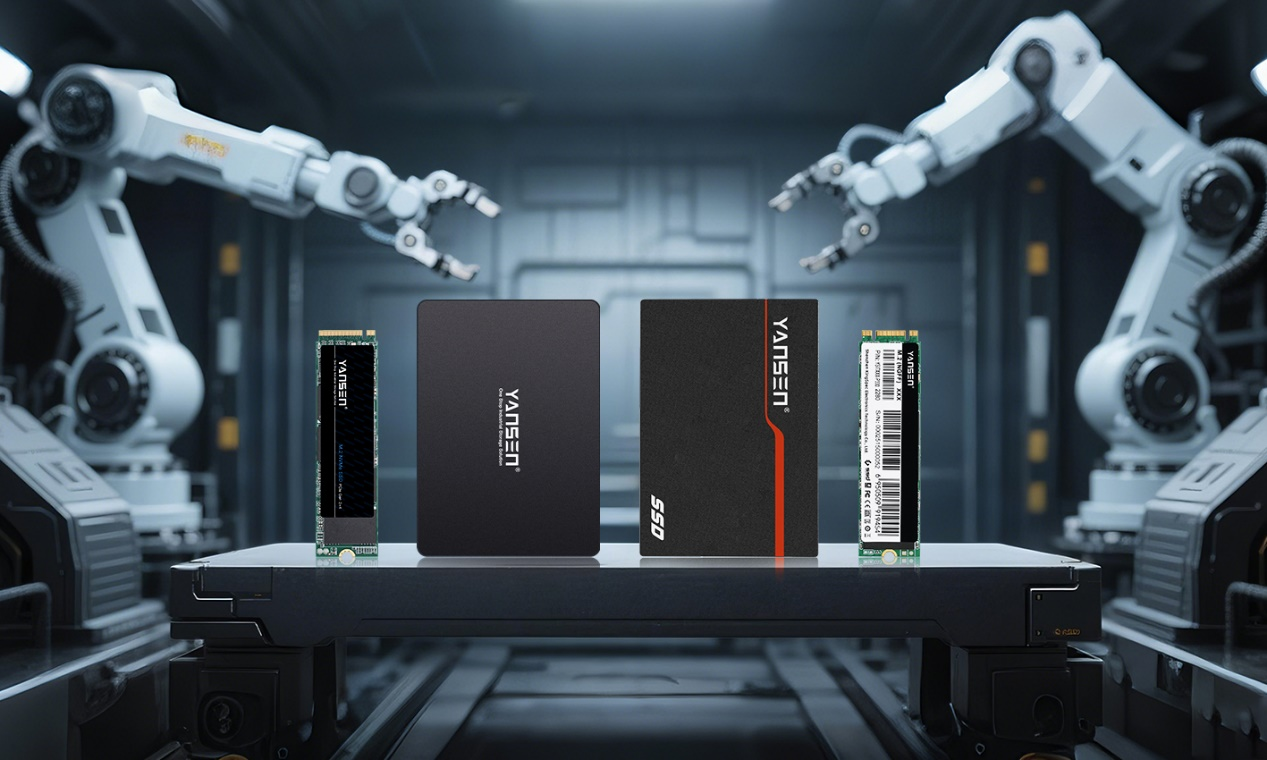
Full ranges of SATA, mSATA, M.2 SATA, M.2 PCIe, PCIe 3.0/4.0 NVMe SSDs and CF/CFast Card
Industrial wide-temperature (-40°C~85°C)
High-endurance firmware optimization
Stable supply for long product life cycles
Customizable capacities, OP ratios, conformal coating, PLP options
Contact us for OEM/ODM, project requirements, or sample evaluation.
Our engineering team can help you choose the ideal SSD for your workload.