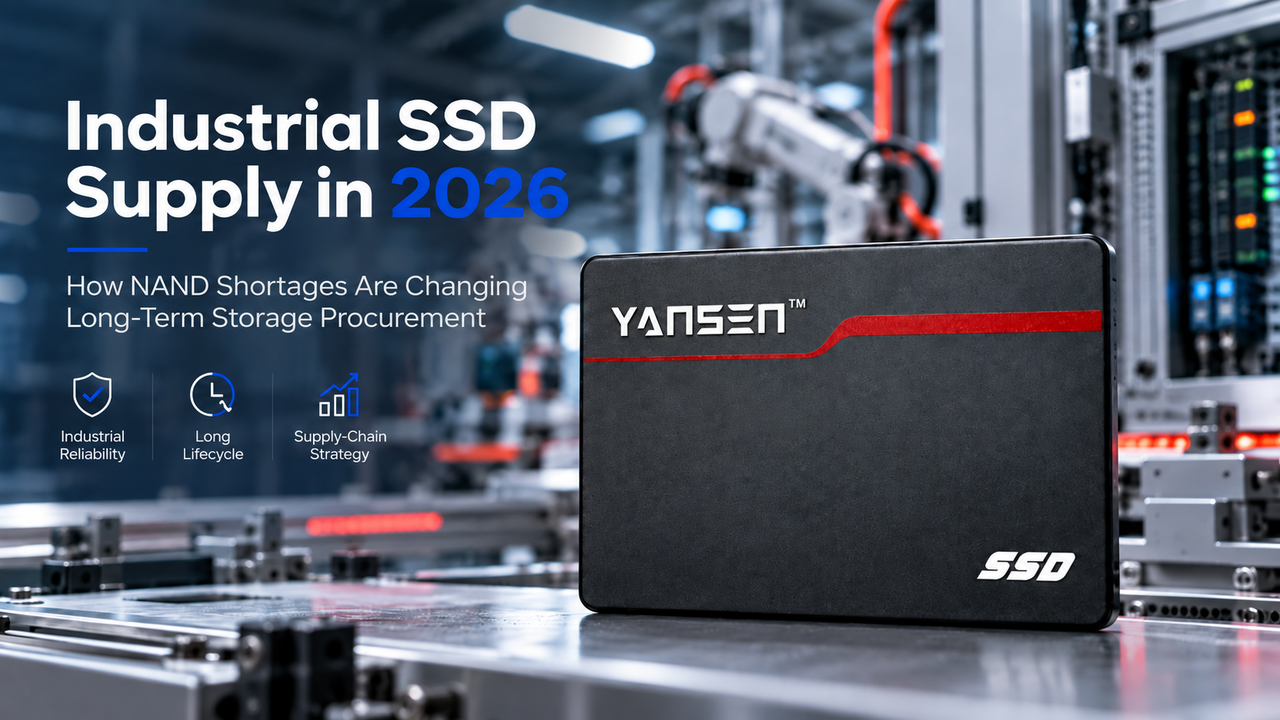
For consumer electronics, storage development is often driven by a familiar formula: higher capacity, higher speed, and lower cost per gigabyte. Industrial storage follows a very different logic.
Industrial equipment may remain in production and field service for 5, 7, 10 years, or even longer. During that period, manufacturers need stable components, predictable performance, consistent qualification, and reliable long-term availability. An SSD that performs well today is not necessarily a good industrial storage choice if its underlying NAND or controller becomes unavailable a few years later.
This issue is becoming more important in 2026 as NAND manufacturers increasingly allocate production toward higher-density and higher-value technologies. Mature NAND products, including some SLC and MLC solutions, are becoming more difficult to source. For industrial, automotive, networking, and embedded applications, simply replacing one NAND generation with another is rarely a straightforward purchasing decision.
A component change may require firmware validation, compatibility testing, reliability testing, regulatory qualification, or even system redesign.
For industrial storage buyers, the real cost of NAND shortages is not simply a higher price per gigabyte. It is the operational and engineering cost created when a qualified storage platform can no longer be supplied.
1. What Is Happening to SLC and MLC NAND Supply in 2026?
The NAND market is increasingly moving toward higher-density technologies. As manufacturers shift mature production capacity toward high-layer-count 3D NAND and other higher-density products, the availability of some legacy NAND technologies is becoming tighter.
This creates a particular challenge for industrial storage. Industrial applications have historically used technologies such as SLC, MLC, pSLC, and industrial-grade 3D TLC because different applications require different combinations of endurance, reliability, capacity, and cost.
From a semiconductor manufacturer’s perspective, however, older NAND technologies can become less attractive as the market moves toward products offering higher bit density and stronger demand. Higher-density NAND can provide better wafer economics and access to much larger mainstream markets.
According to TrendForce’s July 2026 analysis, SLC NAND contract prices in the second half of 2026 are expected to increase by approximately 120%–170% compared with the first half of the year. Demand is being supported by industrial systems, automotive electronics, networking equipment, AI edge computing, and enterprise and data center applications.
The situation is particularly significant because TrendForce also reported that major global SLC suppliers do not currently plan significant new capacity expansion. This suggests that the supply challenge is not simply a temporary price fluctuation. For buyers depending on mature NAND, long-term availability itself needs to become part of the procurement discussion.
But the problem extends far beyond semiconductor pricing.
2. Why Low-Capacity Industrial Storage Still Matters
The mainstream storage market continues to move toward higher capacities, but industrial equipment does not always need more storage.
A PLC, RTU, data logger, factory controller, or embedded gateway may operate perfectly well with 4GB, 8GB, 16GB, or 32GB of storage. Increasing capacity to 128GB or more may provide little practical benefit if the application generates only a limited amount of data.
This creates an important contradiction in the storage industry: the semiconductor market is optimized for increasing density, while many industrial systems are optimized for long-term stability.
Industrial Automation
PLCs, HMIs, CNC equipment, and factory controllers may use relatively small storage capacities but remain deployed for many years.
Energy and Infrastructure
RTUs, smart-grid equipment, monitoring systems, and other infrastructure devices can require reliable local storage for logging, configuration, and system operation without needing very high capacity.
Transportation
Onboard computers, ticketing systems, railway control equipment, and related systems often have long qualification cycles and demanding maintenance requirements.
Embedded Systems
Gateways, diagnostic equipment, and data loggers may similarly prioritize reliability and long-term availability over maximum capacity.
For these applications, the key question is not:
“Why isn‘t the customer upgrading from 8GB to 128GB?”
The more important question is:
“Can the same qualified storage architecture still be supplied throughout the lifecycle of the equipment?”
This highlights a fundamental mismatch between the semiconductor lifecycle and the industrial equipment lifecycle.
3. The Hidden Cost of NAND Transitions
A flash component reaching end-of-life can create costs that are much greater than the price of the SSD itself.
The process often looks like this:
Mature NAND capacity declines → existing NAND or controller reaches EOL → supplier changes NAND, controller, or firmware → storage characteristics may change → existing qualification may no longer apply → customer must revalidate the system.
Two industrial SSDs can have the same capacity, interface, form factor, and advertised sequential performance while still behaving differently in a real application.
A change in NAND or controller can affect:
-
Latency
-
Endurance
-
Power consumption
-
Thermal behavior
-
Error characteristics
-
Firmware behavior
-
Host compatibility
-
Boot performance
This is why controlled BOM management is important in industrial storage. NAND, controller, firmware, and DRAM substitutions should not happen without proper evaluation and notification when they could affect the qualified behavior of the product.
Requalification Is the Real Cost
When an SSD component changes, an industrial OEM may need to allocate engineering resources for sample testing, system integration, environmental testing, customer approval, certification, and production validation.
For medical equipment, transportation systems, industrial automation, telecommunications, or other highly qualified applications, replacing an SSD can therefore involve much more than purchasing a different part number.
There may also be costs associated with inventory management, production interruptions, field maintenance, and supporting multiple versions of the same platform.
For industrial OEMs, a cheaper SSD is not necessarily a lower-cost SSD if it forces the platform through another qualification cycle two years later.
4. Consumer Storage Procurement vs. Industrial Storage Procurement
Consumer storage is commonly evaluated through a relatively simple set of parameters: capacity, speed, price, and sometimes warranty. Industrial storage requires a broader procurement framework because the SSD becomes part of a long-lived product platform.
| Procurement Factor | Consumer Storage | Industrial Storage |
| Primary priority | Capacity, speed, price | Lifecycle stability and predictable performance |
| Product lifecycle | Relatively short | Often 5–10+ years |
| Component changes | Usually acceptable | May require requalification |
| Firmware | Performance-oriented | Consistency and stability are critical |
| Endurance | General consumer workload | Must match the actual industrial write workload |
| Temperature | Controlled environment | May require wide-temperature operation |
| Supply planning | Shorter purchasing cycles | Long-term availability and EOL planning |
4.1 Controlled and Stable BOM
Consistency in NAND, controller, firmware, and other critical components helps ensure that storage supplied several years later continues to behave like the originally qualified product.
4.2 Long-Term Product Availability
Industrial buyers should evaluate the supplier’s lifecycle roadmap, PCN policy, EOL notification process, and last-time-buy procedures before approving a storage platform.
4.3 Stable Firmware
Firmware affects wear leveling, garbage collection, bad-block management, error recovery, and power-loss behavior. Firmware consistency is therefore part of system stability, not simply a software detail.
4.4 Endurance
Industrial systems may continuously write logs, telemetry, sensor information, machine data, or other operational records. SSD selection should therefore consider workload and endurance rather than capacity alone.
4.5 Wide-Temperature Operation
Equipment deployed in factories, transportation systems, outdoor infrastructure, or other uncontrolled environments may require storage designed for extended operating-temperature ranges.
4.6 Power-Loss Protection
Unexpected power interruptions can occur in industrial environments. Where required by the application, appropriate power-loss protection can help reduce the risk of data corruption and incomplete writes.
5. From SLC and MLC to Industrial 3D TLC: Migration Must Be Managed, Not Avoided
The decline in mature NAND availability should not be interpreted as “old NAND is good and new NAND is bad.” Modern 3D TLC can be a practical solution for many industrial applications when it is combined with appropriate SSD architecture, firmware, endurance management, and qualification.
Industrial SSDs can use technologies such as ECC, wear leveling, over-provisioning, thermal management, power-loss protection, and pSLC modes to address application-specific requirements.
The real challenge is managing the transition from one NAND generation to another without compromising the requirements of the industrial system.
The goal should not be:
“Keep SLC or MLC forever.”
Instead, industrial buyers should:
“Plan NAND migration before component availability forces the decision.”
Depending on the application, an SLC or MLC-based platform may eventually transition toward pSLC, industrial 3D TLC, or another controlled NAND architecture. But the decision should consider write workload, data retention, operating temperature, endurance, interface requirements, and qualification requirements.
This approach allows manufacturers to benefit from newer NAND technologies without treating component availability as an emergency.
6. How Industrial Storage Buyers Should Respond to the 2026 NAND Shortage
The current NAND environment makes lifecycle planning more important than simply negotiating the lowest SSD unit price.
Step 1 — Identify Lifecycle-Critical Storage
Not every SSD requires the same level of lifecycle control. Classify storage according to equipment lifecycle, deployment volume, qualification complexity, and replacement difficulty.
A storage device inside a short-lived industrial gateway does not necessarily require the same procurement strategy as one integrated into a railway controller expected to remain in service for ten years.
Step 2 — Confirm the BOM Policy
Before approving an industrial SSD supplier, ask whether the NAND, controller, and firmware are controlled. Also clarify which component changes require PCN notification and how much advance notice is provided before an EOL event.
Step 3 — Understand the NAND Roadmap
If an existing platform depends on legacy SLC or MLC, discuss its expected lifecycle and potential replacement technologies with the supplier before availability becomes critical.
Developing and qualifying a replacement in advance is significantly easier than responding after an EOL announcement.
Step 4 — Match Endurance to the Actual Workload
Evaluate daily writes, expected operating years, workload patterns, operating temperature, and write amplification. Then select the NAND configuration and endurance level appropriate for the application.
Step 5 — Qualify the Next Generation Before EOL
A proactive migration strategy can follow a simple path:
Current qualified SSD → Future replacement identified → Validation completed → Controlled transition
This is far safer than waiting for an EOL notice and then entering emergency sourcing, redesign, and requalification.
Step 6 — Evaluate Total Lifecycle Cost
The final purchasing decision should include more than the SSD quotation. Qualification, engineering time, maintenance, redesign, inventory, production continuity, and supply risk can all affect the actual cost of ownership.
For industrial storage, procurement should account for qualification, maintenance, redesign, and supply continuity—not simply SSD price.
7. What This Means for YANSEN Industrial Storage Solutions
Against this backdrop, industrial storage suppliers need to provide more than capacity and interface compatibility. Storage has to be managed as part of the customer’s product lifecycle.
YANSEN focuses on industrial SSD solutions designed around the requirements of long-term deployments. For industrial OEMs, this means considering not only performance and capacity, but also component consistency, product availability, firmware stability, endurance, and operating conditions.
Depending on the specific product configuration, industrial storage can be selected for requirements such as wide-temperature operation, high endurance, power-loss protection, and other application-specific reliability features.
These capabilities are relevant to applications including industrial automation, smart manufacturing, transportation, networking, embedded systems, edge AI, and other environments where storage may need to remain in service for years.
For an industrial OEM, the objective is not simply to purchase an SSD that meets today’s specification. It is to establish a storage platform that can remain technically suitable and commercially available throughout the expected equipment lifecycle.
YANSEN focuses on industrial storage platforms designed around reliability, lifecycle consistency, and long-term deployment requirements.
8. Conclusion: Storage Procurement Is Becoming a Lifecycle Decision
The 2026 NAND shortage highlights a structural challenge for industrial storage: semiconductor manufacturing economics can change much faster than industrial equipment lifecycles.
As manufacturers shift toward higher-density NAND technologies, mature SLC and MLC products may become more difficult and expensive to source. For industrial OEMs, this makes storage procurement more complicated than comparing capacity, performance, and price.
Long-term storage planning should also consider component lifecycle, BOM stability, NAND roadmaps, qualification requirements, endurance, firmware consistency, and supply continuity.
The objective is not to avoid technological change completely. Industrial systems will eventually need to migrate to newer NAND technologies. The key is to make that migration controlled and predictable rather than allowing component shortages to force an emergency redesign.
As NAND technologies continue to evolve, the strongest industrial storage strategy will not be the one that avoids change completely, but the one that makes change predictable, qualified, and manageable.
For industrial OEMs planning long-lifecycle storage platforms, YANSEN can help evaluate capacity, endurance, operating environment, and lifecycle requirements to identify a storage configuration suited to long-term deployment.
9. Frequently Asked Questions About Industrial SSD Supply
Why are NAND shortages affecting industrial SSD procurement?
NAND manufacturers are increasingly allocating production capacity toward higher-density and higher-value NAND technologies. This can tighten the supply of mature NAND technologies commonly used in long-lifecycle industrial applications, making component availability and long-term supply planning more important for industrial SSD buyers.
Why does NAND or controller replacement require requalification?
An SSD with the same capacity, interface and form factor may not behave exactly the same after a NAND or controller change. Changes can affect endurance, latency, power consumption, thermal behavior, firmware behavior and host compatibility. For industrial equipment, these changes may require additional validation before the replacement SSD can be deployed.
Should industrial applications continue using SLC and MLC NAND?
Not necessarily. SLC and MLC remain relevant for certain industrial workloads, but industrial 3D TLC and pSLC-based solutions can provide alternative options when properly matched with the required endurance, firmware, over-provisioning, temperature range and workload. The key is to manage the technology transition rather than wait until an existing NAND platform reaches end of life.
What should industrial SSD buyers consider besides the SSD price?
Buyers should evaluate the complete lifecycle cost, including BOM stability, long-term availability, EOL and PCN policies, endurance, firmware stability, operating temperature, power-loss behavior, qualification requirements and replacement risk. A lower unit price may not represent a lower total cost if a component change later forces another qualification or system redesign.