Industrial touch panels, IoT gateways, smart retail terminals, and intelligent display systems may serve different purposes, but they share one essential requirement: reliable onboard storage. These devices need to store operating systems, application software, configuration files, and operating logs. The selected storage solution affects system startup, daily operation, software updates, and long-term maintenance.
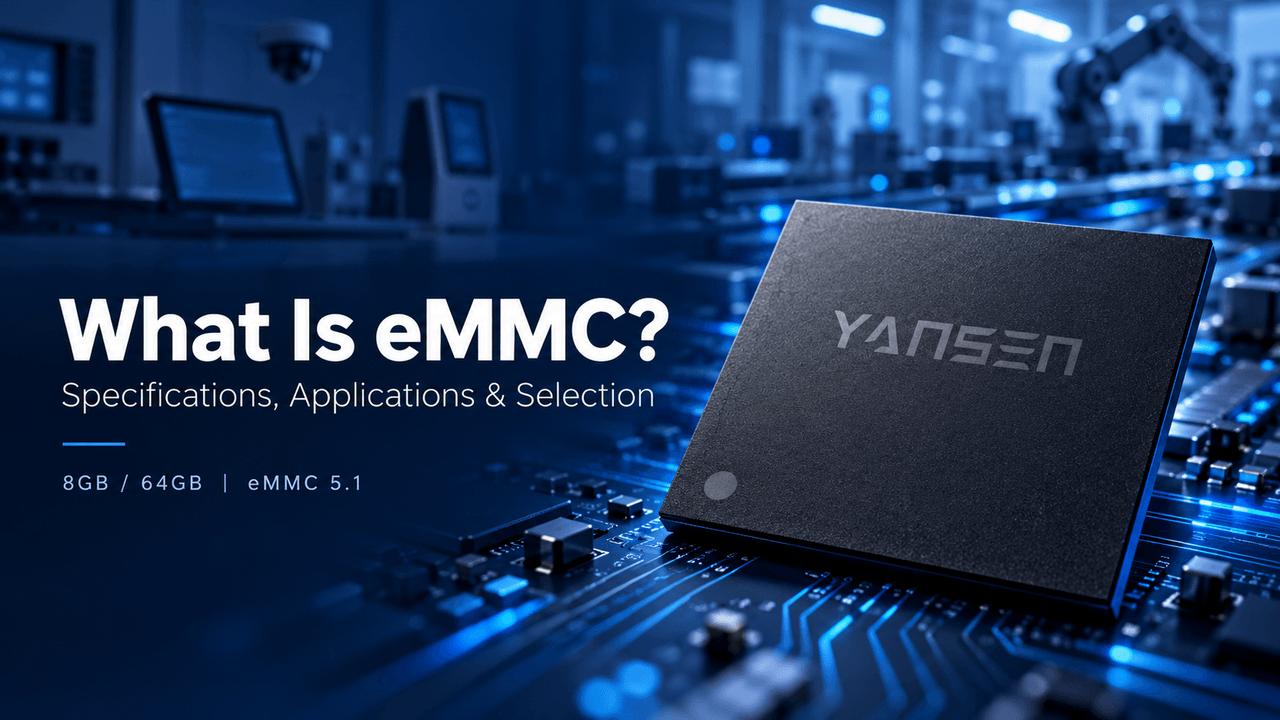
eMMC (Embedded MultiMediaCard) is one option for embedded devices that need compact, board-level storage. It integrates NAND flash and a memory controller into a single package, simplifying storage integration for the host system.
However, choosing eMMC involves more than comparing capacity. Interface compatibility, transfer modes, real-world performance, temperature range, write endurance, and power-loss behavior all need to be considered. This guide explains the key eMMC specifications, typical applications, and practical selection criteria, including YANSEN’s upcoming 8GB and 64GB eMMC solutions.
1. What Is eMMC?
eMMC stands for Embedded MultiMediaCard. It is a non-volatile storage device that integrates NAND flash memory and a controller into one package. Typically using a BGA (Ball Grid Array) package, it is soldered directly onto a device’s mainboard to store operating systems, applications, and user data.
Because it is non-volatile, data that has been properly written and saved does not require continuous power to remain stored. However, whether data currently being written survives an unexpected power interruption depends on the specific product and overall system design.
How Does eMMC Work?
Unlike raw NAND flash, which requires the host system to handle more low-level flash management tasks, eMMC includes an integrated controller. This controller manages functions such as error correction, bad block management, and wear leveling.
These functions help simplify storage integration. Instead of implementing all NAND management at the host level, developers can communicate with eMMC through a standardized interface and focus more on the operating system and application design.
eMMC also has a different role from DRAM. DRAM temporarily holds data that programs need while running, whereas eMMC provides persistent storage for the operating system, applications, and files. It also differs from a removable microSD card: eMMC is normally soldered onto the mainboard, making it suitable for devices that do not require users to frequently replace the storage medium.
2. Key eMMC Specifications You Should Understand
When evaluating eMMC for an embedded project, buyers should look beyond the capacity printed on the product specification. The following parameters help determine whether a device is suitable for the intended platform and workload.
Capacity: How Much Storage Does the Device Need?
Capacity planning should account for the operating system, applications, configuration files, logs, and future software updates. Devices using A/B partitioning for system updates also need sufficient space for a backup system image.
The advertised capacity should not be treated as entirely available for application data. Partitioning, file systems, system reservations, and other uses all affect the final usable capacity.
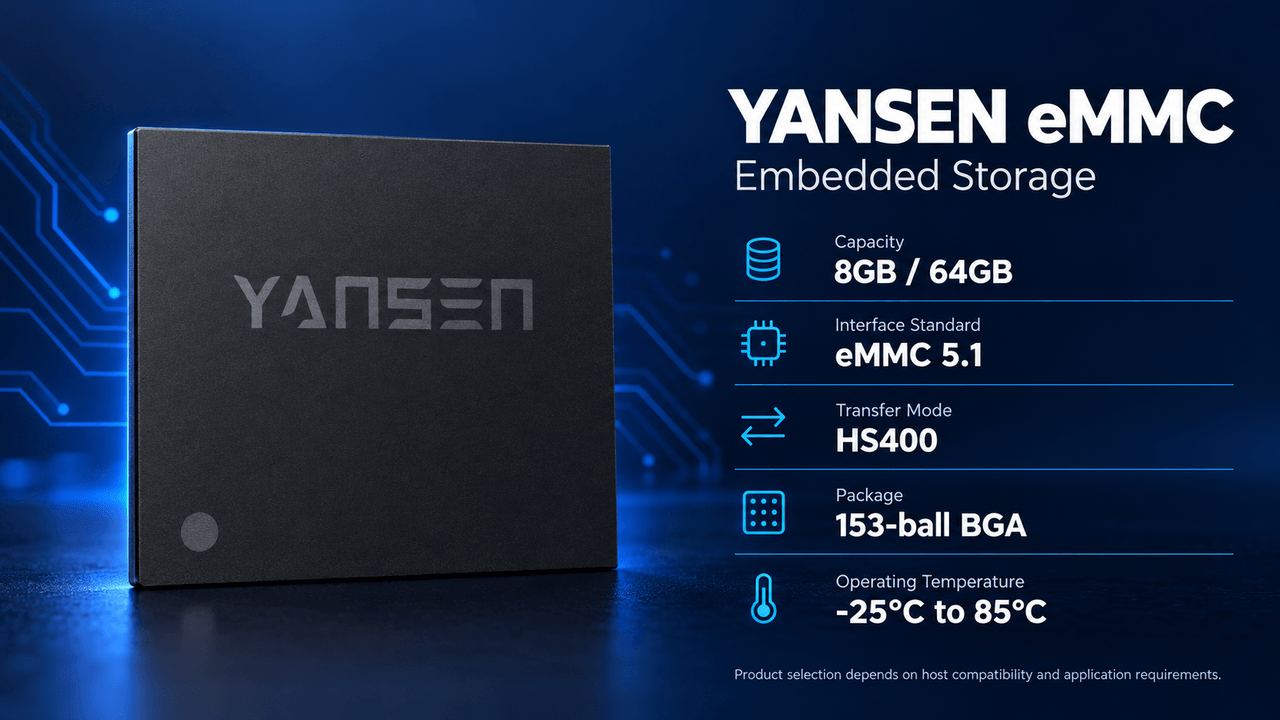
YANSEN’s upcoming 8GB and 64GB eMMC products address different storage requirements:
- 8GB eMMC: A candidate for lightweight operating systems, basic applications, configuration files, and moderate logging.
- 64GB eMMC: More suitable for systems with multiple applications, richer graphical interfaces, larger local resources, or offline content.
The final choice should be based on the actual system image, application footprint, update strategy, and expected data growth—not simply the device category.
Interface Standard and Transfer Modes: eMMC 5.1, HS200, and HS400
eMMC 5.1 identifies the interface standard supported by the product. HS200 and HS400 are different high-speed transfer modes within the eMMC interface specification.
Supporting a particular mode on the storage device does not automatically mean the complete system can use it. The host controller, drivers, power supply, and board-level signal design must also support the corresponding operating mode.
Both upcoming YANSEN eMMC products support eMMC 5.1 and HS400. During project selection, engineers should verify that the target platform supports the required interface mode and that the board design meets its electrical and signal requirements.
HS400 offers a theoretical bandwidth of 400MB/s with an 8-bit bus. This is an interface-level theoretical figure, not a guaranteed real-world read or write speed. Actual performance also depends on NAND flash, controller design, device capacity, access patterns, and test conditions. Two products using eMMC 5.1 may therefore deliver different performance.
Performance: Sequential and Random Access
Sequential read and write performance describes how quickly a storage device transfers continuous blocks of data. It is relevant when handling larger files, media resources, and other sequential workloads.
Random read and write performance, together with access latency, is more relevant to workloads involving small files, configuration updates, and certain application operations.
Device startup usually involves a combination of access patterns, including reading system files, loading applications, and initializing services. Therefore, startup time cannot be judged by sequential read speed alone.
For devices that continuously write logs or cache data, engineers should also evaluate performance during extended operation and when storage utilization is high. Short benchmark results may not represent behavior under a sustained real-world workload.
Package and Power Requirements
The compact BGA package makes eMMC suitable for direct integration into space-constrained embedded devices. However, replacing an existing component requires more than checking its external dimensions. Engineers must also verify ball-map definitions, power requirements, and host compatibility.
eMMC uses separate VCC and VCCQ power supplies, associated with the storage device and its interface, respectively. Their required voltage levels and operating conditions should be designed according to the product specification and selected operating mode.
Both upcoming YANSEN eMMC products use a compact BGA package. OEMs and hardware developers should evaluate the package, PCB footprint, ball assignment, and power design during the hardware integration stage.
Operating Temperature and Write Endurance
Operating temperature refers to the temperature range in which a product is allowed to function. Storage temperature generally refers to the permitted temperature range when the product is not operating. These two specifications should not be confused.
Both upcoming YANSEN eMMC products have an operating temperature range of -25°C to 85°C. Project teams should also consider the actual temperature around the component, because the internal temperature of an enclosure can be higher than the ambient temperature outside it.
Write endurance requires a separate evaluation. It should be assessed according to daily write volume, write amplification, and expected service life. It cannot be reliably inferred from capacity or NAND type alone.
Wear leveling, bad block management, and health-status reporting help manage flash memory over its service life, but they do not provide unlimited write endurance. Applications involving frequent logging, caching, or other sustained writes should confirm the product’s endurance specifications with the supplier and conduct workload-based validation.
3. Typical Applications of eMMC
eMMC is suitable for many embedded devices that need compact onboard storage for operating systems, applications, and moderate amounts of local data. The appropriate capacity and specifications depend on the actual workload.
Industrial HMI and Control Terminals
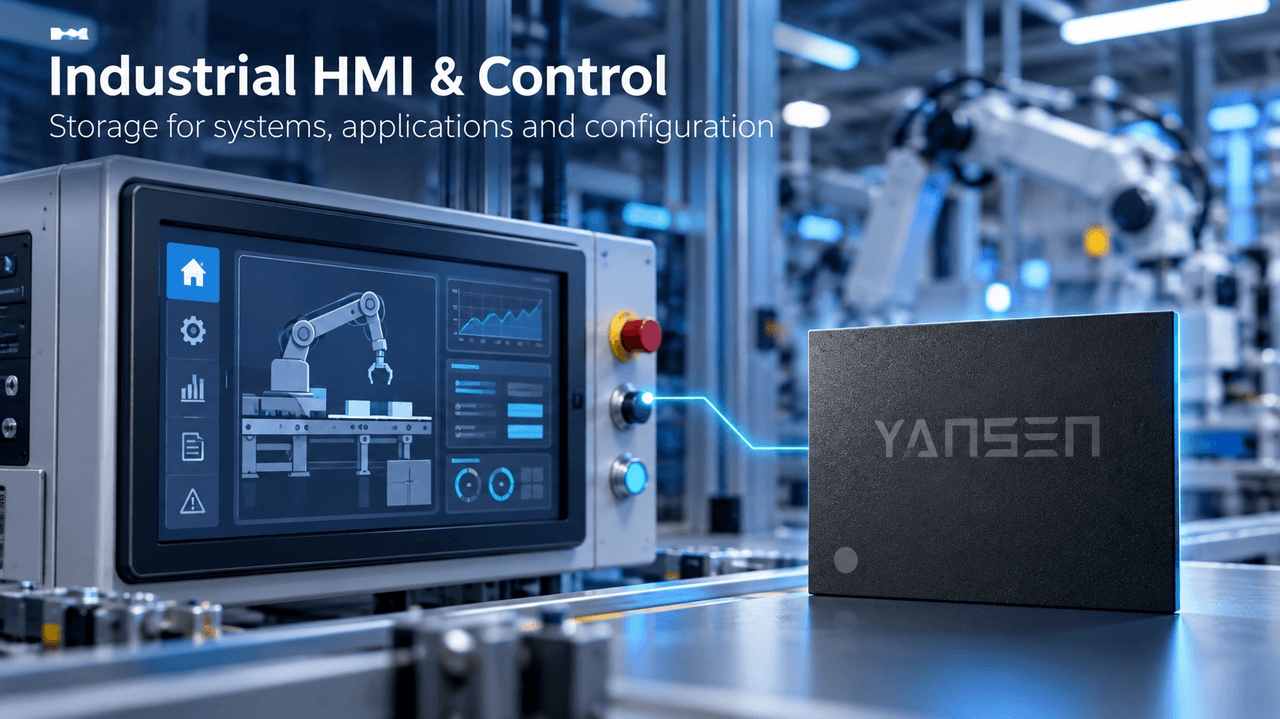
Industrial human-machine interfaces (HMIs) need storage for operating systems, graphical interfaces, control applications, and equipment configuration files. Board-level eMMC integration can help support compact terminal designs without requiring a removable storage device.
For a lightweight terminal with a relatively small system image and basic applications, 8GB may be worth evaluating. Industrial touch panels with more applications, richer interface resources, and larger software packages may need the additional space offered by 64GB.
Selection should account for the operating environment, system footprint, update requirements, and logging workload. The required capacity should leave sufficient room for future software updates rather than only meeting the initial installation requirement.
IoT Gateways and Connectivity Devices
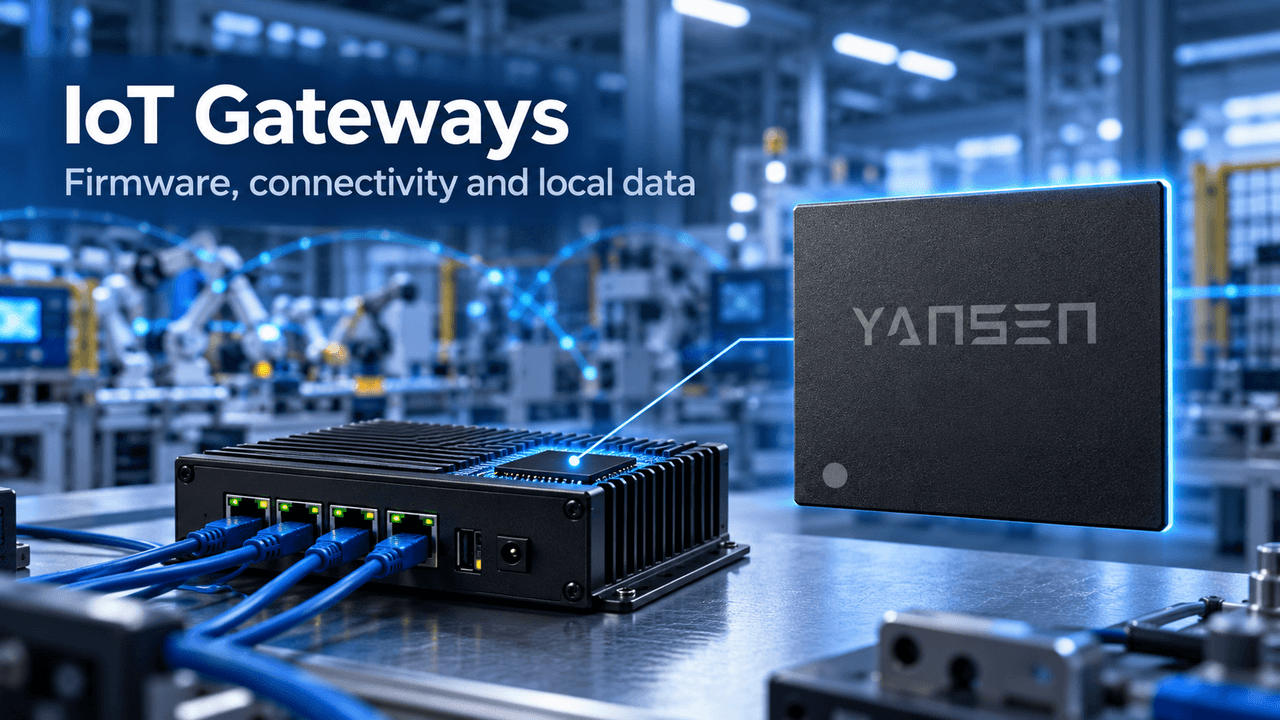
IoT gateways commonly store firmware, communication software, network configurations, and operational logs. Some devices also need local data buffering when network connectivity is temporarily unavailable.
For gateways with relatively small system and application footprints, YANSEN’s 8GB eMMC can be considered as a candidate. If the application requires larger offline buffers, more extensive logging, or additional software, capacity and endurance requirements should be reassessed.
Host compatibility and remote firmware update procedures are particularly important. Engineers should verify the supported eMMC interface mode, boot configuration, and recovery process before mass production.
Smart Retail and Self-Service Terminals
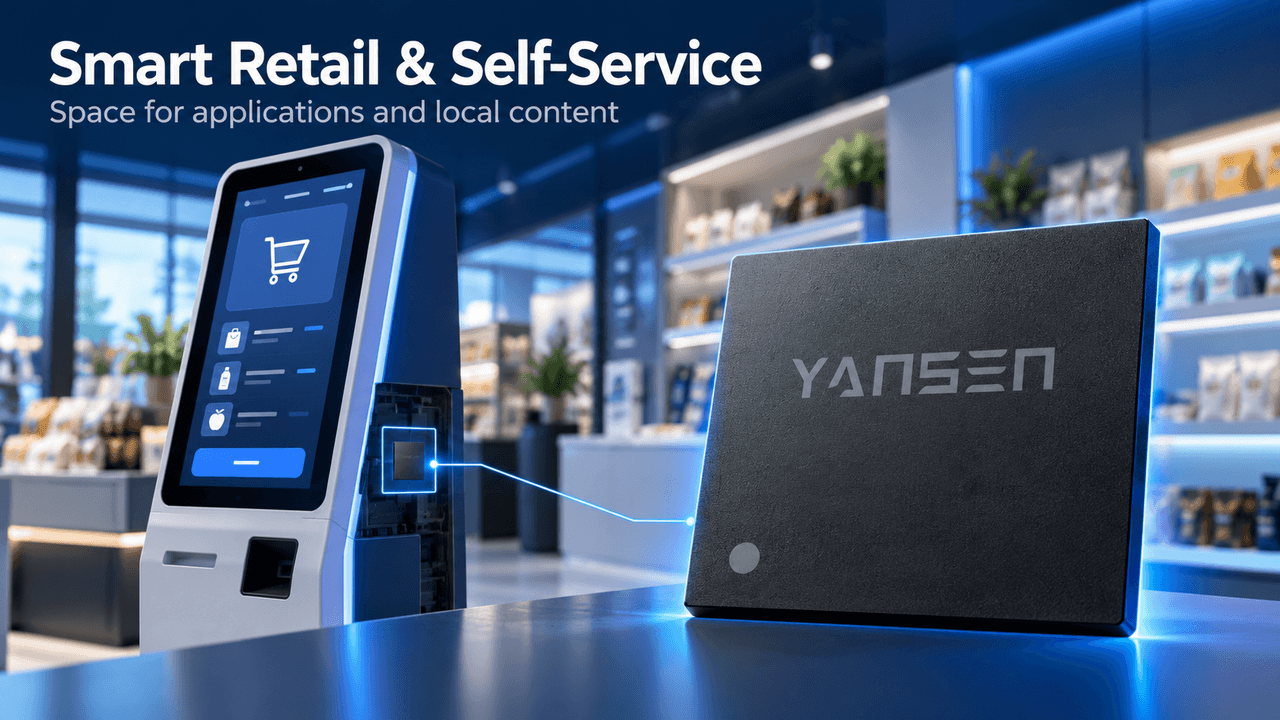
POS systems, self-service kiosks, and other smart retail terminals may store business applications, interactive interfaces, local databases, and multimedia resources. Application count, content size, and update frequency all influence storage requirements.
YANSEN’s 64GB eMMC can be evaluated for terminals that need more room for applications and local resources. Projects should also validate data-writing behavior, software update procedures, and recovery after unexpected power interruptions.
Where transaction data is involved, storage selection should be part of a broader security design. Data protection, access control, encryption, and transaction integrity must be addressed at the system level rather than assumed from the eMMC interface alone.
Multimedia and Smart Display Terminals
Digital signage and smart display devices may use eMMC to store the operating system, playback software, images, and offline video content. For applications that mainly read stored content and update it periodically, 64GB may provide useful space for local media resources.
However, storing playback files is different from continuously recording video. A device that repeatedly writes video streams creates a substantially different workload. Capacity alone cannot establish whether an eMMC product is suitable for high-intensity video recording; write endurance and sustained-write behavior must also be evaluated.
4. 8GB vs. 64GB: Which eMMC Capacity Should You Choose?
Capacity selection should begin with the actual storage requirements of the device. The following comparison shows how YANSEN’s upcoming 8GB and 64GB products may fit different embedded applications.
| Capacity | Potential Applications | What to Verify |
|---|---|---|
| 8GB | Lightweight operating systems, basic applications, configuration files, and moderate logs. | System image size, update space, and whether log growth remains manageable. |
| 64GB | Multiple applications, richer graphical resources, offline media, and larger local data buffers. | Usable capacity, update frequency, and actual write workload. |
A larger capacity provides more storage space, but it does not automatically mean longer service life or higher reliability. For write-intensive applications, endurance specifications, software write strategies, and actual workload must be evaluated together.
For OEMs developing a new product, it is useful to estimate storage consumption across the complete product lifecycle. Include the initial operating system image, application growth, software updates, temporary files, logs, and any backup partitions before deciding between 8GB and 64GB.
5. When Should You Consider Other Storage Technologies?
eMMC is worth evaluating when the host platform supports it and the device mainly needs to store its operating system, applications, and moderate amounts of data. However, some applications require higher throughput, larger capacity, or sustained heavy writes.
Depending on the platform, engineers may compare eMMC with UFS, SATA SSD, or NVMe SSD. These technologies differ in interface, performance potential, power requirements, physical integration, and cost. Compatibility with the host processor and available board interfaces must be checked before making a decision.
A system may also use more than one storage technology. For example, eMMC can store the operating system and applications, while a separately selected storage device handles continuously generated video data. Separating system storage from business-data storage helps match each device to its actual workload.
YANSEN provides a range of embedded storage solutions for space-constrained devices, alongside industrial SSD options for applications with different capacity and performance requirements. Comparing storage technologies at the system-design stage can help avoid choosing a device that is undersized for its workload or unnecessarily expensive for its actual requirements.
6. From Specification Matching to System Validation
A specification sheet helps identify suitable candidates, but it cannot replace testing in the target device. Before mass production, OEMs and system integrators should validate the following areas.
Confirm Platform and Boot Compatibility
Check the host controller’s supported interface version, bus width, transfer modes, and boot configuration. Verify driver support, partition layout, and system-image compatibility. Startup behavior should also be tested under the expected operating temperature conditions.
Evaluate Capacity and Real Write Workloads
Measure the storage space required by the operating system, applications, update packages, and data. Leave sufficient free space for normal operation and future updates.
Record daily write volume, update frequency, and random-access characteristics. Use workloads that resemble actual device operation to evaluate performance and endurance requirements rather than relying only on short synthetic benchmarks.
Validate Power Supply and Unexpected Power Recovery
Test the device under normal operation, software updates, and unexpected power interruptions. eMMC 5.1 or cache-management functions do not, by themselves, constitute complete hardware power-loss protection. They should not be used as a basis for promising that data will never be lost during an unexpected shutdown.
Power design, file-system behavior, application write strategies, and the specific storage product all contribute to recovery behavior. Where data integrity is critical, the complete system should be tested under realistic power-interruption conditions.
Check Security and Maintenance Requirements
If the device requires protected storage areas, health monitoring, or firmware maintenance, verify the specific product functions and host software support.
For example, RPMB (Replay Protected Memory Block) is designed for specific authenticated and replay-protected storage requirements. It should not be treated as equivalent to full-drive encryption. If whole-device data confidentiality is required, the system needs an appropriate encryption and key-management solution.
For long-term embedded projects, also confirm product availability, change-notification arrangements, technical support, and the supplier’s ability to support the expected product lifecycle.
7. YANSEN eMMC Solutions for Embedded Applications
YANSEN is preparing two eMMC products with 8GB and 64GB capacities for embedded storage applications. Both products support the eMMC 5.1 interface and HS400 transfer mode, use compact BGA packaging, and have an operating temperature range of -25°C to 85°C.
The two capacity options address different system requirements. The 8GB version can be evaluated for lightweight embedded systems with basic applications and limited local data. The 64GB version provides more space for devices that need multiple applications, richer interface resources, or offline content.
Potential applications include industrial HMI panels, IoT gateways, smart retail terminals, and intelligent display systems. Final suitability depends on host-platform compatibility, actual storage consumption, write workload, power design, and system validation.
YANSEN also offers broader industrial and embedded storage solutions for projects with different interface, capacity, and performance requirements. You can explore the company’s application solutions to understand how storage requirements vary across industrial automation, transportation, retail, networking, and other environments.
Planning an embedded storage project? Contact YANSEN with your host controller or board model, required capacity, eMMC interface and transfer-mode requirements, operating temperature, daily write volume, and expected service life. If you are deciding between 8GB and 64GB, sharing your system image size, application footprint, and update strategy will help narrow down the appropriate option.
Frequently Asked Questions About eMMC
Is eMMC suitable for industrial applications?
It can be suitable for industrial devices that need compact onboard storage for operating systems, applications, and moderate data volumes. The product’s operating temperature, endurance, host compatibility, and actual workload should be checked against the requirements of the target equipment.
Does eMMC 5.1 guarantee 400MB/s read and write speed?
No. HS400 has a theoretical interface bandwidth of 400MB/s with an 8-bit bus, but this is not a guaranteed product read or write speed. Actual performance depends on NAND flash, controller design, capacity, access patterns, and test conditions.
Should I choose 8GB or 64GB eMMC?
Choose according to the operating system, application size, update strategy, logs, and local data requirements. 8GB may be suitable for lightweight systems, while 64GB offers more space for multiple applications and offline resources. Neither capacity automatically provides greater endurance or reliability.
Does eMMC protect data during unexpected power loss?
Not automatically. Data currently being written may be affected by an unexpected shutdown, depending on the product and system design. eMMC 5.1 and cache-management functions should not be treated as equivalent to complete hardware power-loss protection. Validate the full device’s power and recovery behavior.
Conclusion
eMMC is a practical embedded storage option for devices that need compact, board-level storage for operating systems, applications, and local data. Its suitability depends on more than capacity or interface version. Engineers and procurement teams should evaluate transfer modes, real-world access patterns, package and power requirements, operating temperature, write endurance, and recovery behavior.
YANSEN’s upcoming 8GB and 64GB eMMC products provide two capacity options for embedded system projects. By matching the storage specification to the host platform and actual workload—and validating the complete device before deployment—OEMs can make more informed storage decisions and reduce integration risks.
For product specifications or project inquiries, visit YANSEN’s official website or contact the team at info@yansen-ssd.com.