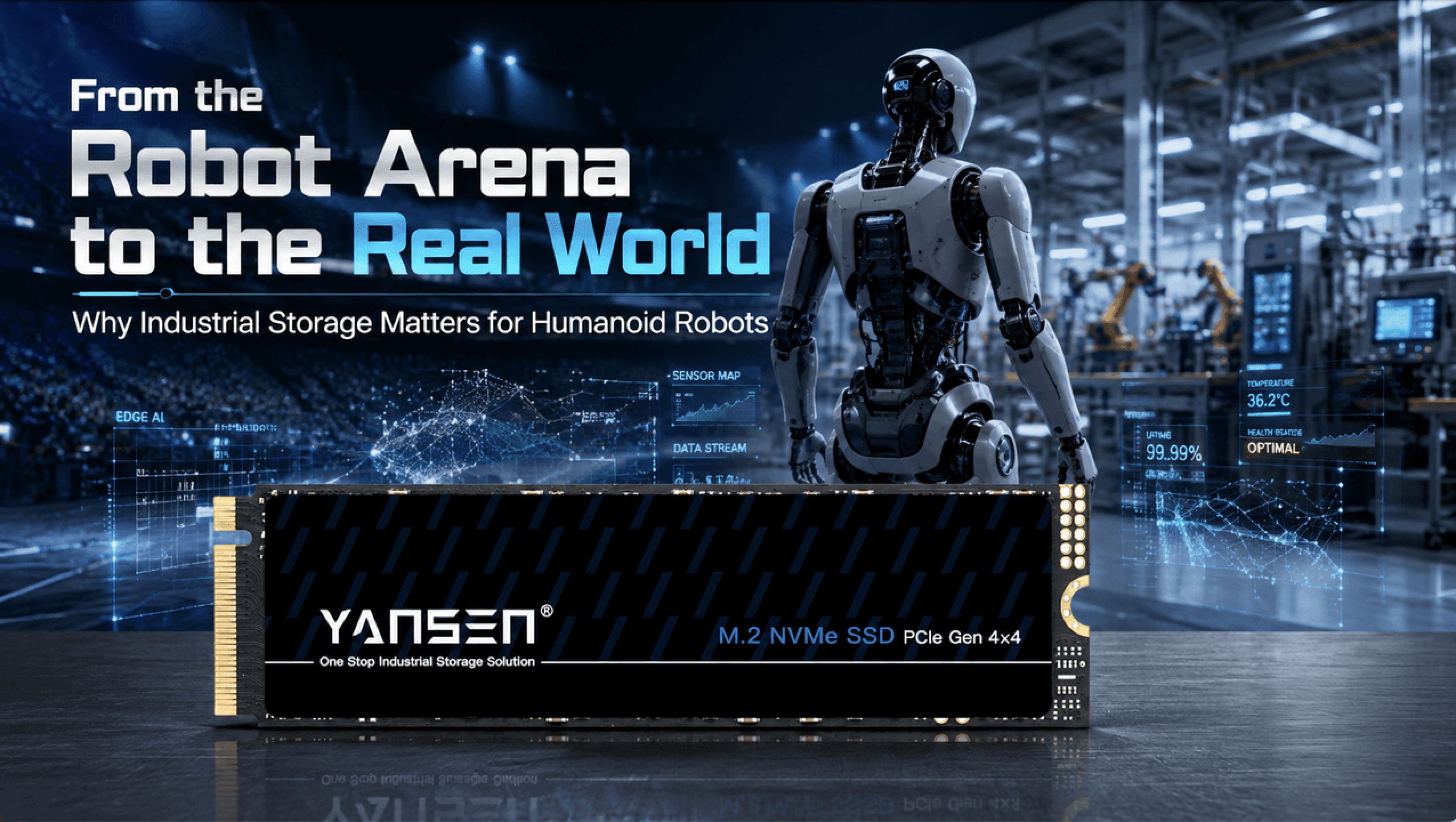
The second World Humanoid Robot Games held in Beijing in August 2026 offered a glimpse of this transition. Beyond athletic competitions, robots were increasingly tested in scenarios closer to real industrial and commercial environments.
From logistics and manufacturing to inspection, hospitality, emergency response, and autonomous navigation, robots are being asked to operate in environments that demand more than mechanical movement.
As robots become more intelligent, they also need to process and store increasing amounts of data. Cameras generate images and video, sensors continuously collect environmental information, AI models need to be loaded and accessed, and operating systems must record logs and diagnostic data. This creates a storage requirement that is easy to overlook when most attention is focused on processors, GPUs, and AI algorithms.
For robots operating in real-world environments, storage is no longer simply a place to keep files. It is part of the computing infrastructure that helps the system access data quickly, operate reliably, and maintain performance over its service life.
Modern Robots Are Becoming Mobile Edge AI Systems
A modern humanoid robot is much more than a mechanical platform. It can be viewed as a mobile edge AI system that continuously senses its environment, processes information, makes decisions, and performs physical actions.
A simplified data path may look like this:
Camera / LiDAR / Sensors → CPU / GPU / AI Accelerator → Memory → Local SSD
During operation, the robot may need to handle computer vision data, navigation maps, AI models, sensor information, system logs, diagnostic records, and task history. These workloads are different from those of a conventional office computer because data is generated and consumed continuously while the machine is performing physical tasks.
The storage system may therefore be responsible for loading AI models, accessing local datasets, saving sensor information, recording system events, and supporting application software at the same time.
This makes storage performance and reliability important parts of the overall robotics architecture. A processor or AI accelerator can only work efficiently when the required data can be delivered to it in a timely and consistent manner.
Why Storage Performance Matters for Real-Time Robotics
In robotics applications, high SSD performance is not simply about making a specification sheet look impressive. The practical objective is to reduce storage-side bottlenecks when the system needs to access large amounts of local data.
For example, a robot may need to load AI models during startup, access navigation maps while moving, read image or video data during inspection, and continuously write system and sensor logs. When several of these workloads occur simultaneously, storage latency and throughput can affect how efficiently the computing platform handles data.
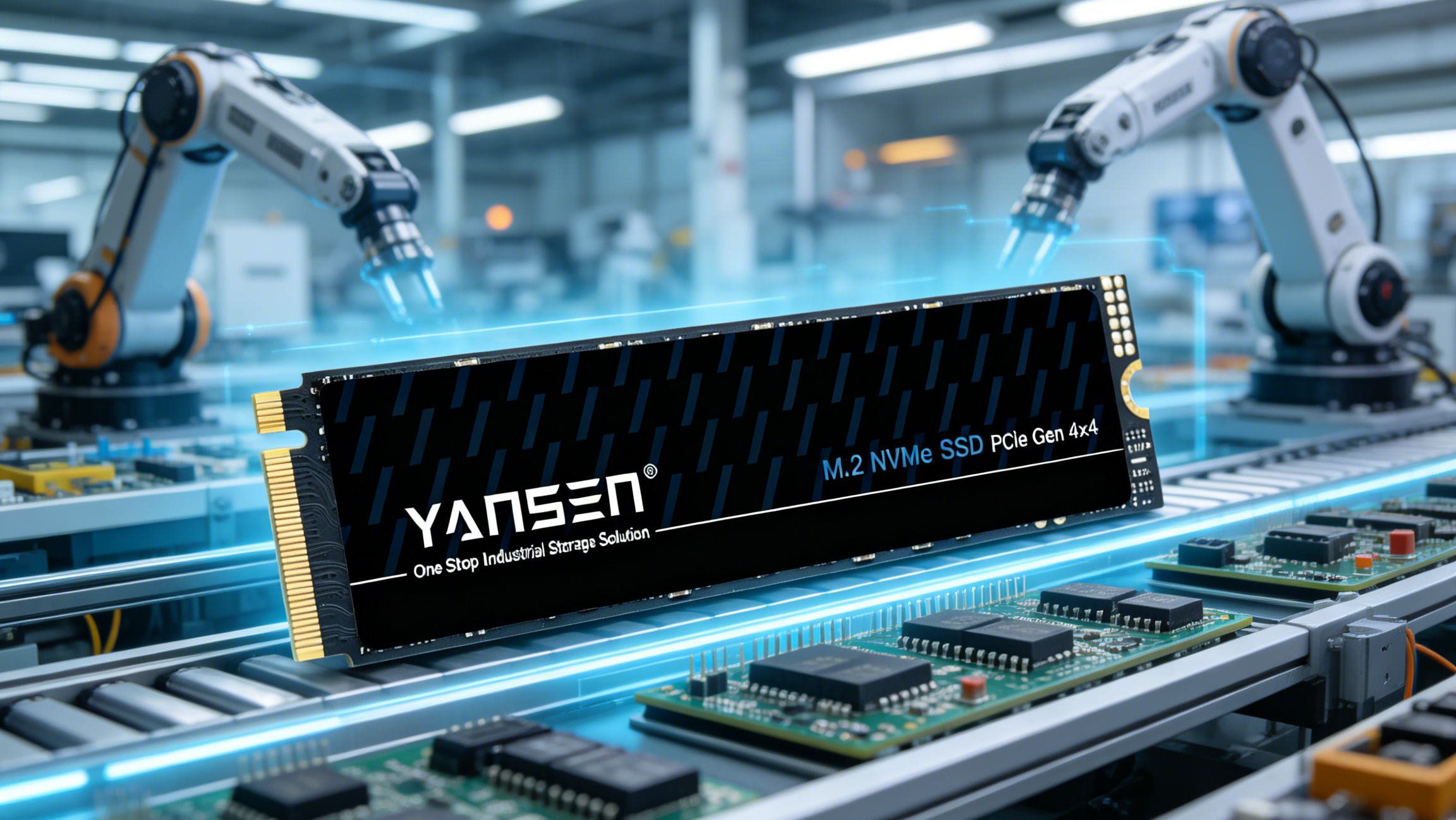
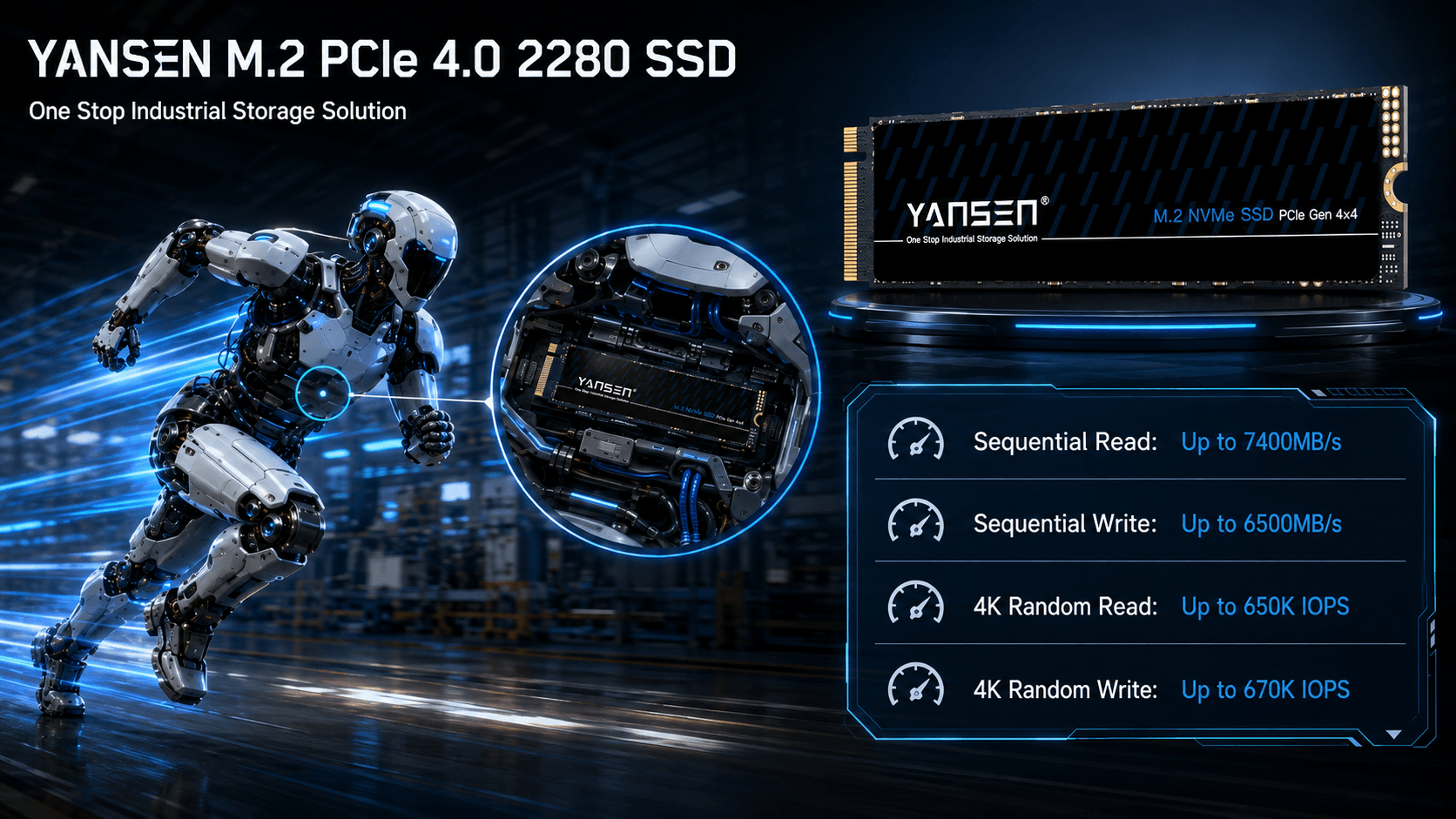
This is where high-speed NVMe storage becomes useful. YANSEN M.2 PCIe 4.0 SSDs use a PCIe Gen4 x4 interface and NVMe protocol to provide high-speed local data access. Selected TLC configurations offer sequential read speeds of up to 7,400 MB/s and sequential write speeds of up to 6,500 MB/s, with 4K random read and write performance of up to 650K and 670K IOPS respectively.
These figures should not be interpreted as a guarantee that a robot itself will operate at a corresponding speed. The actual system performance also depends on the processor, AI accelerator, software, memory, thermal design, and application workload.
The more relevant benefit is that high-performance storage can help edge systems access models, datasets, maps, and other local information efficiently when multiple workloads are running simultaneously.
Industrial Robots Need More Than High Speed
Performance is only one part of the storage equation. A robot working in a factory, warehouse, transportation system, or outdoor environment can face conditions that are very different from those of a desktop PC or a controlled data center.
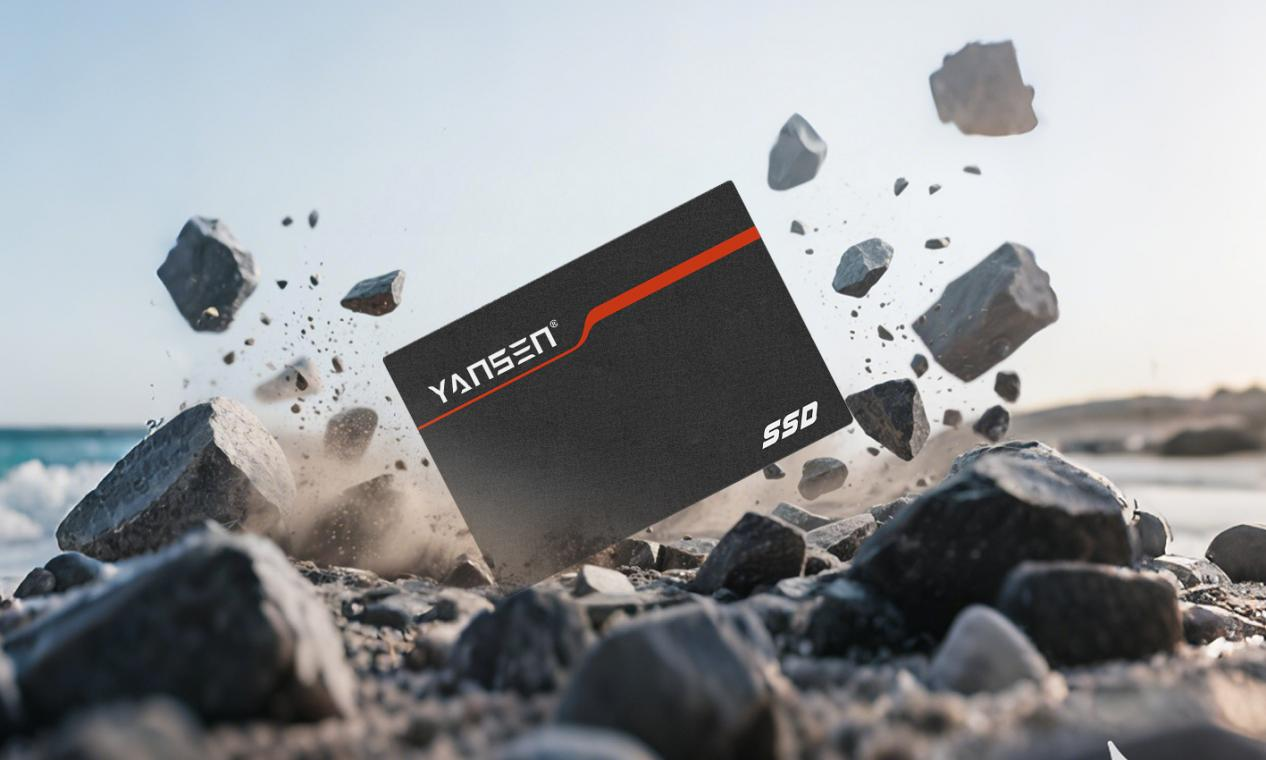
Industrial and mobile robotic systems may experience temperature changes, mechanical shock, vibration, continuous operation, and frequent read/write activity. If the storage device is not suitable for the deployment environment, a high-speed interface alone cannot guarantee reliable operation.
This is why engineers evaluating storage for robotics should consider environmental specifications alongside performance.
| Storage Requirement | Why It Matters in Robotics |
| Wide-temperature operation | Supports deployment in changing or demanding environmental conditions |
| Shock resistance | Helps the storage device withstand mechanical impact and movement |
| Vibration resistance | Important for mobile robots and industrial equipment with continuous mechanical movement |
| Thermal monitoring | Helps monitor SSD temperature under demanding workloads |
| Data management functions | Wear leveling and bad block management support long-term storage reliability |
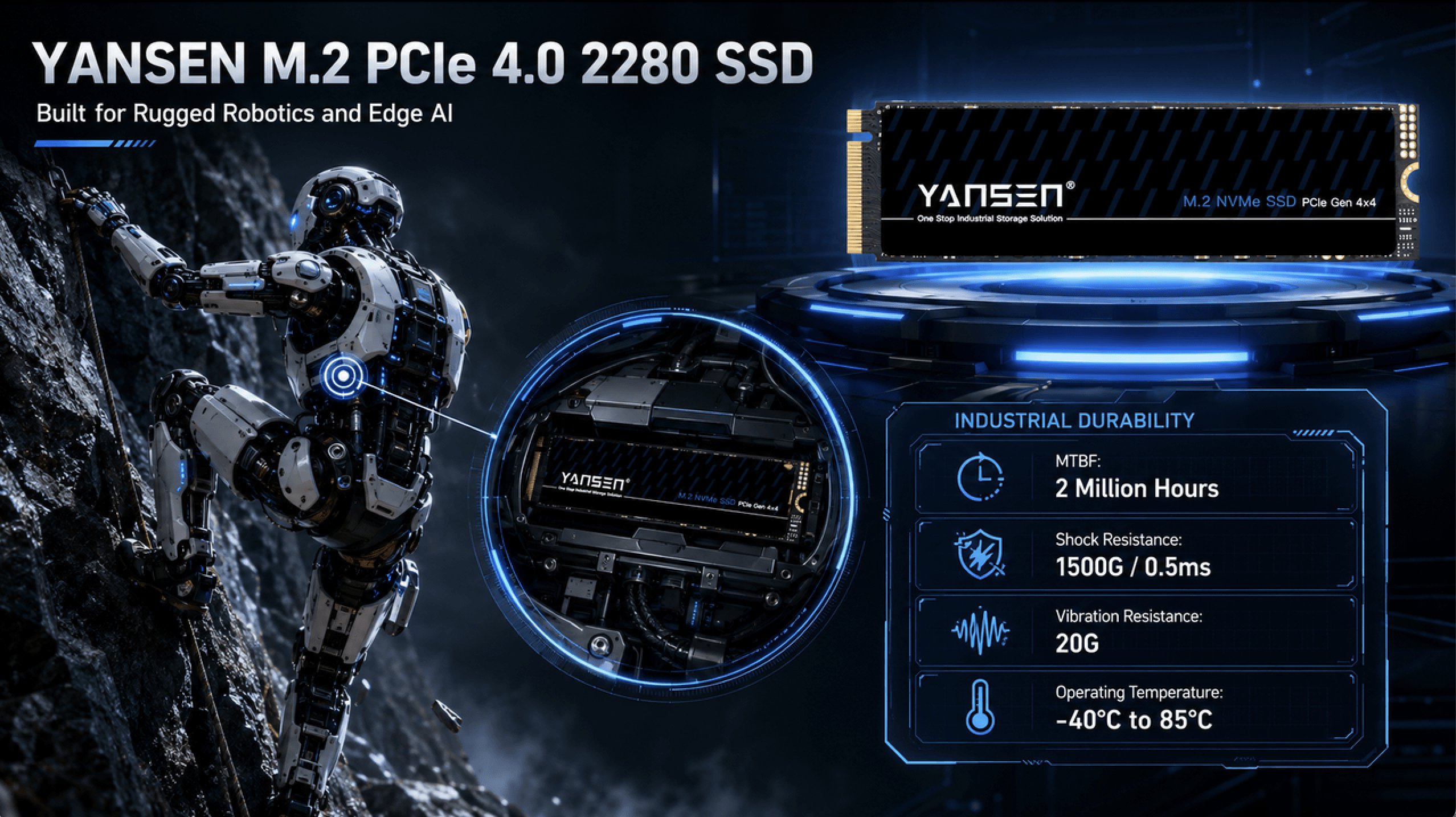
Selected YANSEN PCIe 4.0 SSD configurations support an operating temperature range of -40°C to +85°C, with up to 1,500G shock resistance, 20G vibration resistance, and an MTBF of up to 2 million hours. Features such as thermal sensors, S.M.A.R.T., wear leveling, and bad block management further support reliable operation in demanding applications.
For robotics, storage reliability is not only about protecting data. It can also affect overall system availability. When a robot is deployed as part of a production line or other critical process, unexpected storage problems can result in downtime, maintenance work, or interrupted operations.
Continuous Robot Operation Makes Endurance a Key Consideration
Robots can generate data throughout their entire operating lifecycle. Depending on the application, this may include sensor logs, camera data, navigation history, error records, system status information, and application-generated data.
For an industrial robot operating for many hours every day, the accumulated write workload can be substantially higher than that of a typical office computer. As a result, SSD selection should consider not only capacity and speed, but also write endurance.
Two commonly used indicators are TBW and DWPD. TBW, or Terabytes Written, describes the total amount of data an SSD is rated to write over its specified lifetime. DWPD, or Drive Writes Per Day, describes how many times the drive’s full capacity can theoretically be written each day over a defined warranty period.
YANSEN offers different NAND configurations for different workload requirements. Selected TLC models provide capacities from 256GB to 4TB and up to 4,000TBW. eTLC configurations are available from 400GB to 3.84TB, with options supporting 1 DWPD or 3 DWPD.
The appropriate endurance level should be selected according to the robot’s actual write workload, operating pattern, capacity requirement, and expected service life rather than simply choosing the highest available specification.
Different NAND configurations allow system designers to balance performance, capacity, endurance, and project cost according to the requirements of the specific robotics application.
Why M.2 2280 Fits Compact Edge Robotics
Robotic systems face another constraint that is sometimes overlooked: physical space. A robot’s internal electronics must accommodate processors, AI accelerators, memory, communication modules, power components, cooling systems, and other control hardware. PCB space and thermal headroom are therefore often limited.
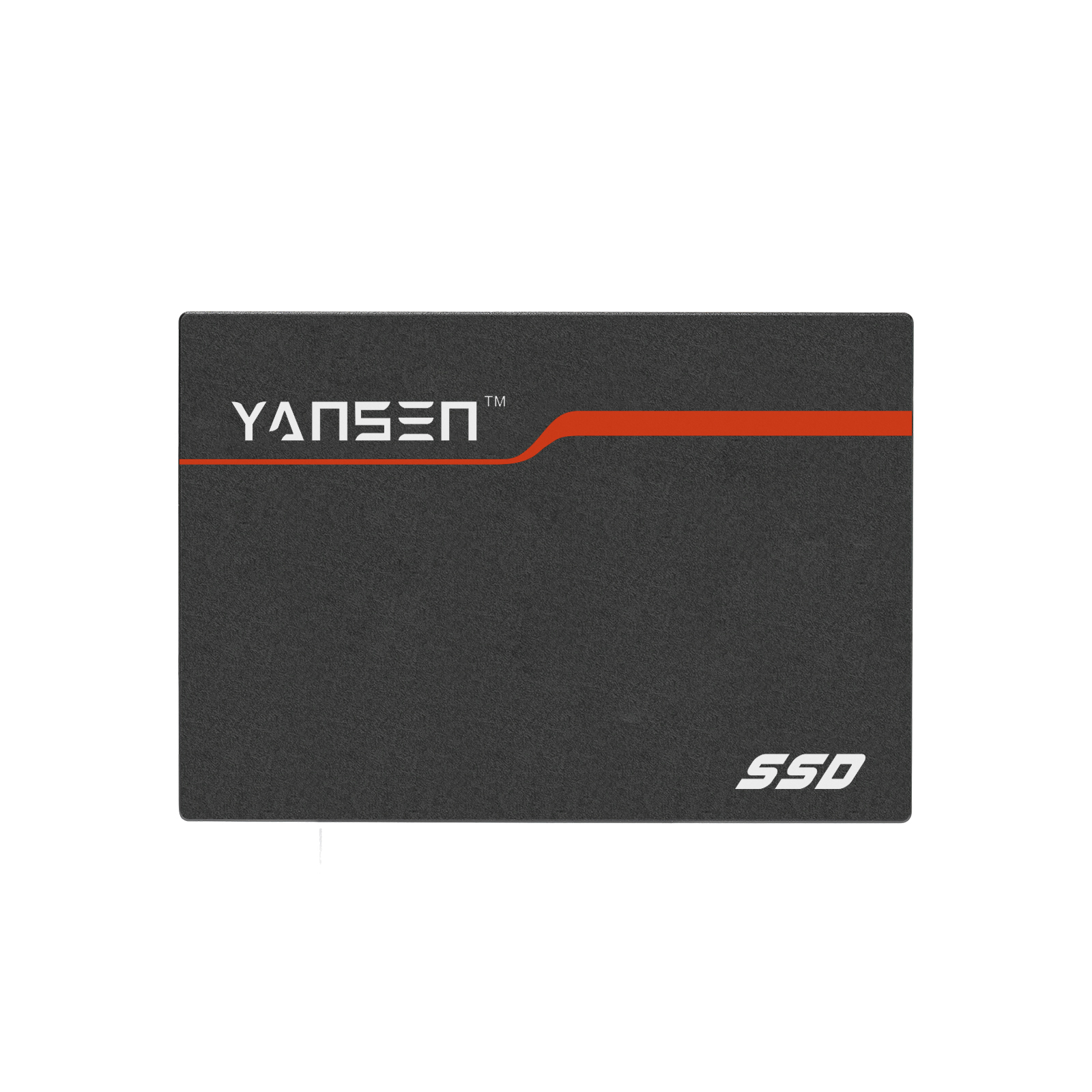
This makes a compact storage form factor valuable. YANSEN M.2 PCIe 4.0 SSDs use the M.2 2280 form factor, measuring approximately 80 × 22 mm, while providing PCIe Gen4 NVMe connectivity.
The combination of a compact footprint and high-speed interface makes M.2 storage suitable for space-constrained edge computing platforms, including robotics controllers, industrial PCs, machine vision systems, and AI-enabled equipment.
However, form factor selection should always be based on the host platform. Engineers should verify mechanical dimensions, interface compatibility, power requirements, thermal conditions, and available PCIe lanes before selecting an SSD.
Choosing an SSD for Robotics: What Should Engineers Consider?
There is no single SSD specification that is ideal for every robot. A warehouse robot, industrial vision system, autonomous machine, and humanoid robot may have very different storage workloads.
For procurement teams and system integrators, the following factors provide a practical starting point:
| Selection Factor | What to Consider |
| Interface | PCIe generation, available lanes, and NVMe compatibility |
| Capacity | AI models, operating system, local datasets, logs, and application data |
| NAND type | TLC or higher-endurance options according to workload requirements |
| Endurance | TBW or DWPD based on expected daily write volume and service life |
| Temperature | Required operating temperature range for the deployment environment |
| Shock and vibration | Important for mobile robots and industrial machinery |
| Reliability | MTBF, S.M.A.R.T., wear leveling, bad block management, and other features |
| Form factor | M.2 2280 or another form factor required by the host platform |
| Lifecycle support | Long-term availability, firmware support, and supplier stability |
One common mistake is choosing an SSD primarily by its maximum sequential read speed. Sequential performance is important for some workloads, but robotics systems can also involve random access, sustained writes, thermal constraints, and continuous operation.
A more practical evaluation should consider the complete combination of performance, endurance, environmental reliability, capacity, compatibility, and lifecycle support.
From Competition Robots to Commercial Robots
Robot competitions are useful demonstrations of what robotic systems can achieve, but commercial deployment introduces a different set of requirements.
In a competition or laboratory environment, one fundamental question is:
Can the robot perform the task?
In commercial and industrial environments, the question becomes more demanding:
Can the robot perform the task reliably every day?
This difference changes how engineers evaluate the entire system. Intelligence and computing performance remain essential, but reliability, maintainability, operating environment, and service lifecycle become equally important.
The same principle applies to storage. Instead of looking only at capacity, system designers increasingly need to evaluate performance, endurance, environmental reliability, and long-term availability together.
For a robot deployed on a production line or in an industrial facility, storage should be treated as part of the system architecture rather than as an interchangeable commodity component.
YANSEN Industrial SSD for Robotics and Edge AI
For robotics and edge AI applications, storage requirements vary according to workload intensity, operating environment, capacity, and expected deployment lifecycle. A storage supplier therefore needs to provide more than a standard consumer SSD specification.
YANSEN provides industrial and enterprise storage solutions for industrial computing, embedded systems, edge AI, and other demanding applications. Its M.2 PCIe 4.0 2280 SSD family combines PCIe Gen4 NVMe performance with different NAND configurations, capacities, and endurance options.
For robotics applications, available configurations can help system integrators address different priorities. TLC models provide a balance between performance, capacity, endurance, and cost, while eTLC options can be considered for applications with more demanding write workloads.
Selected configurations also support wide-temperature operation, shock and vibration resistance, and storage management features designed for long-term operation.
More importantly, storage selection can be matched to the actual application. A robotics system integrator may need to evaluate AI model size, sensor data volume, daily write workload, operating temperature, mechanical conditions, required service life, and available storage space before finalizing the SSD configuration.
YANSEN’s role is not simply to provide a storage device, but to help customers select a suitable storage configuration according to performance, endurance, environmental, and lifecycle requirements.
Conclusion: The Next Challenge for Robots Is Reliable Real-World Operation
The first challenge for humanoid robots was learning how to move. The next challenge is learning how to work reliably in the real world.
As robots move into factories, warehouses, commercial facilities, transportation systems, and other edge AI environments, their success will depend on more than mechanical design and AI algorithms. Computing, memory, networking, and storage must work together to support continuous data processing.
For this reason, industrial SSDs are becoming an important component of modern robotics infrastructure. High-speed NVMe connectivity can support demanding local data workloads, while appropriate endurance, environmental protection, and long-term reliability help prepare robots for sustained operation.
Explore YANSEN industrial SSD solutions for robotics, edge computing, industrial PCs, and intelligent systems.