Skip to content

Products

from Industrial SSD Solution Provider

Product Category

Filter: Industrial DRAM (YANSEN)

Contact Us

Feel free to reach out and we’ll respond promptly.

Frequently Asked Questions

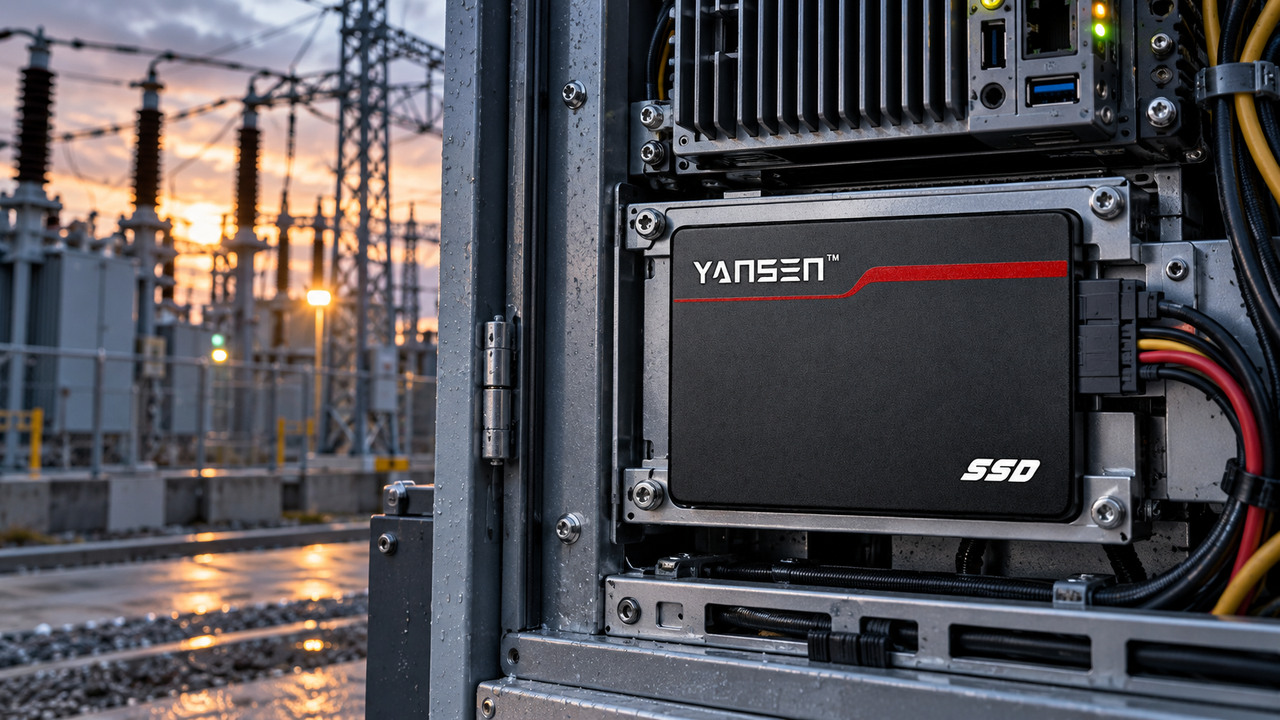
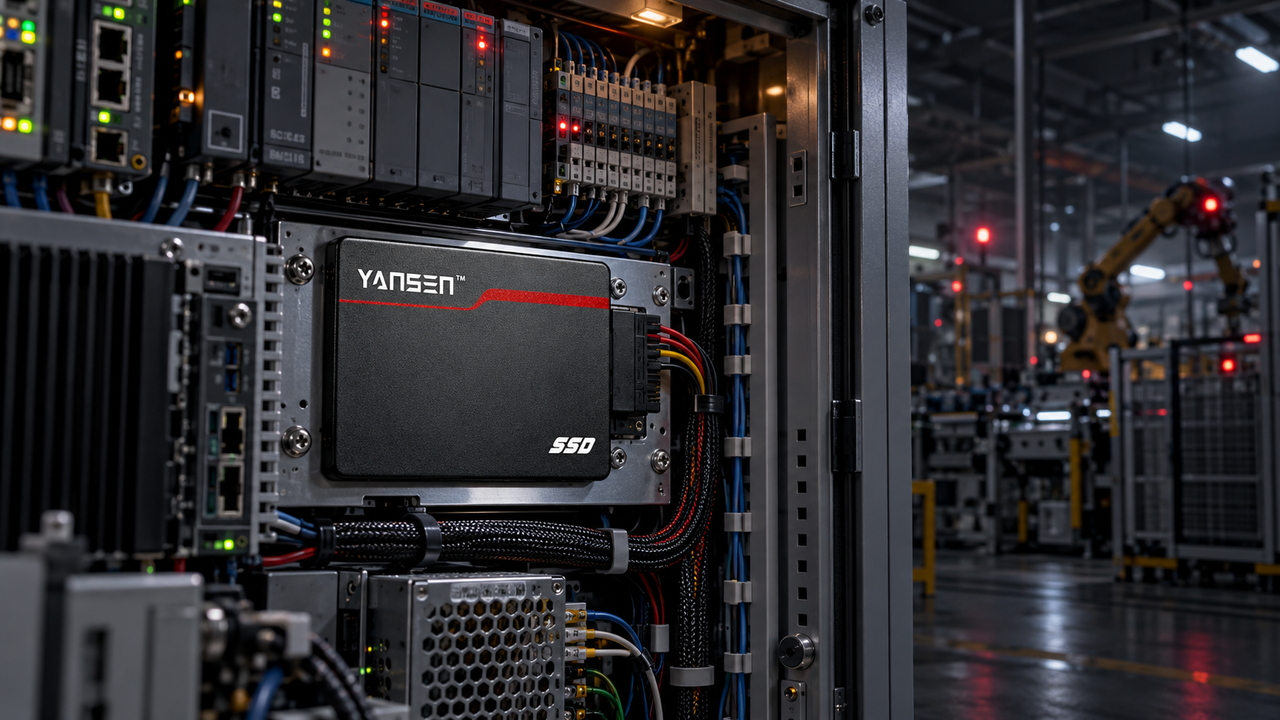
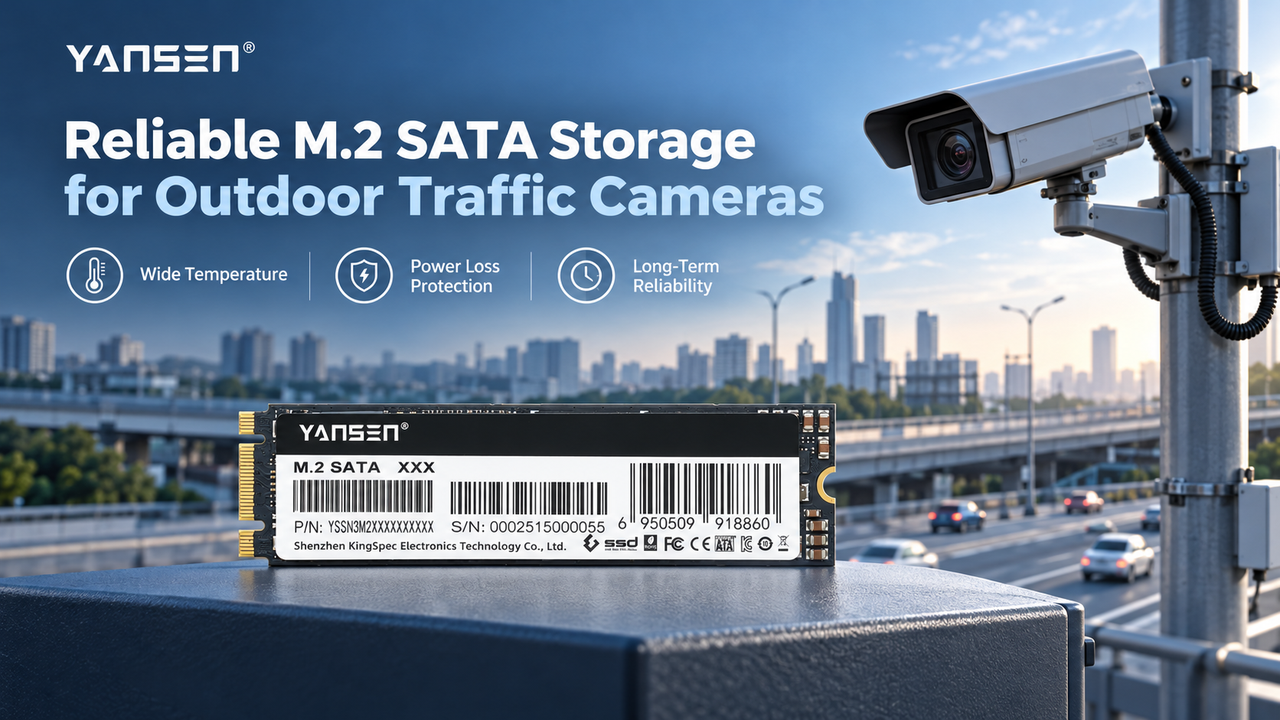
Reliable M.2 SATA Storage for Outdoor Traffic Cameras with Power Loss Protection

M.2 SATA Storage
Customer: Confidential Region: Western Europe Industry: Intelligent Transportation Systems Application: Outdoor Intelligent Traffic Cameras Storage Solution: YANSEN Wide-Temperature M.2 SATA SSD with PLP Capacity: 960GB Key Requirements: Wide-Temperature Operation / Power Loss Protection / Long-Term Reliability

Project Background

A Western European intelligent transportation equipment manufacturer was developing outdoor traffic camera systems for long-term roadside deployment.
The customer specializes in intelligent traffic cameras, automatic number plate recognition (ANPR), vehicle detection, laser measurement, traffic monitoring software and related intelligent transportation equipment.
Unlike conventional indoor surveillance systems, outdoor traffic cameras operate continuously in environments where both temperature and power conditions can be unpredictable.
During daily operation, these systems may capture and store vehicle images, license plate information, detection records, event data and system logs before selected information is transmitted to a central traffic management platform.
This makes local storage an important part of the overall data acquisition chain.
For this project, the customer identified two critical storage requirements:
  1. Reliable data storage across a wide operating temperature range
  2. Protection of in-progress data during unexpected short-duration power interruptions
Because sudden power loss was considered a real operating risk, Power Loss Protection (PLP) was a mandatory requirement.
To address these requirements, YANSEN provided a 960GB wide-temperature M.2 SATA SSD with PLP.

The Challenge: Outdoor ITS Storage Must Handle More Than Continuous Writing

Traffic cameras are often installed on roadside poles, intersections, gantries or other distributed infrastructure.
Once deployed, they may operate continuously for long periods with limited direct maintenance.
Storage therefore needs to remain dependable not only during normal recording, but also when environmental or power conditions become less predictable.
For the customer, the challenge was not simply finding an SSD with sufficient capacity or bandwidth.
The storage solution needed to combine:
  • Wide-temperature operation
  • Power Loss Protection
  • Stable SATA performance
  • High write endurance
  • Long-term operational reliability
  • Compact embedded integration
Each of these requirements contributes to the reliability of the complete camera system.
Challenge 1: Reliable Storage Across Wide Temperature Conditions

Outdoor traffic infrastructure cannot rely on a tightly controlled operating environment.
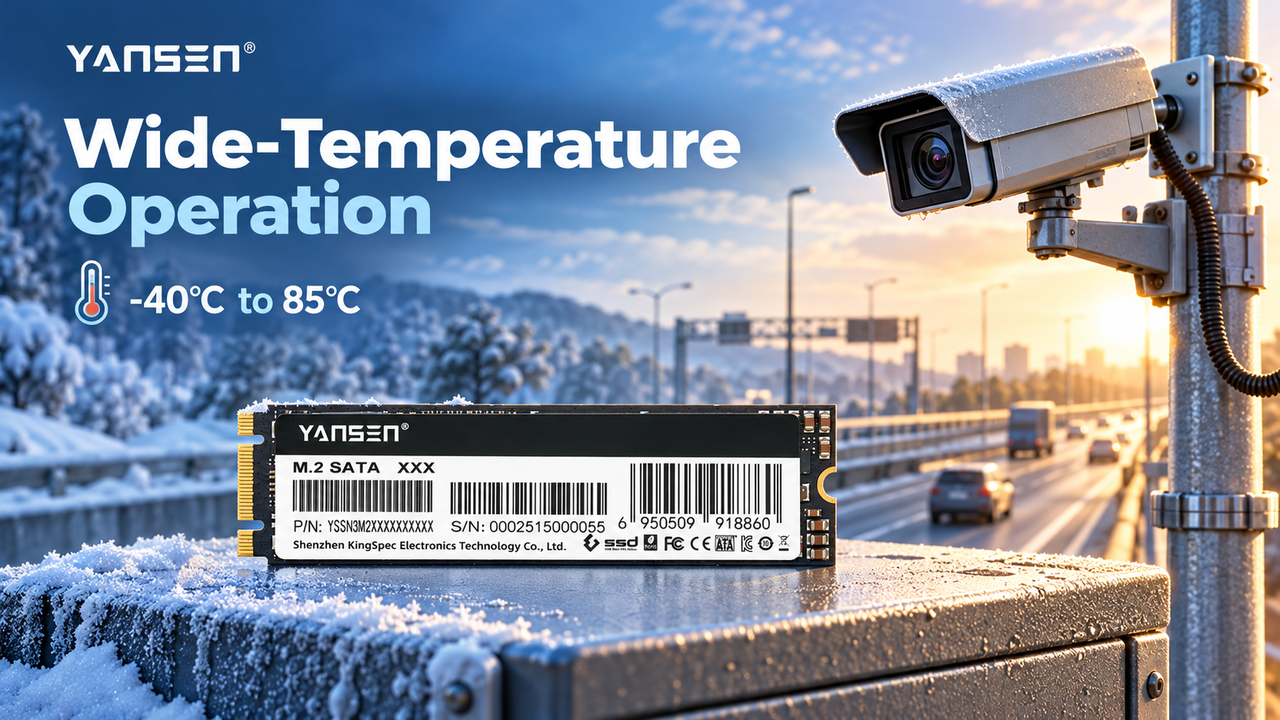
Depending on the season, installation location and enclosure design, a roadside camera may experience cold starts, direct sunlight, enclosure heat accumulation and significant temperature variation between day and night.
For this reason, the customer required storage designed for wide-temperature operation.
The YANSEN M.2 SATA solution supports:

-40°C to 85°C Operating Temperature

and:

-50°C to 95°C Storage Temperature

The product is also designed to withstand demanding mechanical conditions, with vibration resistance up to 80Hz–2000Hz / 20G and shock resistance up to 1500G / 0.5ms.
For outdoor ITS equipment, these environmental specifications provide additional design margin compared with storage intended mainly for controlled indoor environments.
The value is not simply the temperature rating itself.
It is the ability to keep the storage subsystem aligned with the environmental conditions expected throughout long-term roadside deployment.
Challenge 2: Sudden Power Loss Can Put In-Progress Data at Risk

For intelligent traffic systems, storage reliability is also closely connected to the power environment.
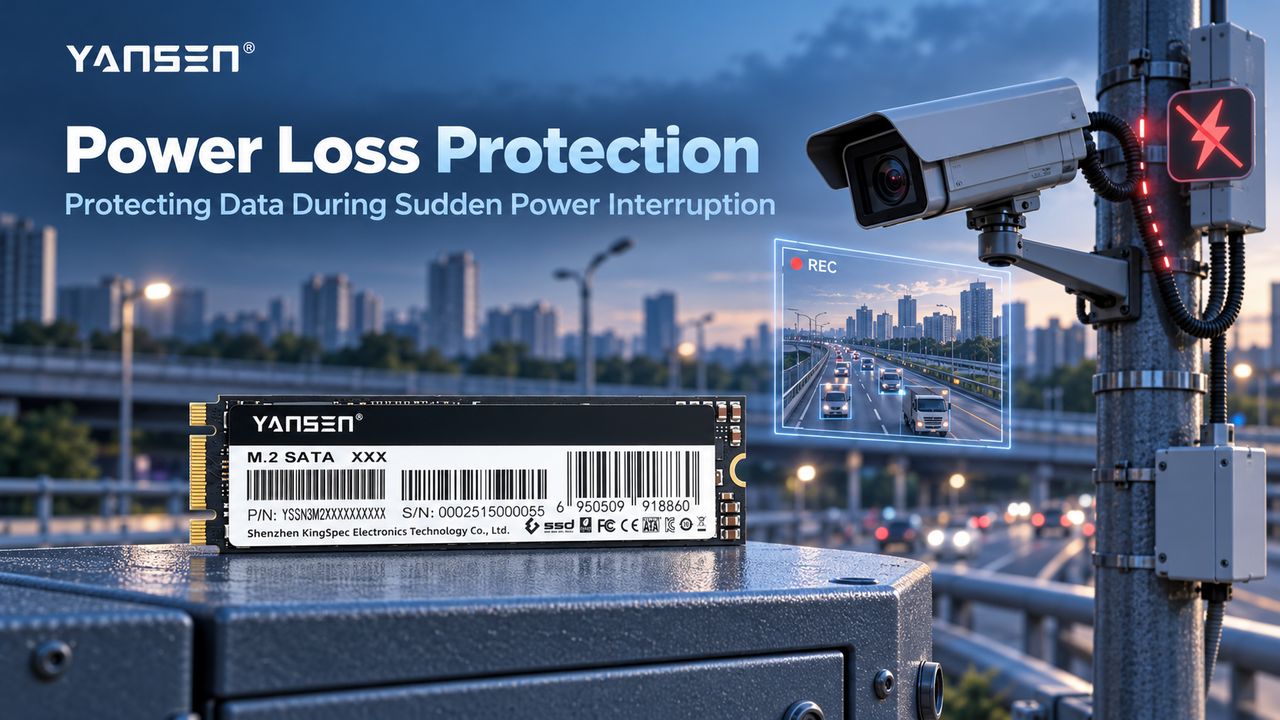
Roadside cameras and detection systems may experience short-duration interruptions caused by maintenance, local power instability, accidental shutdown or other unexpected events.
If power is interrupted while the SSD is writing data, the system may face risks such as incomplete writes or inconsistent data.
For applications such as ANPR and vehicle detection, that can be particularly important.
A traffic camera may be processing a workflow such as:
Vehicle Detected → Image Captured → Plate Recognized → Event Data Written to Storage
If power is interrupted during this process, important information may still be in the middle of being written.
For this reason, the customer explicitly required:

Power Loss Protection

PLP provides an additional level of protection for storage environments where unexpected power interruption needs to be considered as part of system design.
For this project, it was not treated as an optional feature.
It was a core requirement for supporting data integrity in an outdoor intelligent transportation system.
For outdoor ITS equipment, storage reliability is not only about how data is written—it is also about what happens when power suddenly disappears.

Why PLP Matters in Intelligent Traffic Systems

Modern traffic cameras increasingly perform more processing at the edge.
Instead of simply transmitting raw video, an intelligent camera may detect vehicles, recognize license plates, classify events and generate local metadata before transmitting selected information to a central platform.
Local storage may therefore contain:
  • Vehicle images
  • License plate recognition results
  • Event records
  • Application data
  • Device logs
  • Temporary processing data
Unexpected power interruption can occur at any stage of this workflow.
A storage solution with PLP is therefore particularly valuable when maintaining data consistency during abnormal power events is part of the application requirement.
This made the YANSEN solution well suited to the customer’s outdoor traffic camera architecture.
The YANSEN Solution

To meet the project’s environmental and data integrity requirements, YANSEN supplied a:

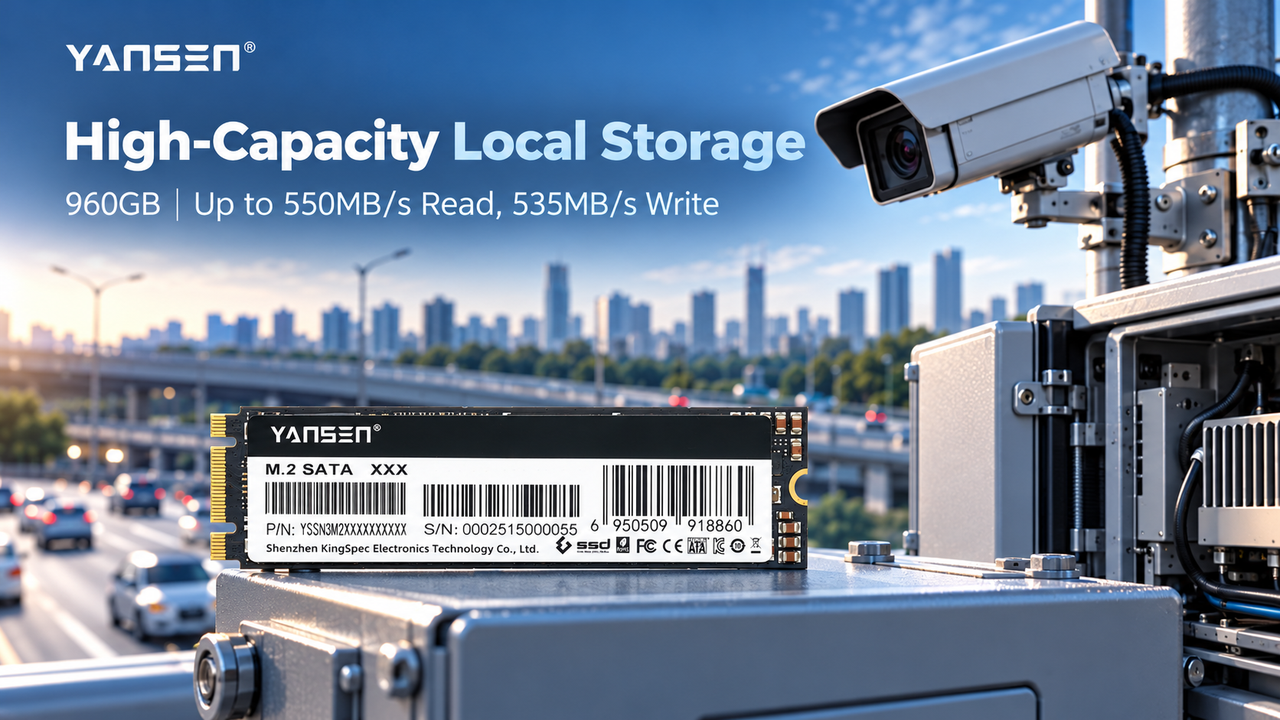
960GB Wide-Temperature M.2 SATA SSD with PLP

The solution combines compact embedded integration with strong SATA-level performance and high write endurance.
Key performance specifications include:
  • Sequential Read: Up to 550MB/s
  • Sequential Write: Up to 535MB/s
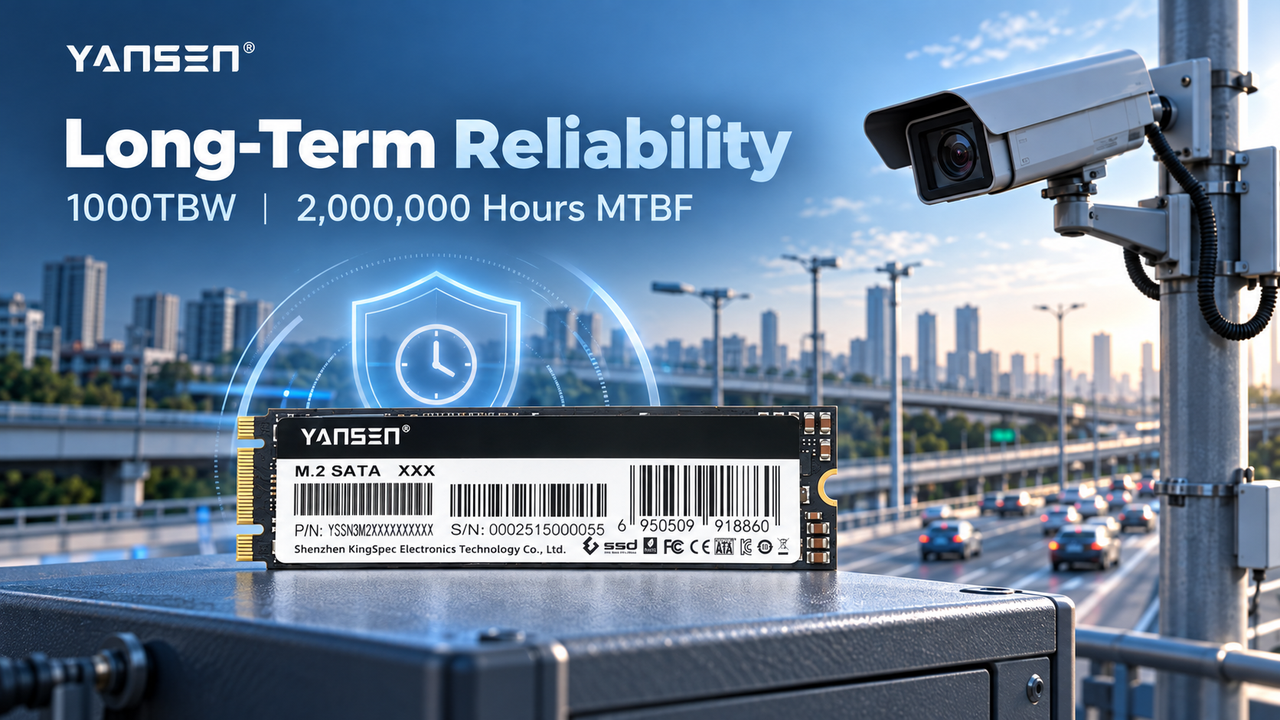
  • TBW: 1000TB
  • Operating Temperature: -40°C to 85°C
 
The product uses an M.2 2280 B&M Key form factor, making it suitable for compact intelligent transportation devices where installation space is limited.
The product family also provides an MTBF rating of:

2,000,000 Hours

 
Together, these characteristics provide a storage platform designed around the actual operating requirements of outdoor ITS equipment.

Key Technical Specifications

Specification YANSEN Solution
Form Factor M.2 2280 B&M Key
Interface SATA 6Gbps
Capacity 960GB
NAND Flash 3D TLC
Sequential Read Up to 550MB/s
Sequential Write Up to 535MB/s
TBW 1000TB
Operating Temperature -40°C to 85°C
Storage Temperature -50°C to 95°C
MTBF 2,000,000 Hours
Power Loss Protection Supported
S.M.A.R.T. Supported
The storage solution also supports wear leveling, garbage collection, over-provisioning, NCQ, TRIM and S.M.A.R.T. monitoring.
Challenge 3: Long-Term Reliability for Continuous Outdoor Deployment

Traffic monitoring equipment is designed for long deployment cycles.
Once installed at a roadside location, frequent physical maintenance is neither efficient nor desirable.
The storage device therefore needs to support repeated write activity while maintaining stable operation over time.
The YANSEN 960GB solution provides:

1000TBW Endurance

This provides additional endurance headroom for traffic monitoring workloads that may continuously generate images, event data and system logs.
The solution also provides:

2,000,000 Hours MTBF

 
These specifications further support equipment designed around long service cycles and continuous outdoor operation.

Compact Storage for Embedded Traffic Equipment

Outdoor intelligent cameras typically have strict mechanical constraints.
The enclosure needs to accommodate imaging hardware, processors, communication modules, power circuitry and storage while remaining compact enough for roadside installation.
The M.2 2280 form factor provides a practical balance between storage capacity and physical footprint.
The product dimensions are approximately:
80.0mm × 22.0mm × 3.5mm
 
With 960GB of capacity, the solution provides substantial local storage without requiring the space of a conventional 2.5-inch drive.

How Storage Fits into the ITS Camera System

Within the customer’s intelligent traffic camera architecture, the SSD acts as the local data layer between real-time detection and central platform communication.
A simplified workflow can be represented as:
Traffic Scene
↓
Intelligent Camera / Sensor
↓
Vehicle Detection / ANPR / Laser Measurement
↓

YANSEN M.2 SATA SSD

Local Image, Event & Metadata Storage
↓
Network Transmission
↓
Traffic Management Platform
Two storage capabilities are particularly important at the local layer:

Wide Temperature

Supports operation in changing outdoor roadside conditions.

Power Loss Protection

Addresses storage risks associated with unexpected power interruption during active writing.
Together, these capabilities align the storage solution with the real operating environment of distributed intelligent transportation infrastructure.

Why M.2 SATA Fits This Application

For outdoor traffic cameras, the highest possible storage interface speed is not necessarily the primary requirement.
The application needs a balanced combination of:
Compact Form Factor + Sufficient Performance + Wide Temperature + High Endurance + Power Loss Protection
With read speeds up to 550MB/s and write speeds up to 535MB/s, the M.2 SATA solution provides strong SATA-level performance while retaining the environmental and reliability characteristics required by the project.
This reflects an important principle in industrial storage selection:
The right storage solution is not always the one with the highest benchmark speed—it is the one that best matches the workload, environment and failure conditions of the system.

Application Value

By integrating YANSEN’s 960GB wide-temperature M.2 SATA SSD with PLP, the customer gained a storage solution designed around the realities of outdoor intelligent transportation infrastructure.

Stable Outdoor Operation

The -40°C to 85°C operating range supports deployment across changing seasonal and roadside temperature conditions.

Data Protection During Unexpected Power Events

PLP addresses one of the project’s most important requirements by providing additional protection when power interruption occurs during active storage operations.

High-Endurance Local Storage

The 1000TBW endurance rating provides additional headroom for long-term traffic monitoring workloads.

Long-Term Reliability

A 2,000,000-hour MTBF rating supports equipment designed for extended operating cycles.

Compact, High-Capacity Integration

The M.2 2280 form factor provides 960GB of local capacity for embedded intelligent traffic equipment.

Beyond Traffic Cameras

The same storage requirements can also appear across a broader range of intelligent transportation systems, including:
  • ANPR Cameras
  • Traffic Enforcement Cameras
  • Vehicle Detection Systems
  • Laser Measurement Equipment
  • Roadside Monitoring Units
  • Intelligent Intersections
  • Traffic Edge Computing Devices
  • Distributed ITS Controllers
Across these applications, storage needs to be considered as part of the complete system rather than as an isolated component.
Temperature conditions, endurance requirements and abnormal power events all need to be considered during product selection.

Industrial Storage Built for Unpredictable Environments

For outdoor intelligent transportation systems, storage reliability depends on more than speed or capacity.
The storage device must remain operational across changing environmental conditions while also being prepared for abnormal events such as unexpected power interruption.
In this project, the combination of:
-40°C to 85°C wide-temperature operation Power Loss Protection 1000TBW endurance 2,000,000-hour MTBF and 960GB M.2 SATA storage
provided a solution aligned with the customer’s outdoor traffic camera requirements.
YANSEN provides industrial and enterprise storage solutions for intelligent transportation, edge computing, industrial automation and other demanding embedded applications.
Building an outdoor ITS system? Talk to YANSEN about your temperature, endurance and power-loss protection requirements.
What Is eMMC? Key Specifications, Applications, and How to Choose the Right Embedded Storage

   embedded storage

Industrial touch panels, IoT gateways, smart retail terminals, and intelligent display systems may serve different purposes, but they share one essential requirement: reliable onboard storage. These devices need to store operating systems, application software, configuration files, and operating logs. The selected storage solution affects system startup, daily operation, software updates, and long-term maintenance.

eMMC (Embedded MultiMediaCard) is one option for embedded devices that need compact, board-level storage. It integrates NAND flash and a memory controller into a single package, simplifying storage integration for the host system.

However, choosing eMMC involves more than comparing capacity. Interface compatibility, transfer modes, real-world performance, temperature range, write endurance, and power-loss behavior all need to be considered. This guide explains the key eMMC specifications, typical applications, and practical selection criteria, including YANSEN’s upcoming 8GB and 64GB eMMC solutions.

1. What Is eMMC?

eMMC stands for Embedded MultiMediaCard. It is a non-volatile storage device that integrates NAND flash memory and a controller into one package. Typically using a BGA (Ball Grid Array) package, it is soldered directly onto a device’s mainboard to store operating systems, applications, and user data.

Because it is non-volatile, data that has been properly written and saved does not require continuous power to remain stored. However, whether data currently being written survives an unexpected power interruption depends on the specific product and overall system design.

How Does eMMC Work?

Unlike raw NAND flash, which requires the host system to handle more low-level flash management tasks, eMMC includes an integrated controller. This controller manages functions such as error correction, bad block management, and wear leveling.

These functions help simplify storage integration. Instead of implementing all NAND management at the host level, developers can communicate with eMMC through a standardized interface and focus more on the operating system and application design.

eMMC also has a different role from DRAM. DRAM temporarily holds data that programs need while running, whereas eMMC provides persistent storage for the operating system, applications, and files. It also differs from a removable microSD card: eMMC is normally soldered onto the mainboard, making it suitable for devices that do not require users to frequently replace the storage medium.

embedded storage

2. Key eMMC Specifications You Should Understand

When evaluating eMMC for an embedded project, buyers should look beyond the capacity printed on the product specification. The following parameters help determine whether a device is suitable for the intended platform and workload.

Capacity: How Much Storage Does the Device Need?

Capacity planning should account for the operating system, applications, configuration files, logs, and future software updates. Devices using A/B partitioning for system updates also need sufficient space for a backup system image.

The advertised capacity should not be treated as entirely available for application data. Partitioning, file systems, system reservations, and other uses all affect the final usable capacity.

YANSEN’s upcoming 8GB and 64GB eMMC products address different storage requirements:

  • 8GB eMMC: A candidate for lightweight operating systems, basic applications, configuration files, and moderate logging.
  • 64GB eMMC: More suitable for systems with multiple applications, richer graphical interfaces, larger local resources, or offline content.

The final choice should be based on the actual system image, application footprint, update strategy, and expected data growth—not simply the device category.

Interface Standard and Transfer Modes: eMMC 5.1, HS200, and HS400

eMMC 5.1 identifies the interface standard supported by the product. HS200 and HS400 are different high-speed transfer modes within the eMMC interface specification.

Supporting a particular mode on the storage device does not automatically mean the complete system can use it. The host controller, drivers, power supply, and board-level signal design must also support the corresponding operating mode.

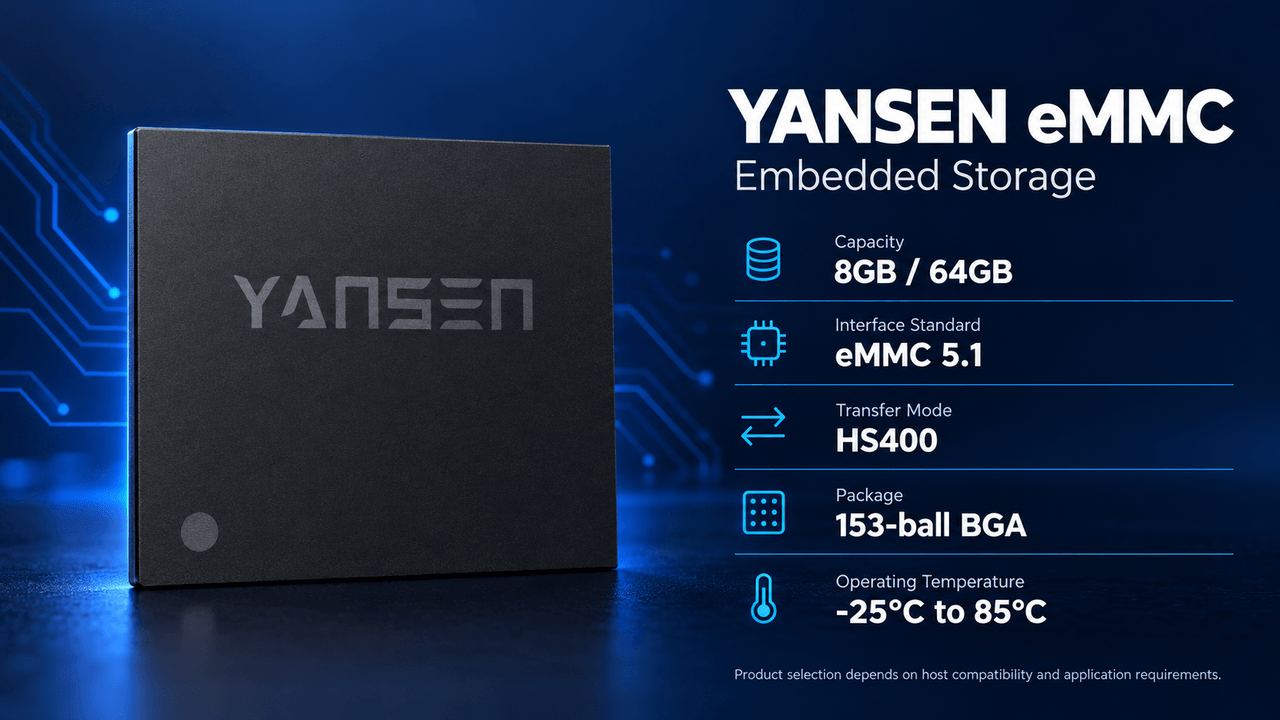
Both upcoming YANSEN eMMC products support eMMC 5.1 and HS400. During project selection, engineers should verify that the target platform supports the required interface mode and that the board design meets its electrical and signal requirements.

HS400 offers a theoretical bandwidth of 400MB/s with an 8-bit bus. This is an interface-level theoretical figure, not a guaranteed real-world read or write speed. Actual performance also depends on NAND flash, controller design, device capacity, access patterns, and test conditions. Two products using eMMC 5.1 may therefore deliver different performance.

Performance: Sequential and Random Access

Sequential read and write performance describes how quickly a storage device transfers continuous blocks of data. It is relevant when handling larger files, media resources, and other sequential workloads.

Random read and write performance, together with access latency, is more relevant to workloads involving small files, configuration updates, and certain application operations.

Device startup usually involves a combination of access patterns, including reading system files, loading applications, and initializing services. Therefore, startup time cannot be judged by sequential read speed alone.

For devices that continuously write logs or cache data, engineers should also evaluate performance during extended operation and when storage utilization is high. Short benchmark results may not represent behavior under a sustained real-world workload.

Package and Power Requirements

The compact BGA package makes eMMC suitable for direct integration into space-constrained embedded devices. However, replacing an existing component requires more than checking its external dimensions. Engineers must also verify ball-map definitions, power requirements, and host compatibility.

eMMC uses separate VCC and VCCQ power supplies, associated with the storage device and its interface, respectively. Their required voltage levels and operating conditions should be designed according to the product specification and selected operating mode.

Both upcoming YANSEN eMMC products use a compact BGA package. OEMs and hardware developers should evaluate the package, PCB footprint, ball assignment, and power design during the hardware integration stage.

Operating Temperature and Write Endurance

Operating temperature refers to the temperature range in which a product is allowed to function. Storage temperature generally refers to the permitted temperature range when the product is not operating. These two specifications should not be confused.

Both upcoming YANSEN eMMC products have an operating temperature range of -25°C to 85°C. Project teams should also consider the actual temperature around the component, because the internal temperature of an enclosure can be higher than the ambient temperature outside it.

Write endurance requires a separate evaluation. It should be assessed according to daily write volume, write amplification, and expected service life. It cannot be reliably inferred from capacity or NAND type alone.

Wear leveling, bad block management, and health-status reporting help manage flash memory over its service life, but they do not provide unlimited write endurance. Applications involving frequent logging, caching, or other sustained writes should confirm the product’s endurance specifications with the supplier and conduct workload-based validation.

3. Typical Applications of eMMC

eMMC is suitable for many embedded devices that need compact onboard storage for operating systems, applications, and moderate amounts of local data. The appropriate capacity and specifications depend on the actual workload.

embedded storage

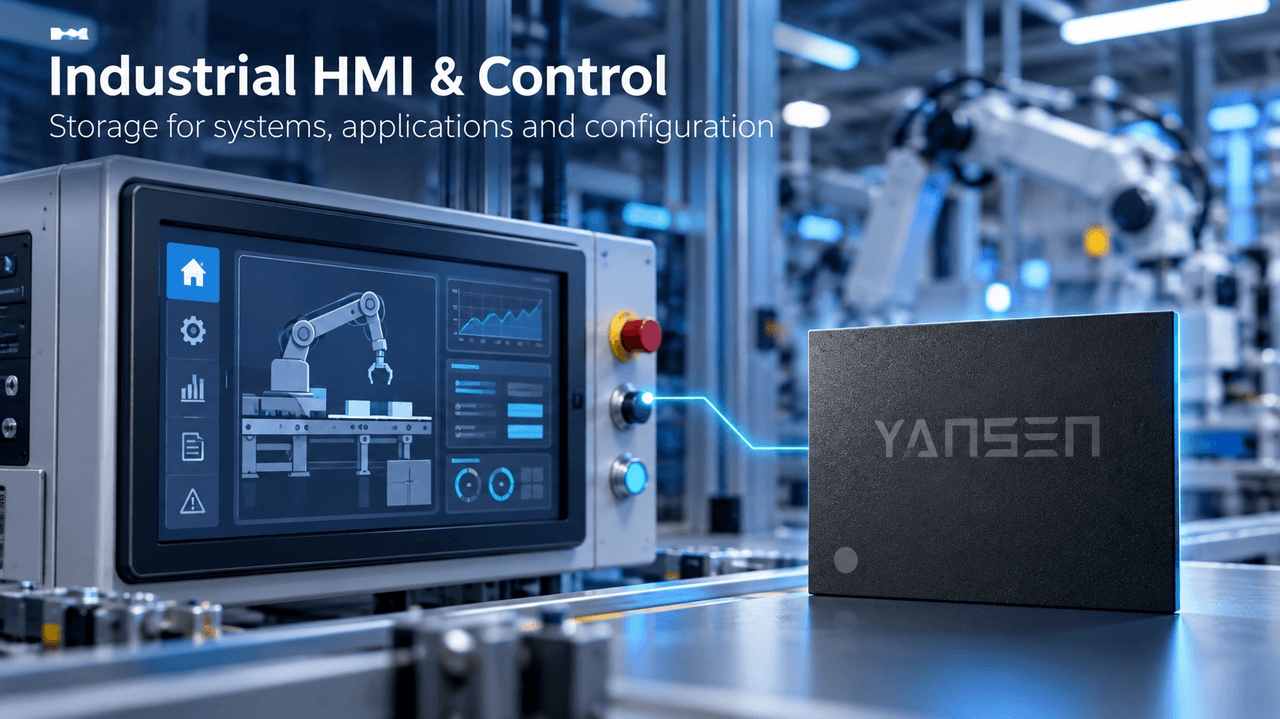
Industrial HMI and Control Terminals

Industrial human-machine interfaces (HMIs) need storage for operating systems, graphical interfaces, control applications, and equipment configuration files. Board-level eMMC integration can help support compact terminal designs without requiring a removable storage device.

For a lightweight terminal with a relatively small system image and basic applications, 8GB may be worth evaluating. Industrial touch panels with more applications, richer interface resources, and larger software packages may need the additional space offered by 64GB.

Selection should account for the operating environment, system footprint, update requirements, and logging workload. The required capacity should leave sufficient room for future software updates rather than only meeting the initial installation requirement.

embedded storage

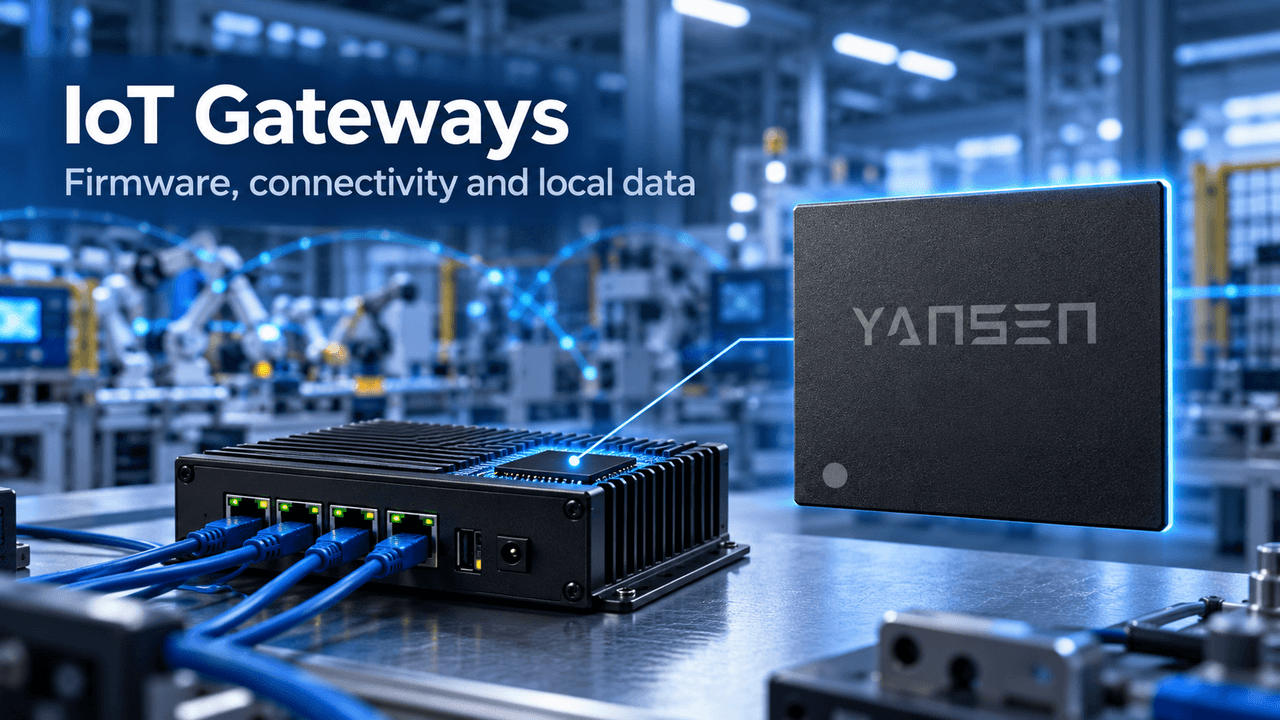
IoT Gateways and Connectivity Devices

IoT gateways commonly store firmware, communication software, network configurations, and operational logs. Some devices also need local data buffering when network connectivity is temporarily unavailable.

For gateways with relatively small system and application footprints, YANSEN’s 8GB eMMC can be considered as a candidate. If the application requires larger offline buffers, more extensive logging, or additional software, capacity and endurance requirements should be reassessed.

Host compatibility and remote firmware update procedures are particularly important. Engineers should verify the supported eMMC interface mode, boot configuration, and recovery process before mass production.

embedded storage

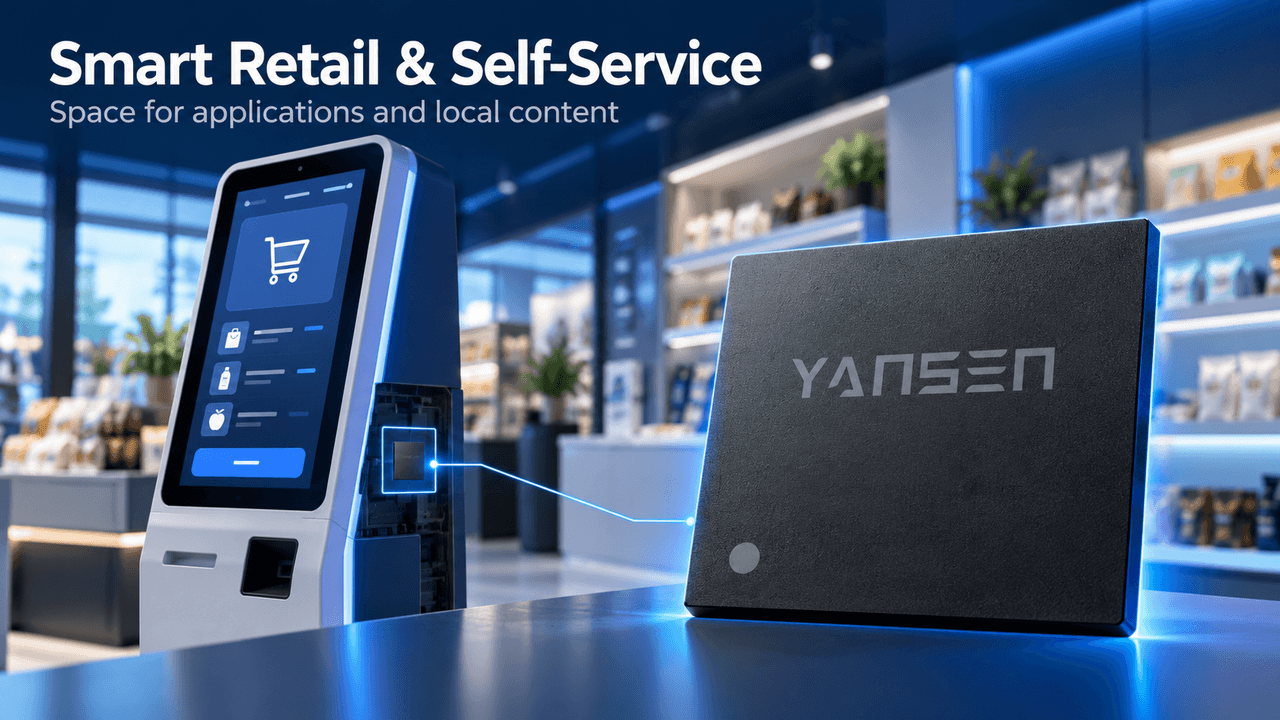
Smart Retail and Self-Service Terminals

POS systems, self-service kiosks, and other smart retail terminals may store business applications, interactive interfaces, local databases, and multimedia resources. Application count, content size, and update frequency all influence storage requirements.

YANSEN’s 64GB eMMC can be evaluated for terminals that need more room for applications and local resources. Projects should also validate data-writing behavior, software update procedures, and recovery after unexpected power interruptions.

Where transaction data is involved, storage selection should be part of a broader security design. Data protection, access control, encryption, and transaction integrity must be addressed at the system level rather than assumed from the eMMC interface alone.

Multimedia and Smart Display Terminals

Digital signage and smart display devices may use eMMC to store the operating system, playback software, images, and offline video content. For applications that mainly read stored content and update it periodically, 64GB may provide useful space for local media resources.

However, storing playback files is different from continuously recording video. A device that repeatedly writes video streams creates a substantially different workload. Capacity alone cannot establish whether an eMMC product is suitable for high-intensity video recording; write endurance and sustained-write behavior must also be evaluated.

4. 8GB vs. 64GB: Which eMMC Capacity Should You Choose?

Capacity selection should begin with the actual storage requirements of the device. The following comparison shows how YANSEN’s upcoming 8GB and 64GB products may fit different embedded applications.

Capacity Potential Applications What to Verify
8GB Lightweight operating systems, basic applications, configuration files, and moderate logs. System image size, update space, and whether log growth remains manageable.
64GB Multiple applications, richer graphical resources, offline media, and larger local data buffers. Usable capacity, update frequency, and actual write workload.

A larger capacity provides more storage space, but it does not automatically mean longer service life or higher reliability. For write-intensive applications, endurance specifications, software write strategies, and actual workload must be evaluated together.

For OEMs developing a new product, it is useful to estimate storage consumption across the complete product lifecycle. Include the initial operating system image, application growth, software updates, temporary files, logs, and any backup partitions before deciding between 8GB and 64GB.

5. When Should You Consider Other Storage Technologies?

eMMC is worth evaluating when the host platform supports it and the device mainly needs to store its operating system, applications, and moderate amounts of data. However, some applications require higher throughput, larger capacity, or sustained heavy writes.

Depending on the platform, engineers may compare eMMC with UFS, SATA SSD, or NVMe SSD. These technologies differ in interface, performance potential, power requirements, physical integration, and cost. Compatibility with the host processor and available board interfaces must be checked before making a decision.

A system may also use more than one storage technology. For example, eMMC can store the operating system and applications, while a separately selected storage device handles continuously generated video data. Separating system storage from business-data storage helps match each device to its actual workload.

YANSEN provides a range of embedded storage solutions for space-constrained devices, alongside industrial SSD options for applications with different capacity and performance requirements. Comparing storage technologies at the system-design stage can help avoid choosing a device that is undersized for its workload or unnecessarily expensive for its actual requirements.

6. From Specification Matching to System Validation

A specification sheet helps identify suitable candidates, but it cannot replace testing in the target device. Before mass production, OEMs and system integrators should validate the following areas.

Confirm Platform and Boot Compatibility

Check the host controller’s supported interface version, bus width, transfer modes, and boot configuration. Verify driver support, partition layout, and system-image compatibility. Startup behavior should also be tested under the expected operating temperature conditions.

Evaluate Capacity and Real Write Workloads

Measure the storage space required by the operating system, applications, update packages, and data. Leave sufficient free space for normal operation and future updates.

Record daily write volume, update frequency, and random-access characteristics. Use workloads that resemble actual device operation to evaluate performance and endurance requirements rather than relying only on short synthetic benchmarks.

Validate Power Supply and Unexpected Power Recovery

Test the device under normal operation, software updates, and unexpected power interruptions. eMMC 5.1 or cache-management functions do not, by themselves, constitute complete hardware power-loss protection. They should not be used as a basis for promising that data will never be lost during an unexpected shutdown.

Power design, file-system behavior, application write strategies, and the specific storage product all contribute to recovery behavior. Where data integrity is critical, the complete system should be tested under realistic power-interruption conditions.

Check Security and Maintenance Requirements

If the device requires protected storage areas, health monitoring, or firmware maintenance, verify the specific product functions and host software support.

For example, RPMB (Replay Protected Memory Block) is designed for specific authenticated and replay-protected storage requirements. It should not be treated as equivalent to full-drive encryption. If whole-device data confidentiality is required, the system needs an appropriate encryption and key-management solution.

For long-term embedded projects, also confirm product availability, change-notification arrangements, technical support, and the supplier’s ability to support the expected product lifecycle.

7. YANSEN eMMC Solutions for Embedded Applications

YANSEN is preparing two eMMC products with 8GB and 64GB capacities for embedded storage applications. Both products support the eMMC 5.1 interface and HS400 transfer mode, use compact BGA packaging, and have an operating temperature range of -25°C to 85°C.

The two capacity options address different system requirements. The 8GB version can be evaluated for lightweight embedded systems with basic applications and limited local data. The 64GB version provides more space for devices that need multiple applications, richer interface resources, or offline content.

Potential applications include industrial HMI panels, IoT gateways, smart retail terminals, and intelligent display systems. Final suitability depends on host-platform compatibility, actual storage consumption, write workload, power design, and system validation.

YANSEN also offers broader industrial and embedded storage solutions for projects with different interface, capacity, and performance requirements. You can explore the company’s application solutions to understand how storage requirements vary across industrial automation, transportation, retail, networking, and other environments.

Planning an embedded storage project? Contact YANSEN with your host controller or board model, required capacity, eMMC interface and transfer-mode requirements, operating temperature, daily write volume, and expected service life. If you are deciding between 8GB and 64GB, sharing your system image size, application footprint, and update strategy will help narrow down the appropriate option.

Frequently Asked Questions About eMMC

Is eMMC suitable for industrial applications?

It can be suitable for industrial devices that need compact onboard storage for operating systems, applications, and moderate data volumes. The product’s operating temperature, endurance, host compatibility, and actual workload should be checked against the requirements of the target equipment.

Does eMMC 5.1 guarantee 400MB/s read and write speed?

No. HS400 has a theoretical interface bandwidth of 400MB/s with an 8-bit bus, but this is not a guaranteed product read or write speed. Actual performance depends on NAND flash, controller design, capacity, access patterns, and test conditions.

Should I choose 8GB or 64GB eMMC?

Choose according to the operating system, application size, update strategy, logs, and local data requirements. 8GB may be suitable for lightweight systems, while 64GB offers more space for multiple applications and offline resources. Neither capacity automatically provides greater endurance or reliability.

Does eMMC protect data during unexpected power loss?

Not automatically. Data currently being written may be affected by an unexpected shutdown, depending on the product and system design. eMMC 5.1 and cache-management functions should not be treated as equivalent to complete hardware power-loss protection. Validate the full device’s power and recovery behavior.

Conclusion

eMMC is a practical embedded storage option for devices that need compact, board-level storage for operating systems, applications, and local data. Its suitability depends on more than capacity or interface version. Engineers and procurement teams should evaluate transfer modes, real-world access patterns, package and power requirements, operating temperature, write endurance, and recovery behavior.

YANSEN’s upcoming 8GB and 64GB eMMC products provide two capacity options for embedded system projects. By matching the storage specification to the host platform and actual workload—and validating the complete device before deployment—OEMs can make more informed storage decisions and reduce integration risks.

For product specifications or project inquiries, visit YANSEN’s official website or contact the team at info@yansen-ssd.com.

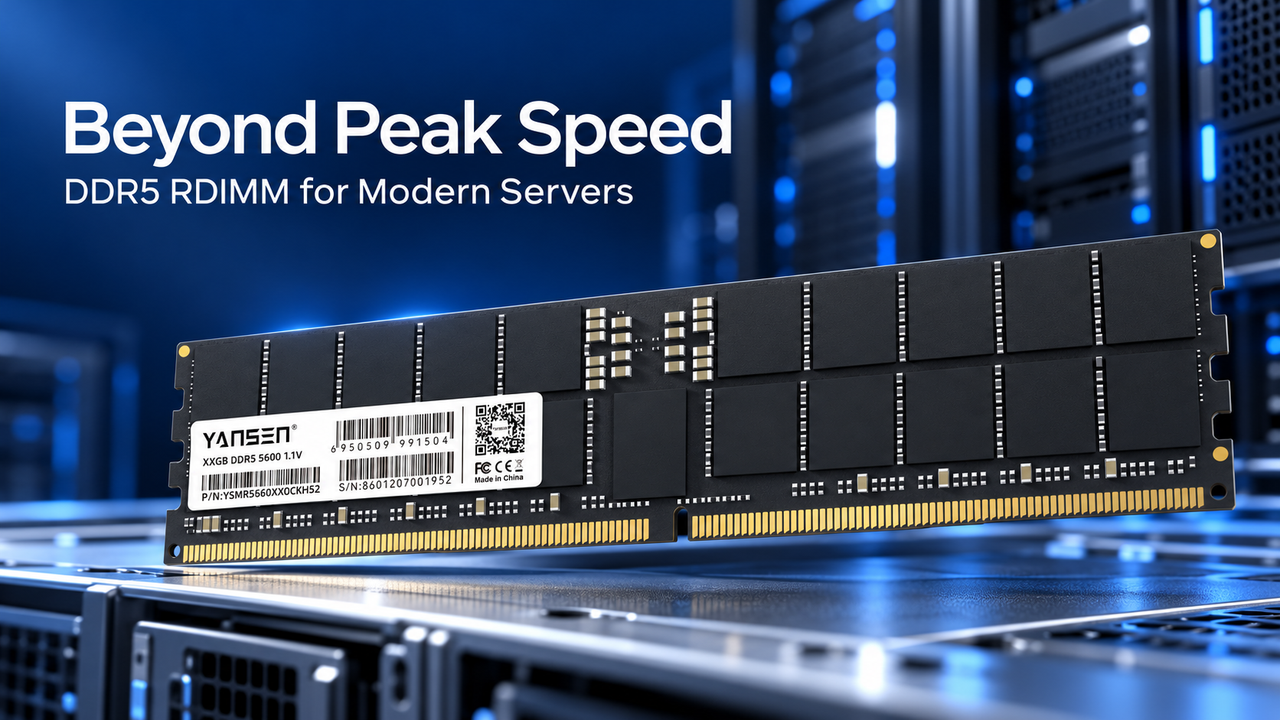
Beyond Peak Speed: Why DDR5 RDIMM Still Matters in Modern Server Infrastructure

ddr5
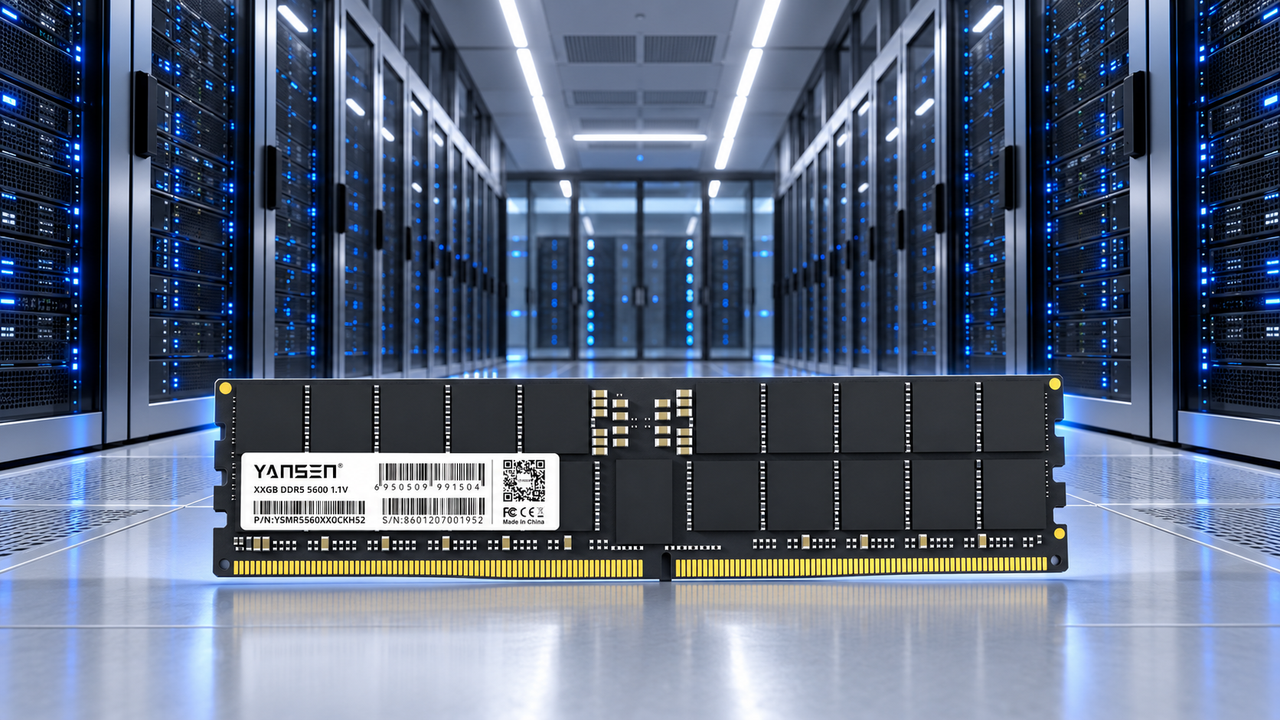
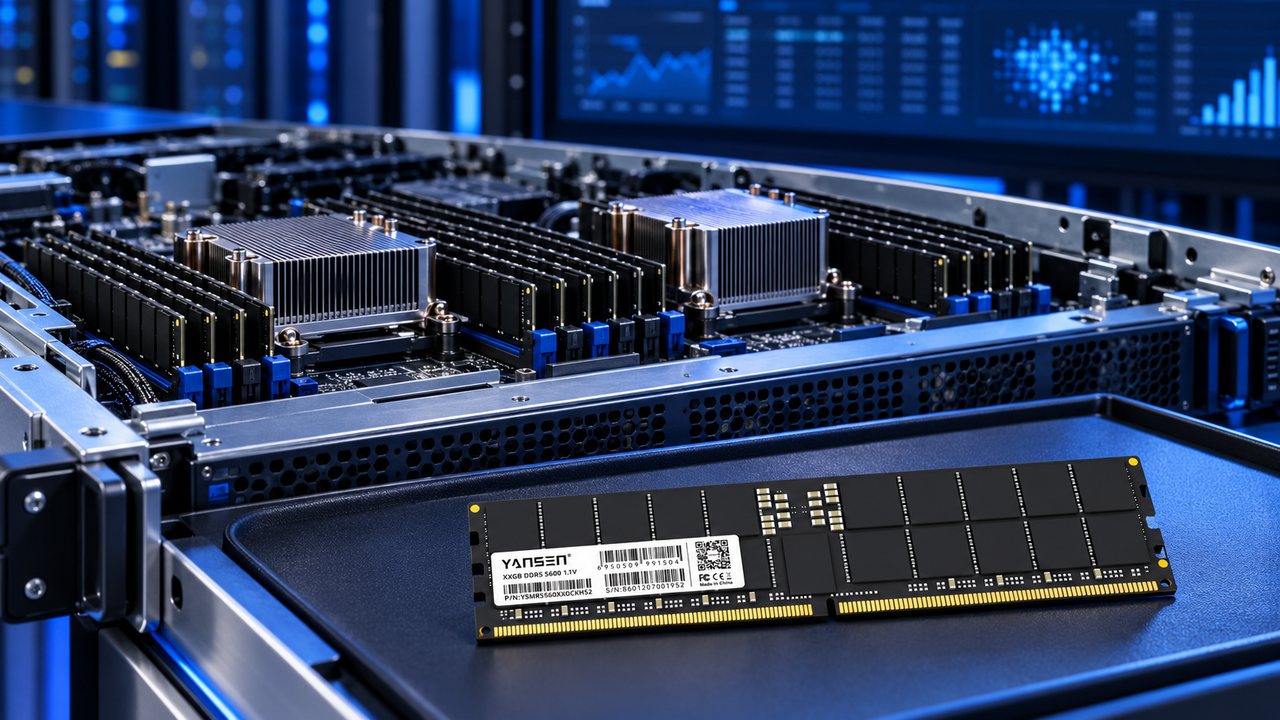
Server memory is becoming a more important part of overall system performance as modern computing platforms continue to evolve. CPUs are adding more cores, AI workloads are becoming more data-intensive, and applications such as high-performance computing, analytics, and large-scale databases increasingly depend on fast access to large amounts of data.
Recent announcements of faster DDR5 RDIMM and MRDIMM interface chipsets show how the industry is responding to rising bandwidth requirements. These developments point to future platform capabilities, but a chipset announcement alone does not establish the availability of qualified memory modules or supported production servers.
However, higher memory speed does not automatically mean a better server. For IT managers, system architects, and procurement teams, the more important question is why memory bandwidth is increasing so rapidly and when a higher-speed memory architecture actually makes sense.
The answer depends on the relationship between processor performance, memory capacity, workload characteristics, platform compatibility, reliability, and total cost. Understanding this relationship is becoming essential when planning the next generation of server infrastructure.
  1. What Next Generation Memory Trends Mean for RDIMM Buyers

Server memory development is increasingly focused on sustaining bandwidth per processor core as CPU core counts and data-intensive workloads grow. Faster interfaces are one part of that effort; capacity, channel utilization and platform qualification remain equally important for deployment.

Faster DDR5 RDIMM Interfaces Indicate the Direction of Development

Rambus announced its DDR5 9600 Server RDIMM chipset in July 2026, built around its sixth-generation registering clock driver, RCD06. The chipset enables RDIMM designs targeting up to 9,600 MT/s. The announcement concerns module interface components for next-generation platforms; it does not mean that every DDR5 server can operate at that data rate.
For buyers, the useful lesson is that the conventional RDIMM architecture continues to evolve. A purchasing decision should still begin with the data rates and module configurations supported by the intended processor and server, followed by workload testing.

MRDIMM-16000 Targets the Next Bandwidth Level

MRDIMM takes a different approach to increasing effective memory bandwidth. By using multiplexing techniques across memory ranks, MRDIMM is designed to deliver significantly higher bandwidth than conventional memory configurations.
Solutions reaching up to 16,000 MT/s are particularly relevant to AI infrastructure, HPC, and other accelerated computing platforms where memory bandwidth can become a limiting factor.
These technologies should not be interpreted as meaning every server will immediately require 16,000 MT/s memory. Instead, they indicate that memory architecture is evolving alongside the growing performance of modern processors.
These industry developments provide context for future bandwidth needs. They are not specifications for the upcoming YANSEN RDIMM products discussed later in this article.
  1. Why Memory Bandwidth Matters for Modern Servers

One of the biggest changes in modern server architecture is the growing gap between computing capability and data delivery.
A faster CPU can execute more operations, but every operation still depends on data being available. If memory cannot supply that data quickly enough, part of the processor’s computing capacity may remain underutilized.
This imbalance is part of the memory-wall problem, which involves both memory latency and bandwidth. Increasing the data transfer rate can improve bandwidth, but it does not automatically reduce every form of memory access latency or eliminate application stalls.
AI makes these distinctions especially important. CPU-based inference, data preprocessing, retrieval services and memory-offload pipelines can place substantial demands on host memory. In GPU-accelerated systems, CPU host memory and GPU-local memory, such as HBM, serve different roles and have different bandwidth limits.
DDR5 RDIMMs improve the host-memory subsystem. They do not directly increase GPU-local memory bandwidth. Their impact on an AI workload depends on where its working data resides and whether host-memory access, computation, storage, networking or CPU–GPU transfers are the limiting factor.
As a result, simply adding more compute resources does not always produce proportional performance gains. The memory subsystem must be capable of feeding those resources efficiently.
  1. Why DDR5 RDIMMs Remain Relevant

Registered Signaling for Supported Server Platforms

A registered DIMM uses a registering clock driver to buffer clock and command/address signals, reducing the electrical load presented to the processor memory controller. Conventional RDIMMs do not buffer the data path in the same way as MRDIMMs. The registered architecture supports server memory configurations when used within the processor and platform population rules.
RDIMM compatibility is specific to the platform. A matching DDR generation or physical connector does not establish compatibility with an unbuffered DIMM system. Buyers must verify the supported module type, capacity, rank organization and operating data rate.

Capacity and Channel Balance for Real Workloads

Registered DIMMs remain a mainstream choice for enterprise servers because they provide a strong balance of memory capacity, stability, performance, and platform compatibility.
They are well suited to many databases, virtualization platforms, enterprise applications, storage servers, and general-purpose data center systems. For these workloads, the additional bandwidth offered by an extreme memory architecture may not justify the added platform requirements or cost.
Capacity determines how much of the working set can stay in RAM. Channel population determines how much of the platform’s aggregate memory bandwidth can be used. More DIMMs per channel or different module organizations can change the supported operating rate, so an expansion plan should follow the server vendor’s guidance.

Reliability Requires More Than a Module Label

Server memory selection should include module-level ECC support, platform error reporting and qualification. DDR5 on-die ECC operates inside individual DRAM devices and is distinct from system-level ECC protection across the memory interface. Buyers should confirm the actual module organization and the processor’s supported error-management features.
RDIMM is a module architecture, not a guarantee of universal compatibility, industrial temperature capability or uninterrupted operation. Claims about validation, environmental limits and service support should be tied to the specific product and platform.

Matching RDIMM Configuration to the Deployment

Deployment priority RDIMM selection focus What to verify
More virtual machines Capacity and balanced channels Supported capacity, DIMMs per channel and population order
Database or analytics growth Working-set capacity and measured bandwidth Application profiling, channel use and platform support
CPU inference or preprocessing Capacity, throughput and access patterns Model footprint, concurrency and host-memory bottlenecks
Long-term project expansion Qualified configurations and service planning Module organization, validation, availability and warranty terms
  1. The Fastest Memory Is Not Always the Right Memory

A high MT/s rating looks attractive on a specification sheet, but server performance cannot be evaluated from memory speed alone.
The first consideration is platform compatibility. The CPU memory controller, motherboard, BIOS, memory channels, and DIMM population all influence the actual operating configuration. A module rated for a particular speed does not guarantee that every server will operate at that speed.
Memory capacity is equally important. If a server does not have enough RAM for its workload, the resulting reliance on slower storage can create a much larger performance penalty than the difference between two memory-speed levels.
Channel configuration also matters. Properly balanced memory population helps the processor make effective use of available bandwidth. Simply installing the fastest modules without considering the platform architecture can lead to disappointing real-world results.
Finally, the workload itself determines whether additional bandwidth is valuable. A highly memory-bandwidth-bound AI or HPC workload may benefit significantly, while a conventional business application may see little improvement.
For this reason, the best memory is not necessarily the one with the highest MT/s rating. It is the one that allows the complete server platform to deliver the required performance reliably and economically.
  1. Different Workloads Need Different RDIMM Strategies

GPU Accelerated AI Servers

In servers with discrete GPUs, RDIMMs provide CPU host memory. They can support input pipelines, CPU-side services and memory-offload tasks. Faster host memory may improve throughput when those functions are limiting performance, but it cannot by itself resolve insufficient GPU-local memory capacity or bandwidth.

AI Inference

For CPU-based inference, model weights, runtime buffers, context length and concurrent requests all influence memory requirements. Some workloads are sensitive to bandwidth, while others depend more strongly on capacity or compute performance.
Data decoding, transformation and preprocessing can also make substantial use of host memory. Higher-bandwidth RDIMM configurations can help when profiling identifies host-memory throughput as a bottleneck, provided the processor and platform support the selected configuration.

HPC

Scientific computing and HPC applications often perform intensive calculations on large datasets. Many of these workloads are sensitive to memory bandwidth because processors can process data faster than conventional memory systems can supply it.
For bandwidth-bound HPC applications, higher-speed memory can therefore have a direct impact on application throughput.
Conventional DDR5 RDIMMs can serve supported HPC platforms, while other architectures may be appropriate when measured bandwidth needs exceed their capabilities. The choice should follow application benchmarks and platform support, rather than the workload category alone.

Databases and Analytics

Large databases often benefit from sufficient memory capacity because frequently accessed data can remain in RAM. Analytics workloads can also involve substantial data movement.
Database performance also depends on CPU performance, storage latency, I/O bandwidth, caching and software architecture. Increasing the memory data rate should therefore be considered as part of a broader system optimization strategy, rather than as a guaranteed database acceleration measure.

Virtualization and Enterprise Servers

Virtualization hosts often prioritize memory capacity because many virtual machines share the same physical server.
For these environments, adding sufficient RAM and maintaining a balanced memory-channel configuration may provide more practical value than choosing the highest available memory speed.
Expansion planning should account for the number of available channels and slots, the validated module capacities and any data-rate changes associated with the target population. A larger memory footprint is useful only when the configuration remains supported and matches the workload.
  1. What Buyers Should Verify Before Selecting DDR5 RDIMMs

For B2B procurement, server memory should be evaluated using a complete system perspective rather than a single specification.
  • Platform compatibility: Verify CPU, motherboard, BIOS, DIMM type, supported data rates, and recommended population rules.
  • Capacity: Determine current requirements and leave sufficient headroom for application growth and future expansion.
  • Bandwidth: Identify whether the workload is genuinely memory-bandwidth bound before paying for higher-speed technology.
  • Reliability: Consider error-management capabilities, module quality, validation, operating stability, and long-term supply consistency.
  • Power and thermal behavior: Higher-performance memory can influence system power consumption and thermal requirements, especially in high-density deployments.
A practical procurement framework is therefore:
Performance × Capacity × Compatibility × Reliability × Total Cost of Ownership
The objective is not to maximize one variable. It is to achieve the best overall configuration for the intended server platform and workload.
  1. YANSEN DDR5 RDIMMs for Upcoming Server Projects

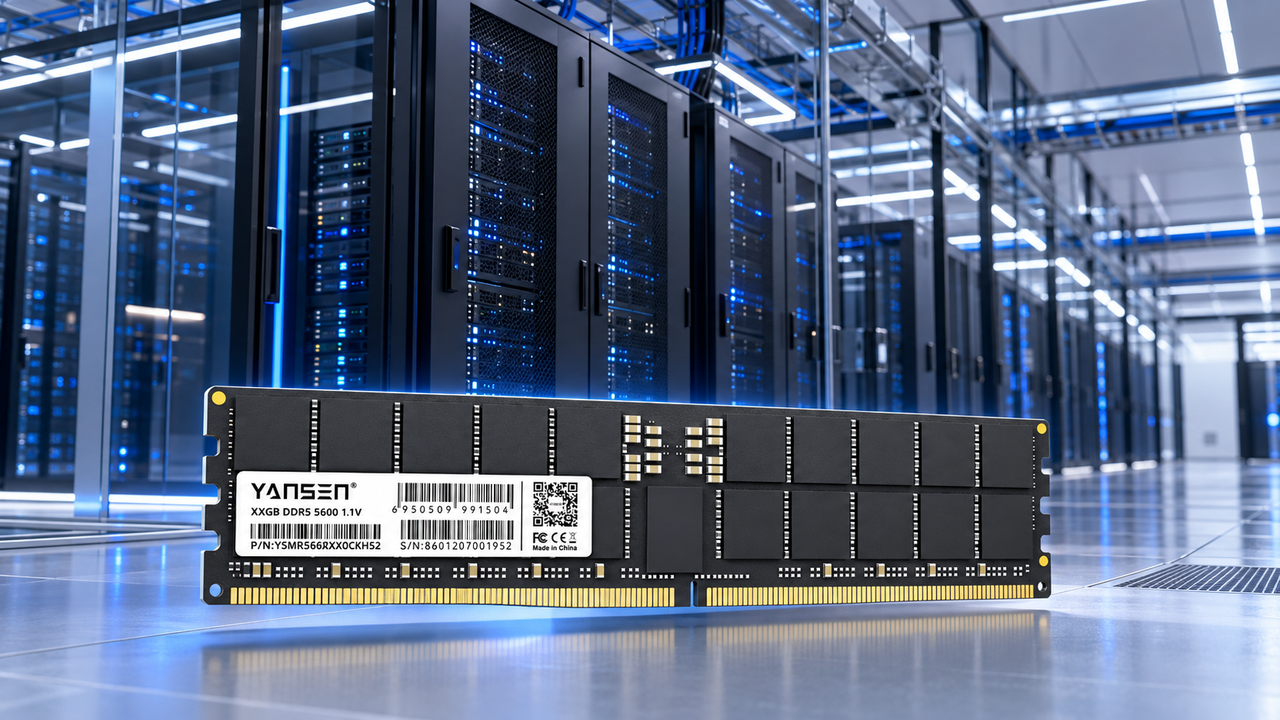
YANSEN is preparing to introduce DDR5 RDIMM products for compatible server platforms. For prospective deployments, selection should begin with the processor and motherboard requirements, followed by capacity planning, supported data rates and DIMM population rules.
Project teams can prepare for evaluation by identifying the server model, processor, BIOS version, existing memory configuration, target capacity and primary workload. These details help define the specifications and qualification checks needed for a suitable RDIMM configuration.
Product-specific capacities, data rates, module organization, operating limits and service terms should be confirmed against the released YANSEN datasheet and applicable qualification information. The industry roadmap figures discussed earlier do not describe the upcoming YANSEN product specifications.
Contact YANSEN to discuss the upcoming DDR5 RDIMM specifications and your server memory requirements.

Conclusion: Matching RDIMM Configuration to System Requirements

Advances in memory interfaces show that bandwidth remains a critical part of server development. For enterprise buyers, the practical task is to select a supported configuration that balances capacity, bandwidth, reliability features, power and cost.
DDR5 RDIMMs remain relevant across virtualization, databases, CPU-based inference, preprocessing and other server workloads. Their value depends on how effectively the selected modules work with the processor, memory channels and application requirements.
A suitable RDIMM configuration starts with platform qualification and workload needs. Peak MT/s is one input to that decision, rather than a substitute for it.
Contact YANSEN to discuss memory and storage solutions for your next server or industrial computing platform.
  1. Frequently Asked Questions About DDR5-9600 and MRDIMM-16000

What is a DDR5 RDIMM?

A DDR5 RDIMM is a registered DDR5 memory module that uses a registering clock driver to buffer clock and command/address signals. It is intended for platforms that explicitly support registered memory and is commonly used in servers.

Which server platforms support DDR5 RDIMMs?

Support depends on the processor memory controller and server design. Check the server specifications, supported module list and memory population guide. DDR5 support alone does not establish RDIMM compatibility.

Can RDIMMs and UDIMMs be mixed?

RDIMMs and UDIMMs should not be mixed in the same memory configuration. They use different signaling architectures, and the platform must explicitly support the installed module type. Physical fit does not establish compatibility.

Will a higher rated RDIMM always run at its advertised data rate?

No. The operating rate depends on the processor, server firmware, module organization and population rules. More DIMMs per channel or a different rank configuration may reduce the supported rate.

How should enterprises balance memory capacity and bandwidth?

First provide enough capacity for the working set and expected growth. Then evaluate channel population and data rate against measured workload needs. Insufficient capacity and insufficient bandwidth create different bottlenecks, so both should be assessed.

Do AI servers need MRDIMMs instead of RDIMMs?

No universal rule applies. Conventional DDR5 RDIMMs can support AI-related workloads on compatible platforms. MRDIMMs require specific platform support and are an option for additional host-memory bandwidth. GPU-local memory and interconnect bottlenecks must be assessed separately.

Is DDR5 on die ECC the same as server ECC?

No. On-die ECC corrects certain errors within an individual DRAM device. Module-level ECC works with the memory controller to provide protection across the memory interface. Confirm the actual module and platform capabilities.

What information is needed to select a YANSEN DDR5 RDIMM?

Prepare the server and CPU models, BIOS version, current memory configuration, target capacity and workload requirements. Confirm the available product specifications, platform validation and service terms with YANSEN before selection.

Industrial SSD Supply in 2026: How NAND Shortages Are Changing Long-Term Storage Procurement

Industrial SSD
For consumer electronics, storage development is often driven by a familiar formula: higher capacity, higher speed, and lower cost per gigabyte. Industrial storage follows a very different logic.
Industrial equipment may remain in production and field service for 5, 7, 10 years, or even longer. During that period, manufacturers need stable components, predictable performance, consistent qualification, and reliable long-term availability. An SSD that performs well today is not necessarily a good industrial storage choice if its underlying NAND or controller becomes unavailable a few years later.
This issue is becoming more important in 2026 as NAND manufacturers increasingly allocate production toward higher-density and higher-value technologies. Mature NAND products, including some SLC and MLC solutions, are becoming more difficult to source. For industrial, automotive, networking, and embedded applications, simply replacing one NAND generation with another is rarely a straightforward purchasing decision.
A component change may require firmware validation, compatibility testing, reliability testing, regulatory qualification, or even system redesign.
For industrial storage buyers, the real cost of NAND shortages is not simply a higher price per gigabyte. It is the operational and engineering cost created when a qualified storage platform can no longer be supplied.

1. What Is Happening to SLC and MLC NAND Supply in 2026?

The NAND market is increasingly moving toward higher-density technologies. As manufacturers shift mature production capacity toward high-layer-count 3D NAND and other higher-density products, the availability of some legacy NAND technologies is becoming tighter.
This creates a particular challenge for industrial storage. Industrial applications have historically used technologies such as SLC, MLC, pSLC, and industrial-grade 3D TLC because different applications require different combinations of endurance, reliability, capacity, and cost.
From a semiconductor manufacturer’s perspective, however, older NAND technologies can become less attractive as the market moves toward products offering higher bit density and stronger demand. Higher-density NAND can provide better wafer economics and access to much larger mainstream markets.
According to TrendForce’s July 2026 analysis, SLC NAND contract prices in the second half of 2026 are expected to increase by approximately 120%–170% compared with the first half of the year. Demand is being supported by industrial systems, automotive electronics, networking equipment, AI edge computing, and enterprise and data center applications.
The situation is particularly significant because TrendForce also reported that major global SLC suppliers do not currently plan significant new capacity expansion. This suggests that the supply challenge is not simply a temporary price fluctuation. For buyers depending on mature NAND, long-term availability itself needs to become part of the procurement discussion.
But the problem extends far beyond semiconductor pricing.

2. Why Low-Capacity Industrial Storage Still Matters

The mainstream storage market continues to move toward higher capacities, but industrial equipment does not always need more storage.
A PLC, RTU, data logger, factory controller, or embedded gateway may operate perfectly well with 4GB, 8GB, 16GB, or 32GB of storage. Increasing capacity to 128GB or more may provide little practical benefit if the application generates only a limited amount of data.
This creates an important contradiction in the storage industry: the semiconductor market is optimized for increasing density, while many industrial systems are optimized for long-term stability.

Industrial Automation

PLCs, HMIs, CNC equipment, and factory controllers may use relatively small storage capacities but remain deployed for many years.

Energy and Infrastructure

RTUs, smart-grid equipment, monitoring systems, and other infrastructure devices can require reliable local storage for logging, configuration, and system operation without needing very high capacity.

Transportation

Onboard computers, ticketing systems, railway control equipment, and related systems often have long qualification cycles and demanding maintenance requirements.

Embedded Systems

Gateways, diagnostic equipment, and data loggers may similarly prioritize reliability and long-term availability over maximum capacity.
For these applications, the key question is not:
“Why isn‘t the customer upgrading from 8GB to 128GB?”
The more important question is:
“Can the same qualified storage architecture still be supplied throughout the lifecycle of the equipment?”
This highlights a fundamental mismatch between the semiconductor lifecycle and the industrial equipment lifecycle.

3. The Hidden Cost of NAND Transitions

A flash component reaching end-of-life can create costs that are much greater than the price of the SSD itself.
The process often looks like this:
Mature NAND capacity declines → existing NAND or controller reaches EOL → supplier changes NAND, controller, or firmware → storage characteristics may change → existing qualification may no longer apply → customer must revalidate the system.
Two industrial SSDs can have the same capacity, interface, form factor, and advertised sequential performance while still behaving differently in a real application.
A change in NAND or controller can affect:
  • Latency
  • Endurance
  • Power consumption
  • Thermal behavior
  • Error characteristics
  • Firmware behavior
  • Host compatibility
  • Boot performance
This is why controlled BOM management is important in industrial storage. NAND, controller, firmware, and DRAM substitutions should not happen without proper evaluation and notification when they could affect the qualified behavior of the product.

Requalification Is the Real Cost

When an SSD component changes, an industrial OEM may need to allocate engineering resources for sample testing, system integration, environmental testing, customer approval, certification, and production validation.
For medical equipment, transportation systems, industrial automation, telecommunications, or other highly qualified applications, replacing an SSD can therefore involve much more than purchasing a different part number.
There may also be costs associated with inventory management, production interruptions, field maintenance, and supporting multiple versions of the same platform.
For industrial OEMs, a cheaper SSD is not necessarily a lower-cost SSD if it forces the platform through another qualification cycle two years later.

4. Consumer Storage Procurement vs. Industrial Storage Procurement

Consumer storage is commonly evaluated through a relatively simple set of parameters: capacity, speed, price, and sometimes warranty. Industrial storage requires a broader procurement framework because the SSD becomes part of a long-lived product platform.
Procurement Factor Consumer Storage Industrial Storage
Primary priority Capacity, speed, price Lifecycle stability and predictable performance
Product lifecycle Relatively short Often 5–10+ years
Component changes Usually acceptable May require requalification
Firmware Performance-oriented Consistency and stability are critical
Endurance General consumer workload Must match the actual industrial write workload
Temperature Controlled environment May require wide-temperature operation
Supply planning Shorter purchasing cycles Long-term availability and EOL planning

4.1 Controlled and Stable BOM

Consistency in NAND, controller, firmware, and other critical components helps ensure that storage supplied several years later continues to behave like the originally qualified product.

4.2 Long-Term Product Availability

Industrial buyers should evaluate the supplier’s lifecycle roadmap, PCN policy, EOL notification process, and last-time-buy procedures before approving a storage platform.

4.3 Stable Firmware

Firmware affects wear leveling, garbage collection, bad-block management, error recovery, and power-loss behavior. Firmware consistency is therefore part of system stability, not simply a software detail.

4.4 Endurance

Industrial systems may continuously write logs, telemetry, sensor information, machine data, or other operational records. SSD selection should therefore consider workload and endurance rather than capacity alone.

4.5 Wide-Temperature Operation

Equipment deployed in factories, transportation systems, outdoor infrastructure, or other uncontrolled environments may require storage designed for extended operating-temperature ranges.

4.6 Power-Loss Protection

Unexpected power interruptions can occur in industrial environments. Where required by the application, appropriate power-loss protection can help reduce the risk of data corruption and incomplete writes.

5. From SLC and MLC to Industrial 3D TLC: Migration Must Be Managed, Not Avoided

The decline in mature NAND availability should not be interpreted as “old NAND is good and new NAND is bad.” Modern 3D TLC can be a practical solution for many industrial applications when it is combined with appropriate SSD architecture, firmware, endurance management, and qualification.
Industrial SSDs can use technologies such as ECC, wear leveling, over-provisioning, thermal management, power-loss protection, and pSLC modes to address application-specific requirements.
The real challenge is managing the transition from one NAND generation to another without compromising the requirements of the industrial system.
The goal should not be:
“Keep SLC or MLC forever.”
Instead, industrial buyers should:
“Plan NAND migration before component availability forces the decision.”
Depending on the application, an SLC or MLC-based platform may eventually transition toward pSLC, industrial 3D TLC, or another controlled NAND architecture. But the decision should consider write workload, data retention, operating temperature, endurance, interface requirements, and qualification requirements.
This approach allows manufacturers to benefit from newer NAND technologies without treating component availability as an emergency.

6. How Industrial Storage Buyers Should Respond to the 2026 NAND Shortage

The current NAND environment makes lifecycle planning more important than simply negotiating the lowest SSD unit price.

Step 1 — Identify Lifecycle-Critical Storage

Not every SSD requires the same level of lifecycle control. Classify storage according to equipment lifecycle, deployment volume, qualification complexity, and replacement difficulty.
A storage device inside a short-lived industrial gateway does not necessarily require the same procurement strategy as one integrated into a railway controller expected to remain in service for ten years.

Step 2 — Confirm the BOM Policy

Before approving an industrial SSD supplier, ask whether the NAND, controller, and firmware are controlled. Also clarify which component changes require PCN notification and how much advance notice is provided before an EOL event.

Step 3 — Understand the NAND Roadmap

If an existing platform depends on legacy SLC or MLC, discuss its expected lifecycle and potential replacement technologies with the supplier before availability becomes critical.
Developing and qualifying a replacement in advance is significantly easier than responding after an EOL announcement.

Step 4 — Match Endurance to the Actual Workload

Evaluate daily writes, expected operating years, workload patterns, operating temperature, and write amplification. Then select the NAND configuration and endurance level appropriate for the application.

Step 5 — Qualify the Next Generation Before EOL

A proactive migration strategy can follow a simple path:
Current qualified SSD → Future replacement identified → Validation completed → Controlled transition
This is far safer than waiting for an EOL notice and then entering emergency sourcing, redesign, and requalification.

Step 6 — Evaluate Total Lifecycle Cost

The final purchasing decision should include more than the SSD quotation. Qualification, engineering time, maintenance, redesign, inventory, production continuity, and supply risk can all affect the actual cost of ownership.
For industrial storage, procurement should account for qualification, maintenance, redesign, and supply continuity—not simply SSD price.

7. What This Means for YANSEN Industrial Storage Solutions

Against this backdrop, industrial storage suppliers need to provide more than capacity and interface compatibility. Storage has to be managed as part of the customer’s product lifecycle.
YANSEN focuses on industrial SSD solutions designed around the requirements of long-term deployments. For industrial OEMs, this means considering not only performance and capacity, but also component consistency, product availability, firmware stability, endurance, and operating conditions.
Depending on the specific product configuration, industrial storage can be selected for requirements such as wide-temperature operation, high endurance, power-loss protection, and other application-specific reliability features.
These capabilities are relevant to applications including industrial automation, smart manufacturing, transportation, networking, embedded systems, edge AI, and other environments where storage may need to remain in service for years.
For an industrial OEM, the objective is not simply to purchase an SSD that meets today’s specification. It is to establish a storage platform that can remain technically suitable and commercially available throughout the expected equipment lifecycle.
YANSEN focuses on industrial storage platforms designed around reliability, lifecycle consistency, and long-term deployment requirements.

8. Conclusion: Storage Procurement Is Becoming a Lifecycle Decision

The 2026 NAND shortage highlights a structural challenge for industrial storage: semiconductor manufacturing economics can change much faster than industrial equipment lifecycles.
As manufacturers shift toward higher-density NAND technologies, mature SLC and MLC products may become more difficult and expensive to source. For industrial OEMs, this makes storage procurement more complicated than comparing capacity, performance, and price.
Long-term storage planning should also consider component lifecycle, BOM stability, NAND roadmaps, qualification requirements, endurance, firmware consistency, and supply continuity.
The objective is not to avoid technological change completely. Industrial systems will eventually need to migrate to newer NAND technologies. The key is to make that migration controlled and predictable rather than allowing component shortages to force an emergency redesign.
As NAND technologies continue to evolve, the strongest industrial storage strategy will not be the one that avoids change completely, but the one that makes change predictable, qualified, and manageable.
For industrial OEMs planning long-lifecycle storage platforms, YANSEN can help evaluate capacity, endurance, operating environment, and lifecycle requirements to identify a storage configuration suited to long-term deployment.

9. Frequently Asked Questions About Industrial SSD Supply

Why are NAND shortages affecting industrial SSD procurement?

NAND manufacturers are increasingly allocating production capacity toward higher-density and higher-value NAND technologies. This can tighten the supply of mature NAND technologies commonly used in long-lifecycle industrial applications, making component availability and long-term supply planning more important for industrial SSD buyers.

Why does NAND or controller replacement require requalification?

An SSD with the same capacity, interface and form factor may not behave exactly the same after a NAND or controller change. Changes can affect endurance, latency, power consumption, thermal behavior, firmware behavior and host compatibility. For industrial equipment, these changes may require additional validation before the replacement SSD can be deployed.

Should industrial applications continue using SLC and MLC NAND?

Not necessarily. SLC and MLC remain relevant for certain industrial workloads, but industrial 3D TLC and pSLC-based solutions can provide alternative options when properly matched with the required endurance, firmware, over-provisioning, temperature range and workload. The key is to manage the technology transition rather than wait until an existing NAND platform reaches end of life.

What should industrial SSD buyers consider besides the SSD price?

Buyers should evaluate the complete lifecycle cost, including BOM stability, long-term availability, EOL and PCN policies, endurance, firmware stability, operating temperature, power-loss behavior, qualification requirements and replacement risk. A lower unit price may not represent a lower total cost if a component change later forces another qualification or system redesign.

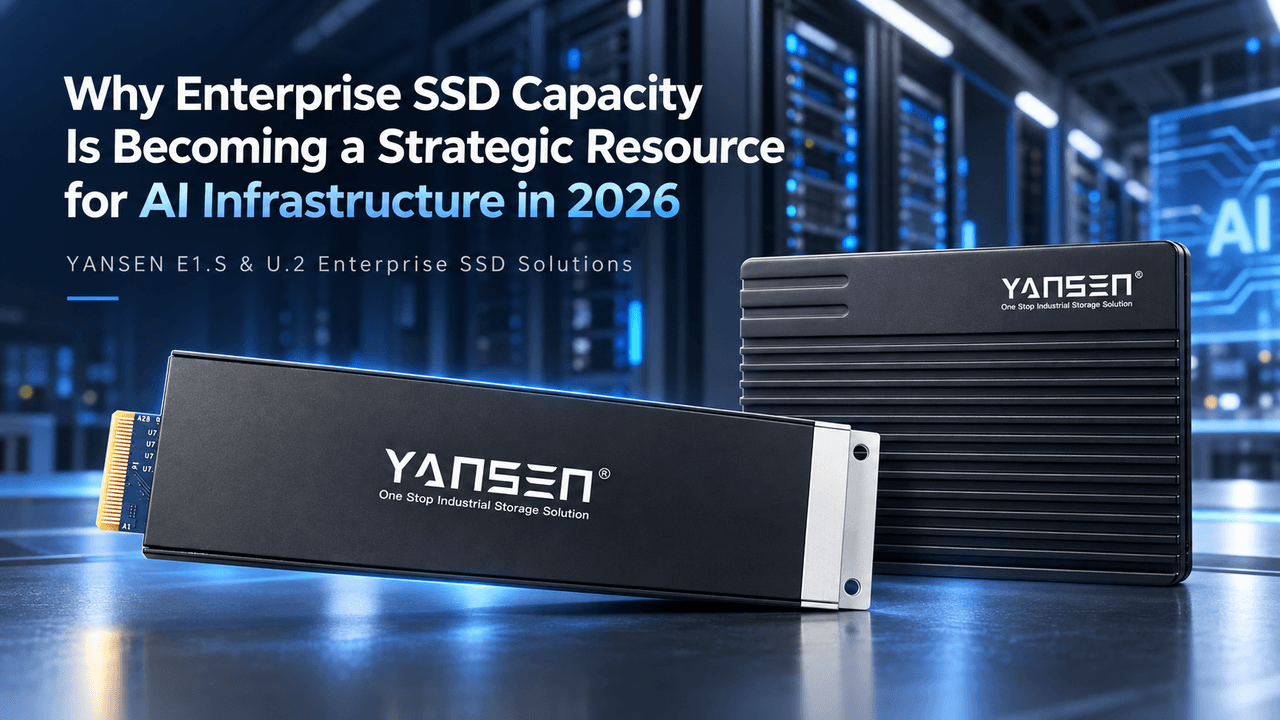
Why Enterprise SSD Capacity Is Becoming a Strategic Resource for AI Infrastructure in 2026

Enterprise SSD
For years, AI infrastructure planning has centered on one scarce resource: GPUs. In 2026, another resource is rapidly entering the capacity-planning equation—enterprise storage.
The shift is already visible in the NAND market. In Q2 2026, enterprise SSDs accounted for 48% of global NAND bit shipments, compared with approximately 26% a year earlier. The growing demand for AI infrastructure, particularly as workloads move from model training toward large-scale inference, is becoming an important driver of enterprise SSD consumption.
At the same time, NAND supply is tightening as AI server demand continues to grow. Cloud infrastructure providers are responding accordingly. CoreWeave, for example, signed a multi-year agreement with Solidigm to secure priority access to enterprise SSD capacity, describing storage as a critical constraint in capacity planning.
These developments point to a broader change in how AI infrastructure should be designed. AI infrastructure is entering an era in which storage capacity must increasingly be planned alongside GPU capacity.
But why is AI inference creating so much demand for enterprise flash? And what should data center operators consider when selecting SSD infrastructure for AI workloads?

From Training-Centric AI to Always-On Inference

The infrastructure requirements of AI are changing because the way AI systems are used is changing.

Training Is Intensive—but Temporary

Traditional AI infrastructure discussions have largely focused on model training. Training clusters require enormous computational resources and fast access to datasets, checkpoints, HBM, networking infrastructure and storage. A large training run may continue for weeks or even months, creating extremely demanding but relatively concentrated infrastructure requirements.
The central objective is often straightforward: feed the GPUs fast enough to keep expensive compute resources busy.
Storage certainly matters during training, particularly for datasets, checkpoints and intermediate data, but the GPU cluster remains the primary focus of capacity planning.

Inference Changes the Operating Model

Once an AI model moves into production, the infrastructure faces a fundamentally different workload. Instead of running a limited number of training jobs, it may need to support:
  • Continuous user requests
  • Thousands or millions of concurrent sessions
  • Longer context windows
  • Multi-turn conversations
  • Retrieval-augmented generation (RAG)
  • AI agents
  • Multimodal workloads
The system therefore needs to serve AI continuously at production scale.
This changes the storage equation. Training is primarily concerned with feeding GPUs efficiently. Inference increasingly requires the infrastructure to keep the right data close enough to the compute layer, for enough users, at an acceptable cost.
That is where memory hierarchy, context data and KV cache become increasingly important.

Why AI Inference Is Increasing Demand for Enterprise SSDs

Modern inference workloads are becoming more data-intensive. Long-context LLMs, enterprise copilots, AI agents, multimodal models and persistent conversations all require systems to maintain and access more information during inference.

KV Cache Is Changing the AI Memory Hierarchy

When an LLM processes a prompt, it generates a Key-Value (KV) cache that stores information from previously processed tokens. This allows subsequent token generation to reuse previously calculated context rather than repeatedly performing the same computation.
As three variables increase, the KV cache footprint can also grow:
More users → More concurrent inference sessions → Larger KV caches → Greater memory pressure → Greater need for additional storage tiers
This does not mean SSDs are replacing HBM or DRAM. Instead, the different memory technologies are increasingly serving different roles within a broader AI memory hierarchy:
  • GPU HBM: Highest-performance active data
  • System DRAM: Working memory and intermediate data
  • Enterprise NVMe SSD: Larger context data, active datasets and additional KV-cache tiers
  • Capacity storage: Models, datasets and longer-term data
This architecture is already becoming visible in new AI infrastructure designs. NVIDIA has introduced CMX Context Memory Storage for long-context and agentic AI inference, positioning shared storage as an additional context tier beyond GPU memory.
The implication is important: storage is becoming part of the inference memory architecture—not simply a place where data is saved after computation.

HBM Cannot Economically Hold Everything

HBM provides extremely high bandwidth, but using the highest-performance memory tier for every model, dataset and context workload would be inefficient from a system-cost and capacity perspective.
Enterprise NVMe SSDs provide a much larger capacity tier while still offering substantially lower latency than conventional storage architectures. As AI systems handle larger context windows and more concurrent sessions, SSD capacity can therefore become an important part of the overall memory and data-access strategy.

Why AI Storage Is No Longer Just About SSD Speed

Traditional SSD specifications tend to emphasize sequential read/write speeds, random IOPS and latency. These metrics remain important, but they do not fully describe what AI infrastructure operators need.
AI storage planning is becoming a multidimensional problem.

Capacity

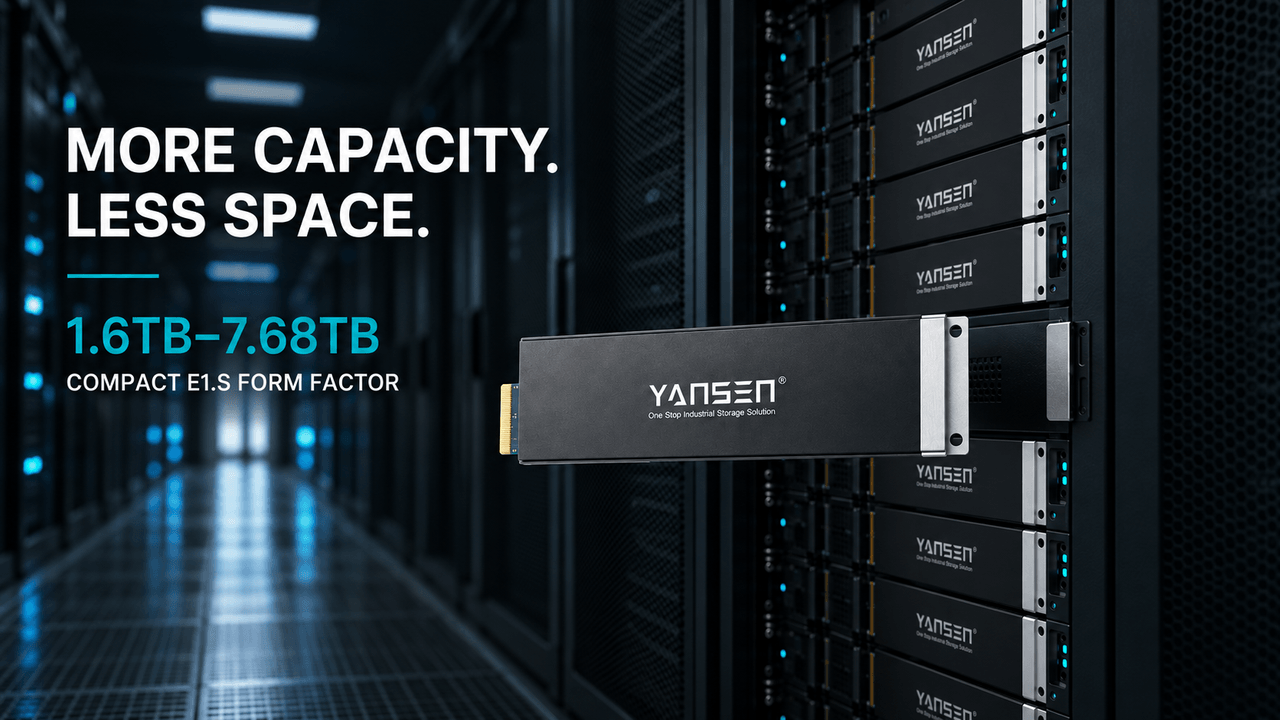
AI infrastructure needs to accommodate models, embeddings, datasets, checkpoints, inference data and cached context. The relevant question is increasingly not simply how fast one SSD can operate, but how much usable flash capacity can be deployed per drive and per server.

Density

Data center space, server chassis and rack capacity are all limited. Higher-capacity drives can reduce the physical footprint required for a given amount of flash storage, making capacity per rack and capacity per server important infrastructure metrics.

Sustained Performance

Peak benchmark numbers can be useful for comparison, but AI infrastructure operates continuously. Operators should also evaluate how an enterprise NVMe SSD performs under sustained workloads rather than focusing exclusively on short benchmark bursts.

Endurance

AI environments may generate repeated writes through cache updates, metadata operations, data movement and high-concurrency services. DWPD and TBW should therefore be evaluated against the actual workload rather than treated as isolated specification numbers.
Higher endurance is not automatically better if the workload does not require it. The objective is to match SSD endurance to the expected write profile and deployment lifetime.

Power and Thermal Efficiency

AI data centers already operate under significant rack-level power constraints because GPUs and networking equipment consume substantial energy. Storage must fit within the available power envelope.
At the same time, increasing storage density can create additional thermal challenges:
More drives → More heat → Greater cooling requirements
For this reason, performance per watt, capacity per watt and thermal behavior under sustained workloads are becoming increasingly relevant alongside raw performance.
AI storage planning is becoming a multidimensional optimization problem involving capacity, performance, endurance, power, thermal management and physical density.

The NAND Market Is Already Reflecting the AI Storage Shift

The growing importance of enterprise storage is not simply a theoretical infrastructure trend. It is already affecting the NAND market.

Enterprise SSDs Are Consuming a Growing Share of NAND

48%
That is the share of global NAND bit shipments represented by enterprise SSDs in Q2 2026, according to the market data referenced in this analysis. A year earlier, the figure was approximately 26%.
In other words, nearly one out of every two NAND bits shipped globally in Q2 2026 went into enterprise SSDs.
Counterpoint Research also expects server enterprise SSD demand to remain a major source of NAND consumption, with server eSSD demand potentially absorbing more than half of NAND bits by the end of 2026.

Supply Is Tightening

AI server demand is occurring while NAND manufacturers face constraints on how quickly supply can expand. TrendForce has identified AI server eSSD demand as a contributor to NAND supply shortages and expects AI server demand for enterprise SSDs to remain strong in Q3 2026.
The situation is further complicated by semiconductor manufacturers allocating investment toward other high-value memory opportunities, including DRAM and HBM. NAND capacity therefore cannot simply expand without considering broader semiconductor economics.

AI Cloud Providers Are Securing Supply Directly

The procurement behavior of major infrastructure operators is also changing. CoreWeave’s multi-year agreement with Solidigm is significant not merely because of the SSD supplier involved, but because of what the agreement represents.
Enterprise storage capacity can increasingly become something infrastructure operators secure through long-term strategic agreements rather than treating SSDs as ordinary server components purchased only when individual systems are built.
The enterprise SSD is evolving from a server component into an infrastructure planning resource.

Why Storage Capacity Must Scale Alongside GPU Capacity

Traditional AI infrastructure expansion can be simplified as:
More AI demand → Add GPUs → Add networking → Add compute nodes
Inference infrastructure introduces another layer:
More AI users → More inference instances → More concurrent context → Larger KV-cache footprint → More active datasets → More storage bandwidth → More SSD capacity
This is why adding GPUs without scaling the surrounding data infrastructure can simply move the bottleneck elsewhere.
If GPU capacity grows significantly faster than storage infrastructure, several problems can emerge. GPUs may spend more time waiting for data, the storage layer may become a bottleneck, systems may need to recompute context more frequently, and overall infrastructure utilization can decline. Ultimately, these inefficiencies can affect the economics of serving AI tokens.
Storage should therefore be included in Day-0 AI infrastructure planning, rather than treated purely as a Day-2 capacity expansion problem.
For data center operators, this means estimating not only how many GPUs will be deployed, but also how much enterprise flash capacity will be required as user concurrency, model count, context length and inference traffic increase.

Six Enterprise SSD Requirements for AI Infrastructure

As enterprise SSDs become a strategic part of AI infrastructure, procurement decisions should move beyond sequential speed and unit price.
  1. High Capacity

AI datasets and context workloads continue to grow. Higher-capacity enterprise SSDs can reduce the number of drives required for a given storage target.
Evaluate both capacity per drive and capacity per server, because the latter determines how efficiently the storage layer fits into the overall infrastructure.
  1. High Storage Density

Data centers have finite rack space and power budgets. High-density storage allows operators to deploy more terabytes within a limited server chassis or rack footprint.
This is one reason modern enterprise form factors such as E1.S are gaining attention in high-density server architectures.
  1. Consistent NVMe Performance

Do not select an enterprise NVMe SSD solely because its maximum benchmark number is higher.
For AI infrastructure, sustained performance under real-world enterprise workloads can be more meaningful than short-duration peak results. Thermal behavior, workload consistency and latency stability should also be considered.
  1. Endurance

Inference environments can involve repeated writes, cache updates, metadata operations and high concurrency. SSD endurance should therefore be evaluated against the expected workload profile.
Consider daily writes, workload patterns, deployment duration and write amplification when determining the appropriate DWPD or TBW requirement.
Endurance should be matched to the actual workload profile.
  1. Power Efficiency

Storage has to operate within the data center’s rack-level power budget. When comparing high-capacity drives, consider not only performance but also the amount of usable storage capacity delivered for the available power envelope.
Capacity per watt can become an important metric as AI storage density increases.
  1. Thermal Management and Reliability

High-density AI servers require careful consideration of airflow, SSD temperature, thermal throttling and sustained workloads. A drive that delivers impressive peak performance but frequently throttles under continuous operation may not provide the expected system-level performance.
Reliability should therefore be evaluated together with thermal design and the intended operating environment.

Choosing the Right Enterprise SSD Form Factor

Capacity and performance are only part of the storage architecture. The physical form factor also affects server density, thermal management, serviceability and deployment flexibility.

E1.S: Designed for High-Density Modern Servers

E1.S is part of the EDSFF family developed for modern data center architectures. Its compact enterprise form factor, NVMe architecture and hot-service-oriented design make it well suited to high-density server environments.
For AI infrastructure, the key advantages to evaluate include:
  • High storage density
  • Efficient use of server space
  • Modern NVMe architecture
  • Thermal management options
  • Serviceability
  • Compatibility with modern server platforms

YANSEN E1.S Enterprise SSD

YANSEN’s E1.S enterprise SSD platform is positioned for modern high-density storage applications where capacity, reliability and deployment flexibility are important considerations.
Depending on the specific configuration, buyers should verify the final product specifications for:
  • Capacity: Verified YANSEN configuration
  • Interface: PCIe / NVMe
  • Sequential performance: Verified product specification
  • Random performance: Verified product specification
  • Endurance: Verified product specification
  • Power and thermal characteristics: Verified product specification
Potential applications include AI inference infrastructure, cloud servers, high-density servers, data centers and HPC systems.

U.2: A Proven Enterprise Form Factor

U.2 remains an established choice for enterprise storage. Its familiar 2.5-inch deployment format, PCIe NVMe interface and compatibility with existing server architectures make it practical for organizations that want to integrate enterprise SSDs into proven infrastructure.
U.2 can be appropriate for enterprise servers, AI storage nodes, database infrastructure, cloud platforms and data centers where existing server compatibility is an important consideration.
The decision should not be framed as E1.S versus U.2. The appropriate form factor depends on server architecture, density requirements, thermal design and existing infrastructure.

YANSEN U.2 Enterprise SSD

YANSEN’s U.2 enterprise SSD solutions are designed for enterprise storage environments where PCIe NVMe performance, capacity and deployment compatibility are required.
For infrastructure planners, the key consideration is not simply which form factor is newer, but which one provides the best balance of capacity, density, thermal behavior and compatibility for the target server platform.

AI Is Changing How Data Centers Buy Storage

Enterprise storage procurement traditionally revolved around three basic questions:
Capacity + Performance + Price
AI infrastructure requires a broader procurement framework that also considers:
  • Supply availability
  • Long-term capacity planning
  • Qualification cycles
  • Consistent product availability
  • Firmware stability
  • Lifecycle management
  • Technical support
  • Customization requirements
  • Supply-chain resilience
The multi-year SSD supply agreement signed by CoreWeave illustrates why storage availability itself can become a strategic consideration. For AI infrastructure operators, securing predictable access to enterprise storage may become almost as important as selecting the drive itself.
YANSEN focuses on industrial and enterprise storage solutions designed for customers that require stable performance, deployment flexibility and long-term storage availability. Depending on project requirements, the product portfolio can be evaluated around enterprise SSD configurations, form factors, endurance, qualification and application-specific requirements.
For AI infrastructure projects, this approach is particularly relevant when storage must be integrated into a broader server platform rather than purchased as an isolated component.

The Next AI Infrastructure Bottleneck May Not Be the GPU

The most important change in 2026 is not that SSDs are replacing GPUs. It is that AI infrastructure is becoming a system-level problem.
The AI stack increasingly depends on the coordinated scaling of:
GPU → Memory → Networking → Storage → Software
As inference workloads expand, storage capacity must grow alongside compute capacity. Longer contexts, higher concurrency, larger datasets and increasingly sophisticated AI applications are turning enterprise flash into an active part of the infrastructure rather than a passive storage layer.
As inference workloads scale, the question for data center operators is no longer simply how many GPUs they can deploy. It is whether the entire data infrastructure—including enterprise flash—can scale with them.
YANSEN enterprise NVMe SSD solutions, including E1.S and U.2 form factors, are designed to support the capacity, performance and reliability requirements of modern enterprise and AI infrastructure.
Talk to YANSEN about enterprise storage solutions for your next AI infrastructure deployment.

YANSEN Freight Truck MDVR Customer Case

industrial ssd

CASE OVERVIEW

Customer Confidential
Customer Profile A globally leading MDVR and vehicle telematics solution provider
Industry Intelligent Transportation / Commercial Vehicles
Application Freight Truck Video Surveillance & Fleet Management
Storage Solution YANSEN Industrial microSD Card
Model / Capacity YSDT1A3KT512INNNN / 512GB
Primary Workload Multi-channel continuous video recording

Project Background

A globally leading provider of Mobile Digital Video Recorder (MDVR) and vehicle telematics solutions was developing an intelligent in-vehicle terminal for commercial freight truck applications.

The platform integrates multiple functions within a single system, including video acquisition, real-time encoding, local recording, vehicle positioning, wireless communication and remote fleet management.

In a typical deployment, multiple cameras installed around the truck continuously capture video while the vehicle is operating. The MDVR processes these video streams and stores the footage locally before selected data is transmitted to a remote fleet management platform.

For this type of application, local storage is not simply a place to save files. It is a critical part of the vehicle’s video recording infrastructure.

The customer therefore required a compact storage solution capable of supporting long recording cycles, multi-channel video workloads and the demanding operating environment of commercial freight trucks. YANSEN provided a 512GB industrial microSD card, model YSDT1A3KT512INNNN, specifically matched to these requirements.

The Challenge: Storage That Operates as Long as the Truck Does

Freight truck MDVR systems operate very differently from consumer cameras or portable electronics. A commercial truck may remain on the road for many hours at a time, during which the onboard monitoring system continuously records video.

The storage device therefore experiences repeated and sustained write activity throughout the vehicle’s operating cycle. At the same time, it must operate inside a compact vehicle terminal exposed to temperature changes, vibration and long service hours.

For the customer, the challenge was not simply finding a memory card with sufficient capacity. The storage solution had to meet several requirements simultaneously:

  • Support continuous multi-channel video recording
  • Provide sufficient local recording capacity
  • Maintain stable write performance over long recording periods
  • Deliver adequate NAND endurance for repeated recording
  • Operate under changing vehicle temperatures
  • Fit within the compact architecture of the MDVR
  • Support deployment across commercial fleets in different operating environments

This combination of requirements made an industrial-grade storage solution necessary.

Challenge 1: Multi-Channel Full HD Video Creates a Continuous Write Workload

The MDVR platform is designed to support multiple onboard cameras and can handle several video streams simultaneously. In freight truck applications, cameras may monitor the road ahead, the rear of the vehicle, side areas, cargo surroundings or the driver environment.

Once the vehicle begins operating, these video streams may be recorded continuously for hours. This creates a very different storage workload from typical consumer use. A consumer memory card may experience short periods of recording followed by significant idle time. In an MDVR system, the storage pattern is much closer to continuous, repeated writing.

The storage device therefore needs to maintain stable write behavior over extended periods rather than simply deliver high peak benchmark performance. For the selected 512GB industrial microSD card, sequential performance reaches up to 170MB/s read and up to 150MB/s write. The card also delivers up to 2,500 IOPS random read and up to 1,600 IOPS random write.

For this project, however, the most important factor was not maximum speed alone. It was the ability to support stable, sustained recording over long operating cycles.

industrial ssd

Continuous multi-channel recording: stable local storage for long-haul truck surveillance.

Challenge 2: 512GB Capacity in a Compact Embedded Format

Commercial vehicle monitoring systems need to retain sufficient video footage locally. Recording duration can be affected by several factors, including the number of cameras, video resolution, compression settings and the customer’s data retention strategy.

Increasing local storage capacity allows more video data to remain available within the vehicle before it is overwritten, transferred or archived. However, MDVR equipment is highly space constrained, and a larger storage device can increase mechanical complexity and occupy valuable internal space.

The selected YANSEN industrial microSD solution provides 512GB of storage capacity in an extremely compact form factor. This combination allows the MDVR manufacturer to increase local recording capacity without significantly changing the internal architecture of the terminal.

industrial ssd

High-capacity compact storage: 512GB industrial microSD for embedded MDVR systems.

Challenge 3: Repeated Recording Requires Higher NAND Endurance

Continuous video recording also creates another challenge: NAND wear. Every recording cycle writes new data to the flash memory. Over the lifetime of a commercial vehicle monitoring system, this process is repeated again and again.

For large fleet deployments, storage endurance becomes an important consideration because the memory card may need to support continuous or near-continuous recording throughout long service cycles.

The YANSEN industrial microSD card used in this project adopts 3D TLC NAND and provides 3,000 P/E cycles. This endurance profile is designed to support repeated recording workloads more effectively than storage selected purely for occasional consumer use.

The combination of high capacity and NAND endurance is particularly important in MDVR applications. A storage device needs not only to hold large volumes of footage, but also to withstand the repeated write cycles created as old footage is overwritten by new recordings.

Challenge 4: Freight Trucks Operate Across Changing Temperature Conditions

Temperature is another major consideration in vehicle applications. Commercial freight trucks may travel across different regions and climates during a single route.

  • Cold morning starts
  • Significant seasonal temperature changes
  • Extended operation during hot weather
  • Heat accumulation inside the equipment enclosure
  • Long operating periods without climate-controlled conditions

For this project, the customer required storage capable of operating reliably at temperatures down to at least -20°C. This requirement reflects the realities of commercial fleet operation, where trucks may need to start and record video even in cold outdoor environments.

YANSEN’s industrial-grade microSD solution provides the environmental capability required to satisfy this operating condition, giving the MDVR platform additional margin for deployment across varied vehicle environments. For global fleet applications, this environmental adaptability is especially important.

industrial ssd

Vehicle environment adaptability: reliable storage for long-haul fleet operation in demanding climates.

YANSEN Industrial microSD Solution

To address these requirements, YANSEN supplied the YSDT1A3KT512INNNN 512GB industrial microSD card. Rather than focusing on one specification, the solution was selected because it balanced the key requirements of the complete vehicle application: performance, capacity, endurance, environmental adaptability and compact integration.

Specification YANSEN YSDT1A3KT512INNNN
Capacity 512GB
NAND Flash 3D TLC
Controller SA3309
Sequential Read Up to 170MB/s
Sequential Write Up to 150MB/s
Random Read Up to 2,500 IOPS
Random Write Up to 1,600 IOPS
Speed Class U3 / A1
Interface UHS-II
P/E Cycles 3,000
Environmental Requirement Meets customer’s requirement for operation down to at least -20°C

How Storage Fits into the MDVR System

Within the freight truck monitoring platform, the industrial microSD card serves as the local recording layer between video acquisition and remote fleet management. The data flow can be simplified as:

Vehicle Cameras MDVR Video Acquisition & Encoding YANSEN Industrial microSD Cellular / Network Fleet Management Platform

The locally stored video can then support remote video review, event playback, vehicle incident investigation, route and fleet monitoring, driver behavior analysis and operational record keeping.

In this architecture, storage is closely connected to the availability of recorded vehicle data. A failure at the storage layer could affect the ability to retrieve footage generated during vehicle operation. That is why storage selection must be considered as part of the complete MDVR system design.

Why Industrial microSD Instead of General Consumer Storage?

Industrial and consumer storage products may share the same physical form factor, but their target workloads can be very different. Typical consumer microSD applications include smartphones, cameras and occasional video recording under relatively controlled environmental conditions.

A freight truck MDVR presents a more demanding workload: multiple cameras, long recording hours, repeated write cycles, temperature changes, vehicle vibration and long service life.

Industrial storage is not simply about higher speed. It is about matching the storage device to the actual workload and operating environment.

For vehicle surveillance, this means balancing sustained recording performance, capacity, NAND endurance and environmental adaptability.

From a Single Vehicle to Global Fleet Deployment

Storage requirements become even more important when a system moves from a single vehicle to large-scale fleet deployment. A single microSD card may appear to be only a small component inside an MDVR, but when the same platform is deployed across hundreds or thousands of commercial vehicles in different markets, consistency becomes critical.

The storage device must perform reliably not only in one truck, but across different vehicle models, route conditions, climates, operating schedules and fleet configurations. For a globally deployed MDVR platform, storage therefore becomes part of the overall system reliability strategy.

YANSEN’s industrial microSD solution helps provide the customer with a consistent storage platform for commercial vehicle applications across varied operating environments.

Application Value

By integrating the YANSEN 512GB industrial microSD card, the customer gained a storage solution designed around the realities of commercial vehicle video recording.

High-Capacity Local Recording
512GB supports extended video retention within a compact form factor.
Stable Recording Performance
Up to 150MB/s sequential write performance supports continuous video workloads.
Endurance for Repeated Recording
3D TLC NAND and 3,000 P/E cycles address repeated write requirements.
Environmental Adaptability
Meets the customer’s requirement for reliable operation down to at least -20°C.

Industrial Storage for Intelligent Transportation

As commercial vehicles become increasingly connected, onboard storage must handle more than simple video files. Modern MDVR and telematics systems continuously generate video, location information, event records and operational data.

Selecting the right storage solution therefore requires an understanding of both the workload and the environment in which the device operates. YANSEN provides industrial storage solutions for intelligent transportation applications including freight trucks, public transportation, school buses, taxis and ride-hailing vehicles, construction vehicles, special-purpose vehicles, fleet telematics terminals and in-vehicle video surveillance systems.

From compact industrial microSD cards to SSD solutions for higher-capacity vehicle computing systems, YANSEN supports storage configurations designed around different recording workloads and operating environments.

Looking for reliable storage for your MDVR or vehicle telematics system?
Talk to YANSEN about your recording workload, capacity requirements and operating environment.

Industrial mSATA SSD for Continuous Waveform Recording in Power Quality Measurement Equipment

Region: Southern Africa Industry: Power & Energy / Electrical Measurement Application: Multifunction Waveform-Synchronised Power Quality Analyzer, Recorder and Measurement Device Storage Solution: YANSEN Industrial mSATA SSD Capacity: 512GB NAND Flash: 3D TLC Operating Temperature: -40°C to 85°C

Project Background

A professional electrical measurement equipment manufacturer in Southern Africa was developing a new multifunction, waveform-synchronised power quality analyzer, recorder and measurement device.
The system is designed to acquire, process and record electrical measurement data and waveform information over extended operating periods.
For this type of equipment, storage is not simply used for operating system files or occasional data transfer. It becomes part of the continuous data acquisition chain.
The customer therefore required a compact embedded SSD that could combine continuous recording capability, high endurance, wide-temperature operation, low power consumption and strong resistance to environmental stress.
This created a significantly more demanding storage requirement than a conventional PC or general-purpose embedded application.

Project Challenge: Reliable Storage Under Continuous Measurement Workloads

Power quality monitoring systems may continuously generate waveform records, measurement data and event information.
Unlike consumer workloads, where storage activity often occurs in short bursts, professional measurement equipment may perform sustained data acquisition for long operating periods.
The main challenge was therefore not simply achieving a high peak transfer speed.
The SSD had to deliver a balanced combination of:
  • Stable continuous read and write performance
  • High write endurance
  • Wide-temperature operation
  • Resistance to shock and vibration
  • Low power consumption
  • Compact embedded integration
  • Storage health monitoring
  • Reliable long-term operation
Each of these requirements directly affects the reliability of the complete measurement system.

Challenge 1: Continuous Waveform Recording Requires Stable Storage Performance

Waveform-synchronised measurement can generate a continuous stream of data.
During long-duration monitoring, the storage subsystem needs to receive and retain measurement information consistently without becoming a weak point in the acquisition process.
For this application, YANSEN supplied a 512GB industrial mSATA SSD delivering sequential read speeds of up to 510MB/s and sequential write speeds of up to 460MB/s.
Its 4K random performance reaches up to 70,000 IOPS read and 81,000 IOPS write, providing responsive access to both sequential recording workloads and smaller data operations generated by the system.
However, performance alone was not the primary design consideration.
For professional measurement equipment, predictable and dependable operation over extended periods is more important than pursuing benchmark numbers that exceed the actual requirements of the application.

Challenge 2: High Write Endurance for Long-Term Data Recording

Continuous measurement means continuous data generation.
Over the operating life of the equipment, this can create a substantial cumulative write workload on the SSD.
To address this requirement, the selected industrial mSATA SSD provides an endurance rating of up to 500TBW.
This gives the system a storage platform better suited to repeated data recording than solutions designed mainly around lighter consumer workloads.
For power quality analyzers, recorders and other data acquisition systems, endurance is a particularly important design consideration because the storage device may be required to write data day after day throughout the equipment lifecycle.

Challenge 3: Operating Reliably from -40°C to 85°C

Professional electrical measurement equipment may be deployed in locations where ambient temperatures cannot be controlled as precisely as in an office or data center.
Depending on the installation environment, equipment may experience cold starts, elevated enclosure temperatures or significant temperature variations during operation.
For this reason, the project required a storage solution capable of operating across an industrial temperature range.
The YANSEN mSATA SSD supports operation from -40°C to 85°C, enabling it to function in a much broader range of environmental conditions than typical commercial-temperature storage products.
This wide-temperature capability was one of the key reasons the industrial SSD was suitable for the project.

Challenge 4: Mechanical Reliability in Industrial Environments

Temperature was not the only environmental consideration.
Equipment installed in industrial, energy or field environments may also be exposed to mechanical shock or continuous vibration during transportation, installation or operation.
The selected mSATA SSD is designed to withstand:
  • Shock: up to 1500G / 0.5ms
  • Vibration: 80Hz to 2000Hz / 20G
  • Humidity: 5% to 95% RH, non-condensing
These characteristics provide additional protection for the storage subsystem when used in environments that are more demanding than conventional desktop computing conditions.
Because the mSATA SSD contains no moving mechanical components, it is also well suited to embedded equipment where resistance to vibration is an important consideration.

Challenge 5: Compact Integration Without Sacrificing Capacity

The measurement device also imposed mechanical constraints.
The storage solution needed to fit into an embedded system without taking up the space required by a conventional 2.5-inch drive.
The mSATA form factor provides a compact PCB-level storage solution while retaining the mature SATA interface.
With 512GB of capacity, the SSD gives the system sufficient local storage for waveform data, event records, measurement results and other device-generated information while maintaining a compact physical footprint.
For embedded equipment manufacturers, this balance between capacity and form factor can simplify system design and help reduce internal space requirements.

Challenge 6: Low Power Consumption for Embedded Equipment

Power efficiency is another important consideration in professional embedded systems.
Storage is only one component within the complete device, which may also contain processors, data acquisition modules, communication interfaces and measurement circuitry.
The YANSEN industrial mSATA SSD has a maximum power consumption of approximately 1.66W, helping limit the power and thermal contribution of the storage subsystem.
Lower storage power consumption can be particularly valuable in compact enclosures where thermal design margins are limited.

Technical Requirements and YANSEN Solution

Project Requirement
YANSEN mSATA Specification
Application Value
Embedded Storage
mSATA
Compact integration into measurement equipment
Capacity
512GB
Local storage for waveform and measurement data
NAND Flash
3D TLC
Balances capacity, performance and endurance
Sequential Read
Up to 510MB/s
Supports efficient data access
Sequential Write
Up to 460MB/s
Supports continuous data recording
4K Random Read
Up to 70K IOPS
Responsive access to small data blocks
4K Random Write
Up to 81K IOPS
Supports mixed recording workloads
Endurance
Up to 500TBW
Designed for repeated write-intensive operation
Operating Temperature
-40°C to 85°C
Supports demanding industrial environments
MTBF
2,000,000 Hours
Supports long-term system reliability requirements
Max. Power Consumption
1.66W
Reduces power and thermal load
Shock Resistance
1500G / 0.5ms
Supports operation in mechanically demanding environments
Vibration Resistance
80Hz–2000Hz / 20G
Improves suitability for industrial equipment
Humidity
5%–95% RH, Non-Condensing
Supports a wider range of deployment environments
Health Monitoring
Enables SSD health and status monitoring
Data Security
One-Key Data Destruction
Provides an additional option for sensitive data management

Additional Requirement: Storage Health and Data Security

Reliability in professional equipment also depends on the ability to monitor storage condition over time.
The SSD supports S.M.A.R.T. health monitoring, allowing the host system to access storage health information and support preventive maintenance strategies.
This can be valuable for measurement equipment expected to remain in service for extended periods.
The solution also supports a one-key data destruction function, providing an additional data management option for applications where locally recorded measurement information may need to be securely removed.
For professional monitoring and measurement systems, these functions extend the role of the SSD beyond basic storage capacity.

Why an Industrial SSD Was Necessary

For this project, using a consumer SSD would have addressed only part of the requirement.
The actual challenge was to satisfy multiple engineering constraints at the same time:
continuous recording + 500TBW endurance + -40°C to 85°C operation + shock and vibration resistance + low power consumption + compact mSATA integration + health monitoring.
This combination is what made industrial storage necessary.
The SSD was not selected simply because it could deliver 510MB/s read speeds. It was selected because its performance, endurance, environmental specifications and embedded form factor aligned with the operating requirements of the complete measurement platform.

Application Value

By integrating a YANSEN 512GB industrial mSATA SSD, the customer was able to deploy a storage solution designed around the requirements of continuous waveform recording and professional electrical measurement.
The solution combines:
512GB capacity for local data retention, 500TBW endurance for repeated recording workloads, -40°C to 85°C wide-temperature operation for environmental adaptability, and industrial shock and vibration resistance for demanding deployment conditions.
Together, these specifications make the SSD suitable for power quality analyzers, electrical recorders, data acquisition systems and other professional monitoring equipment where storage reliability is an essential part of overall system design.

Industrial Storage Built Around the Application

Industrial storage selection should begin with the workload and operating environment—not simply interface speed or capacity.
From temperature range and endurance to form factor, performance and data management features, storage configurations can be selected according to the technical requirements of the equipment.
Building equipment for a demanding industrial environment? Talk to YANSEN about the storage requirements behind your application.

From the Robot Arena to the Real World: Why Industrial Storage Matters for Humanoid Robots

Industrial Storage
The second World Humanoid Robot Games held in Beijing in August 2026 offered a glimpse of this transition. Beyond athletic competitions, robots were increasingly tested in scenarios closer to real industrial and commercial environments.
From logistics and manufacturing to inspection, hospitality, emergency response, and autonomous navigation, robots are being asked to operate in environments that demand more than mechanical movement.
As robots become more intelligent, they also need to process and store increasing amounts of data. Cameras generate images and video, sensors continuously collect environmental information, AI models need to be loaded and accessed, and operating systems must record logs and diagnostic data. This creates a storage requirement that is easy to overlook when most attention is focused on processors, GPUs, and AI algorithms.
For robots operating in real-world environments, storage is no longer simply a place to keep files. It is part of the computing infrastructure that helps the system access data quickly, operate reliably, and maintain performance over its service life.

Modern Robots Are Becoming Mobile Edge AI Systems

A modern humanoid robot is much more than a mechanical platform. It can be viewed as a mobile edge AI system that continuously senses its environment, processes information, makes decisions, and performs physical actions.
A simplified data path may look like this:
Camera / LiDAR / Sensors → CPU / GPU / AI Accelerator → Memory → Local SSD
During operation, the robot may need to handle computer vision data, navigation maps, AI models, sensor information, system logs, diagnostic records, and task history. These workloads are different from those of a conventional office computer because data is generated and consumed continuously while the machine is performing physical tasks.
The storage system may therefore be responsible for loading AI models, accessing local datasets, saving sensor information, recording system events, and supporting application software at the same time.
This makes storage performance and reliability important parts of the overall robotics architecture. A processor or AI accelerator can only work efficiently when the required data can be delivered to it in a timely and consistent manner.

Why Storage Performance Matters for Real-Time Robotics

In robotics applications, high SSD performance is not simply about making a specification sheet look impressive. The practical objective is to reduce storage-side bottlenecks when the system needs to access large amounts of local data.
For example, a robot may need to load AI models during startup, access navigation maps while moving, read image or video data during inspection, and continuously write system and sensor logs. When several of these workloads occur simultaneously, storage latency and throughput can affect how efficiently the computing platform handles data.
This is where high-speed NVMe storage becomes useful. YANSEN M.2 PCIe 4.0 SSDs use a PCIe Gen4 x4 interface and NVMe protocol to provide high-speed local data access. Selected TLC configurations offer sequential read speeds of up to 7,400 MB/s and sequential write speeds of up to 6,500 MB/s, with 4K random read and write performance of up to 650K and 670K IOPS respectively.
These figures should not be interpreted as a guarantee that a robot itself will operate at a corresponding speed. The actual system performance also depends on the processor, AI accelerator, software, memory, thermal design, and application workload.
The more relevant benefit is that high-performance storage can help edge systems access models, datasets, maps, and other local information efficiently when multiple workloads are running simultaneously.

Industrial Robots Need More Than High Speed

Performance is only one part of the storage equation. A robot working in a factory, warehouse, transportation system, or outdoor environment can face conditions that are very different from those of a desktop PC or a controlled data center.
Industrial and mobile robotic systems may experience temperature changes, mechanical shock, vibration, continuous operation, and frequent read/write activity. If the storage device is not suitable for the deployment environment, a high-speed interface alone cannot guarantee reliable operation.
This is why engineers evaluating storage for robotics should consider environmental specifications alongside performance.
Storage Requirement Why It Matters in Robotics
Wide-temperature operation Supports deployment in changing or demanding environmental conditions
Shock resistance Helps the storage device withstand mechanical impact and movement
Vibration resistance Important for mobile robots and industrial equipment with continuous mechanical movement
Thermal monitoring Helps monitor SSD temperature under demanding workloads
Data management functions Wear leveling and bad block management support long-term storage reliability
Selected YANSEN PCIe 4.0 SSD configurations support an operating temperature range of -40°C to +85°C, with up to 1,500G shock resistance, 20G vibration resistance, and an MTBF of up to 2 million hours. Features such as thermal sensors, S.M.A.R.T., wear leveling, and bad block management further support reliable operation in demanding applications.
For robotics, storage reliability is not only about protecting data. It can also affect overall system availability. When a robot is deployed as part of a production line or other critical process, unexpected storage problems can result in downtime, maintenance work, or interrupted operations.

Continuous Robot Operation Makes Endurance a Key Consideration

Robots can generate data throughout their entire operating lifecycle. Depending on the application, this may include sensor logs, camera data, navigation history, error records, system status information, and application-generated data.
For an industrial robot operating for many hours every day, the accumulated write workload can be substantially higher than that of a typical office computer. As a result, SSD selection should consider not only capacity and speed, but also write endurance.
Two commonly used indicators are TBW and DWPD. TBW, or Terabytes Written, describes the total amount of data an SSD is rated to write over its specified lifetime. DWPD, or Drive Writes Per Day, describes how many times the drive’s full capacity can theoretically be written each day over a defined warranty period.
YANSEN offers different NAND configurations for different workload requirements. Selected TLC models provide capacities from 256GB to 4TB and up to 4,000TBW. eTLC configurations are available from 400GB to 3.84TB, with options supporting 1 DWPD or 3 DWPD.
The appropriate endurance level should be selected according to the robot’s actual write workload, operating pattern, capacity requirement, and expected service life rather than simply choosing the highest available specification.
Different NAND configurations allow system designers to balance performance, capacity, endurance, and project cost according to the requirements of the specific robotics application.

Why M.2 2280 Fits Compact Edge Robotics

Robotic systems face another constraint that is sometimes overlooked: physical space. A robot’s internal electronics must accommodate processors, AI accelerators, memory, communication modules, power components, cooling systems, and other control hardware. PCB space and thermal headroom are therefore often limited.
This makes a compact storage form factor valuable. YANSEN M.2 PCIe 4.0 SSDs use the M.2 2280 form factor, measuring approximately 80 × 22 mm, while providing PCIe Gen4 NVMe connectivity.
The combination of a compact footprint and high-speed interface makes M.2 storage suitable for space-constrained edge computing platforms, including robotics controllers, industrial PCs, machine vision systems, and AI-enabled equipment.
However, form factor selection should always be based on the host platform. Engineers should verify mechanical dimensions, interface compatibility, power requirements, thermal conditions, and available PCIe lanes before selecting an SSD.

Choosing an SSD for Robotics: What Should Engineers Consider?

There is no single SSD specification that is ideal for every robot. A warehouse robot, industrial vision system, autonomous machine, and humanoid robot may have very different storage workloads.
For procurement teams and system integrators, the following factors provide a practical starting point:
Selection Factor What to Consider
Interface PCIe generation, available lanes, and NVMe compatibility
Capacity AI models, operating system, local datasets, logs, and application data
NAND type TLC or higher-endurance options according to workload requirements
Endurance TBW or DWPD based on expected daily write volume and service life
Temperature Required operating temperature range for the deployment environment
Shock and vibration Important for mobile robots and industrial machinery
Reliability MTBF, S.M.A.R.T., wear leveling, bad block management, and other features
Form factor M.2 2280 or another form factor required by the host platform
Lifecycle support Long-term availability, firmware support, and supplier stability
One common mistake is choosing an SSD primarily by its maximum sequential read speed. Sequential performance is important for some workloads, but robotics systems can also involve random access, sustained writes, thermal constraints, and continuous operation.
A more practical evaluation should consider the complete combination of performance, endurance, environmental reliability, capacity, compatibility, and lifecycle support.

From Competition Robots to Commercial Robots

Robot competitions are useful demonstrations of what robotic systems can achieve, but commercial deployment introduces a different set of requirements.
In a competition or laboratory environment, one fundamental question is:
Can the robot perform the task?
In commercial and industrial environments, the question becomes more demanding:
Can the robot perform the task reliably every day?
This difference changes how engineers evaluate the entire system. Intelligence and computing performance remain essential, but reliability, maintainability, operating environment, and service lifecycle become equally important.
The same principle applies to storage. Instead of looking only at capacity, system designers increasingly need to evaluate performance, endurance, environmental reliability, and long-term availability together.
For a robot deployed on a production line or in an industrial facility, storage should be treated as part of the system architecture rather than as an interchangeable commodity component.

YANSEN Industrial SSD for Robotics and Edge AI

For robotics and edge AI applications, storage requirements vary according to workload intensity, operating environment, capacity, and expected deployment lifecycle. A storage supplier therefore needs to provide more than a standard consumer SSD specification.
YANSEN provides industrial and enterprise storage solutions for industrial computing, embedded systems, edge AI, and other demanding applications. Its M.2 PCIe 4.0 2280 SSD family combines PCIe Gen4 NVMe performance with different NAND configurations, capacities, and endurance options.
For robotics applications, available configurations can help system integrators address different priorities. TLC models provide a balance between performance, capacity, endurance, and cost, while eTLC options can be considered for applications with more demanding write workloads.
Selected configurations also support wide-temperature operation, shock and vibration resistance, and storage management features designed for long-term operation.
More importantly, storage selection can be matched to the actual application. A robotics system integrator may need to evaluate AI model size, sensor data volume, daily write workload, operating temperature, mechanical conditions, required service life, and available storage space before finalizing the SSD configuration.
YANSEN’s role is not simply to provide a storage device, but to help customers select a suitable storage configuration according to performance, endurance, environmental, and lifecycle requirements.

Conclusion: The Next Challenge for Robots Is Reliable Real-World Operation

The first challenge for humanoid robots was learning how to move. The next challenge is learning how to work reliably in the real world.
As robots move into factories, warehouses, commercial facilities, transportation systems, and other edge AI environments, their success will depend on more than mechanical design and AI algorithms. Computing, memory, networking, and storage must work together to support continuous data processing.
For this reason, industrial SSDs are becoming an important component of modern robotics infrastructure. High-speed NVMe connectivity can support demanding local data workloads, while appropriate endurance, environmental protection, and long-term reliability help prepare robots for sustained operation.
Explore YANSEN industrial SSD solutions for robotics, edge computing, industrial PCs, and intelligent systems.

From IoT to Edge AI: Why Enterprise Storage Is the Foundation of Intelligent Infrastructure

Enterprise Storage
Over the past decade, the Internet of Things (IoT) has fundamentally changed how devices communicate, collect information, and interact with the physical world. From smart factories and autonomous machines to intelligent robots, smart transportation systems, and connected cities, more devices are becoming equipped with sensors, cameras, AI capabilities, and real-time communication technologies.
However, as IoT continues to expand, the value of connected devices is no longer determined only by connectivity. The real challenge is how quickly, securely, and reliably the massive amount of generated data can be processed.
Modern IoT devices continuously produce different types of data, including machine operation records, sensor information, video streams, and AI inference data. Traditional cloud-based architectures are increasingly facing limitations when applications require immediate responses and continuous data processing.
This is why Edge Computing is becoming a critical part of next-generation intelligent infrastructure. By moving computing and storage closer to where data is generated, edge systems can reduce latency, improve efficiency, and support real-time decision-making.

The Shift from Cloud Computing to Edge Intelligence

Traditional IoT architectures usually follow a centralized model:
  • Device collects data
  • Network transfers information
  • Cloud processes and analyzes data
  • Applications receive results
This architecture works well for many traditional applications. However, as IoT evolves toward AI-driven systems, the limitations of cloud-only processing are becoming more obvious.
  1. Low Latency Requirements for Real-Time Applications

Many modern intelligent applications require immediate responses. Industrial robots, autonomous systems, and automated production lines cannot always wait for data to travel between devices and distant cloud servers.
For example, an industrial vision system inspecting products on a manufacturing line may need to identify defects and make decisions within milliseconds. Any delay in data transmission can affect production efficiency and system accuracy.
Edge Computing solves this challenge by processing critical data closer to the source, enabling:
  • Faster response times
  • Reduced network delays
  • Real-time decision-making
  1. Increasing Bandwidth Pressure from Massive Data Generation

The growth of cameras, sensors, and AI-enabled devices has created unprecedented data volumes. A single industrial camera system can generate large amounts of image and video data every day, while smart machines continuously produce operational information.
Sending all of this data to the cloud is not always practical. It increases network costs, consumes bandwidth resources, and may reduce system efficiency.
Edge computing allows organizations to process and filter data locally, transmitting only valuable information to centralized systems. This approach improves both performance and infrastructure efficiency.
  1. Data Security and Local Processing Requirements

For many industries, data security has become a major concern. Manufacturing data, medical information, transportation records, and enterprise operational data often contain sensitive information that cannot always be transferred to external cloud environments.
By storing and processing data locally, edge computing provides organizations with greater control over their information while maintaining fast access for intelligent applications.

Why Storage Becomes Critical in Edge Computing

While computing power and network connectivity remain important components of edge infrastructure, storage has become another key factor affecting system performance.
An edge AI system must not only calculate results but also continuously manage:
  • Large volumes of sensor data
  • AI model files
  • Historical operation records
  • Video and image datasets
  • System logs
Without reliable and high-performance storage, even powerful processors may not achieve their full potential.

Edge AI Requires More Than Computing Power

In the early stages of AI development, most attention was focused on computing performance. Companies invested heavily in CPUs, GPUs, AI accelerators, and network infrastructure to improve model training and inference capabilities.
However, as AI applications move from centralized data centers into real-world environments, another challenge is becoming increasingly important: how efficiently data can be stored, accessed, and processed.
For Edge AI systems, storage is no longer just a place to keep files. It has become an active component that connects data collection, AI processing, and intelligent decision-making.

The Role of Storage in the Edge AI Workflow

A typical Edge AI workflow includes several key stages:
  • Data Collection
  • Local Storage
  • AI Inference
  • Real-Time Decision Making
Each stage creates specific storage requirements. Unlike traditional IoT devices that mainly record simple sensor information, modern AI-enabled systems must handle much larger and more complex datasets.
  1. High-Speed Data Writing for Real-Time Data Collection

The first challenge for Edge AI storage is handling continuous data generation.
Smart factories, autonomous machines, and intelligent robots may collect data from multiple sources, including:
  • High-resolution images
  • Video streams
  • Sensor information
  • Machine operation records
  • Environmental monitoring data
These data streams often require fast and stable writing performance. If storage cannot process incoming data efficiently, important information may be delayed, lost, or require additional buffering resources.
For industrial AI applications, storage performance directly affects the reliability of the entire system.
  1. Fast Data Access for AI Model Inference

After data collection, Edge AI systems need to load AI models and process information locally. Unlike traditional applications, AI workloads frequently access large model files and related datasets.
The storage system needs to provide:
  • Fast model loading
  • Low access latency
  • Stable random read performance
  • Reliable operation under continuous workloads
For example, an industrial vision inspection system may need to quickly load a trained AI model and analyze images from production equipment in real time. Slow storage can increase inference latency and reduce overall system efficiency.
  1. Long-Term Reliability for Continuous Edge Operation

Many Edge AI devices are deployed in locations where maintenance is difficult, including:
  • Factory production lines
  • Transportation infrastructure
  • Outdoor monitoring systems
  • Remote industrial environments
Unlike consumer devices that may operate only several hours per day, industrial edge systems often need to run continuously for years.
Therefore, storage solutions used in these environments must focus on more than peak performance. They need:
  • High endurance
  • Stable long-term performance
  • Data protection capability
  • Resistance to demanding operating conditions
This is why enterprise and industrial SSDs are becoming increasingly important in Edge AI infrastructure.

Why E1.S SSD Is Becoming a Future Storage Choice for Edge Infrastructure

As AI computing moves closer to the edge, storage architectures also need to evolve. Traditional storage solutions may face challenges related to performance, thermal management, and deployment density in modern intelligent systems.
The E1.S SSD form factor, developed as part of the Enterprise and Data Center Standard Form Factor (EDSFF) family, was designed specifically for next-generation computing environments.
Compared with traditional 2.5-inch enterprise SSDs, E1.S provides a more flexible design approach for high-density servers, AI infrastructure, and edge computing platforms.

YANSEN E1.S SSD: Designed for the Future of Edge Infrastructure

YANSEN E1.S Enterprise SSD is designed to support demanding AI, edge computing, and intelligent infrastructure applications where performance, reliability, and long-term stability are equally important.
By combining NVMe performance with enterprise-grade reliability, YANSEN E1.S SSD helps organizations build storage systems capable of supporting next-generation intelligent workloads.
  1. High-Speed NVMe Performance for Real-Time AI Applications

AI and IoT applications depend on rapid data movement. Whether processing machine vision data, loading AI models, or analyzing sensor information, storage latency can directly influence system responsiveness.
YANSEN E1.S SSD adopts an enterprise NVMe architecture to provide:
  • High data throughput
  • Low access latency
  • Efficient data processing
  • Stable performance under demanding workloads
This makes it suitable for applications such as:
  • AI inference servers
  • Smart robotics
  • Industrial edge gateways
  • Intelligent manufacturing systems
By reducing storage bottlenecks, high-performance NVMe SSDs allow edge systems to process more data with faster response times.
  1. Enterprise Reliability for 24/7 Edge Operation

Performance is only one part of the equation for Edge AI storage. In many real-world deployments, reliability is even more critical because edge devices are often installed in environments where maintenance opportunities are limited.
A failure in an industrial AI system, smart transportation platform, or remote monitoring device can lead to production interruptions, data loss, and increased maintenance costs. Therefore, storage devices used in these applications must be designed for continuous operation.
Compared with consumer SSDs, enterprise and industrial SSDs are optimized for demanding workloads through technologies and design considerations such as:
  • High endurance NAND flash selection
  • Advanced error correction mechanisms
  • Firmware optimization for stable operation
  • Long-term data integrity management
YANSEN E1.S SSD is designed to support mission-critical environments that require reliable storage performance over extended periods. It helps reduce the risks associated with unexpected downtime and provides a stable storage foundation for intelligent systems.
For applications such as industrial automation, AI servers, and edge computing nodes, the goal is not only achieving maximum benchmark performance, but maintaining predictable performance throughout the entire product lifecycle.
  1. Compact E1.S Form Factor for High-Density Computing Environments

As AI infrastructure continues to evolve, computing systems are becoming smaller, denser, and more specialized. Traditional storage designs may face limitations when more processing power and storage capacity need to be integrated into limited physical space.
The E1.S form factor was developed to address these challenges by providing a storage solution optimized for modern server and edge computing architectures.
Compared with traditional 2.5-inch SSDs, E1.S SSDs offer several advantages:
  • Smaller physical footprint
  • Improved airflow management
  • Better thermal efficiency
  • Higher storage density potential
These characteristics make E1.S particularly suitable for next-generation platforms where space utilization and thermal control are important design considerations.
For AI edge servers, industrial computing systems, and high-density infrastructure, efficient storage design helps organizations achieve better system integration and long-term scalability.

Supporting the Next Generation of Intelligent Applications

The transition from IoT to Edge AI is creating new requirements across multiple industries. Intelligent systems are no longer limited to collecting data; they must analyze information, make decisions, and respond instantly.
Reliable enterprise storage plays an important role in enabling these applications by ensuring that data can be captured, processed, and accessed efficiently.

Smart Manufacturing: Enabling Real-Time Industrial Intelligence

Manufacturing is one of the industries where Edge AI adoption is accelerating rapidly. Modern factories use intelligent systems to improve production efficiency, quality control, and equipment management.
Industrial AI systems continuously collect:
  • Machine operation data
  • Production information
  • Quality inspection images
  • Sensor measurements
For example, AI-powered vision inspection systems analyze product images in real time to identify defects during manufacturing. These systems require storage that can handle continuous data recording while providing fast access for AI processing.
YANSEN E1.S SSD helps industrial computing platforms maintain stable data access performance, supporting more efficient and reliable smart manufacturing operations.

AI Robotics: Supporting Intelligent Machines

Robots are becoming increasingly intelligent as AI technologies improve. Modern robots need to process information from multiple sources, including cameras, sensors, and control systems.
A single intelligent robot may need to manage:
  • Vision data
  • Motion information
  • Environmental sensing data
  • AI decision models
Storage performance directly affects how quickly robots can understand their environment and respond to changes.
With high-speed NVMe performance and enterprise reliability, E1.S SSDs provide a strong storage foundation for AI robotics applications requiring fast response and continuous operation.

Smart Transportation: Processing Data at the Edge

Transportation systems are generating increasing amounts of data through cameras, sensors, and connected infrastructure.
Applications such as intelligent traffic management, railway monitoring, and autonomous transportation systems require local data processing to reduce response times and improve operational efficiency.
Edge storage allows these systems to analyze critical information closer to where it is generated, reducing dependence on centralized cloud processing.
For transportation applications, storage reliability is essential because many systems operate continuously in demanding environments and require long-term stability.

Healthcare Infrastructure: Reliable Storage for AI-Assisted Applications

Healthcare is another field where AI and edge computing are creating new opportunities. Medical imaging analysis, intelligent diagnostic systems, and healthcare data management platforms require fast and reliable access to large amounts of information.
AI-assisted healthcare applications often process:
  • Medical images
  • Diagnostic data
  • Patient information
  • Machine-generated records
In these environments, storage reliability and data protection are essential to maintaining system availability and supporting accurate analysis.

Building a Reliable Storage Foundation for the Intelligent Era

IoT is entering a new stage of development. The future is moving from connected devices toward intelligent systems powered by AI and edge computing.
As more devices gain sensing, computing, and decision-making capabilities, storage will become a critical foundation connecting data collection, AI processing, and real-world applications.
High-performance storage is no longer only a component for saving data. It has become an essential infrastructure element that determines how efficiently intelligent systems can operate.
YANSEN provides enterprise storage solutions designed for AI, edge computing, and intelligent infrastructure, helping businesses build faster, more reliable, and scalable systems for the future.
Explore YANSEN enterprise storage solutions for AI, edge computing, and intelligent infrastructure.

Frequently Asked Questions (FAQ)

  1. Why does Edge AI require enterprise-grade storage?

Edge AI systems process large amounts of data locally, including images, sensor information, and AI model files. Enterprise-grade storage provides higher reliability, endurance, and consistent performance compared with standard consumer SSDs, making it suitable for long-term industrial and commercial deployments.
  1. What are the advantages of E1.S SSD compared with traditional SSD formats?

E1.S SSDs are designed specifically for modern data centers and edge computing environments. Compared with traditional 2.5-inch SSDs, E1.S provides a more compact form factor, improved thermal management, and better suitability for high-density server architectures.
  1. Is E1.S SSD suitable for industrial applications?

Yes. E1.S SSDs can be deployed in industrial computing environments where high-speed data access, long-term reliability, and continuous operation are required. Typical applications include smart manufacturing, industrial AI systems, robotics, and edge servers.
  1. How does storage performance affect AI inference speed?

AI inference requires frequent access to AI models, datasets, and temporary processing data. Slow storage can increase model loading time and create delays during data processing. High-performance NVMe SSDs help reduce latency and improve overall system responsiveness.
  1. How should enterprises choose storage for Edge AI applications?

Enterprises should evaluate several factors, including:
  • Read and write performance requirements
  • Data retention and workload intensity
  • Operating temperature conditions
  • Storage endurance and reliability
  • Long-term product availability and technical support
The right storage solution should match both current workloads and future system expansion requirements.
Related News

Our Advantage

Industrial Storage Solutions

YANSEN's industrial storage solutions are designed for extreme environments, offering high durability and reliability under harsh conditions. With advanced error correction, data protection and extended wide temperature support, they ensure consistent performance in demanding industrial applications.

Enterprise Storage Solutions

YANSEN's enterprise storage solutions deliver exceptional speed and scalability, tailored for data-intensive workloads. Optimized for reliability and security, they are ideal for mission-critical applications in modern data centers.

Embedded Storage Solutions

YANSEN's embedded storage solutions are compact, efficient, and highly customizable, perfect for integration into various devices. With low power consumption and high endurance, they ensure optimal performance and longevity in embedded systems.

SmartKit

coming soon

FAQ of Industrial DRAM (YANSEN)

Related News of Industrial DRAM (YANSEN)

Contact Us

Please fill out the inquiry form below to provide us with your specific requirements, and we will promptly assist you.

FAQs of Industrial SSD

YANSEN’s industrial SSD solutions are mostly applied in industries like manufacturing, aerospace, automotive, energy, and transportation, where extreme environments are usual hence reliability crucial.

Yes, YANSEN SSDs are generally more expensive than regular consumer-grade SSDs. This is due to the specialized components, advanced features, and rigorous testing required to meet strict industrial standards.

Using a normal SSD in an industrial environment is generally not recommended due to the lack of necessary ruggedization, durability, and reliability features. Industrial SSDs are specifically designed to handle the extreme conditions, which are real challenges for regular SSDs.

FAQs of Enterprise SSD

An enterprise SSD (Solid State Drive) is a type of storage device specially designed for use in enterprise applications which offers high performance, reliability, and endurance, making it the most suitable choice for heavy workloads and demanding applications.

Enterprise SSDs generally offer faster data access, lower power consumption, and increased reliability compared to traditional hard disk drives. They also provide better performance for data-intensive applications and workloads.

Enterprise SSDs are designed to meet the demanding enterprise environments, with features such as higher endurance, power-loss protection, and advanced error correction. They are also required to go through tests and validations for use in critical applications and data centers.

When choosing an enterprise SSD, factors such as performance, endurance, reliability, power efficiency, and compatibility with existing infrastructure should be considered. It’s also important to consider the specific requirements of the enterprise workload and application.

Get Quote