Skip to content

Products

from Industrial SSD Solution Provider

Product Category

Filter: CFast

Contact Us

Feel free to reach out and we’ll respond promptly.

Frequently Asked Questions

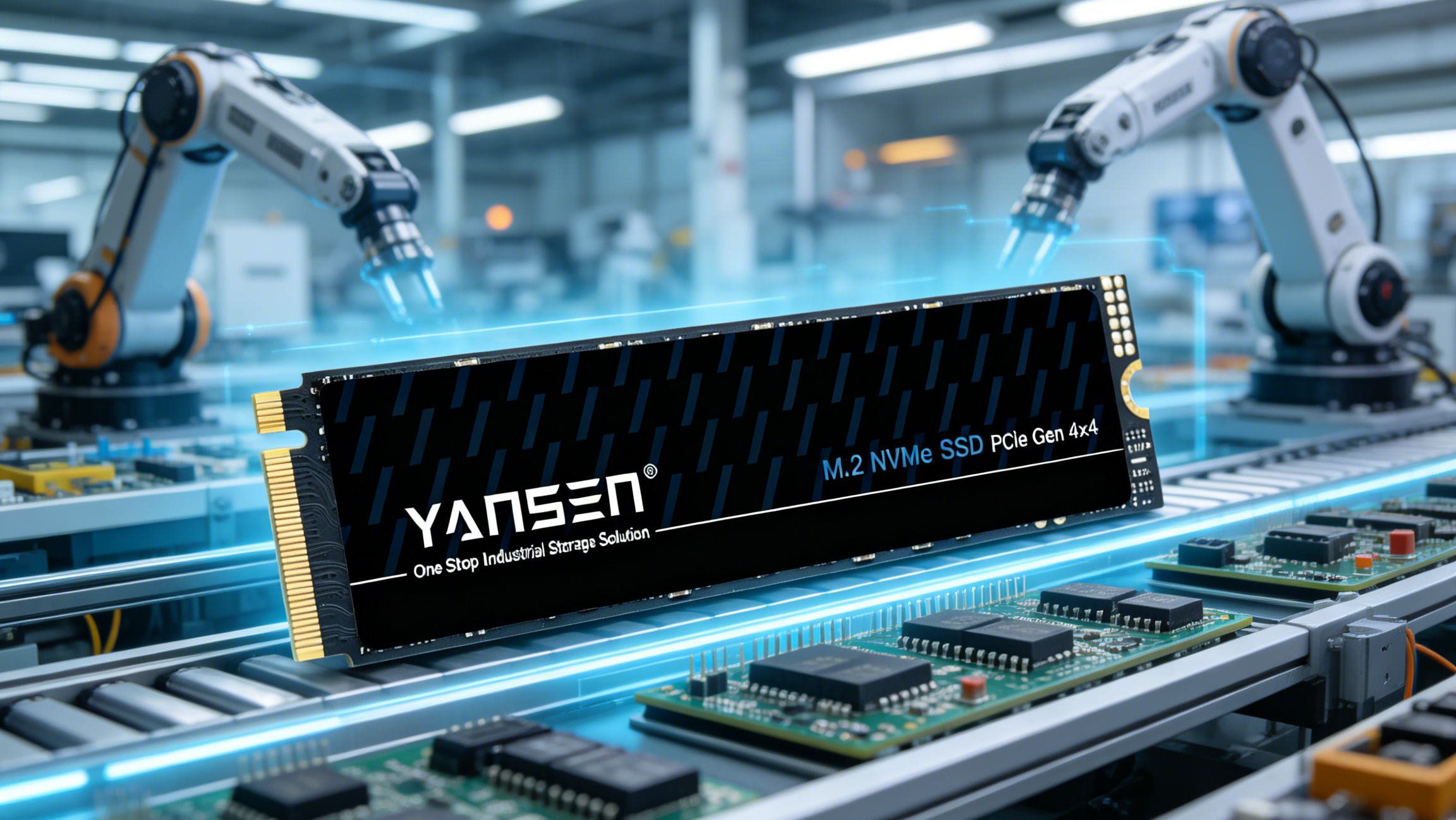
Industrial NVMe SSD – PCIe 3.0 vs PCIe 4.0 for AI-Driven Manufacturing and Edge Computing

When “Stable Enough” Is No Longer Enough

For years, the industrial storage conversation revolved around three things: stability, longevity, and wide-temperature tolerance. And for good reason — a PLC on a factory floor does not care about sequential read speeds. It cares about not crashing mid-shift.

But something shifted. AI models started running at the edge. Machine vision systems began demanding 4K video ingestion. Robot controllers started loading neural networks locally instead of streaming from a cloud server.

The question industrial buyers are asking today is no longer “which SSD survives the factory floor?” — it is “which SSD keeps up with what the factory floor is becoming?”

This is where the PCIe 3.0 versus PCIe 4.0 decision gets interesting — and consequential.

Industrial NVMe SSD

First, What Is an Industrial NVMe SSD?

NVMe (Non-Volatile Memory Express) was designed from the ground up for flash storage. Unlike SATA, which was retrofitted from spinning-disk interfaces, NVMe speaks directly to the SSD over the PCIe bus — cutting latency, raising throughput, and allowing parallel command queues that SATA simply cannot match.

An industrial NVMe SSD takes this architecture and adds the hardening required for non-consumer environments:

The NVMe form factor itself (M.2, U.2, or add-in card) has become the go-to for industrial systems that need more than SATA can deliver. The question is: which PCIe generation?

Industrial NVMe SSD

PCIe 3.0 vs. PCIe 4.0: Where the Real Differences Are

Bandwidth and Throughput

The headline number is straightforward:

Specification

PCIe Gen3 x4

PCIe Gen4 x4

Per-lane Bandwidth

~1 GB/s

~2 GB/s

Total (x4)

~4 GB/s

~8 GB/s

Typical Sequential Read (NVMe SSD)

2,000–3,500 MB/s

5,000–7,500 MB/s

Typical Sequential Write

1,500–3,000 MB/s

4,000–6,500 MB/s

For tasks like booting an operating system or loading configuration files, both are effectively instant. The gap appears when you move large datasets — and in industrial AI, datasets are getting larger.

Power and Heat: The Industrial Reality Check

Here is the catch with PCIe 4.0 that the marketing material does not always mention: it runs hotter.

A typical PCIe 3.0 NVMe SSD draws 4–6 watts under load. A PCIe 4.0 drive can draw 7–10 watts or more, depending on the controller and NAND configuration. In a desktop or server with active cooling, that is manageable. In a fanless industrial embedded system operating at 60°C ambient, that extra 4 watts can be the difference between stable operation and thermal throttling — or failure.

This is the single most important consideration for industrial buyers. PCIe 4.0 delivers more bandwidth, but only if the thermal design of the host system can handle it. Many existing industrial PCs and embedded platforms were thermally designed around PCIe 3.0 power envelopes.

Compatibility and Ecosystem Maturity

PCIe 3.0 is a known quantity. The ecosystem has been stable for over a decade. Industrial motherboard designs, BIOS implementations, and operating system drivers have been tested across thousands of configurations. If your application does not need Gen4 bandwidth, Gen3 offers wider compatibility with fewer integration surprises.

PCIe 4.0 is mature on the consumer side but still catching up in industrial platforms. Many IPC vendors released Gen4-capable boards only in the last two years, and qualification cycles for industrial systems are longer than commercial ones.

Where PCIe 3.0 Still Makes Sense

For a large portion of industrial applications, PCIe 3.0 NVMe SSDs are still the right choice. These are scenarios where predictable stability matters more than peak throughput:

Industrial Automation (PLC, HMI, MES Terminals)
Programmable logic controllers cycle through the same logic thousands of times per hour. Their storage workload is mostly small, random reads and writes. PCIe 3.0’s latency profile is already measured in microseconds — Gen4 would offer no practical improvement in these environments.

Rail Transit and In-Vehicle Systems
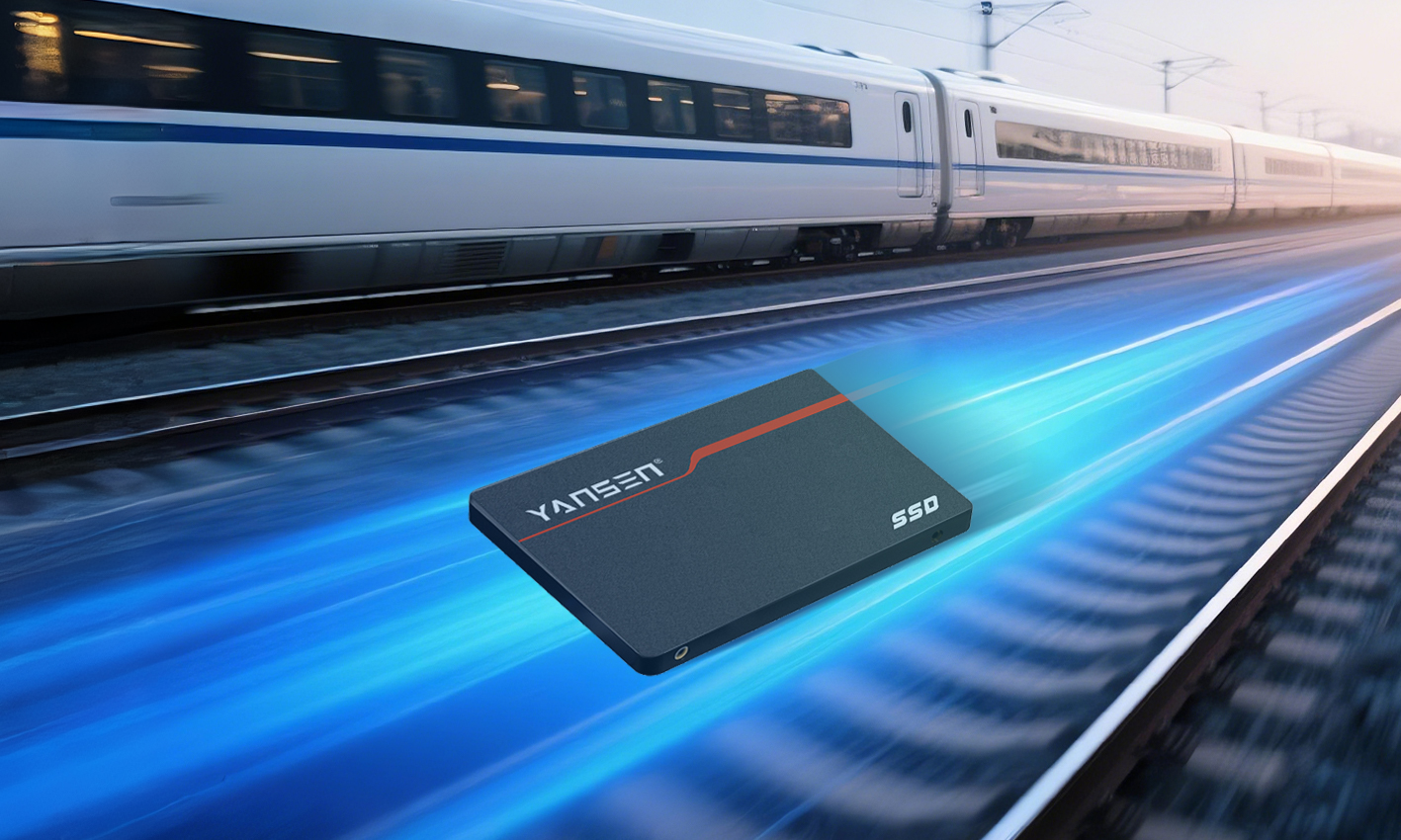
Rail systems and in-vehicle applications prioritize low power consumption, wide-temperature tolerance, and shock resistance over raw bandwidth. PCIe 3.0 NVMe SSDs deliver these characteristics at a lower thermal cost than Gen4.

Industrial Edge Gateways
Data aggregation gateways in IIoT deployments typically buffer sensor data, run local databases, and forward summarized payloads to the cloud. The write workload is modest, and the bottleneck is rarely the storage interface. Gen3 is sufficient — and more cost-effective at scale.

YANSEN Industrial PCIe 3.0 SSD solutions are built around these exact requirements: wide-temperature support, high compatibility with industrial chipsets, industrial-grade NAND with extended longevity, and stable long-term supply that allows OEMs to lock in a BOM without worrying about component obsolescence within the product lifecycle.

Where PCIe 4.0 Is Becoming Essential

These are the applications where PCIe 3.0 bandwidth becomes the bottleneck, and upgrading to Gen4 translates directly to better system performance.

AI Edge Computing

Loading a 7-billion-parameter quantized large language model — about 4 GB of weights — takes roughly 1.2 seconds from a Gen3 NVMe drive and roughly 0.6 seconds from a Gen4 drive. In a real-time edge AI inference application where model loading happens on demand, that difference matters.

More importantly, AI applications tend to be data-hungry. Edge AI boxes performing multi-model inference need fast access to large datasets stored locally. Gen4’s doubled bandwidth reduces data-loading bottlenecks in AI pipelines.

Machine Vision and Intelligent Surveillance

A single 4K camera at 30 fps generates roughly 600 MB/s of uncompressed video data. With compression, the sustained ingest is still significant — and when you multiply across six or eight cameras feeding into one AI analytics unit, the aggregate throughput can saturate a Gen3 x4 link.

Machine vision systems in AOI (automated optical inspection) and smart city surveillance are increasingly using PCIe 4.0 NVMe SSDs for:

  • High-speed continuous writes from multi-camera arrays
  • Large-frame image buffers for defect detection algorithms
  • Simultaneous read-write workloads during live inspection

Industrial AI Servers and GPU-Accelerated Systems

Some industrial deployments now include local GPU servers for model training, simulation, or real-time processing of production data. These systems benefit from GPU Direct Storage, where the GPU accesses data directly from the NVMe SSD without passing through system RAM. PCIe 4.0 doubles the bandwidth available for this path, meaning faster data delivery to the GPU.

YANSEN PCIe 4.0 Industrial SSD Solutions for AI computing integrate: high-speed NVMe architecture with sustained read/write performance, high TBW endurance for continuous AI workloads, thermal optimization through firmware-managed power states, and validation for 24/7 continuous operation in industrial enclosures. Applications include AI edge boxes, machine vision platforms, autonomous robot controllers, and industrial inference servers.

How to Choose: A Decision Framework

Rather than a blanket recommendation, the choice between PCIe 3.0 and PCIe 4.0 should follow the application’s actual requirements:

Consideration

Lean Gen3

Lean Gen4

Peak throughput needed

< 3 GB/s

> 4 GB/s

System cooling

Fanless / passive

Active cooling available

Operating ambient temp

> 60°C sustained

< 50°C typical

AI model loading

Minimal or none

Frequent large-model loads

Multi-camera video ingest

1–2 cameras

4+ cameras

Supply voltage stability

Limited power headroom

Adequate power budget

Platform compatibility

Legacy or mature IPC

New-design Gen4-capable

A quick rule of thumb: if your system currently runs SATA SSDs, PCIe 3.0 NVMe will already be a dramatic improvement. If it already runs PCIe 3.0 NVMe and you are hitting storage bottlenecks during peak loads, PCIe 4.0 is worth evaluating — with thermal validation.

Looking Ahead: What Comes After Gen4

The industry is already shipping PCIe 5.0 controllers for client SSDs, and industrial adoption will follow — though with the typical 2-to-3-year lag. PCIe 5.0 doubles bandwidth again to 16 GB/s per x4 link, which will matter for future AI workloads, high-channel-count video analytics, and real-time digital twin simulations.

But for most industrial applications being designed today, the decision is between Gen3 and Gen4. And for most, Gen3 remains the pragmatic choice — unless the application specifically needs the bandwidth that only Gen4 can deliver.

Frequently Asked Questions

Q: Is PCIe 4.0 backward compatible with PCIe 3.0 slots?

A: Yes. A PCIe 4.0 NVMe SSD will operate in a PCIe 3.0 slot, but it will be limited to Gen3 speeds. The reverse is also true — a Gen3 SSD in a Gen4 slot runs at Gen3 speed. Compatibility is generally excellent across both generations.

Q: Does an industrial NVMe SSD require special drivers?

A: Modern operating systems include native NVMe drivers. Most industrial Linux distributions and Windows 10/11 IoT editions support NVMe out of the box. However, check with your IPC vendor for BIOS configuration guidance, especially on legacy platforms.

Q: Will PCIe 4.0 shorten the lifespan of an SSD in an industrial environment?

A: The higher power consumption of PCIe 4.0 can lead to higher operating temperatures, which is the primary factor affecting NAND longevity. If the system has adequate thermal management, the lifespan difference between Gen3 and Gen4 is negligible. If cooling is marginal, Gen4 may accelerate wear.

Q: What is the price difference between Gen3 and Gen4 industrial SSDs?

A: PCIe 4.0 industrial SSDs typically carry a 20% to 40% premium over equivalent-capacity Gen3 drives, depending on the NAND configuration and endurance rating. The premium is justified when the bandwidth is needed; otherwise, Gen3 offers better value.

Q: Can YANSEN provide custom firmware for industrial NVMe SSDs?

A: Yes. YANSEN supports firmware customization including power management profiles, thermal throttling thresholds, and vendor-specific features tailored to the host system’s requirements.

Q: How long will YANSEN supply a specific PCIe 3.0 NVMe SSD model?

A: YANSEN typically guarantees a minimum 3-year supply commitment for industrial NVMe SSD product lines, with fixed BOM to ensure consistency across production batches. Product change notifications are issued a minimum of 6 months before any component changes.

Not sure whether PCIe 3.0 or PCIe 4.0 fits your application? Contact YANSEN with your system specifications and workload profile — our engineering team can help match the right storage solution to your thermal, performance, and longevity requirements.

Industrial SSD Solutions for Rail Transit Systems

The Digital Backbone of Modern Rail Transit

Walk into any metro control room today, and you will see walls of screens streaming live footage from thousands of cameras, real-time train positions, passenger flow analytics, and predictive maintenance alerts. The days when railways ran on purely mechanical signals and paper timetables are long gone.

Modern rail systems — from high-speed cross-country trains to urban metro networks — are generating and processing more data than ever. Automatic train operation (ATO), AI-driven video surveillance, passenger information displays, and onboard edge computing nodes all depend on one critical enabler: reliable data storage.

And here is the problem most rail operators eventually discover: consumer-grade storage simply cannot survive the demands of a moving train.

Industrial SSD

Where Does Storage Matter Most in Rail Systems?

Onboard Video Surveillance (CCTV)

This is the largest storage consumer on any modern train. A single metro car can pack 6 to 8 high-definition cameras recording continuous footage. Multiply that across a 6-car train running 18 hours a day, and you are looking at terabytes of data per week.

What makes this challenging:

  • Continuous write cycles day after day — standard SSDs wear out quickly
  • Footage must survive sudden power cuts (common during depot maintenance or emergency braking)
  • Data retention periods can extend to 90 days or more by regulatory mandate

For these reasons, industrial SATA SSDs and industrial NVMe SSDs with power-loss protection and high endurance ratings have become the default choice for rolling stock CCTV systems across Europe and Asia.

Train Control and Signaling Systems

Systems like ATP (Automatic Train Protection), CBTC (Communications-Based Train Control), and ETCS (European Train Control System) handle data that literally cannot be lost. These subsystems log operational parameters, record safety events, and store configuration files that must persist through decades of service.

The storage requirements here are less about capacity and more about absolute data integrity. A single corrupted log file during an incident investigation can raise months of regulatory questions. Industrial-grade NAND flash with built-in power-loss protection and advanced error correction is not optional — it is a safety prerequisite.

Passenger Information Systems (PIS)

Think about the displays telling passengers the next stop, or the infotainment screens playing route maps and advertisements. These systems store media files — images, pre-recorded announcements, video loops — that must play reliably across thousands of operating hours.

The reading pattern is mostly sequential, and write cycles are infrequent, which makes M.2 SATA SSDs, M.2 NVMe SSDs, and even high-end eMMC modules well-suited here. The key is long-term availability: rail operators expect the same storage module to be serviceable for 7 to 10 years.

Edge Computing and AI Analytics

This is the fastest-growing segment. Rail operators are increasingly deploying AI inference boxes onboard trains and at trackside cabinets to run:

  • Real-time anomaly detection (passenger falls, unauthorized track access)
  • Passenger flow counting for dynamic scheduling
  • Predictive maintenanceon bogies, brakes, and HVAC systems

These edge nodes process video streams locally, sending only metadata to the cloud. That means high-speed PCIe Gen3 and Gen4 SSDs with low latency and sustained write performance are becoming standard in modern rail deployments.

Industrial SSD

What Rail Environments Do to Storage (And Why Most SSDs Fail)

Temperature Extremes Are the Norm

An SSD inside a wayside cabinet in Munich sees -20°C in January and +60°C inside the enclosure by July afternoon. Onboard a train, the ambient temperature near the axle-mounted sensors is even worse. Without -40°C to +85°C wide-temperature support, standard SSDs will either fail to start or suffer from accelerated data retention loss.

Vibration Is Constant and Cumulative

A train does not sit still. Continuous low-frequency vibration from the rails, combined with occasional shock loads during coupling and braking, gradually damages mechanical components. SSDs have no spinning platters, which already puts them ahead of HDDs in rail applications — but not all SSDs are built alike. Industrial SSDs use reinforced soldering, conformal coating, and shock-dampening enclosures to withstand 20G to 50G shock ratings.

24/7 Operation Across Decades

Railway equipment is designed for a 10-to-15-year service life with minimal maintenance. An SSD that fails after three years of continuous writes is a liability. Industrial drives are rated for higher TBW (Total Bytes Written) and undergo extended burn-in testing to weed out early-life failures before they reach the customer.

Power Fluctuations and Sudden Blackouts

Trains experience voltage spikes during regenerative braking and complete power loss during depot power-downs. Without dedicated power-loss protection (PLP) circuitry, in-flight data can be corrupted or the drive’s mapping table can be damaged, rendering the device unresponsive. Industrial SSDs from experienced manufacturers implement discrete PLP with tantalum polymer capacitors that provide enough energy to flush the DRAM cache to NAND during an unexpected shutdown.

Security Is No Longer Optional

As railways become more connected, they become more exposed. AES 256-bit hardware encryption, secure erase capabilities, and tamper-resistant firmware are increasingly listed as mandatory requirements in European rail tenders. Industrial SSD controllers now integrate these security features at the silicon level, not as afterthoughts.

Industrial SSD vs. Consumer SSD: A Straightforward Decision

A simple way to think about it: a consumer SSD is designed to boot your desktop computer quickly. An industrial SSD is designed to survive a train.

Specification

Consumer SSD

Industrial SSD

Operating Temperature

0°C to 70°C

-40°C to 85°C

Sustained Write Performance

Standard

Optimized for continuous workloads

Power-Loss Protection

Rarely included

Standard (PLP circuit)

Lifecycle

3–5 years

5–10+ years

Firmware Customization

Not available

Supported

Long-Term Supply

Unstable, short window

Extended lifecycle commitment

For mission-critical rail applications, the choice is not even close.

What the Next Decade Brings

Railway operators are already piloting autonomous trains on mainline tracks in Germany, France, and China. AI vision systems are replacing manual track inspections. Digital twin simulations of entire rail networks are running on edge infrastructure.

These developments share a common storage requirement: higher throughput, greater endurance, and guaranteed data integrity.

The shift from PCIe Gen3 to Gen4 industrial NVMe SSDs is already underway in newer rail projects. As AI models grow larger and edge inference becomes more demanding, Gen4 and eventually Gen5 SSDs will become the norm rather than the exception.

Industrial SSD

How YANSEN Supports Rail Transit Applications

YANSEN’s industrial storage portfolio has been developed with input from rail system integrators across Europe and Asia. The product range covers the full spectrum of rail storage needs:

  • Industrial SSDs: 2.5″ SATA, M.2 SATA, M.2 NVMe PCIe Gen3, M.2 NVMe PCIe Gen4 — all with wide-temperature support
  • Industrial DRAM: DDR4 and DDR5 modules tested for extended thermal and vibration profiles
  • Embedded storage: eMMC for space-constrained PIS and signaling applications

Every YANSEN SSD ships with power-loss protection as a standard feature on relevant form factors, AES 256-bit encryption, and high-endurance NAND flash selected for industrial duty cycles.

Beyond the hardware itself, YANSEN operates its own automated testing systems covering SSD, DRAM, and eMMC validation under wide-temperature, shock, and power-cycling conditions. This in-house testing capability enables rail customers to qualify storage components faster and with greater confidence than relying on third-party test reports alone.

Frequently Asked Questions

Q: Can I use a commercial off-the-shelf SSD in a railway CCTV system?

A: You can, but you should expect higher failure rates within two to three years due to temperature stress, vibration, and power cycling. Industrial SSDs are engineered specifically for these conditions and typically carry higher TBW ratings to match the continuous write workload of surveillance systems.

Q: What is the typical lifespan of an industrial SSD in rail applications?

A: With proper thermal management and write workload sizing, most industrial SSDs in rail systems last 5 to 8 years. Many rail operators plan for a mid-life storage replacement around year 7 as part of routine maintenance cycles.

Q: How do I select between PCIe Gen3 and Gen4 for a rail project?

A: Gen3 is sufficient for most current applications — CCTV recording, PIS, signaling logs. Choose Gen4 if your project involves AI inference, multi-channel video analytics, or edge computing where sustained throughput above 3GB/s is needed.

Q: Does your testing capability include custom qualification for rail standards?

A: Yes. YANSEN’s in-house test systems can be configured to match EN 50155 thermal profiles, IEC 61373 vibration specifications, and custom power-cycling sequences that replicate real-world rail operating conditions.

Q: What is the minimum supply commitment for rail-grade SSDs?

A: YANSEN supports long-term supply agreements with fixed BOM (Bill of Materials) — typically 5-year lifecycle commitments with product change notification to ensure seamless transitions if component changes become unavoidable.

Looking for storage components for your next rail project? Contact YANSEN to discuss your application requirements, operating environment, and compliance standards.

ZD102 DRAM Testing System:Redefining Intelligent Memory Module Validation

In today’s rapidly evolving memory industry, the performance and reliability of DDR modules are no longer just “quality indicators” — they directly determine the stability of servers, industrial systems, AI workstations, gaming PCs, and edge computing devices.

As the demand for memory modules continues to rise, manufacturers are facing increasing challenges in mass production testing:

  • Higher capacity modules require longer validation cycles
  • Production lines demand higher automation efficiency
  • Fault localization must become faster and more precise
  • MES integration and data traceability are becoming essential

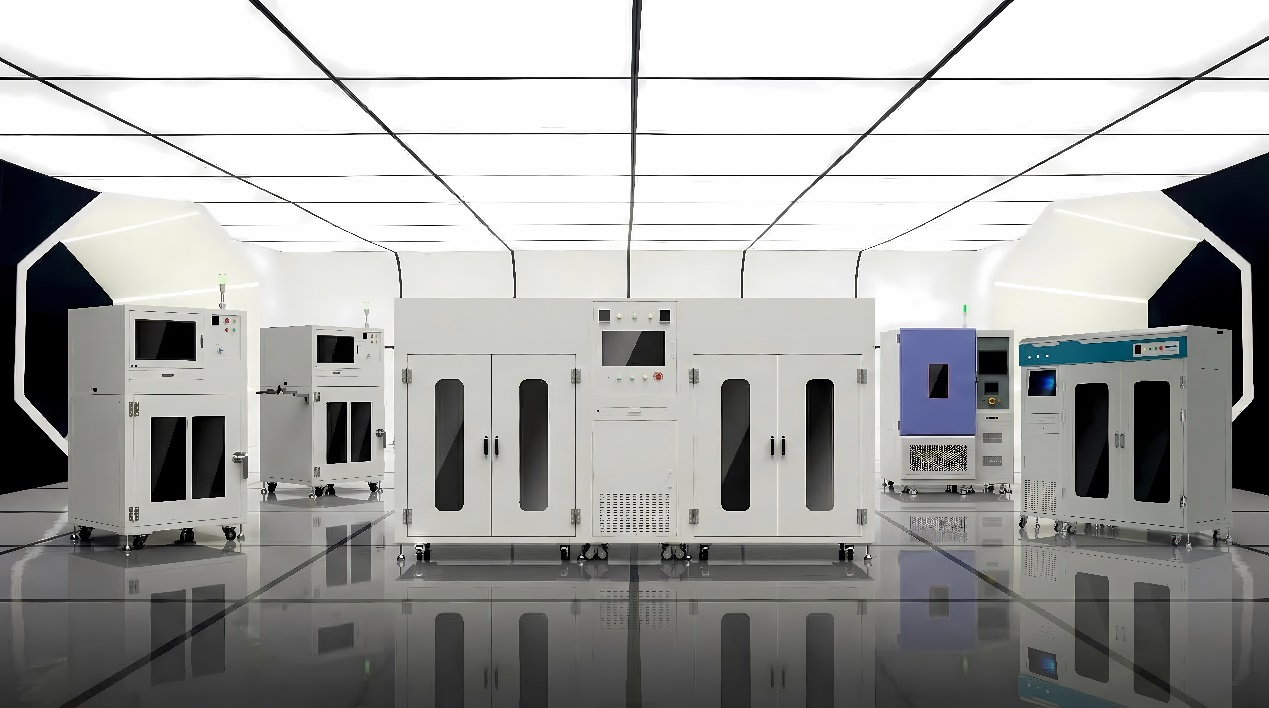
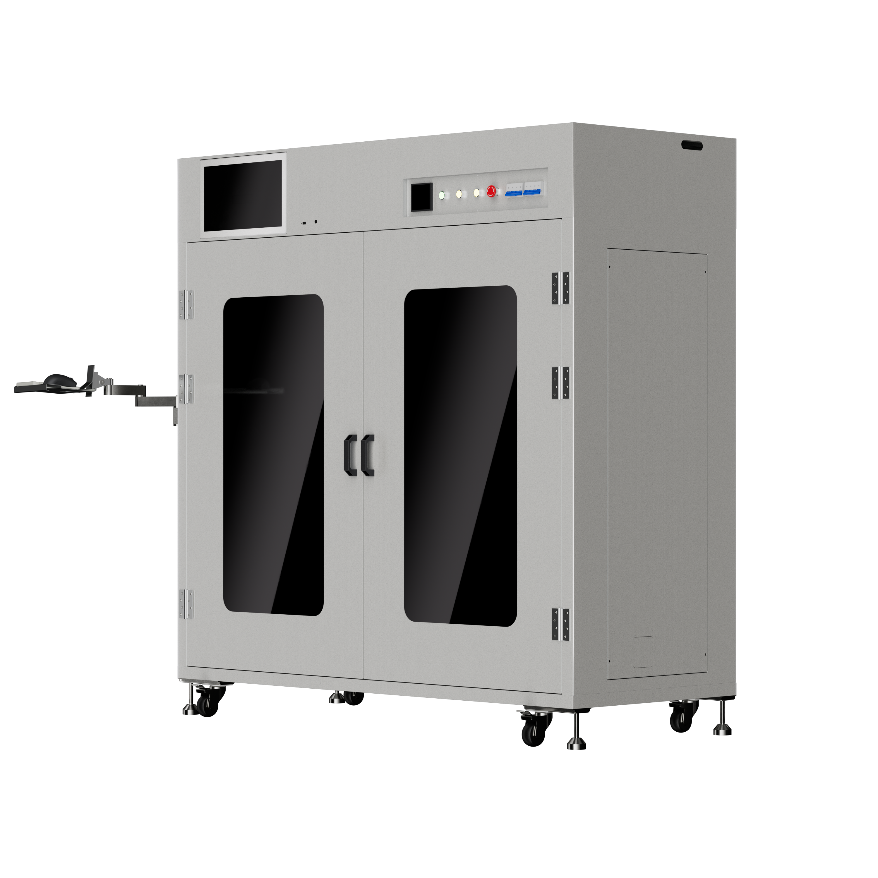
To address these challenges, MemoThink introduced the ZD102 Intelligent Memory Testing System — a compact, automated, industrial-grade testing cabinet designed specifically for high-efficiency UDIMM DDR4 validation and mass production environments.

Designed for High-Efficiency DDR4 Module Testing

The ZD102 is engineered for manufacturers who require scalable and reliable DDR4 testing in production environments. Despite its compact footprint, the system supports simultaneous testing of up to 60 UDIMM DDR4 modules in a single batch, significantly improving throughput and reducing manual intervention.

With support for one-click startup of 30 host systems simultaneously, production teams can dramatically simplify repetitive testing operations while maintaining consistent test standards across batches.

This makes the ZD102 especially suitable for:

  • DDR memory manufacturers
  • OEM / ODM factories
  • Industrial PC solution providers
  • Embedded hardware validation labs
  • Server and edge computing equipment vendors

Intelligent Testing Beyond Traditional Burn-In

Traditional memory testing often focuses only on basic read/write verification. However, modern industrial and enterprise applications require much deeper validation.

The ZD102 integrates a highly flexible testing architecture with:

  • Customizable graphical test configuration
  • Real-time progress visualization
  • Automated fault DRAM chip localization
  • Multi-pattern MemTest86 validation support
  • MES synchronization and report generation

Unlike conventional manual debugging workflows, the system can visually indicate the position of failed DRAM chips, helping engineers identify defective components faster and reducing troubleshooting time during production.

Additionally, support for 14 MemTest86 testing patterns allows manufacturers to validate modules under multiple stress conditions, improving long-term reliability and compatibility.

Stable Validation Under High-Temperature Conditions

For industrial-grade and enterprise-grade memory products, temperature stability is critical.

The ZD102 supports customizable high-temperature testing up to 70°C, enabling manufacturers to simulate demanding operating environments and identify potential instability before products leave the factory.

This capability is especially important for applications such as:

  • Industrial automation systems
  • Edge AI devices
  • Networking equipment
  • Surveillance systems
  • Rugged embedded platforms

By performing stress validation under elevated temperatures, manufacturers can significantly reduce field failure risks and improve product reliability.

Automation + Data Visualization = Smarter Manufacturing

Modern memory manufacturing is no longer just about hardware testing — it is also about data management and production intelligence.

The ZD102 automatically generates test reports and synchronizes data with MES systems, helping manufacturers build traceable and standardized production workflows.

Its graphical interface allows operators to monitor test progress in real time, while customizable software modules make it easier to integrate into different manufacturing environments.

This combination of automation, visualization, and data integration enables:

  • Faster production scaling
  • Reduced labor costs
  • Improved yield management
  • Easier quality traceability
  • More efficient R&D validation workflows

Built for Continuous Industrial Production

The ZD102 is designed for long-term deployment in factory environments, featuring:

  • Industrial-grade power architecture
  • PLC-controlled automatic restart and power cycling
  • Stable operation under high humidity conditions
  • Continuous mass-production support without EOL concerns

With an operational humidity range of 5%–95% and support for continuous production environments, the ZD102 is built to meet the reliability requirements of modern electronics manufacturing.

Empowering the Future of Reliable Memory Production

As AI computing, industrial automation, and edge infrastructure continue to expand, the demand for stable and thoroughly validated DDR memory will only grow stronger.

The ZD102 is more than just a testing cabinet — it is an intelligent production platform designed to help manufacturers improve testing efficiency, strengthen quality control, and accelerate scalable DDR4 deployment.

For companies seeking higher reliability, lower failure rates, and smarter production workflows, the ZD102 delivers a practical and future-ready solution for modern memory testing.

From SLC to QLC: A Complete Industrial SSD Selection Guide for Modern Edge, IIoT & Factory Automation

Solid State Drives

In the era of digital transformation and Industry 4.0, Solid State Drives (SSDs) have become the backbone of everything—from high-precision CNC machines and AI-powered edge gateways to data centers handling mission-critical analytics.
Yet many engineers and procurement teams still struggle when facing terms like SLC, MLC, TLC and QLC. Choosing an industrial SSD is not as simple as comparing capacities or price; it requires a deep understanding of endurance, stability, controller quality, firmware optimization, and long-term reliability under harsh environments.

This guide breaks down NAND flash technology in simple, practical terms and offers a field-proven SSD selection framework, with real industrial scenarios and product recommendations inspired by Yansen, a certified National High-Tech Enterprise trusted by TCL, ASUS, Lenovo and global OEM partners.

1. Core Fundamentals — How SLC, MLC, TLC and QLC NAND Really Differ

At the heart of every SSD lies the NAND flash cell. The number of bits stored in each cell determines performance, endurance, and reliability.

1.1 How NAND Stores Data

A NAND cell stores electrons in a floating gate. The number of voltage levels defines how many bits can be represented.

1.2 Breakdown of NAND Types

1.2.1 SLC (Single-Level Cell) — 1 bit per cell

Only 2 voltage states (0 or 1)

Fastest, most stable, longest lifespan

Ideal for ultra-critical environments

Cost per GB is extremely high

1.2.2 MLC (Multi-Level Cell) — 2 bits per cell

4 voltage states

Good performance & endurance

Previously dominant in enterprise systems

Now gradually replaced by 3D industrial TLC

1.2.3 TLC (Triple-Level Cell) — 3 bits per cell

8 voltage states

Currently the mainstream industrial choice

Balanced cost, endurance, and performance

Widely used in industrial PCs, automation, vehicles, and edge AI systems

1.2.4 QLC (Quad-Level Cell) — 4 bits per cell

16 voltage states

Highest density, lowest cost

Endurance drops significantly

Suitable for read-intensive, cold data or archival workloads, not for continuous heavy writes

Solid State Drives

1.3 NAND Comparison Table

NAND Type

Bits per Cell

Voltage States

P/E Cycles

Strengths

Limitations

SLC

1

2

~100,000

Fastest, extremely durable

Very expensive

MLC

2

4

3,000–10,000

Strong endurance

Not mainstream today

TLC (Industrial/Enterprise-grade)

3

8

1,000–3,000

Best balance for industrial use

Lower endurance vs MLC

QLC

4

16

150–1,000+

Ultra-low cost, high capacity

Weak endurance, slow sustained writes

2. Real-World Industrial SSD Selection Guide

Selecting an industrial SSD is ultimately about the right match between workload and NAND type. Below is a practical roadmap used by many factories, integrators and industrial OEMs.

2.1 How to Choose Based on Application

2.1.1 SLC — When reliability is everything

Best for:

Military & aerospace systems

Financial transaction logging

Specialized automation with 24/7 real-time writes

Today, pure SLC is rare, so many industrial SSDs use pSLC mode, where TLC/QLC blocks run as 1-bit SLC to deliver higher endurance.

2.2.2 MLC — Legacy industrial systems

  • Best for:

Older automation controllers

Industrial PCs with long product cycles

Still available in some industrial lines but is being replaced by advanced 3D TLC.

2.2.3 Industrial 3D TLC — The current sweet spot

  • Best for:

PLCs, CNC machines, robotic systems

Edge computing, machine vision

Industrial AI inference

Harsh-environment systems needing -40°C to 85°C wide-temperature support

  • Why it dominates today:

With optimized firmware, high-quality controllers and extra OP (Over-Provisioning), industrial TLC SSDs achieve endurance levels sufficient for almost all industrial workloads at a much more reasonable cost.

2.2.4 QLC — Not for system disks

  • Best for:

Temperature-stable data centers

Cold storage

Surveillance video archiving

AI/ML datasets with low write frequency

  • Avoid using QLC for:

OS drives

Heavy random writes

Harsh industrial environments

3. Industrial SSD Selection Matrix (With Yansen Product References)

Industrial Scenario

Recommended NAND

Capacity Range

Key Requirements

Suitable Yansen Solutions

PLC / CNC / Automation Equipment

Industrial 3D TLC

480GB–1.92TB

Wide-temp, vibration resistance, SATA for compatibility

 2.5” Industrial SATA SSD (-40°C to 85°C)

Vehicle / Rail / Transportation Systems

Industrial 3D TLC

256GB–2TB

Strong vibration resistance, wide-temp, power-loss protection

M.2 2280 / mSATA Industrial Series

Edge AI, Machine Vision, IoT Gateways

High-performance 3D TLC

1TB–7.68TB

High IOPS, PCIe Gen3/4/5, optional heat spreader

M.2 PCIe 4.0 NVMe Series

Data Center Cold Storage / Archive

QLC

≥7.68TB

Low TCO, high density

High-Capacity Enterprise QLC SSD

Yansen’s industrial-grade SSDs incorporate:

  • Advanced controllers with enhanced ECC
  • Static & dynamic wear-leveling
  • Extended OP for industrial endurance
  • Full wide-temperature support (-40°C to +85°C)
  • Optional function such as PLP, write protection and AES 256 encryption
  • Long-term supply & stable BOM,essential for industrial projects

Conclusion: The Right SSD Is a Long-Term Investment, Not a Cost Comparison

SLC, MLC, TLC and QLC are not “good vs bad” technologies—they are engineered for different priorities. In the industrial world, the best SSD must deliver:

High endurance & reliability

Stable supply chain

Robust controller + firmware

Thermal & vibration tolerance

Predictable lifetime under real workloads

For 90% of modern industrial applications, enterprise/industrial-grade 3D TLC represents the most stable and cost-effective choice—especially when paired with high-quality controllers and firmware optimization, as found in Yansen’s industrial SSD lineup.

If you’re upgrading factory equipment, building IoT gateways, deploying edge AI, or sourcing long-life SSD solutions, the safest path is to evaluate reliability, durability, data integrity features, and vendor stability—not only the NAND type.

Looking for Long-Life Industrial Storage Solutions?

Yansen provides:

Full ranges of SATA, mSATA, M.2 SATA, M.2 PCIe, PCIe 3.0/4.0 NVMe SSDs and CF/CFast Card

Industrial wide-temperature (-40°C~85°C)

High-endurance firmware optimization

Stable supply for long product life cycles

Customizable capacities, OP ratios, conformal coating, PLP options

Contact us for OEM/ODM, project requirements, or sample evaluation.
Our engineering team can help you choose the ideal SSD for your workload.

Edge Computing Explained: Architecture, Benefits, and Storage Challenges

1. Why Cloud-Only Architecture Is No Longer Enough

Imagine a smart factory where robotic arms must respond in milliseconds, or an AI-powered surveillance camera that needs to detect anomalies in real time. In these scenarios, sending all data to a centralized cloud for processing introduces unacceptable latency and bandwidth bottlenecks.

As industries become more data-driven, three challenges are becoming increasingly evident:

  • Low latency requirementsfor real-time decision-making
  • Massive data generationfrom IoT devices and sensors
  • Network limitationsthat cannot handle continuous data transmission to the cloud

Traditional cloud computing was designed for centralized processing. However, modern applications such as autonomous driving, industrial automation, and smart cities demand instant insights at the data source.

This is where edge computing emerges—not as a replacement for the cloud, but as a critical extension that brings computation and storage closer to where data is generated.

2. What Is Edge Computing?

2.1 A Simple Definition

Edge computing refers to a distributed computing model where data processing and storage are performed near the data source, rather than relying entirely on centralized cloud infrastructure.

  • Cloud computing: Centralized data processing
  • Edge computing: Distributed, localized processing

This shift enables faster response times, reduced bandwidth usage, and improved system reliability.

2.2 Architecture: How Edge Computing Works

A typical edge computing architecture follows a layered data flow:

Devices → Edge Nodes → Cloud

  • Devices: Sensors, cameras, industrial machines generating raw data
  • Edge Nodes: Local servers or gateways performing real-time processing
  • Cloud: Centralized platform for long-term storage, analytics, and model training

This hybrid approach allows organizations to process time-sensitive data locally, while still leveraging the cloud for large-scale analytics.

2.3 Core Components of Edge Infrastructure

A complete edge computing system includes:

  • Edge Devices / Edge Servers: Handle local computation
  • Networking Layer: 5G, LAN, or IoT connectivity
  • Compute Resources: CPU, GPU, or AI accelerators
  • Local Storage and Memory: SSD and DDR

Here is a critical insight often overlooked:

Edge computing is not just about moving compute closer to the edge—it is also about moving storage closer to the edge.

Without reliable local storage and memory, edge systems cannot function efficiently.

3. Cloud vs Edge Computing: Key Differences

Dimension

Cloud Computing

Edge Computing

Latency

Higher

Ultra-low

Bandwidth Usage

High

Reduced

Real-Time Capability

Limited

Strong

Data Security

Depends on transmission

Local processing enhances security

Cost Structure

Ongoing bandwidth costs

Higher upfront hardware investment

Key takeaway:
Edge computing does not replace cloud computing. Instead, it creates a collaborative “cloud + edge + device” architecture that balances performance, cost, and scalability.

4. Why Edge Computing Is Growing Rapidly

4.1 Technology Drivers

Several technological advancements are accelerating edge adoption:

  • Increasing demand for AI inference at the edge
  • Deployment of 5G networks, enabling faster connectivity
  • Rapid growth of IoT devices, generating massive data volumes

4.2 Industry Drivers

Edge computing is being widely adopted across multiple sectors:

  • Industrial automation (Industry 4.0)
  • Smart cities and intelligent transportation systems
  • Autonomous vehicles
  • Security and surveillance systems

A simple principle explains this trend:

The closer data is processed to where it is generated, the more valuable and actionable it becomes.

5. Key Challenges in Edge Computing Deployments

While edge computing offers clear advantages, it also introduces new challenges—especially at the hardware level.

5.1 Harsh Environmental Conditions

Edge systems often operate outside controlled data centers:

  • Extreme temperatures (high or low)
  • Vibration and mechanical shock
  • Unstable or intermittent power supply

5.2 Data Processing Challenges

Edge workloads typically involve:

  • High-frequency data generation
  • Continuous write operations
  • Real-time processing and buffering

This puts significant pressure on both storage and memory subsystems.

5.3 Hardware Constraints

Unlike cloud servers, edge devices must operate within strict limits:

  • Compact physical space
  • Power consumption constraints
  • Requirement for 24/7 stable operation

6. Why SSD and DDR Are Critical to Edge Computing

6.1 The Role of SSD in Edge Systems

Solid-state drives (SSDs) are essential for handling data at the edge:

  • Local data cachingto reduce cloud dependency
  • High-speed read/write for AI inference workloads
  • Data protection during network interruptions

Key technical requirements include:

  • NVMe / PCIe interfacesfor high bandwidth
  • High endurance (DWPD) for continuous writes
  • Power-loss protection (PLP)for data integrity

6.2 The Role of DDR Memory

DDR memory plays a complementary role:

  • Real-time data buffering and processing
  • AI model loading and execution
  • Supporting multitasking and low-latency operations

6.3 The Critical Combination

The performance of edge systems depends on the synergy between storage and memory:

SSD handles data persistence and throughput, while DDR enables real-time processing and responsiveness.

Together, they form the core performance foundation of edge computing infrastructure.

7. YANSEN Edge Storage and Memory Solutions

To address the challenges of edge computing, YANSEN provides industrial-grade SSD and enterprise DDR solutions designed for demanding environments.

Industrial SSD Capabilities:

  • Wide temperature support from -40°C to 85°C
  • Resistance to shock and vibration
  • Higherendurance for continuous workloads
  • AES-256 encryption for data security
  • Power-loss protection (PLP)for mission-critical applications

DDR Memory Features:

  • ECC support for data integrity
  • High stability under long-term workloads
  • Long lifecycle supply for industrial applications

Typical Application Scenarios:

  • Industrial robotics and automation systems
  • Intelligent transportation infrastructure
  • Edge AI servers and inference systems

By combining reliable storage with high-performance memory, YANSEN enables customers to build robust, scalable, and efficient edge computing systems.

PICe Gen3 x 4, NVME 1.3 -YANSEN YSNN5M3 | Industrial M.2 NVMe PCIE SSD

DDR4 U-DIMM – YSXXXXD4PXXXXXXI – YANSEN

8. Future Trends: Edge Computing Meets AI and Advanced Storage

The evolution of edge computing is closely tied to advancements in AI and hardware:

  • Increasing adoption of Edge AI (localized model inference)
  • Transition to PCIe 5.0 and DDR5for higher performance
  • Growing demand for high-density and high-reliability storage
  • Emergence of ubiquitous computing, where processing happens everywhere

As these trends converge, the importance of high-performance, reliable storage and memory will continue to grow.

9. Conclusion: Building a Future-Ready Edge Architecture

Edge computing is redefining how data is processed, stored, and utilized. It shifts the focus from centralized systems to distributed intelligence, enabling faster decisions and more efficient operations.

For enterprises and system integrators, the key question is no longer whether to adopt edge computing, but how to design the right infrastructure.

Choosing the right storage and memory solution will ultimately determine the performance, reliability, and scalability of your edge deployment.

Is your system ready for real-time data processing at the edge?

10. FAQ: Edge Computing, Storage, and Memory Solutions

Q1: What is the main difference between edge computing and cloud computing?

A1: The key difference lies in where data is processed. Cloud computing relies on centralized data centers, while edge computing processes data closer to where it is generated. This reduces latency, lowers bandwidth usage, and enables real-time decision-making, which is critical for applications like industrial automation and AI inference.

Q2: Does edge computing replace cloud computing?

A2: No. Edge computing complements cloud computing rather than replacing it. Most modern architectures adopt a hybrid model, where time-sensitive data is processed at the edge, while the cloud handles long-term storage, analytics, and large-scale model training.

Q3: Why is low latency so important in edge computing?

A3: Many edge applications—such as autonomous systems, smart manufacturing, and real-time video analytics—require immediate responses. Even small delays can impact performance or safety. By processing data locally, edge computing minimizes latency and ensures faster, more reliable system behavior.

Q4: Why are SSDs critical in edge computing environments?

A4: SSDs provide fast, reliable local storage that supports real-time data processing. In edge environments, SSDs are used for:

  • Data caching and buffering
  • High-speed read/write operations for AI workloads
  • Data protection during network interruptions

Industrial-grade SSDs also offer features such as power-loss protection, high endurance, and wide temperature support, which are essential for edge deployments.

Q5: What role does DDR memory play in edge computing?

A5: DDR memory is responsible for real-time data processing and system responsiveness. It supports:

  • AI model execution
  • Data buffering for high-speed operations
  • Multitasking in edge servers

While SSDs handle storage, DDR ensures that data can be processed quickly and efficiently.

Q6: How should enterprises choose storage for edge computing applications?

A6: When selecting storage solutions for edge environments, enterprises should consider:

  • Reliability under extreme conditions (temperature, vibration)
  • Endurance for continuous data writing (DWPD)
  • Data protection features such as power-loss protection
  • Interface performance (NVMe / PCIe)
  • Long-term supply and lifecycle support

Choosing the right SSD is critical to ensuring stable and continuous operation.

Q7: What are the biggest challenges in edge computing hardware design?
A7: The main challenges include:

  • Limited space and power constraints
  • Harsh environmental conditions
  • Need for continuous, stable operation
  • High-frequency data processing requirements

These factors make it essential to use industrial-grade components rather than consumer hardware.

Q8: Why is the combination of SSD and DDR important in edge systems?

A8: Edge computing performance depends on both storage and memory working together. SSDs handle persistent data storage and high-throughput workloads, while DDR provides the speed required for real-time processing. A well-balanced system ensures optimal performance, efficiency, and reliability.

Q9: How does YANSEN support edge computing deployments?

A9: YANSEN provides industrial-grade SSD and enterprise memory solutions designed specifically for edge environments. These solutions focus on:

  • High reliability under harsh conditions
  • Stable performance for continuous workloads
  • Advanced data protection features
  • Long lifecycle supply for industrial applications

This enables customers to build robust and scalable edge computing systems.

AI Is Not Using Less Memory — It’s Using Memory Differently: What It Means for Enterprise DDR and SSD Architecture

1. The Real Meaning Behind “Reducing Memory Usage”

Recent optimization efforts led by hyperscale companies like Google are often interpreted as a simple goal: use less memory.

In reality, the shift is far more strategic. The objective is not to reduce hardware, but to increase efficiency per workload—which fundamentally changes how memory is consumed, allocated, and complemented by storage.

1.1 Model-Level Optimization: More Work Per Byte

Modern AI frameworks are aggressively improving model efficiency, reducing the memory footprint required for the same task:

  • Quantization: Transition from FP32 to FP16, INT8, or even INT4
  • Sparse Models: Eliminating redundant parameters
  • Parameter Sharing: Reusing weights across layers

Impact:
Instead of requiring massive memory pools, models now achieve similar or better performance with significantly reduced per-task memory consumption.

But here’s the critical insight for buyers: This does not reduce infrastructure demand—it redistributes it.

1.2 Memory–Compute Tradeoff: Reducing Peak Usage

AI systems are also redesigning how memory is used during execution:

  • Activation recomputation(trading compute cycles for lower memory footprint)
  • KV cache optimization(especially in LLM inference)
  • Streaming / chunk-based data loading

Impact:
Peak memory usage is reduced, but data movement increases significantly.

This introduces a new bottleneck: memory bandwidth and data flow efficiency, not just capacity.

1.3 System-Level Optimization: Smarter Memory Utilization

At the infrastructure level, optimization continues:

  • Advanced memory allocators
  • NUMA-aware scheduling
  • Reduced redundancy in distributed training

Impact:
Memory is used more efficiently, but system complexity increases, requiring better coordination between CPU, GPU, memory, and storage.

2. What This Means for Enterprise DDR: A Shift in Priorities

2.1 Capacity Growth Is Slowing—But Not Declining

Historically, AI infrastructure followed a simple rule: More memory = better performance.

This drove rapid scaling from 256GB → 512GB → 1TB+ per server.

Now, with optimization:

  • The same workload requires less memory
  • But model sizes continue to grow

Result:
DDR capacity demand still grows—but at a slower, more controlled rate

2.2 Bandwidth Becomes the New Battleground

This is the most important shift for procurement teams.

As memory usage becomes more dynamic:

  • Data is accessed more frequently
  • Real-time streaming replaces bulk loading
  • CPU–GPU–memory interaction intensifies

New DDR Requirements:

  • DDR5 and beyond (DDR6 roadmap)
  • Higher frequency: 4800 → 6400 → 8000 MT/s
  • Lower latency for real-time AI inference

Key Insight: 

In AI infrastructure, bandwidth is becoming more critical than capacity.

2.3 Memory Access Patterns Are Changing

The workload pattern is shifting from: Modern AI systems are evolving from large, sequential data loading patterns typical of training workloads to high-frequency, small-block, and latency-sensitive access patterns seen in inference and edge deployments.

This leads to:

  • Increased importance of IOPS-like memory behavior
  • Greater reliance on memory controller optimization
  • Mandatory NUMA-aware system design

2.4 The Rise of Memory Tiering Architecture

Modern AI infrastructure is no longer built around a single memory layer.

Instead, it follows a hierarchical model:

HBM (GPU Memory)
   ↓
DDR (System Memory)
   ↓
NVMe SSD (Extended Memory / Cold Data)

Critical Shift:

  • DDR is no longer just “capacity provider”
  • It becomes a data orchestration hub
  • SSDs increasingly act as memory extensions

2.5 The Blurring Line Between Memory and Storage

Technologies such as:

  • CXL (Compute Express Link)
  • Memory pooling
  • NVMe over Fabrics

are redefining infrastructure boundaries.

Emerging trend: 

High-performance SSDs are beginning to replace part of traditional DDR roles in certain workloads.

This is especially relevant in:

  • Large-scale inference clusters
  • Edge AI deployments
  • Cost-sensitive datacenter environments

3. Strategic Impact on Enterprise DDR Vendors

3.1 From Capacity Selling to Performance Engineering

Traditional DDR positioning:

  • 32GB / 64GB / 128GB capacity tiers

New decision criteria:

  • Bandwidth performance
  • Latency optimization
  • Stability under sustained AI workloads

Buyers are no longer asking:

  • “How much memory?”
  • They are asking:
  • “How efficiently can my system move data?”

3.2 Workload-Specific Optimization Becomes Essential

Different AI workloads now demand different memory characteristics:

Scenario

DDR Requirement Shift

AI Training

Large capacity + efficiency

AI Inference

High bandwidth + low latency

Edge AI

Small capacity + high efficiency

Real-Time AI

Ultra-low latency

This fragmentation forces vendors to align products with specific use cases, rather than offering generic solutions.

3.3 Convergence with Storage: A New Opportunity

This is where the biggest structural change happens.

Reality today:

  • DDR alone cannot solve performance bottlenecks
  • Storage is no longer just “cold data storage”

New architecture requires:

  • DDR + NVMe SSD coordination
  • Intelligent data flow design
  • Tiered memory-storage integration

4. What This Means for Enterprise SSD & Industrial SSD Vendors

This transformation is not a threat—it’s a major opportunity.

4.1 SSDs Are Becoming “Extended Memory”

In modern AI systems, SSDs now:

  • Store KV cache overflow data
  • Handle streaming datasets
  • Act as memory expansion layers

This elevates SSD requirements:

  • Higher endurance (DWPD)
  • Lower latency
  • Consistent performance under mixed workloads

4.2 Edge AI Is Accelerating SSD Demand

With optimized models:

  • AI can run on smaller systems
  • DDR requirements decrease
  • Deployment shifts to edge environments

Result:

  • Less dependency on large memory pools
  • Strong demand for industrial-grade SSDs

Typical requirements include:

  • Wide temperature support
  • Power-loss protection (PLP)
  • Long lifecycle supply

4.3 YANSEN’s Approach: Memory–Storage Synergy

As a provider of enterprise and industrial storage solutions, YANSEN aligns with this architectural shift by focusing on:

  • High-performance NVMe SSDs for data-intensive AI workloads
  • Reliable storage for edge and industrial deployments
  • Long-term supply and lifecycle management

Key capabilities include:

  • Enterprise-grade NAND for endurance
  • Stable firmware for mixed read/write workloads
  • PLP for data integrity
  • Optimized performance for AI data streaming and caching

Instead of replacing DDR, YANSEN SSDs extend and enhance memory capabilities, enabling more flexible and scalable system design.

5. Procurement Insight: How to Design for the AI Era

For system integrators and enterprise buyers, the key takeaway is:

AI optimization is not reducing infrastructure—it is redistributing performance requirements across components.

When selecting your architecture, consider:

  • Is your bottleneck capacity, bandwidth, or latency?
  • Are you optimizing for training, inference, or edge deployment?
  • Does your storage support real-time data flow, not just storage?
  • Can your vendor ensure long-term consistency and reliability?

6. Conclusion: AI Optimization Is Reshaping Infrastructure, Not Reducing It

AI-driven optimization is fundamentally changing how resources are allocated:

  • DDR is evolving into a high-speed coordination layer
  • SSDs are becoming capacity expansion and data streaming engines

The future is not about choosing between memory and storage.

It is about how effectively they work together.

In the AI era: DDR delivers speed, while SSD delivers scalable capacity and flexibility.

With solutions like YANSEN’s enterprise and industrial SSDs, organizations can build balanced, efficient, and future-ready architectures—capable of handling both centralized datacenters and distributed edge environments.

7. FAQ: AI Memory Optimization, DDR, and SSD Architecture

Q1: Does AI optimization really reduce the need for DDR memory?
A1: Not exactly. AI optimization techniques such as quantization, sparsity, and activation recomputation reduce the memory required per task, but overall infrastructure demand continues to grow as model sizes expand. In practice, DDR capacity demand is still increasing—just at a slower rate. At the same time, requirements for memory bandwidth and latency are rising significantly.

Q2: Why is memory bandwidth becoming more important than capacity?
A2: Modern AI workloads—especially inference and real-time applications—rely on frequent data movement rather than large static datasets. This means systems must continuously transfer data between CPU, GPU, and memory. As a result, high-bandwidth DDR (such as DDR5) and low-latency performance are now more critical than simply increasing memory size.

Q3: What is memory tiering, and why is it important for AI infrastructure?

A3: Memory tiering is an architecture that distributes data across multiple layers:

  • High-speed GPU memory (HBM)
  • System memory (DDR)
  • High-performance storage (NVMe SSD)

This approach optimizes both cost and performance. Frequently accessed data stays in fast memory, while less critical or overflow data is handled by SSDs. This allows enterprises to scale efficiently without relying solely on expensive DDR expansion.

Q4: Can NVMe SSDs really act as an extension of memory?
A4: Yes, in modern architectures, NVMe SSDs are increasingly used as extended memory layers. Technologies such as CXL, memory pooling, and NVMe over Fabrics enable SSDs to handle:

  • KV cache overflow in large language models
  • Streaming datasets
  • Intermediate data in AI pipelines

While SSDs cannot fully replace DDR due to latency differences, they significantly reduce memory pressure and improve scalability.

Q5: How do AI inference workloads change memory and storage requirements?

A5: AI inference workloads differ from training in several ways:

  • More random and small-block data access
  • Higher request frequency (QPS)
  • Strong dependence on real-time response

This leads to:

  • Increased need for low-latency DDR
  • Greater reliance on high-performance SSDs for data streaming and caching

Q6: What should enterprise buyers prioritize when designing AI infrastructure?

A6: Instead of focusing only on memory size, buyers should evaluate:

  • Memory bandwidth and latency performance
  • Storage read/write consistency under mixed workloads
  • System-level data flow efficiency
  • Compatibility with tiered architecture (DDR + NVMe SSD)

A balanced design often delivers better performance and cost efficiency than simply increasing DDR capacity.

Q7: Why are SSDs becoming more important in edge AI deployments?

A7: Edge AI systems typically operate with:

  • Limited hardware resources
  • Smaller memory capacity
  • Harsh or variable environments

As AI models become more efficient, edge systems rely more on SSDs for data storage, buffering, and reliability. Industrial-grade SSDs with features like power-loss protection, wide temperature support, and long lifecycle are essential for these deployments.

Q8: How does YANSEN support AI-oriented memory and storage architecture?
A8: YANSEN focuses on delivering enterprise and industrial SSD solutions that complement modern memory architectures by:

  • Supporting high-performance NVMe interfaces for data-intensive workloads
  • Providing stable firmware optimized for mixed AI workloads
  • Offering power-loss protection (PLP) for data integrity
  • Ensuring long-term supply consistency for industrial and enterprise clients

By aligning storage performance with evolving AI memory strategies, YANSEN enables customers to build scalable, reliable, and future-ready systems.

Japan IT Week Recap: Building Stronger Connections and Accelerating Industrial & Enterprise Storage Opportunities

In this year’s Japan IT Week expo, we had a valuable opportunity not only to showcase our latest storage solutions, but more importantly, to engage directly with local customers, partners, and industry professionals.

Throughout the exhibition, our team had extensive discussions with a wide range of Japanese enterprises, including system integrators, industrial solution providers, and hardware distributors. These conversations went far beyond product introductions—they were centered on real-world applications, technical requirements, and long-term collaboration potential.

Japan IT Week Recap: Building Stronger Connections and Accelerating Industrial & Enterprise Storage Opportunities

Deep Engagement with Local Customers

One of the most meaningful takeaways from this exhibition was the depth of communication we achieved with Japanese customers. Compared to other markets, customers in Japan tend to place greater emphasis on product stability, lifecycle consistency, and strict quality assurance processes.

During our discussions, we identified several key priorities among local clients:

  • Long-term supply stability for industrial projects
  • High reliability under extreme environmental conditions
  • Strict validation and testing standards
  • Compatibility across multiple operating systems and platforms

These insights align closely with our long-standing focus on industrial-grade storage solutions. By understanding these expectations in detail, we are better positioned to provide products and services that truly meet the needs of the Japanese market.

Japan IT Week Recap: Building Stronger Connections and Accelerating Industrial & Enterprise Storage Opportunities

Strong Interest in YANSEN Industrial SSD Solutions

A highlight of our participation was the strong interest shown in our industrial-grade SSD products. Several companies engaged in in-depth technical evaluations and expressed clear intentions to move forward with potential collaborations.

This positive response is closely tied to the strengths of our YANSEN industrial SSD portfolio, which has been specifically engineered for demanding industrial applications.

Our industrial SSD solutions are built with a focus on reliability, durability, and long-term performance. Key features include:

  • Wide temperature support (typically ranging from -40°C to 85°C)
  • Power-loss protection to ensure data integrity during unexpected shutdowns
  • High endurance NAND configurations tailored for industrial workloads
  • Compatibility validation across Windows, Linux, and other operating systems

In addition, we have developed in-house intelligent testing systems that simulate real-world industrial environments, enabling large-scale and highly efficient product validation. This ensures that every SSD delivered meets strict performance and reliability standards.

The strong alignment between our product capabilities and the requirements of Japanese customers played a key role in generating trust and opening the door to new cooperation opportunities.

Growing Demand for Enterprise SSD Solutions

Beyond industrial applications, we also observed a clear and growing demand for enterprise-level storage solutions in the Japanese market.

Customers showed strong interest in high-performance SSD form factors such as U.2 and E1.S, particularly for use cases involving:

  • Data centers
  • Edge computing infrastructure
  • AI and data-intensive workloads
  • High-performance computing environments

These scenarios require not only speed, but also scalability, thermal efficiency, and consistent performance under heavy workloads.

The conversations we had at Japan IT Week made it clear that the demand for enterprise storage in Japan is evolving rapidly, driven by digital transformation and the expansion of data-driven applications.

Japan IT Week Recap: Building Stronger Connections and Accelerating Industrial & Enterprise Storage Opportunities

Intelligent Testing Systems: The Core Behind Our Reliability

A key factor behind the strong interest from customers at Japan IT Week lies in our advanced and fully integrated intelligent testing systems. These systems are not only a quality assurance tool, but a core competitive advantage that enables us to deliver consistent, high-reliability storage solutions across multiple industries.

Our testing systems  cover both module-level and chip-level validation, ensuring full control across the entire storage value chain. At the module level, we support comprehensive testing for SSD, DDR, portable SSD (PSSD), and memory cards. At the semiconductor level, our system extends to NAND Flash, LPDDR, and eMMC, enabling precise validation from wafer and chip stages to finished products.

We provide automated testing solutions across consumer-grade, industrial-grade, enterprise-grade, and even aerospace-grade storage, meeting the stringent requirements of diverse application scenarios. These include validation under extreme and complex conditions such as:

  • Wide temperature environments
  • Power-loss and unexpected shutdown simulations
  • Data encryption and security verification
  • Multi-platform compatibility testing
  • Endurance and lifecycle validation
  • Voltage fluctuation and stress testing
  • 24/7 uninterrupted read/write performance

At the software level, our digital testing platform seamlessly integrated with MES (Manufacturing Execution System) data pipelines. This enables end-to-end intelligent management of the entire testing process, with key advantages including:

  • Fully autonomous and controllable system architecture
  • Real-time data interconnectivity
  • Intelligent and automated testing workflows
  • Full lifecycle data traceability

From a hardware perspective, we adopt an integrated all-in-one testing architecture, designed to maximize efficiency and scalability. The system supports:

  • Multi-protocol compatibility
  • High-performance testing throughput
  • Full-function validation capabilities
  • Parallel testing at scale
  • Intelligent thermal control systems
  • Fully automated testing processes

These capabilities allow us to replicate real-world operating conditions with high precision, ensuring that every product delivered meets the highest standards of reliability and stability.

Ultimately, this intelligent testing system forms the backbone of our product quality—and is a critical reason why customers in Japan, a market known for its strict quality expectations, have shown strong confidence in our solutions.

Looking Ahead: From Connections to Long-Term Partnerships

Japan IT Week was not just an exhibition for us—it was a platform to build meaningful relationships and gain deeper insight into one of the world’s most demanding markets.

The strong interest in our industrial SSDs, the clear demand for enterprise solutions, and the positive feedback from local customers all point toward significant growth opportunities ahead.

We believe that the connections established during this event will evolve into long-term partnerships, as we continue to support our customers with reliable, high-performance storage solutions.

Moving forward, we remain committed to innovation, quality, and customer-centric development—delivering storage technologies that empower industrial systems, enterprise infrastructure, and next-generation applications worldwide.

Why EDSFF (E1.S) Is Replacing U.2: The Next Evolution of Data Center SSD Form Factors

1. Structural Transformation in Data Center Storage

Enterprise and hyperscale data centers are undergoing a profound transformation. The rise of artificial intelligence (AI), cloud computing, and high-performance computing (HPC) workloads is driving unprecedented demand for high-bandwidth, low-latency storage. Legacy 2.5-inch U.2 SSDs, originally designed to replace mechanical hard drives, are increasingly challenged by the thermal, power, and density requirements of next-generation datacenters.

With the proliferation of PCIe Gen5 SSDs, sustained bandwidth has surpassed 10 GB/s per drive, while power consumption and heat generation have also increased significantly. Maintaining thermal efficiency and ensuring reliable operation in dense server racks have become critical design constraints. Traditional form factors struggle to provide the combination of serviceability, airflow optimization, and high-density deployment required by modern workloads.

In addition, hyperscale operators now expect 24/7 operation, making even minor storage failures potentially costly. Storing and managing AI inference datasets, real-time analytics, and high-frequency transactions puts enormous stress on traditional U.2 and M.2 SSDs, highlighting the need for a form factor optimized for next-generation NVMe deployment.

Industrial ssd

2. EDSFF: Purpose-Built for Modern Data Centers

EDSFF (Enterprise and Datacenter Standard Form Factor) was introduced by the Open Compute Project (OCP) to meet the evolving demands of hyperscale data centers. Unlike incremental updates to existing U.2 or M.2 drives, EDSFF represents a complete structural redesign, focusing on thermal efficiency, density, and serviceability.

The E1.S variant of EDSFF provides:

  • Higher power support (20–25W+)for sustained high-performance workloads
  • Front-access hot-swap capabilityfor reduced maintenance downtime
  • Optimized airflow channelsto ensure consistent thermal performance
  • Higher density per rack unit, enabling more drives in the same 1U server

Form Factor Comparison

Feature

U.2

M.2

EDSFF (E1.S)

Max Power Support

Medium (10–15W)

Low (<10W)

High (20–25W+)

Hot-Swap Support

Yes

No

Yes

Thermal Management

Conventional

Limited

Optimized

Rack Density

Medium

Low

High

Application Focus

Enterprise Servers

Embedded Systems

Hyperscale & Edge

EDSFF was engineered not as a minor update but as a strategic solution for hyperscale, edge, and industrial computing deployments.

3. Why E1.S Is the Ideal Choice for 1U Servers and Beyond

The E1.S specification is emerging as the preferred form factor for 1U and high-density servers. Its structural advantages directly address the limitations of U.2 SSDs:

  1. High-Power Operation:Supports 20–25W+ sustained load, enabling NVMe SSDs to maintain peak throughput without thermal throttling.
  2. Serviceability:Front-access hot-swap bays reduce downtime in mission-critical servers.
  3. Thermal Optimization:Designed with airflow channels that maintain consistent performance even under rack-dense deployments.
  4. Density Efficiency:More drives per 1U rack, increasing storage capacity without expanding the datacenter footprint.

For example, in AI inference servers or edge computing clusters, E1.S allows operators to maximize performance density while maintaining serviceability and reliability, which is crucial for industrial and hyperscale workloads.

4. EDSFF vs PCIe SSD

A common misconception is that EDSFF replaces PCIe. It does not. Instead:

  • EDSFF: Defines the physical form factor.
  • PCIe: Defines the interface and protocol.
  • NVMe: Provides the command set for storage communication.

Therefore, a comprehensive SSD solution is: NVMe + PCIe + Form Factor (E1.S / U.2 / M.2). EDSFF optimizes the physical layout to handle high-power, high-density NVMe drives efficiently.

SSD

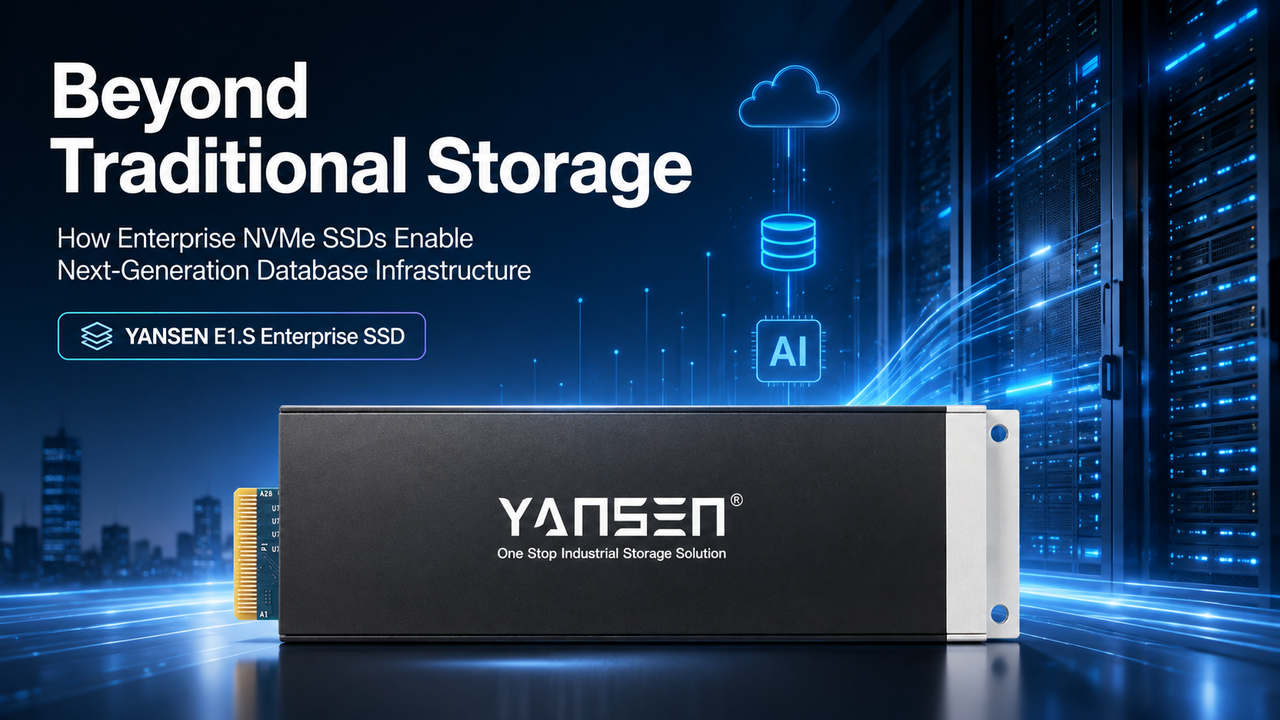
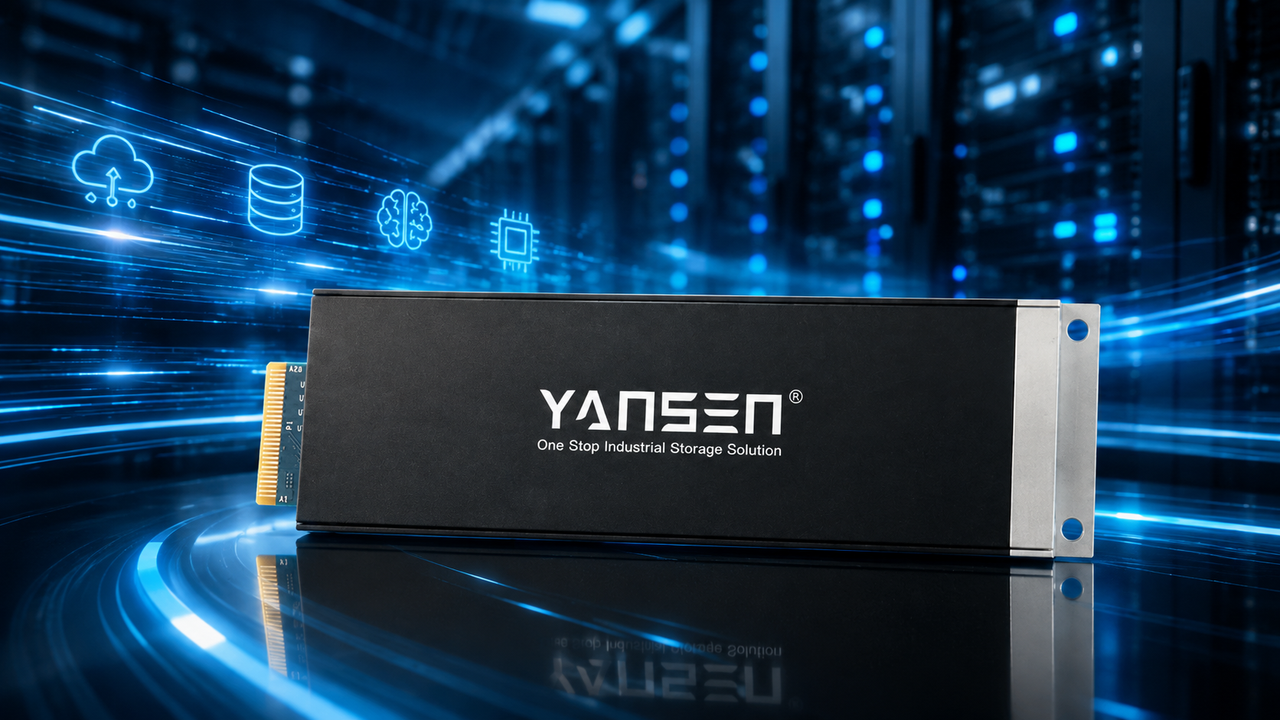
5. YANSEN E1.S Enterprise SSD Solution

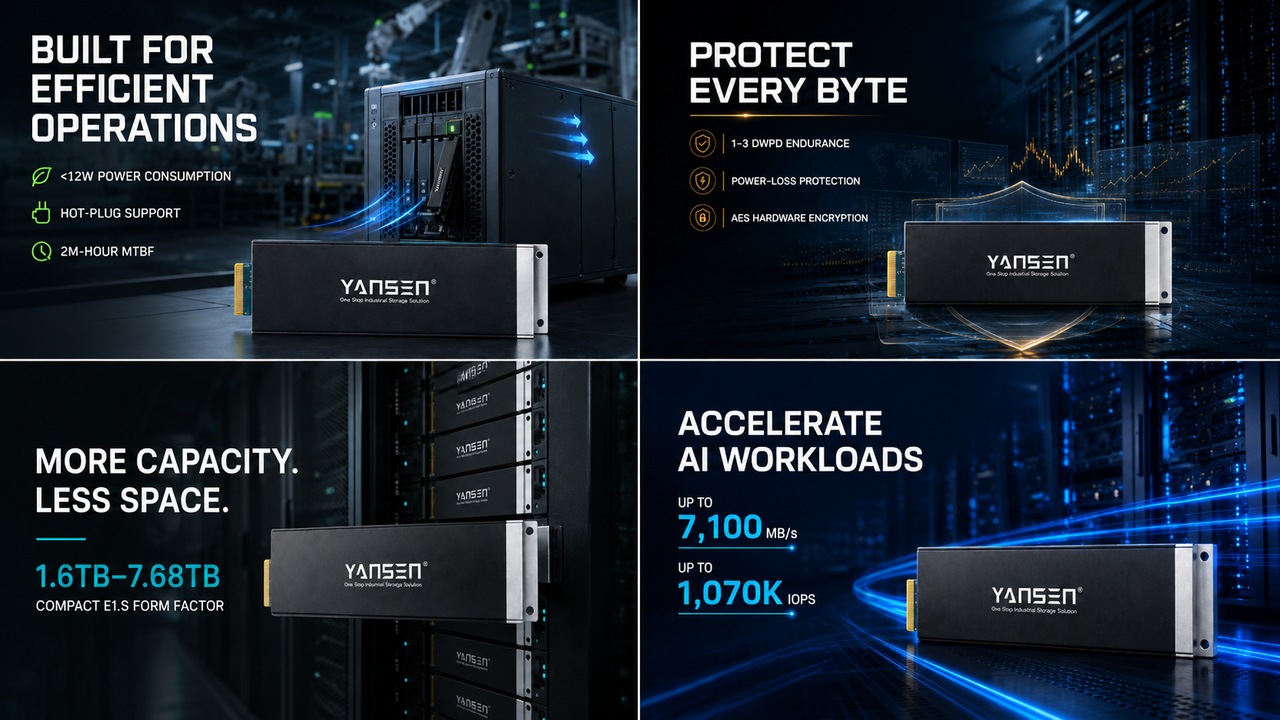
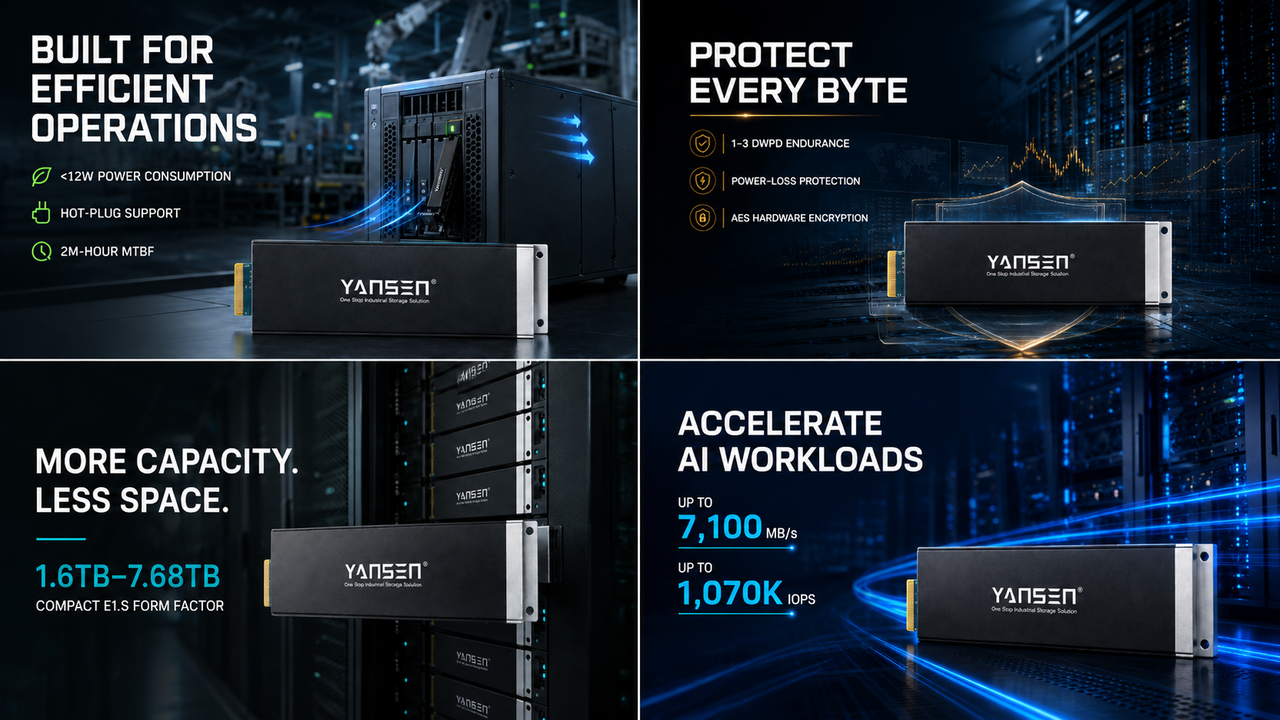
Recognizing the shift toward EDSFF, YANSEN has developed the E1.S industrial SSD and enterprise-grade SSD series, engineered for demanding workloads:

  • PCIe Gen4 Interface: Future-proof performance platform
  • Enterprise eTLC NAND: Ensures high endurance
  • Capacity up to 7.68TB: Reduces system SSD count, simplifying management
  • High DWPD Design: Optimized for heavy write workloads
  • Power-Loss Protection (PLP): Ensures data integrity under unexpected shutdowns
  • Front-Accessible Hot-Swap: Reduces maintenance downtime
  • MTBF: 2Million Hours: Guarantees long-term reliability
  • AES-256 Encryption: Protects sensitive data

Application Scenarios:

  • AI Inference Servers: Handles high-throughput analytics and model execution
  • Edge Datacenters: Supports compact, high-density deployments
  • Industrial Computing Clusters: Provides stable, long-term operation in demanding environments

By aligning form factor and enterprise-grade features, YANSEN E1.S SSDs deliver predictable performance, thermal efficiency, and lifecycle assurance, essential for hyperscale and industrial deployments.

6. Procurement Perspective: Choosing the Right Form Factor

Selecting EDSFF drives should not be based solely on raw performance. Consider:

  • System Architecture:Does your deployment require high-density 1U servers or standard 2U/3U configurations?
  • Thermal Constraints:Are airflow and cooling optimized for dense rack deployments?
  • Serviceability Needs:Is hot-swap critical to minimize downtime?
  • Long-Term Supply Assurance:Can your vendor guarantee consistent NAND and controller components for 5–10 years?

Unlike consumer-grade SSDs, industrial and enterprise SSD procurement prioritizes reliability, serviceability, and predictable long-term supply. YANSEN’s E1.S series addresses all these factors, providing both technical performance and operational assurance.

7. Market Timing: Why Transition to EDSFF Now

Several trends make now the ideal time for EDSFF adoption:

  • PCIe 5.0 adoptionincreases bandwidth and power requirements.
  • AI workloadsrequire higher IOPS and lower latency.
  • Rack-space cost pressuresdemand high-density storage solutions.
  • Edge computing and micro datacentersblur the line between enterprise and industrial deployments.

EDSFF is not merely a design trend—it is an architectural solution for the next generation of datacenter workloads.

8. Conclusion: EDSFF as the Future of Enterprise and Industrial Storage

EDSFF (E1.S) is more than a new form factor; it represents a strategic evolution in datacenter architecture, addressing density, thermal efficiency, and serviceability.

With YANSEN E1.S SSDs, industrial and enterprise customers benefit from:

  • High-density, high-power NVMe deployment
  • Front-access serviceability and hot-swap support
  • Enterprise-grade endurance, reliability, and lifecycle management

Transitioning to EDSFF ensures your storage infrastructure is future-ready, efficient, and reliable, making it the logical choice for AI, cloud, and industrial applications.

FAQ: EDSFF (E1.S) for Enterprise and Industrial SSDs

Q1: What makes EDSFF (E1.S) different from U.2 and M.2?
A1: EDSFF is a structural redesign aimed at high-density and high-power NVMe deployment. Compared to U.2 and M.2, it supports higher power, optimized thermal management, hot-swap capability, and greater storage density per rack unit.

Q2: Do industrial SSDs benefit from EDSFF?
A2: Yes, particularly edge computing and industrial clusters where high-density deployment and serviceability are important. However, embedded systems may still use M.2 or U.2 with wide-temperature, shock-resistant, and PLP features instead of relying on hot-swap.

Q3: Does EDSFF replace PCIe or NVMe?
A3: No. EDSFF only defines the form factor. NVMe and PCIe remain the protocol and interface standards. EDSFF optimizes how these protocols are implemented in dense, high-power environments.

Q4: How does YANSEN ensure reliability for E1.S SSDs?
A4: YANSEN E1.S SSDs undergo system-level validation, thermal and airflow testing, and PLP verification to ensure 24/7 stability. They are designed for AI servers, edge datacenters, and industrial applications.

Q5: When should I transition to EDSFF in my datacenter?
A5: Consider EDSFF if you require high rack density, hot-swappable serviceability, and high-power NVMe deployment. For standard enterprise servers with less density requirement, U.2 may remain sufficient. YANSEN can advise on the optimal solution for your workload, rack, and operational environment.

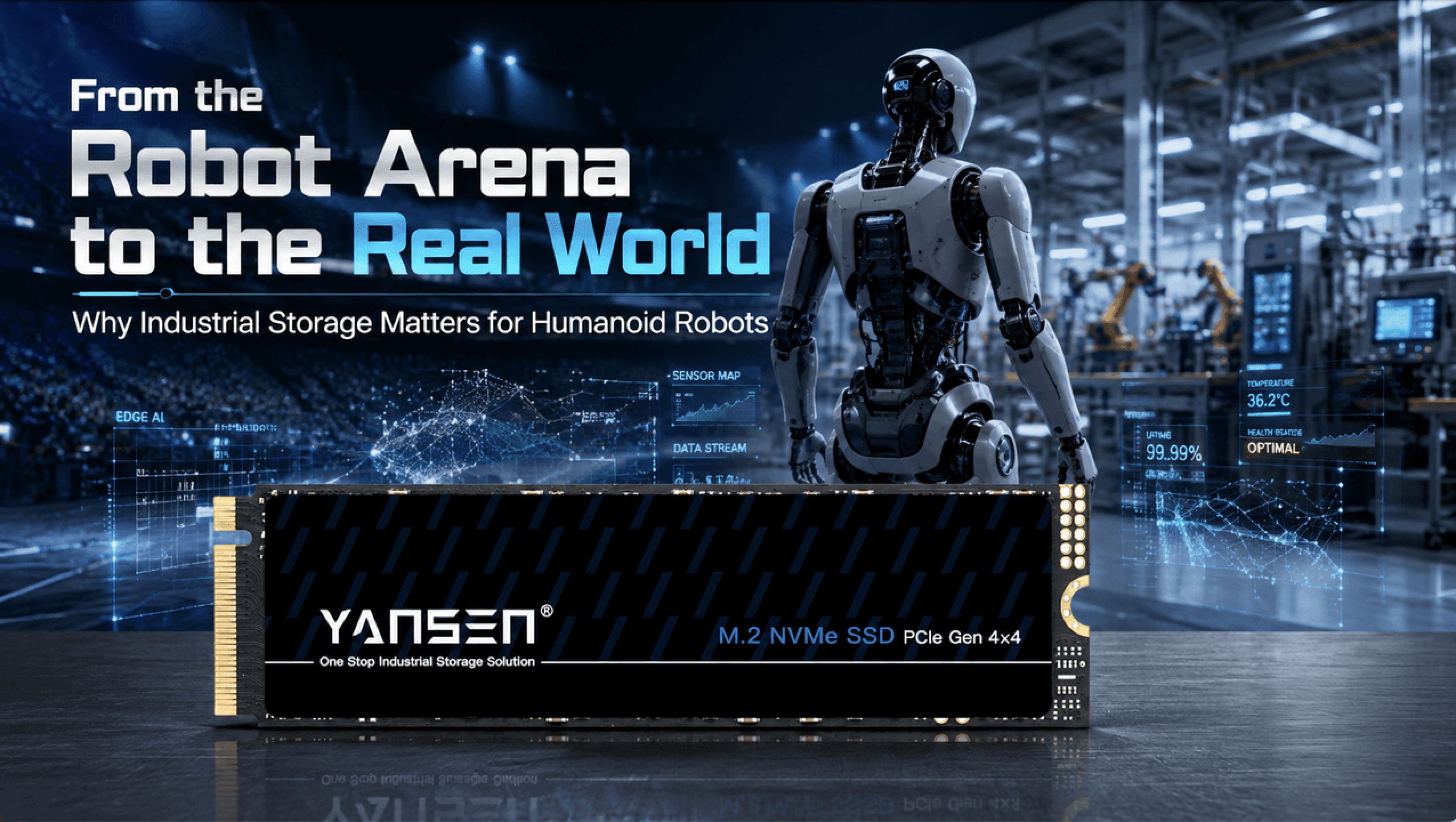
From “WuBot” to the Future of Robotics: The Storage Power Behind Humanoid Performance

In 2026, several leading technology companies, including Unitree Robotics, Dreame Technology, MagicLab, Galaxy General Robotics, and Songyan Dynamics, were featured during the CCTV Spring Festival Gala, highlighting the rapid advancement of China’s humanoid robot technology and robotics industry ecosystem.

Among the highlights was the widely discussed “WuBot” performance, where multiple humanoid robots executed high-precision, synchronized martial arts routines.

Beyond the visual spectacle, the show was a powerful demonstration of cutting-edge robotics engineering, raising an essential question: what technical systems enable humanoid robots to execute complex actions with such precision? At the heart of this innovation lies massive data processing and high-performance storage infrastructure, turning robots into fully functional, mobile data centers.

The Storage Power Behind Humanoid Performance

1. Understanding the Technology Behind Humanoid Robots

1.1 Hardware Layer: Mechanics Meets Sensing Systems

Humanoid robots are far more than moving machines. Their hardware architecture combines mechanical components with sophisticated sensing systems to process real-world stimuli in real time. Key elements include:

  • Multi-degree-of-freedom joint systems for fluid, human-like movement
  • IMU (Inertial Measurement Units) and vision cameras for real-time perception
  • Force feedback sensors to monitor and adjust movement dynamics
  • Edge computing units embedded for local processing and decision-making

These systems generate terabytes of data every second. To maintain balance, execute dynamic movements, and interact with the environment, robots rely on ultra-fast data processing. The speed of this data pipeline is critical: milliseconds of delay can result in movement errors or failed synchronization. This is where storage for robotics systems and edge computing SSD solutions play a pivotal role.

1.2 Software Layer: Algorithms, Models, and AI-Driven Decisions

Humanoid robots operate on complex software frameworks that integrate reinforcement learning, pre-trained action databases, real-time balance algorithms such as MPC (Model Predictive Control) and ZMP (Zero Moment Point), and collaborative synchronization protocols for group performances. The process follows a continuous loop:

  • AI-based training generates motion models
  • Data is stored and indexed in high-speed storage
  • Models are retrieved locally during execution
  • Real-time adjustments occur based on sensory input

This data-driven workflow demands high-performance storage for AI robotics infrastructure, ensuring that model retrieval, caching, and logging happen without bottlenecks.

2. Three Core Storage Scenarios in Humanoid Robotics

The Storage Power Behind Humanoid Performance

2.1 AI Model Training — Data Center Storage Requirements

Developing humanoid robot AI models requires massive datasets, including:

  • Terabytes of video recordings for motion capture
  • Tens of terabytes of simulation and environmental data
  • Frequent read/write operations for iterative model training

Traditional storage interfaces are insufficient to handle this scale. Modern AI training clusters increasingly adopt PCIe NVMe SSDs, particularly:

  • PCIe 4.0 SSDs: Offering 16 GT/s per lane and read speeds around 7 GB/s
  • PCIe 5.0 SSDs: Delivering up to 32 GT/s per lane and over 12 GB/s

These high-speed SSDs enable faster data loading, accelerated AI model iteration, and optimal GPU utilization. For robotics R&D enterprises, storage bandwidth is no longer secondary—it directly impacts AI training efficiency. Products like YANSEN enterprise-grade NVMe SSDs in EDSFF E1.S form factor offer dense, reliable storage for AI training infrastructure.

2.2 Onboard Robot Storage — Industrial Edge SSDs

Once deployed, humanoid robots operate in environments that require resilient edge computing storage solutions. Onboard tasks include:

  • Storing action libraries and behavioral datasets
  • Caching AI models for low-latency decision-making
  • Logging sensory data continuously
  • Writing operational metrics for performance analysis

Challenges for edge storage include vibration, high-frequency writes, wide temperature ranges, and sudden power losses. Industrial-grade SSDs provide:

  • High Total Bytes Written (TBW) for long-term endurance
  • Wide temperature operation ranges for reliable field performance
  • Power-loss protection to safeguard data integrity
  • Stable firmware for deterministic behavior in autonomous systems

YANSEN industrial NVMe and SATA SSDs are specifically engineered for these robotic and automation applications, ensuring the integrity of real-time data processing and control.

2.3 Real-Time Collaborative Systems — Low-Latency Caching

During performances like “WuBot,” multiple robots must execute perfectly synchronized actions. Storage latency can directly affect:

  • Frame-level motion synchronization
  • Timely network data distribution
  • Real-time corrective feedback loops

Even minor delays can disrupt choreography, highlighting the need for low-latency edge computing SSDs. Consistency and fast data access are crucial, especially when robots operate as a coordinated swarm or collaborative system.

3. How Humanoid Robotics Drives Storage Industry Trends

The next five years will see humanoid robots adopted in diverse sectors:

  • Manufacturing and automation
  • Commercial services and customer engagement
  • Healthcare and caregiving
  • Education, entertainment, and interactive learning
  • Logistics and warehouse operations

Each robot functions as a local AI terminal and continuous data-writing node. This evolution leads to storage trends such as:

  • Growing demand for industrial-grade SSDs
  • Rapid expansion of edge AI storage solutions
  • Increased enterprise storage capacity for training clusters
  • Replacement of consumer-grade storage with robust, high-reliability industrial solutions

Humanoid robotics is reshaping the requirements for storage infrastructure, driving innovation and adoption of high-performance SSDs.

4. Lessons from “WuBot”: Upgrading Infrastructure for the AI Era

The Storage Power Behind Humanoid Performance

“WuBot” represents more than entertainment—it signals the arrival of an AI-driven robotics era. The foundation of all intelligent machines lies in:

  • High-compute power for AI processing
  • Reliable enterprise and industrial-grade storage
  • Real-time, low-latency data pipelines

Without a robust storage backbone, humanoid robotics cannot achieve full operational potential. In this context, enterprise NVMe SSDs, industrial SSDs, and edge computing storage solutions are no longer optional—they are mission-critical.

5. Conclusion & Call to Action

As humanoid robots evolve, the importance of reliable, high-performance storage becomes undeniable. From AI training clusters to edge robotic systems, enterprise-grade and industrial-grade SSDs form the backbone of intelligent automation.

Businesses and developers looking to integrate high-performance humanoid robots into their operations should consider:

  • Exploring enterprise-grade storage solutions for AI and robotics
  • Leveraging industrial SSD products for edge computing applications
  • Engaging technical teams to optimize storage infrastructure for robotics deployments

With cutting-edge storage solutions, the robotics industry can unlock unprecedented capabilities, driving innovation across research, industrial, and consumer applications.

6. FAQ

Q1: What is humanoid robot technology and why is storage important for it?
A1: Humanoid robot technology refers to robots designed to mimic human movements and behaviors. These robots generate massive amounts of data every second from sensors, cameras, and motion systems. High-performance storage, such as industrial SSDs and edge computing SSDs, is critical for real-time data processing, AI model execution, and reliable operation.

Q2: How does NVMe SSD improve AI robotics infrastructure?
A2: NVMe SSDs, particularly PCIe 4.0 NVMe SSDs and PCIe 5.0 SSDs, offer ultra-high bandwidth and low latency. This allows AI training clusters to process terabytes of video, simulation, and model data efficiently, boosting GPU utilization and reducing AI model training time in robotics applications.

Q3: Why do robots need edge computing in robotics?
A3: Robots rely on edge computing to process data locally, enabling real-time responses without waiting for cloud communication. Edge computing storage solutions, including industrial NVMe SSDs, store AI models, motion databases, and sensor data, ensuring low-latency decision-making for humanoid robots in dynamic environments.

Q4: What types of storage are used in robotics data storage systems?
A4: Robotics data storage systems use high-performance storage for AI, such as enterprise SSDs for AI training, industrial NVMe SSDs for edge devices, and high-reliability SSDs to handle vibration, temperature fluctuations, and frequent writes. These storage solutions maintain stability and ensure continuous operation of robotics systems.

Q5: How does high-performance storage support real-time collaboration among robots?
A5: In scenarios like synchronized humanoid robot performances, low-latency storage ensures data frames and action commands are distributed and cached in real time. Edge computing SSDs provide consistent, high-speed access, preventing delays or synchronization errors across multiple robots.

Q6: What trends in the robotics industry are driving storage demand?
A6: As humanoid robots enter manufacturing, healthcare, education, logistics, and entertainment, demand for high-capacity, industrial-grade, and low-latency SSDs increases. Storage requirements expand for AI training, edge computing, and collaborative robot systems, driving adoption of PCIe 4.0 and PCIe 5.0 NVMe SSDs in the robotics industry.

Q7: Why choose YANSEN industrial SSDs for robotics applications?
A7: YANSEN industrial NVMe and SATA SSDs are designed for edge robotics applications. They offer high TBW, power-loss protection, wide operating temperature ranges, and stable firmware, making them ideal for humanoid robots that operate under high vibration, frequent writes, and real-time computing requirements.

Related News

Our Advantage

Industrial Storage Solutions

YANSEN's industrial storage solutions are designed for extreme environments, offering high durability and reliability under harsh conditions. With advanced error correction, data protection and extended wide temperature support, they ensure consistent performance in demanding industrial applications.

Enterprise Storage Solutions

YANSEN's enterprise storage solutions deliver exceptional speed and scalability, tailored for data-intensive workloads. Optimized for reliability and security, they are ideal for mission-critical applications in modern data centers.

Embedded Storage Solutions

YANSEN's embedded storage solutions are compact, efficient, and highly customizable, perfect for integration into various devices. With low power consumption and high endurance, they ensure optimal performance and longevity in embedded systems.

SmartKit

coming soon

FAQ of CFast

Related News of CFast

Contact Us

Please fill out the inquiry form below to provide us with your specific requirements, and we will promptly assist you.

FAQs of Industrial SSD

YANSEN’s industrial SSD solutions are mostly applied in industries like manufacturing, aerospace, automotive, energy, and transportation, where extreme environments are usual hence reliability crucial.

Yes, YANSEN SSDs are generally more expensive than regular consumer-grade SSDs. This is due to the specialized components, advanced features, and rigorous testing required to meet strict industrial standards.

Using a normal SSD in an industrial environment is generally not recommended due to the lack of necessary ruggedization, durability, and reliability features. Industrial SSDs are specifically designed to handle the extreme conditions, which are real challenges for regular SSDs.

FAQs of Enterprise SSD

An enterprise SSD (Solid State Drive) is a type of storage device specially designed for use in enterprise applications which offers high performance, reliability, and endurance, making it the most suitable choice for heavy workloads and demanding applications.

Enterprise SSDs generally offer faster data access, lower power consumption, and increased reliability compared to traditional hard disk drives. They also provide better performance for data-intensive applications and workloads.

Enterprise SSDs are designed to meet the demanding enterprise environments, with features such as higher endurance, power-loss protection, and advanced error correction. They are also required to go through tests and validations for use in critical applications and data centers.

When choosing an enterprise SSD, factors such as performance, endurance, reliability, power efficiency, and compatibility with existing infrastructure should be considered. It’s also important to consider the specific requirements of the enterprise workload and application.

Get Quote