Artificial intelligence is changing not only how data is processed, but also how much data must be generated, moved, cached, and retained. As AI evolves from simple chatbots to reasoning systems and autonomous agents, storage is becoming a core part of the computing stack—and the market is beginning to feel the pressure.
From Chatbots to Agents: A Step Change in Storage Demand
Industry presentation data illustrates the scale of the shift. A conventional chatbot may process about 1,000 tokens per task and require roughly 10 MB of peak KV cache per user. A standard agent can consume around 40,000 tokens for a task, use 100 MB to 1 GB of peak KV cache, and call tools repeatedly. Long-running agents may consume millions of tokens and require several to tens of gigabytes of KV cache per user.
In practical terms, estimated token consumption rises from 1× for chatbots to 4–15× for agents and 10–100× for long-running agents. Persistent memory, user preferences, conversation history, intermediate reasoning, and tool outputs all add to the amount of data that must be stored and accessed quickly.
The NAND Market Is Moving into Deficit
The supply outlook points in the same direction. Industry estimates show global NAND demand slightly exceeding supply in 2025, with the gap widening in 2026 before remaining negative in 2027. Demand is forecast to reach 1,130 EB in 2026, compared with 1,071 EB of supply—a projected deficit of 5.22%.
|
Year
|
NAND Supply
|
NAND Demand
|
Supply Gap
|
|
2024
|
839 EB
|
778 EB
|
+7.84%
|
|
2025E
|
986 EB
|
988 EB
|
−0.20%
|
|
2026E
|
1,071 EB
|
1,130 EB
|
−5.22%
|
|
2027E
|
1,447 EB
|
1,501 EB
|
−3.60%
|
China’s Export Data Adds a Market-Side Signal
China Customs data provides further evidence of the shift toward higher-value storage products. In the first quarter of 2026, China exported USD 72.47 billion of integrated circuits, up 77.5% year over year. Export volume, however, increased by only 13.4%, indicating a sharp rise in the average export value and a more valuable product mix.
Memory products were the standout category: exports reached USD 45.99 billion, accounting for 63.3% of China’s total integrated-circuit export value and rising 174.2% year over year. Memory was the only category to outpace the overall growth rate of integrated-circuit exports. Industry observers attribute this surge to both the cyclical tightening of global memory supply and structural changes, including faster domestic substitution and rising market share for Chinese suppliers.
This does not mean every product category will face the same conditions, but it does indicate a tighter market in which capacity planning, procurement visibility, and supply resilience become more important.

KingSpec Is Preparing for the Next Demand Cycle
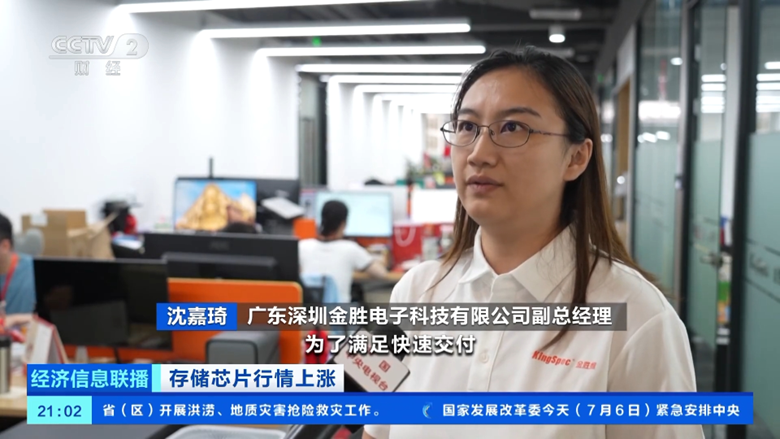
Against this backdrop, KingSpec is optimizing production-line configurations, increasing automation, and strengthening supply chain coordination. The goal is to improve manufacturing efficiency, delivery reliability, and the flexibility to support different order volumes, product specifications, and schedules.
The broader supply side is also accelerating. The same industry materials forecast that China’s equipment demand across NAND, DRAM, and advanced logic could rise from approximately USD 21.1 billion in 2025 to USD 70 billion in 2028. For advanced storage alone, projected equipment demand increases from USD 9.85 billion to USD 46 billion over the same period. These figures are forecasts rather than customs statistics, but they signal strong investment expectations across the domestic semiconductor ecosystem.
Storage Built Around Real-World Workloads
KingSpec continues to develop solid-state drives, memory modules, and industrial storage around the needs of specific applications:
-
AI servers and enterprise systems — high throughput, large capacity, consistent performance, and dependable supply.
-
Industrial and edge applications — stable operation under vibration, temperature variation, electromagnetic interference, and unstable power.
-
AI PCs and workstations — faster local access and greater capacity for content creation, analytics, and local model deployment.
Turning Market Pressure into Long-Term Value
AI is making storage a strategic resource. As workloads become longer, more stateful, and more data-intensive, customers will judge suppliers not only by product specifications, but also by quality management, lifecycle support, capacity readiness, and delivery performance.
By investing in manufacturing capabilities and application-oriented storage solutions, KingSpec aims to help customers navigate a tighter market and build the reliable data infrastructure required for the intelligent era.