Introduction: When Heat Becomes the Invisible Killer of Industrial Storage
In the world of industrial computing, intelligent manufacturing, railway transportation, and smart energy systems, solid-state drives (SSDs) have become indispensable as the backbone of data storage. Yet, as storage performance and density continue to grow, thermal management has emerged as the invisible but decisive factor in determining the reliability of industrial-grade SSDs.
Unlike consumer SSDs, which typically operate in controlled environments such as offices or data centers, industrial-grade SSDs must survive in harsh environments: extreme heat, freezing cold, high-frequency vibration, dusty enclosures, and limited airflow. Under these conditions, traditional heat dissipation methods—whether passive heat sinks or small cooling fans—often fail, creating the risk of thermal throttling, premature wear, or even sudden data loss.
This article provides an in-depth exploration of the state of industrial SSD thermal management, analyzing current technologies, persistent challenges, and the innovations shaping the future.
 1. Current State of Technology: From Passive Protection to Intelligent Closed-Loop Systems
1.1 Passive Cooling: Foundational Yet Limited
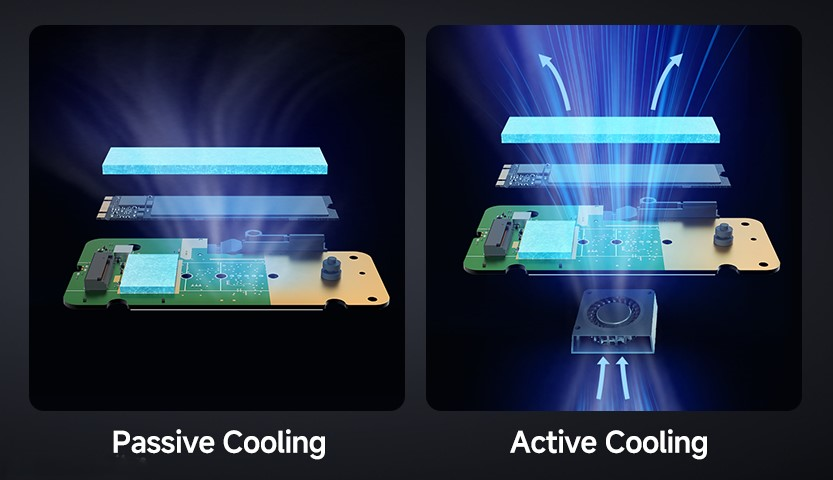
For decades, passive cooling has been the baseline thermal strategy for SSDs. Common solutions include aluminum heat sinks paired with thermal grease to transfer heat from NAND chips and controllers to the SSD casing.
In environments reaching 85°C, passive convection is often insufficient. Temperature rise rates can reach 12°C per hour, quickly surpassing safe operating thresholds in high-load industrial scenarios such as edge AI inference or real-time railway monitoring.
Passive methods are lightweight and reliable, but they cannot cope with high power densities in compact industrial machines, nor can they adapt to fluctuating workloads.
1.2 Active Cooling: A Trade-Off Between Performance and Complexity
As workloads intensify, manufacturers have increasingly experimented with active cooling methods.
Micro Fans: SSD integrates a brushless fan capable of 20 CFM airflow. However, in dusty environments like mining or factories, the failure rate can reach 15%, undermining long-term reliability.
Liquid Cooling Cold Plates: SSD liquid-cooled version achieves 5× thermal efficiency improvement over air-based systems. However, liquid cooling adds mechanical complexity, higher costs, and maintenance overhead, limiting adoption in cost-sensitive deployments.
Thus, while active cooling improves thermal headroom, the trade-off lies in reliability, cost, and environmental suitability.
1.3 Intelligent Thermal Control: The Closed-Loop Revolution
The most promising advancement in SSD thermal management has been the adoption of closed-loop intelligent systems that integrate sensors, algorithms, and firmware.
- Multi-Node Sensors: The YANSEN5 inch SATA SSD deploys sensors at the controller, NAND chips, and PCB, creating a temperature-time mapping model for predictive adjustments.
- Dynamic Frequency Scaling:
Three-Stage Thermal Control: At 85°C, current limiting begins; at 95°C, speed reduction is enforced; at 100°C, emergency shutdown is triggered.
Gradual Throttling: YANSEN’s Thermal Throttling Technology avoids abrupt performance drops, ensuring continuity of industrial workloads.
This shift from reactive protection to proactive prediction represents a paradigm change: SSDs no longer merely endure heat but actively manage it.
1.4 Breakthroughs in Materials Science
Recent advancements in thermal interface materials (TIMs) are redefining SSD heat management.
- Graphene Heat Spreaders: With a thermal conductivity of 5000 W/m·K, graphene films can be applied inside SSD packaging to reduce thermal resistance. In one defense project, this lowered SSD thermal resistance to 05°C/W.
- Nano-Silver Solder: By replacing conventional tin solder, nano-silver pastes reduce contact thermal resistance by 30%, improving long-term efficiency and reliability under thermal stress.
Material innovation is thus becoming a critical enabler for next-generation industrial SSDs.
2. Core Challenges: The Survival Test in Extreme Environments
Despite progress, four major challenges remain the bottleneck for industrial SSD thermal management:
|
Challenge Dimension |
Specific Problem |
Industry Pain Point Example |
|
Extreme Temperatures |
At -55°C, NAND leakage rate increases by 300%; at 85°C, NAND lifespan decays 5× faster |
A photovoltaic SSD throttled due to heat, causing data acquisition delays |
|
Space Constraints |
Industrial PCs allow M.2 slot thickness ≤22mm; traditional heat sinks are incompatible |
Railway SSDs blocked by oversized heat spreaders, causing design conflicts |
|
Power vs. Performance |
Instantaneous power draw can reach 15W during AI inference; difficult to balance cooling and performance |
Edge nodes throttled, causing 40% inference latency increase |
|
Vibration & Shock |
Robotic arms generate 5–20G vibrations, loosening SSD connectors and solder joints |
Mining SSDs reached 20% failure rate due to vibration damage |
This demonstrates that thermal management is not an isolated issue, but deeply intertwined with mechanical design, power efficiency, and environmental survivability.

3. Future Trends: From Passive Endurance to Active Mastery
3.1 AI-Driven Predictive Cooling
By leveraging machine learning, SSDs can analyze workload patterns and preemptively activate cooling strategies.
- Case Study: A hyperscale data center reduced itsPower Usage Effectiveness (PUE) from 5 to 1.2 by integrating AI-optimized cooling strategies.
3.2 3D Stacking and Microfluidic Cooling
Future SSDs will integrate microfluidic channels within 3D NAND packages, enabling self-circulating liquid cooling through capillary action.
- Research labs are already prototyping 3D NAND stacks exceeding 200 layers, with per-die capacity up to 4TBand 18% lower power per bit.
This combination of density scaling and thermal efficiency will redefine SSD design for high-load industrial systems.
3.3 Self-Healing Thermal Coatings
New coatings embedded with microcapsule phase-change materials (PCMs) can release cooling agents when damaged.
- Example: Coatings using paraffin-filled capsulesextend protective lifespan to 10 years in mining or maritime application
3.4 Thermoelectric Cooling (TEC) Integration
By exploiting the Peltier effect, TEC modules can create active temperature differentials of up to 60°C, enabling SSDs to function in -55°C Arctic conditions.
- A military-grade SSD with TEC integration has already demonstrated stable operation in sub-zero environments.
3.5 Standardization and Modular Designs
To improve serviceability, vendors are pursuing standardized thermal modules compatible with popular SSD form factors.
This modular approach allows industries to balance performance, cost, and maintainability more effectively.
Conclusion: Heat Management Defines the Future of Industrial Storage
In the age of Industry 4.0 and intelligent automation, SSD thermal management is no longer a secondary feature—it has become a core competency.
The shift is clear:
- From passive endurance→ to active intelligence
- From simple heat sinks→ to AI-driven, material-science-enhanced, system-wide cooling strategies
Future SSDs will not only survive in extreme temperatures and vibrations, but they will also self-adapt, predict failures, and sustain mission-critical data flows.
Ultimately, thermal management defines whether an industrial SSD can truly serve as the “digital heartbeat” in factories, rail systems, aerospace, and energy networks. For enterprises, designing with thermal resilience at the core will be the deciding factor in staying competitive in the digital era.