Introduction: When “Perpetual Motion” Becomes the Standard for Industrial Storage
In modern industrial applications—whether on automated manufacturing lines, railway signaling systems, offshore oil rigs, or deep-sea exploration equipment—storage devices must operate like perpetual motion machines. Industrial-grade SSDs (Solid State Drives) are designed not just for speed or capacity, but for uninterrupted 24/7 operation under the harshest conditions.

While consumer SSDs may excel in office or home environments, they struggle when confronted with extreme temperatures, constant vibration, heavy dust, high humidity, or unpredictable power outages. To survive, industrial-grade SSDs must endure a rigorous qualification process involving more than 20 different environmental, electrical, and reliability tests—each simulating a “worst-case scenario” to expose weaknesses before deployment.
This article takes a deep dive into the hidden world of industrial SSD testing, examining how manufacturers validate performance from -40°C Arctic cold starts to 85°C desert heat, from 20G continuous vibration to 1500G shock impacts, and from humidity chambers to salt spray corrosion. These tests reveal why industrial SSDs can be trusted as the digital heart of Industry 4.0 systems.

1. Environmental Stress Testing: Conquering –40°C to +85°C Extremes
1.1 High-Low Temperature Cycling
Test Standard:
Range: -40°C to +85°C
Duration: Each stage maintained for 12 hours
Cycles: 500 full transitions (based on military-grade standards such as MIL-STD-810G)
Testing Equipment: YANSEN ZS1000-80
Technical Challenges:
- NAND flash leakage: At extremely low temperatures, electron leakage in NAND cells can increase by up to 300%, jeopardizing data integrity.
- Controller current leakage: At high temperatures, SSD controllers experience elevated leakage currents, threatening both stability and endurance.
Solutions:
- Wide-temperature NAND flash, such as YANSEN YSNN5M7XT, the M.2 PCIe4.0 2280 SSD, ensures charge stability in low-temp environments.
- Optimized power management ICsreduce current leakage in high-temperature operation.
Case Study:
In one aerospace project, an industrial-grade SSD was subjected to -40°C cold starts. Within 5 minutes, the device completed full data self-checks, achieving 100% data integrity. This capability ensures satellites, drones, and aviation equipment can reliably capture mission-critical telemetry data.
1.2 Humidity and Salt Spray Resistance
Test Standard:
- 85°C / 95% RH (relative humidity)sustained for 168 hours
- 10% NaCl salt sprayfor 96 continuous hours
- Testing Equipment: YANSEN ZS1000-80
Protective Measures:
- Conformal coatings: PCB surfaces sealed with triple-protection coatings against moisture, dust, and corrosion.
- Anti-sulfuration design: Special solder formulations prevent metallic oxidation in high-sulfur coastal or marine environments.
Industrial Context:
In offshore wind turbines, where SSDs face salt-laden air, high humidity, and fluctuating temperatures, these protective measures ensure consistent long-term performance—critical for real-time monitoring and predictive maintenance systems.
2. Beyond Environment: Electrical and Reliability Stress Tests
2.1 Power Cycling and Sudden Power Loss Tests
Industrial SSDs must handle unplanned shutdowns gracefully. Tests simulate over 100,000 power cycles as well as instantaneous blackouts during active write operations.
Key Innovations:
- Power-loss protection (PLP) capacitors: Provide microseconds of backup power, allowing SSDs to complete in-flight writes.
- Firmware-level journaling: Ensures metadata consistency, preventing corruption after sudden outages.
2.2 Endurance and Write Amplification Stress Tests
Workloads such as industrial IoT logging or edge AI inference caching can generate continuous write operations. Industrial SSDs undergo DWPD (Drive Writes Per Day) validation, with some rated at 1–3 DWPD for five years, far exceeding consumer standards.
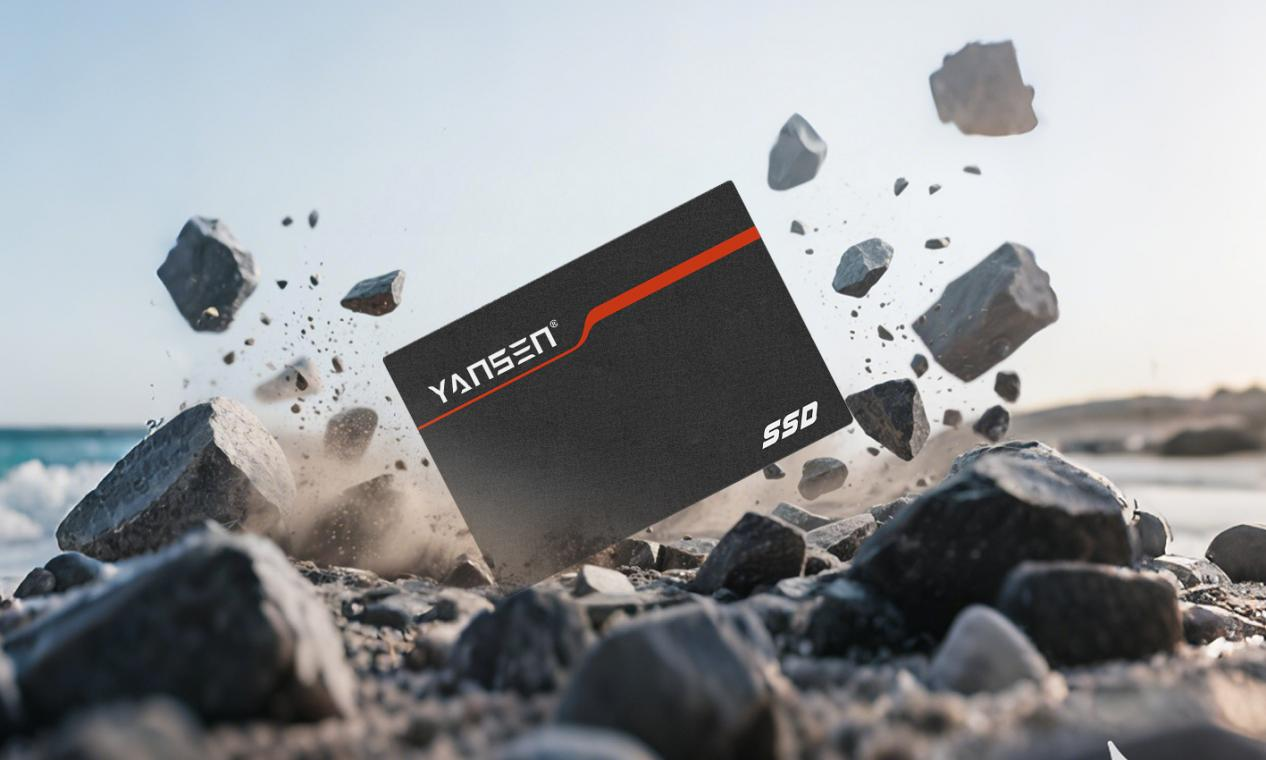
3. The Technology Behind 24/7 Operation
3.1 Wide-Temperature Design
Industrial SSDs integrate -40°C to +85°C wide-temp controllers and high-grade NAND flash. Components undergo accelerated aging tests to predict lifespan under harsh conditions.
3.2 Dynamic Thermal Management
Integrated multi-node temperature sensors provide real-time data. Firmware employs predictive throttling to adjust voltage and frequency dynamically, avoiding catastrophic overheating while maintaining uptime.
3.3 Ruggedized PCB and Housing
PCB designs feature:
- Thicker copper tracesfor heat dissipation.
- Epoxy resin reinforcementfor vibration tolerance.
- Metal casingswith graphene thermal foils for efficient heat spreading.
Conclusion: No Perfect SSDs, Only Relentlessly Tested Ones
The pursuit of absolute reliability in data storage leads to one undeniable truth: there are no inherently perfect SSDs, only those forged through relentless and rigorous testing. This is where YANSEN distinguishes itself.
As an industry leader with over 18 years of R&D experience and its own 3,000-square-meter intelligent manufacturing base, YANSEN possesses profound expertise in industrial-grade SSD validation. Leveraging this mature technology and experience, the company has independently developed the versatile YANSEN ZS1000-80, a dedicated intelligent testing system for industrial SSDs.
This advanced equipment simulates military-grade challenges, including extreme temperature cycles, humidity tests, and sudden power-loss protection tests. By subjecting every YANSEN industrial SSD to this uncompromising, continuous scrutiny, we ensure that each drive meets the diverse and demanding needs of various sectors, guaranteeing 24/7 stable operation and unwavering reliability in every application. It never stops.
As industries accelerate toward AI-driven automation, smart factories, and edge computing, the demand for always-on, mission-critical storage will continue to grow. YANSEN will continue to invest in technological innovations in industrial-grade SSDs, including predictive AI monitoring and wide-temperature design, evolving them from mere data guardians to key pillars of Industry 4.0 systems.
FAQ: Industrial-Grade SSD Testing and Reliability
Q1: How are industrial SSDs different from consumer SSDs?
Industrial SSDs are designed for extreme environments (-40°C to 85°C), constant vibration, power instability, and 24/7 workloads. Consumer SSDs focus on cost and speed, while industrial SSDs prioritize longevity, resilience, and data integrity.
Q2: Why is power-loss protection so critical in industrial SSDs?
Industrial systems often face sudden outages. Without PLP, data corruption can occur. With supercapacitors and log rollback mechanisms, industrial SSDs guarantee 100% data recovery after blackouts.
Q3: What is the significance of MTBF in SSDs?
MTBF (Mean Time Between Failures) indicates expected reliability. Industrial SSDs target ≥3 million hours, far exceeding consumer drives (~1 million hours).
Q4: Do industrial SSDs sacrifice performance for reliability?
Not necessarily. Advanced controllers, thermal throttling, and AI-driven management allow high-speed performance with consistent reliability, even in mission-critical settings.
Q5: Which industries benefit most from industrial SSDs?
Sectors such as railway systems, aerospace, oil & gas, manufacturing automation, and defense rely heavily on industrial SSDs to ensure continuous operation and data safety.