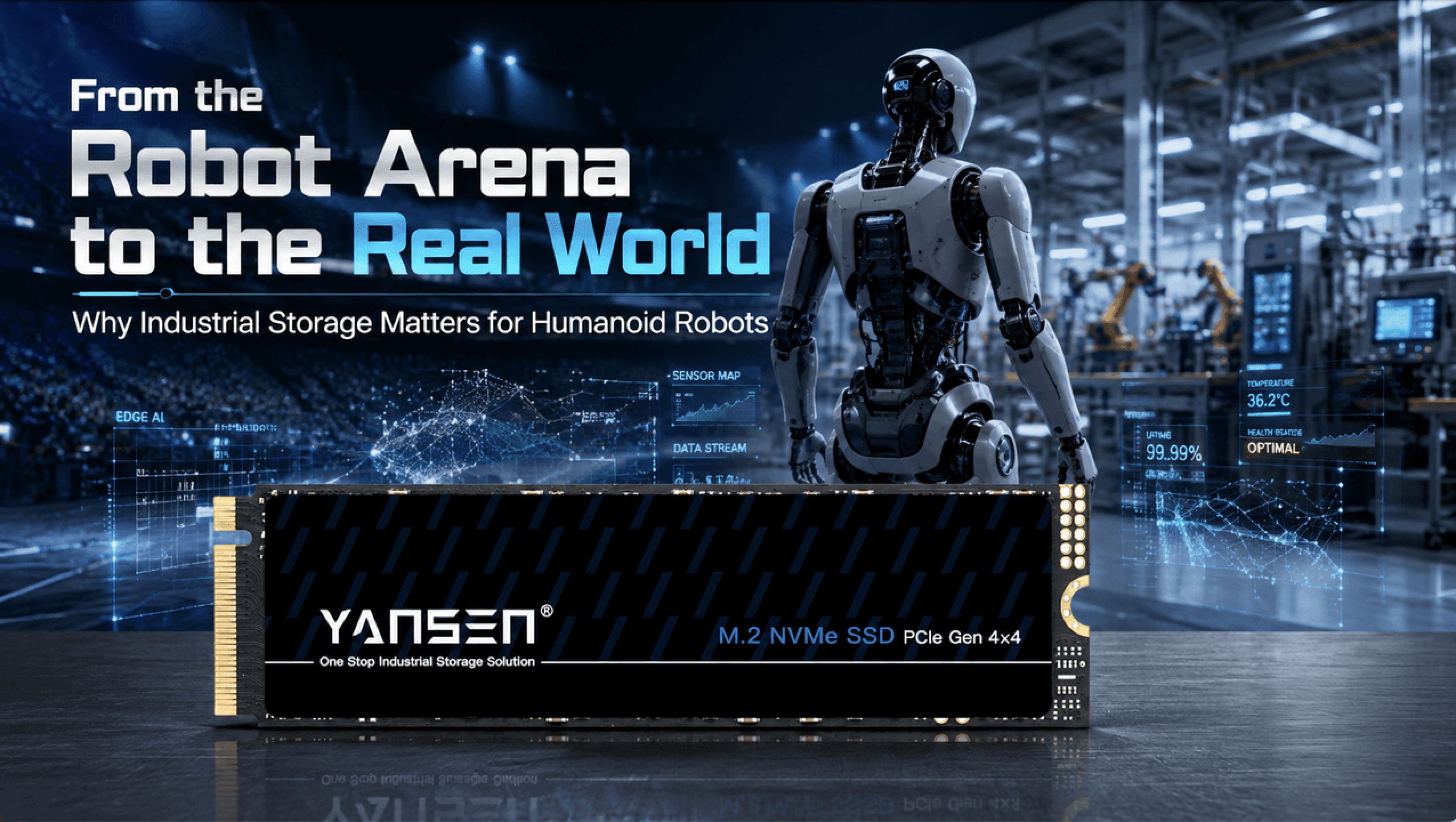
In the era of Industry 4.0, AI-powered industrial robotics are no longer a futuristic vision—they are the new norm for modern manufacturing. Whether it’s robotic arms performing quality inspections, smart pick-and-place machines in logistics, or predictive maintenance systems in factories, these advanced systems generate and process massive volumes of data in real time. Underpinning all this intelligent automation is one indispensable component: high-performance, rugged, industrial-grade SSDs.
As robotics evolve in complexity and capability, the demands on data storage technology are intensifying. In this article, we explore how YANSEN’s industrial SSDs meet these stringent requirements and drive the efficiency, accuracy, and reliability of AI robotics worldwide.
1. AI Robotics: Data-Intensive Workflows in Industrial Environments
Application Scenarios and Data Characteristics
|
Application |
Data Generated |
Workflow |
|
Visual Inspection (AOI) |
4K@60fps video (500MB/s per camera) |
Image capture → AI inference → Defect classification |
|
Flexible Sorting Robots |
3D point cloud + RGB (≥1GB/object) |
Object recognition → Path planning → Arm movement |
|
Predictive Maintenance |
Multi-axis vibration (10kHz/channel) |
Edge processing → Model update |
|
Collaborative Learning Robots |
Motion trajectory + environment mapping (TBs per cycle) |
Imitation learning → Digital twin → Policy optimization |
These applications are unified by their need for:
- High-throughput video processing
- Low-latency real-time controls
- Large-scale training data handling
2. Core Storage Challenges in AI Robotics
2.1 Real-Time Response Paradox
AI robotics demand ultra-low-latency response:
- AOI systems must transfer and store multi-stream 4K video with <5ms total latency.
- Robotic arm control systems require command write delays ≤100μsto ensure smooth, accurate movement.
- Traditional HDDs (>8ms latency) are entirely inadequate, while YANSEN PCIe 4.0 SSDsoffer consistent <65μs latency with high IOPS.
2.2 Harsh Environment Reliability
Industrial settings expose electronics to:
- Vibration (5–2000Hz), common in manufacturing lines
- Rapid thermal shifts (−25°C to 70°C)
- Dust, moisture, corrosive gas environments
YANSEN SSDs incorporate full silicone potting, wide-temp NAND chips, and military-grade conformal coatings to counter these risks.
2.3 Data Safety and Availability
Data loss from unexpected shutdowns is a mission-critical risk:
- A single power loss during 3D mapping could corrupt the robot’s spatial awareness data.
- YANSEN SSDs integrate firmware-level power loss protectionand end-to-end ECC to safeguard critical write operations.
2.4 Edge Storage Capacity Wall
Each robot can generate 4–6TB/day from sensors and cameras. Without scalable SSD options, local processing becomes a bottleneck.
3. Recommended Storage Architecture for Edge Robotics
3.1 On-Device Storage Deployment
|
Device |
Recommended Model |
Core Advantage |
|
Industrial SSD |
YSNN5M7XXXXXXNNEN (PCIe 4.0) |
6.6GB/s write, 1 DWPD endurance, 1.5 million IOPS |
|
SATA SSD |
YSS25P2XTXXXXNNNN |
Rugged, cost-effective, vibration-resistant |
|
Memory Module |
64GB DDR5 ECC (4800MT/s) |
Prevents single-bit fault-related downtime |
|
Power Loss Protection |
Supercapacitor module |
50ms+ emergency write window |
These configurations are ideal for:
- AOI robotsneeding high-speed storage for real-time video processing
- Sorting armsrequiring consistent random IOPS for precise movement coordination
3.2 PCIe Interface Tier Recommendations
|
Spec |
PCIe 3.0 x4 |
PCIe 4.0 x4 |
Robotics Value |
|
Bandwidth |
3.94 GB/s |
7.88 GB/s |
Doubled throughput |
|
4K Latency |
85–100μs |
45–65μs |
Enhanced robotic response |
|
Queue Depth |
QD32: 380K |
QD32: 880K |
Sensor concurrency support |
PCIe 4.0 SSDs such as YSNN5T1KEXXXEPNNA (7GB/s read) offer headroom for next-gen SLAM and multi-sensor operations.
4. Industrial-Grade SSD Selection Criteria
4.1 Performance Thresholds
|
Metric |
Minimum Requirement |
|
Sustained Read/Write |
≥3.0GB/s (PCIe 3.0), ≥5.0GB/s (PCIe 4.0) |
|
4K Random Write |
≥150K IOPS |
|
Latency Consistency |
99.9% <200μs |
4.2 Ruggedization Features
|
Protection |
Implementation |
Example |
|
Vibration |
Potting + screwless lock |
YANSEN anti-shock chassis |
|
Temperature |
−40°C to +85°C NAND |
KIOXIA wide-temp NAND |
|
Power |
Supercapacitor (≥100ms) |
PLP+NVRAM |
|
EMI |
Shielded PCB layers + filters |
Linked to Innogrit controllers |
5. Deployment Cost vs. Performance ROI
|
Plan |
Cost (per unit) |
Data Efficiency Gain |
Downtime Risk |
|
PCIe 3.0 Base Plan |
$350 |
Baseline |
High (8%/yr) |
|
PCIe 4.0 Premium |
$750 |
+180% |
Low (1.2%/yr) |
|
Hybrid 3.0+4.0 |
$520 |
+110% |
Medium (3.5%/yr) |
Decision Tree:
- Budget-sensitive, low-latency-insensitive: Use PCIe 3.0 (e.g., YSNN5M3XTXXXCNNNN)
- New AI vision line: Go PCIe 4.0 (YSNN5M7XXXXXXNNNN)
- Legacy system upgrade: Add 2 PCIe 4.0 SSDs for caching
2025 Trend Alert: With industrial motherboards migrating toward PCIe 5.0 (14GB/s), design your robot architecture for forward compatibility.
6. Cross-System Integration Requirements
6.1 Edge-to-Cloud Flow
- Robots must synchronize quality data, maintenance logs, and control analytics with central systems.
- YANSEN SSDssupport SR-IOV, making them virtualization-ready for cloud–edge orchestration.
6.2 Protocol Compatibility
Support for NVMe 1.4, TRIM, and SMART monitoring ensures integration with popular MES, SCADA, and ERP platforms.
7. Industrial Compliance and Certification
To deploy in regulated environments:
- EMC resistance is essential: SSDs must pass EN 55032, IEC 61000.
- Storage for collaborative robots must meetISO 13849 safety specs.
- Medical robotics need AES-256 encryptionand PLP to comply with HIPAA/GDPR.
8. Industry Use Cases
8.1 Optical Inspection (AOI)
Electronics manufacturers deploy dual-SSD AOI robots using YANSEN PCIe 4.0 models, increasing defect detection throughput by 40%.
8.2 Pharma Lines
Round-the-clock operations benefit from wide-temp SSDs with power loss protection, avoiding product spoilage from processing halts.
8.3 Food-grade AGVs
Deploy conformal-coated SSDs that resist high-humidity, corrosive washdown zones—improving AGV operational life by 2.8x.
9. Conclusion: The Future of Storage in Robotics is Industrial-Grade
AI-driven industrial robotics operate at the crossroads of high data rates, harsh environments, and zero-failure tolerance. To support these next-gen workflows, storage solutions must be fast, durable, intelligent—and above all, industrial-strength.
With its wide portfolio of rugged, high-performance, PCIe 3.0 and 4.0 SSDs, wide-temperature NAND solutions, and B2B customization services, YANSEN empowers system integrators, automation OEMs, and robotics developers to build future-proof, resilient, and cost-effective solutions.
Whether you’re building the next smart factory, automated warehouse, or AI-driven inspection platform—YANSEN is the storage engine you can trust.