1. Introduction: The Hidden Engine Behind Robotic Intelligence
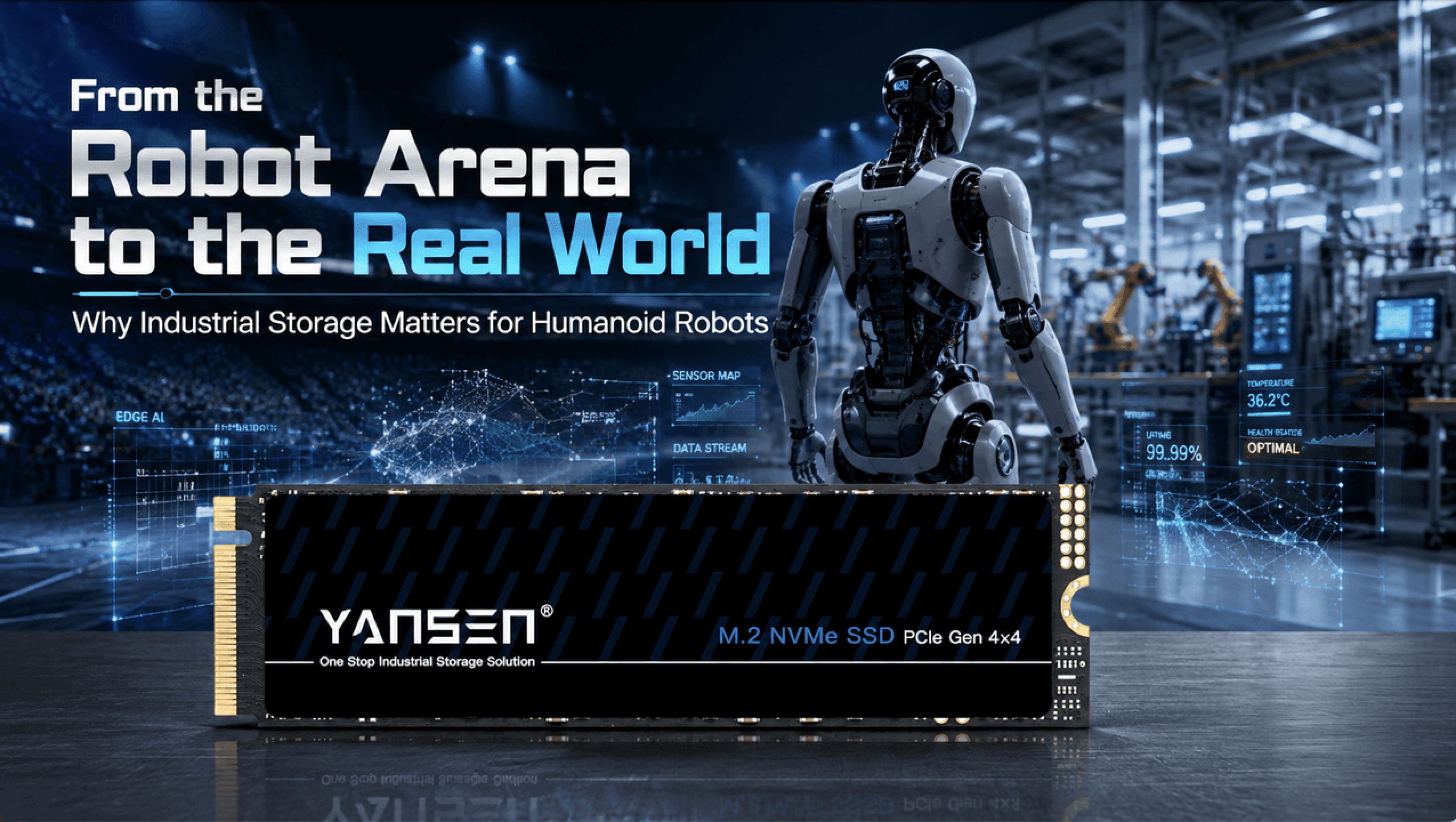
Imagine a humanoid robot navigating a crowded warehouse, identifying human faces, processing voice commands, avoiding moving forklifts, and manipulating tools with precision—all while making split-second decisions that mirror human reflexes. To the outside observer, these behaviors look like magic, powered solely by advanced CPUs, GPUs, and neural networks.
But behind every real-time action lies an equally critical component:
a high-performance storage system capable of ingesting, retrieving, and preserving enormous volumes of sensor and operational data without delay.
While processors enable cognition, SSDs serve as the robot’s long-term working memory and the foundation of its rapid response capabilities. They ensure that perception, decision-making, and actuation remain fluid, predictable, and safe.
In modern humanoid robots, the SSD has quietly become the unsung hero that enables true autonomy and intelligence.

2. The Unique Data Challenges of Humanoid Robots
Humanoid robots are among the most data-intensive autonomous systems ever developed. Their anatomy—multiple sensors, joints, actuators, and AI workloads—creates extraordinary storage challenges.
2.1 A Flood of Perception Data
A humanoid robot continuously collects data from:
- multi-camera stereo or depth systems
- LiDAR units
- tactile/force sensors
- IMU and proprioceptive arrays
- microphone arrays for speech recognition
A single robot can easily generate terabytes of raw perception data per day. Compressing, caching, and indexing this data requires a storage medium that can handle sustained throughput at scale.
2.2 Millisecond-Level Latency Requirements
Delays aren’t just inefficient—they can be dangerous.
Safe navigation, real-time localization, and interactive voice or gesture communication demand:
- instant data lookup
- microsecond-level queueing
- zero bottleneck in sensor-to-actuator pipelines
An SSD’s random-read IOPS and latency directly influence how quickly a robot can perceive and respond to its environment.
2.3 Harsh Operating Conditions
Robots face:
- constant vibrations from actuators and locomotion
- temperature fluctuations due to outdoor tasks or onboard processing heat
- unexpected shutdowns during testing or field operations
Storage must remain stable despite these physical stresses.
2.4 Limitations of Legacy Storage
Traditional eMMC or SD-based solutions suffer from:
- limited endurance
- slow random performance
- poor thermal stability
- insufficient bandwidth for large-model execution
As robots transition from scripted to adaptive autonomy, professional-grade SSDs become indispensable.

3. Why SSDs Are the Ideal Storage Backbone for Humanoid Robots
Below we examine how SSD characteristics map directly onto robotic performance requirements.
3.1 Ultra-Fast Response and Low Latency
Robot requirement: maintaining real-time perception → decision → action loops.
SSD contribution:
- NVMe SSDs provide massive parallelism and extremely low-latency queues.
- High random IOPS accelerate:
loading large AI models
accessing motion-planning graph data
retrieving sensor history buffers
- Eliminates control “hiccups” that cause unstable walking, delayed reactions, or inconsistent manipulation.
In other words, fast storage directly improves movement smoothness and interaction quality.
3.2 Exceptional Reliability and Endurance
Robot requirement: 24/7 mission reliability in unpredictable environments.
SSD contribution:
- No mechanical parts → inherently shock- and vibration-resistant.
- Wide-temperature SSDs support –40°C to +85°C
- High TBW ratings ensure endurance for continuous logging.
- Power-loss protection prevents corrupted files when the robot is unplugged or loses balance and shuts down.
These features allow robots to operate across factories, homes, hospitals, outdoor sites, or R&D labs without storage-related downtime.
3.3 High Energy Efficiency and Compact Form Factor
Robot requirement: limited internal space and battery power.
SSD contribution:
- NVMe M.2, BGA, or custom industrial modules offer extremely compact dimensions.
- Low active power reduces thermal buildup and extends battery life.
- Consistent performance per watt supports long-duration autonomous missions.
Storage becomes invisible but essential, fitting neatly into the increasingly compact humanoid architecture.
3.4 Enabling Continuous Learning and Personalization
Robot requirement: retain long-term experience, adapt to user behavior, and refine skills.
SSD contribution:
- High-capacity SSDs store:
multimodal interaction logs
behavior reinforcement data
incremental training results
personalized user profiles
- Acts as the robot’s lifelong memory, enabling incremental or offline learning.
As robots accumulate real-world experience, the SSD becomes the foundation of their evolving intelligence.
4. Key Application Scenarios: How SSDs Empower Robotic Performance
4.1 Industrial Manufacturing and Logistics
- Instant loading of task routines and 3D models
- Recording high-frequency assembly data for QA
- Supporting predictive maintenance algorithms
SSD endurance directly affects uptime in mission-critical workflows.
4.2 Healthcare and Assistive Robotics
- Fast and secure access to patient data
- Real-time motion planning for safe human interaction
- Long-term storage of therapy or monitoring logs
Data integrity becomes a matter of safety and regulatory compliance.
4.3 Social and Service Robotics
- Personalization of conversations and user preferences
- Emotion and gesture recognition logs
- Large local databases for multilingual interaction
SSD capacity enables more natural and contextual human–robot relationships.
4.4 Research, Development, and Training
- High-speed capture of experiment data
- Rapid deployment of updated simulation models
- Replay of robot trajectories for algorithm refinement
Storage performance accelerates the entire robotics innovation cycle.
5. How to Choose the Right SSD for Humanoid Robots
For robotics R&D teams and manufacturers, the following guidelines ensure optimal performance and durability.
5.1 Interface & Protocol
Robots often require bandwidth far beyond SATA or eMMC.
- Yansen PCIe 0NVMe SSD, with up to 4TB capacity, 7400MB/s read speed and 6500MB/s write speed, is able to deliver the throughput needed for:
AI workloads
sensor fusion pipelines
fast boot and hot reload of modules
5.2 Endurance and Data Integrity
Evaluate:
- TBW based on expected daily write load
- DWPD for high-frequency log generation
- LDPC ECC and end-to-end data protection for maintaining data accuracy
- strong wear-leveling for long-term stability
Robotics workloads are closer to industrial logging systems than to consumer usage models.
Yansen storage solutions offer PCIe 4.0 NVMe SSDs with a TBW of 4000TB, an MTBF of 2 million hours, ensuring the robot can stably and completely record data even under prolonged high-load conditions.
5.3 Security Features
Humanoid robots often handle sensitive or proprietary data.
Look for:
- AES-256 hardware encryption
- secure erase
- TCG Opal support
- firmware integrity protections
These protect intellectual property, user privacy, and operational safety. Yansen industrial-level SSD solution provides customized data security functions. This provides our partners with more flexible and cost-effective storage solutions, enabling us to jointly offer robotic solutions that meet diverse market needs.
5.4 Management and Predictive Maintenance
Professional robots benefit from advanced monitoring:
- SMART health reporting
- temperature and error-rate telemetry
- remaining-life prediction
Predictive maintenance prevents mission failures and reduces service costs.
6. Future Outlook: How Storage Will Shape the Next Generation of Robotics
The evolution of humanoid robots is deeply intertwined with the evolution of storage technology.
6.1 Convergence of Edge AI and Storage
Emerging technologies aim to bring computation closer to data:
- in-storage processing
- near-data AI acceleration
- tighter coupling of NVMe and system AI pipelines
This reduces latency and boosts autonomy.
6.2 Next-Gen Interfaces and NAND Technology
- PCIe Gen6 and beyond promise unprecedented bandwidth.
- Higher-density QLC/PLC NAND will lower cost per GB.
- New controller architectures will unlock even more AI-oriented optimizations.
6.3 Enabler of General-Purpose Autonomy
Reliable storage will be essential for robots to evolve from:
task-executing machines → continuously learning, adaptive, general-purpose intelligent agents.
Without robust, high-endurance SSDs, AGI-class robotics is simply impossible.
7. Conclusion
SSDs are far more than passive storage devices.
They are the silent powerhouse enabling humanoid robots to think faster, learn continuously, and operate safely in complex environments.
Investing in robot-grade, industrial SSDs ensures:
- long-term reliability
- consistent real-time performance
- secure handling of sensitive data
- the ability to evolve through learning
In the next era of robotics, the quality of storage will directly determine how far robots can advance—and how seamlessly they can integrate into human environments. Yansen will be deeply involved in the robotics field, providing increasingly reliable and efficient solutions to support the continuous development of the robotics industry.