1. The Real Meaning Behind “Reducing Memory Usage”
Recent optimization efforts led by hyperscale companies like Google are often interpreted as a simple goal: use less memory.
In reality, the shift is far more strategic. The objective is not to reduce hardware, but to increase efficiency per workload—which fundamentally changes how memory is consumed, allocated, and complemented by storage.
1.1 Model-Level Optimization: More Work Per Byte
Modern AI frameworks are aggressively improving model efficiency, reducing the memory footprint required for the same task:
- Quantization: Transition from FP32 to FP16, INT8, or even INT4
- Sparse Models: Eliminating redundant parameters
- Parameter Sharing: Reusing weights across layers
Impact:
Instead of requiring massive memory pools, models now achieve similar or better performance with significantly reduced per-task memory consumption.
But here’s the critical insight for buyers: This does not reduce infrastructure demand—it redistributes it.
1.2 Memory–Compute Tradeoff: Reducing Peak Usage
AI systems are also redesigning how memory is used during execution:
- Activation recomputation(trading compute cycles for lower memory footprint)
- KV cache optimization(especially in LLM inference)
- Streaming / chunk-based data loading
Impact:
Peak memory usage is reduced, but data movement increases significantly.
This introduces a new bottleneck: memory bandwidth and data flow efficiency, not just capacity.
1.3 System-Level Optimization: Smarter Memory Utilization
At the infrastructure level, optimization continues:
- Advanced memory allocators
- NUMA-aware scheduling
- Reduced redundancy in distributed training
Impact:
Memory is used more efficiently, but system complexity increases, requiring better coordination between CPU, GPU, memory, and storage.
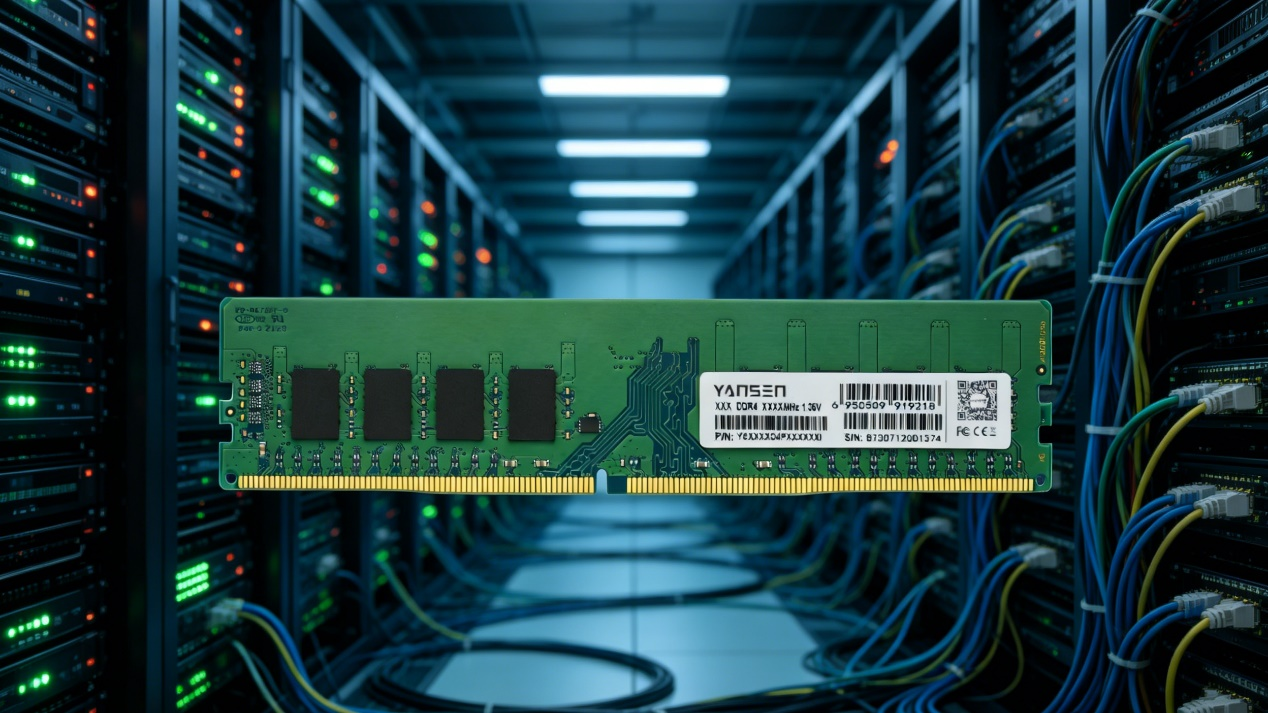
2. What This Means for Enterprise DDR: A Shift in Priorities
2.1 Capacity Growth Is Slowing—But Not Declining
Historically, AI infrastructure followed a simple rule: More memory = better performance.
This drove rapid scaling from 256GB → 512GB → 1TB+ per server.
Now, with optimization:
- The same workload requires less memory
- But model sizes continue to grow
Result:
DDR capacity demand still grows—but at a slower, more controlled rate
2.2 Bandwidth Becomes the New Battleground
This is the most important shift for procurement teams.
As memory usage becomes more dynamic:
- Data is accessed more frequently
- Real-time streaming replaces bulk loading
- CPU–GPU–memory interaction intensifies
New DDR Requirements:
- DDR5 and beyond (DDR6 roadmap)
- Higher frequency: 4800 → 6400 → 8000 MT/s
- Lower latency for real-time AI inference
Key Insight:
In AI infrastructure, bandwidth is becoming more critical than capacity.
2.3 Memory Access Patterns Are Changing
The workload pattern is shifting from: Modern AI systems are evolving from large, sequential data loading patterns typical of training workloads to high-frequency, small-block, and latency-sensitive access patterns seen in inference and edge deployments.
This leads to:
- Increased importance of IOPS-like memory behavior
- Greater reliance on memory controller optimization
- Mandatory NUMA-aware system design
2.4 The Rise of Memory Tiering Architecture
Modern AI infrastructure is no longer built around a single memory layer.
Instead, it follows a hierarchical model:
HBM (GPU Memory)
↓
DDR (System Memory)
↓
NVMe SSD (Extended Memory / Cold Data)
Critical Shift:
- DDR is no longer just “capacity provider”
- It becomes a data orchestration hub
- SSDs increasingly act as memory extensions
2.5 The Blurring Line Between Memory and Storage
Technologies such as:
- CXL (Compute Express Link)
- Memory pooling
- NVMe over Fabrics
are redefining infrastructure boundaries.
Emerging trend:
High-performance SSDs are beginning to replace part of traditional DDR roles in certain workloads.
This is especially relevant in:
- Large-scale inference clusters
- Edge AI deployments
- Cost-sensitive datacenter environments
3. Strategic Impact on Enterprise DDR Vendors
3.1 From Capacity Selling to Performance Engineering
Traditional DDR positioning:
- 32GB / 64GB / 128GB capacity tiers
New decision criteria:
- Bandwidth performance
- Latency optimization
- Stability under sustained AI workloads
Buyers are no longer asking:
- “How much memory?”
- They are asking:
- “How efficiently can my system move data?”
3.2 Workload-Specific Optimization Becomes Essential
Different AI workloads now demand different memory characteristics:
|
Scenario |
DDR Requirement Shift |
|
AI Training |
Large capacity + efficiency |
|
AI Inference |
High bandwidth + low latency |
|
Edge AI |
Small capacity + high efficiency |
|
Real-Time AI |
Ultra-low latency |
This fragmentation forces vendors to align products with specific use cases, rather than offering generic solutions.
3.3 Convergence with Storage: A New Opportunity
This is where the biggest structural change happens.
Reality today:
- DDR alone cannot solve performance bottlenecks
- Storage is no longer just “cold data storage”
New architecture requires:
- DDR + NVMe SSD coordination
- Intelligent data flow design
- Tiered memory-storage integration

4. What This Means for Enterprise SSD & Industrial SSD Vendors
This transformation is not a threat—it’s a major opportunity.
4.1 SSDs Are Becoming “Extended Memory”
In modern AI systems, SSDs now:
- Store KV cache overflow data
- Handle streaming datasets
- Act as memory expansion layers
This elevates SSD requirements:
- Higher endurance (DWPD)
- Lower latency
- Consistent performance under mixed workloads
4.2 Edge AI Is Accelerating SSD Demand
With optimized models:
- AI can run on smaller systems
- DDR requirements decrease
- Deployment shifts to edge environments
Result:
- Less dependency on large memory pools
- Strong demand for industrial-grade SSDs
Typical requirements include:
- Wide temperature support
- Power-loss protection (PLP)
- Long lifecycle supply
4.3 YANSEN’s Approach: Memory–Storage Synergy
As a provider of enterprise and industrial storage solutions, YANSEN aligns with this architectural shift by focusing on:
- High-performance NVMe SSDs for data-intensive AI workloads
- Reliable storage for edge and industrial deployments
- Long-term supply and lifecycle management
Key capabilities include:
- Enterprise-grade NAND for endurance
- Stable firmware for mixed read/write workloads
- PLP for data integrity
- Optimized performance for AI data streaming and caching
Instead of replacing DDR, YANSEN SSDs extend and enhance memory capabilities, enabling more flexible and scalable system design.
5. Procurement Insight: How to Design for the AI Era
For system integrators and enterprise buyers, the key takeaway is:
AI optimization is not reducing infrastructure—it is redistributing performance requirements across components.
When selecting your architecture, consider:
- Is your bottleneck capacity, bandwidth, or latency?
- Are you optimizing for training, inference, or edge deployment?
- Does your storage support real-time data flow, not just storage?
- Can your vendor ensure long-term consistency and reliability?
6. Conclusion: AI Optimization Is Reshaping Infrastructure, Not Reducing It
AI-driven optimization is fundamentally changing how resources are allocated:
- DDR is evolving into a high-speed coordination layer
- SSDs are becoming capacity expansion and data streaming engines
The future is not about choosing between memory and storage.
It is about how effectively they work together.
In the AI era: DDR delivers speed, while SSD delivers scalable capacity and flexibility.
With solutions like YANSEN’s enterprise and industrial SSDs, organizations can build balanced, efficient, and future-ready architectures—capable of handling both centralized datacenters and distributed edge environments.
7. FAQ: AI Memory Optimization, DDR, and SSD Architecture
Q1: Does AI optimization really reduce the need for DDR memory?
A1: Not exactly. AI optimization techniques such as quantization, sparsity, and activation recomputation reduce the memory required per task, but overall infrastructure demand continues to grow as model sizes expand. In practice, DDR capacity demand is still increasing—just at a slower rate. At the same time, requirements for memory bandwidth and latency are rising significantly.
Q2: Why is memory bandwidth becoming more important than capacity?
A2: Modern AI workloads—especially inference and real-time applications—rely on frequent data movement rather than large static datasets. This means systems must continuously transfer data between CPU, GPU, and memory. As a result, high-bandwidth DDR (such as DDR5) and low-latency performance are now more critical than simply increasing memory size.
Q3: What is memory tiering, and why is it important for AI infrastructure?
A3: Memory tiering is an architecture that distributes data across multiple layers:
- High-speed GPU memory (HBM)
- System memory (DDR)
- High-performance storage (NVMe SSD)
This approach optimizes both cost and performance. Frequently accessed data stays in fast memory, while less critical or overflow data is handled by SSDs. This allows enterprises to scale efficiently without relying solely on expensive DDR expansion.
Q4: Can NVMe SSDs really act as an extension of memory?
A4: Yes, in modern architectures, NVMe SSDs are increasingly used as extended memory layers. Technologies such as CXL, memory pooling, and NVMe over Fabrics enable SSDs to handle:
- KV cache overflow in large language models
- Streaming datasets
- Intermediate data in AI pipelines
While SSDs cannot fully replace DDR due to latency differences, they significantly reduce memory pressure and improve scalability.
Q5: How do AI inference workloads change memory and storage requirements?
A5: AI inference workloads differ from training in several ways:
- More random and small-block data access
- Higher request frequency (QPS)
- Strong dependence on real-time response
This leads to:
- Increased need for low-latency DDR
- Greater reliance on high-performance SSDs for data streaming and caching
Q6: What should enterprise buyers prioritize when designing AI infrastructure?
A6: Instead of focusing only on memory size, buyers should evaluate:
- Memory bandwidth and latency performance
- Storage read/write consistency under mixed workloads
- System-level data flow efficiency
- Compatibility with tiered architecture (DDR + NVMe SSD)
A balanced design often delivers better performance and cost efficiency than simply increasing DDR capacity.
Q7: Why are SSDs becoming more important in edge AI deployments?
A7: Edge AI systems typically operate with:
- Limited hardware resources
- Smaller memory capacity
- Harsh or variable environments
As AI models become more efficient, edge systems rely more on SSDs for data storage, buffering, and reliability. Industrial-grade SSDs with features like power-loss protection, wide temperature support, and long lifecycle are essential for these deployments.
Q8: How does YANSEN support AI-oriented memory and storage architecture?
A8: YANSEN focuses on delivering enterprise and industrial SSD solutions that complement modern memory architectures by:
- Supporting high-performance NVMe interfaces for data-intensive workloads
- Providing stable firmware optimized for mixed AI workloads
- Offering power-loss protection (PLP) for data integrity
- Ensuring long-term supply consistency for industrial and enterprise clients
By aligning storage performance with evolving AI memory strategies, YANSEN enables customers to build scalable, reliable, and future-ready systems.