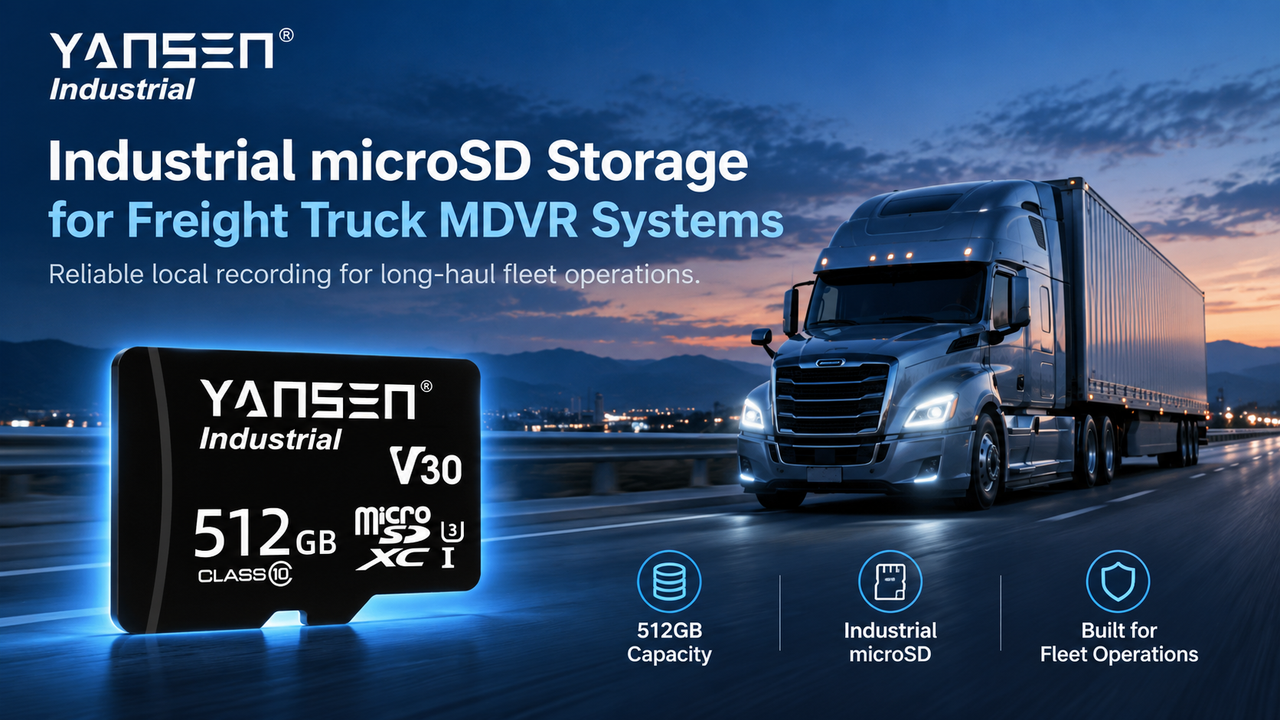
Region: Southern Africa Industry: Power & Energy / Electrical Measurement Application: Multifunction Waveform-Synchronised Power Quality Analyzer, Recorder and Measurement Device Storage Solution: YANSEN Industrial mSATA SSD Capacity: 512GB NAND Flash: 3D TLC Operating Temperature: -40°C to 85°C
Project Background
A professional electrical measurement equipment manufacturer in Southern Africa was developing a new multifunction, waveform-synchronised power quality analyzer, recorder and measurement device.
The system is designed to acquire, process and record electrical measurement data and waveform information over extended operating periods.
For this type of equipment, storage is not simply used for operating system files or occasional data transfer. It becomes part of the continuous data acquisition chain.
The customer therefore required a compact embedded SSD that could combine continuous recording capability, high endurance, wide-temperature operation, low power consumption and strong resistance to environmental stress.
This created a significantly more demanding storage requirement than a conventional PC or general-purpose embedded application.
Project Challenge: Reliable Storage Under Continuous Measurement Workloads
Power quality monitoring systems may continuously generate waveform records, measurement data and event information.
Unlike consumer workloads, where storage activity often occurs in short bursts, professional measurement equipment may perform sustained data acquisition for long operating periods.
The main challenge was therefore not simply achieving a high peak transfer speed.
The SSD had to deliver a balanced combination of:
-
Stable continuous read and write performance
-
High write endurance
-
Wide-temperature operation
-
Resistance to shock and vibration
-
Low power consumption
-
Compact embedded integration
-
Storage health monitoring
-
Reliable long-term operation
Each of these requirements directly affects the reliability of the complete measurement system.
Challenge 1: Continuous Waveform Recording Requires Stable Storage Performance
Waveform-synchronised measurement can generate a continuous stream of data.
During long-duration monitoring, the storage subsystem needs to receive and retain measurement information consistently without becoming a weak point in the acquisition process.
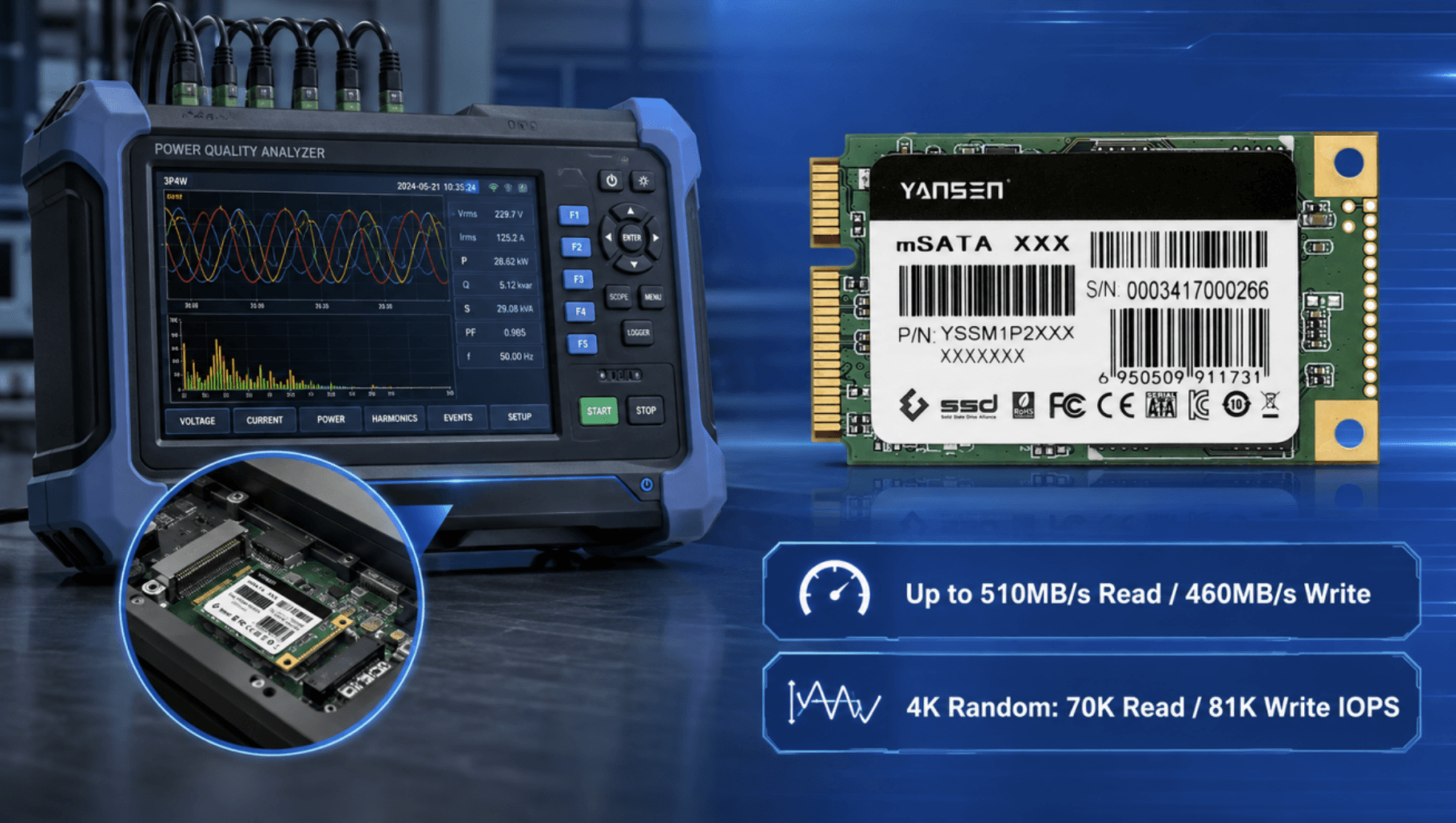
For this application, YANSEN supplied a 512GB industrial mSATA SSD delivering sequential read speeds of up to 510MB/s and sequential write speeds of up to 460MB/s.
Its 4K random performance reaches up to 70,000 IOPS read and 81,000 IOPS write, providing responsive access to both sequential recording workloads and smaller data operations generated by the system.
However, performance alone was not the primary design consideration.
For professional measurement equipment, predictable and dependable operation over extended periods is more important than pursuing benchmark numbers that exceed the actual requirements of the application.
Challenge 2: High Write Endurance for Long-Term Data Recording
Continuous measurement means continuous data generation.
Over the operating life of the equipment, this can create a substantial cumulative write workload on the SSD.
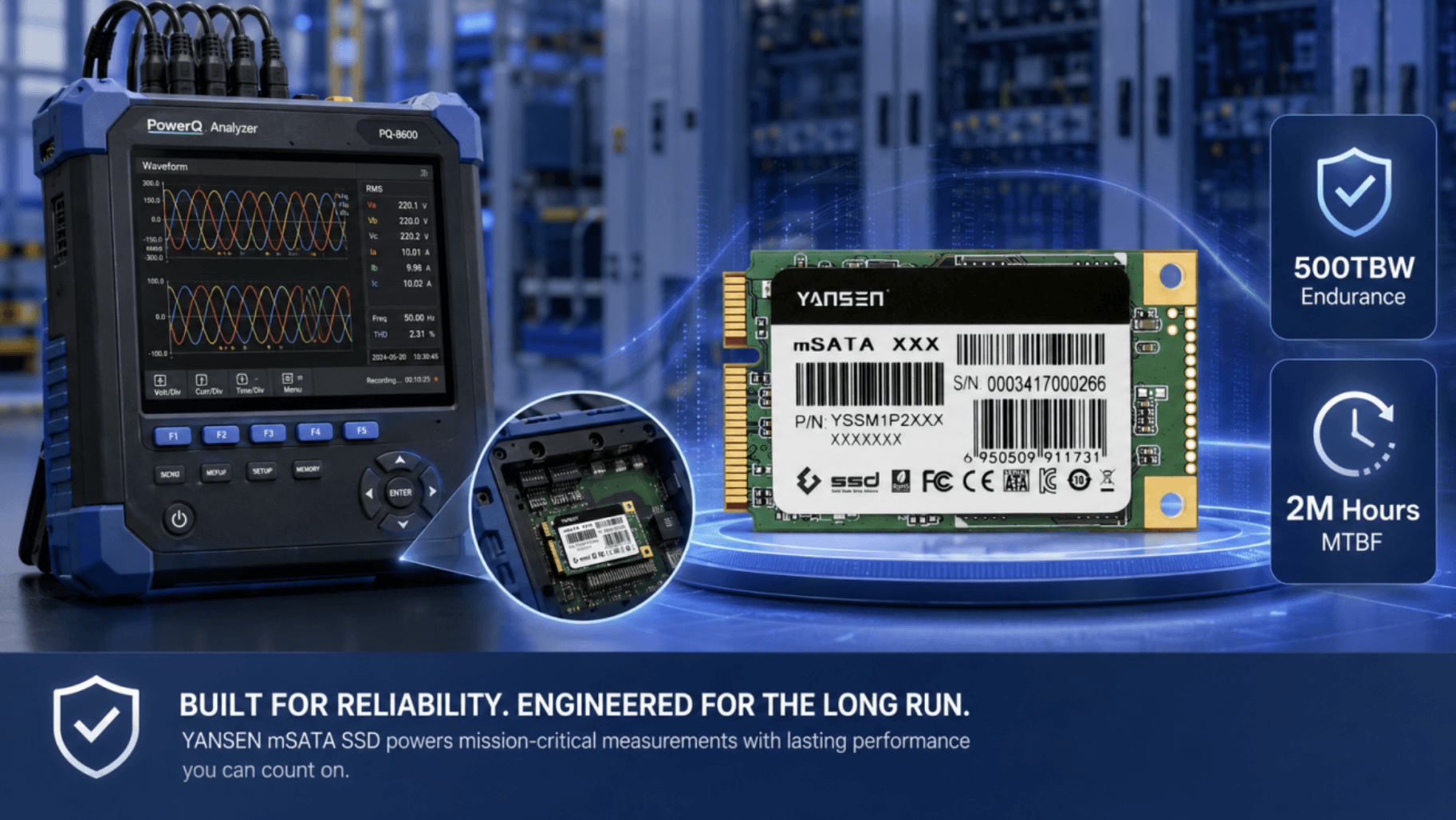
To address this requirement, the selected industrial mSATA SSD provides an endurance rating of up to 500TBW.
This gives the system a storage platform better suited to repeated data recording than solutions designed mainly around lighter consumer workloads.
For power quality analyzers, recorders and other data acquisition systems, endurance is a particularly important design consideration because the storage device may be required to write data day after day throughout the equipment lifecycle.
Challenge 3: Operating Reliably from -40°C to 85°C
Professional electrical measurement equipment may be deployed in locations where ambient temperatures cannot be controlled as precisely as in an office or data center.
Depending on the installation environment, equipment may experience cold starts, elevated enclosure temperatures or significant temperature variations during operation.
For this reason, the project required a storage solution capable of operating across an industrial temperature range.
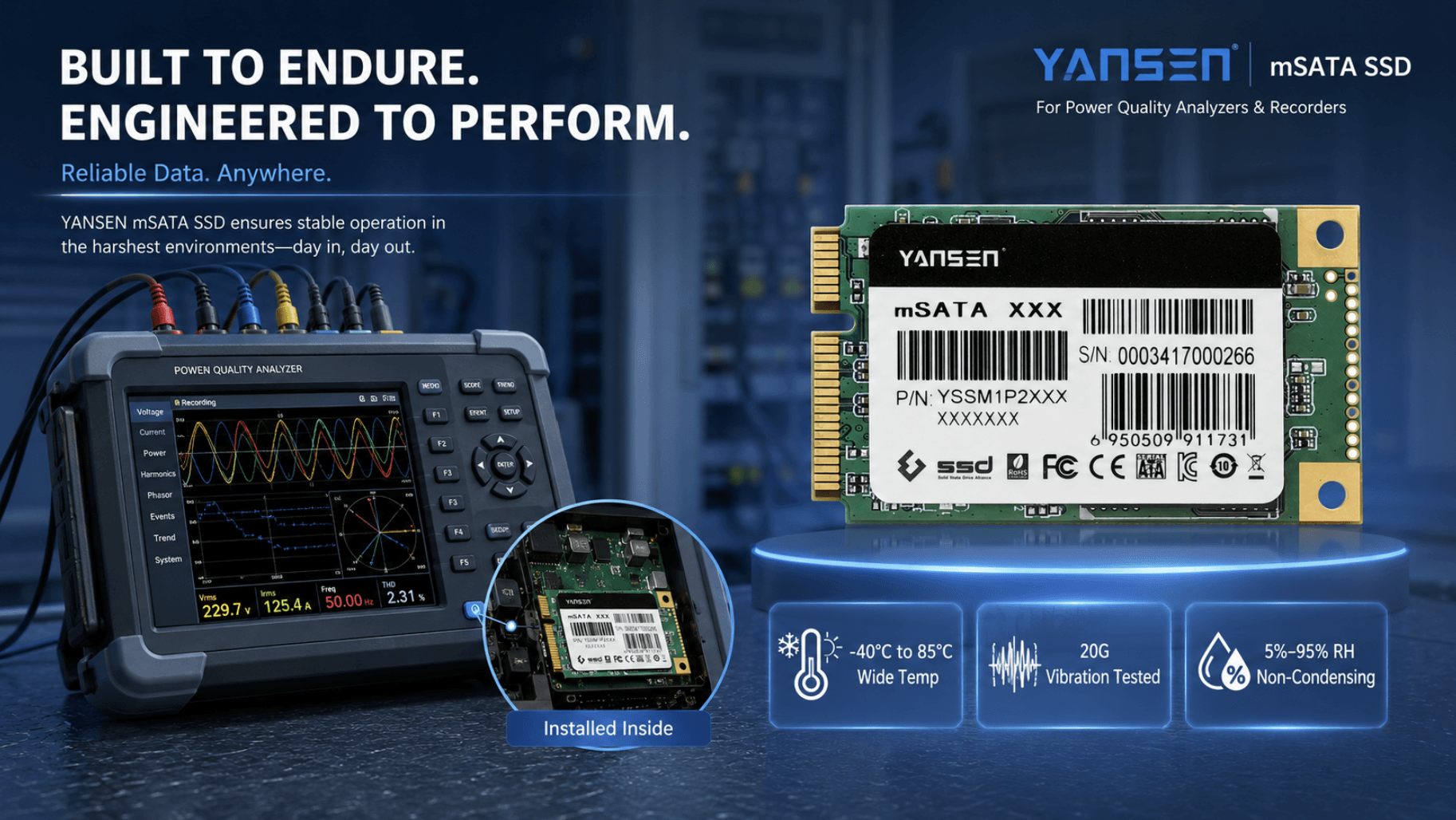
The YANSEN mSATA SSD supports operation from -40°C to 85°C, enabling it to function in a much broader range of environmental conditions than typical commercial-temperature storage products.
This wide-temperature capability was one of the key reasons the industrial SSD was suitable for the project.
Challenge 4: Mechanical Reliability in Industrial Environments
Temperature was not the only environmental consideration.
Equipment installed in industrial, energy or field environments may also be exposed to mechanical shock or continuous vibration during transportation, installation or operation.
The selected mSATA SSD is designed to withstand:
-
Shock: up to 1500G / 0.5ms
-
Vibration: 80Hz to 2000Hz / 20G
-
Humidity: 5% to 95% RH, non-condensing
These characteristics provide additional protection for the storage subsystem when used in environments that are more demanding than conventional desktop computing conditions.
Because the mSATA SSD contains no moving mechanical components, it is also well suited to embedded equipment where resistance to vibration is an important consideration.
Challenge 5: Compact Integration Without Sacrificing Capacity
The measurement device also imposed mechanical constraints.
The storage solution needed to fit into an embedded system without taking up the space required by a conventional 2.5-inch drive.
The mSATA form factor provides a compact PCB-level storage solution while retaining the mature SATA interface.
With 512GB of capacity, the SSD gives the system sufficient local storage for waveform data, event records, measurement results and other device-generated information while maintaining a compact physical footprint.
For embedded equipment manufacturers, this balance between capacity and form factor can simplify system design and help reduce internal space requirements.
Challenge 6: Low Power Consumption for Embedded Equipment
Power efficiency is another important consideration in professional embedded systems.
Storage is only one component within the complete device, which may also contain processors, data acquisition modules, communication interfaces and measurement circuitry.
The YANSEN industrial mSATA SSD has a maximum power consumption of approximately 1.66W, helping limit the power and thermal contribution of the storage subsystem.
Lower storage power consumption can be particularly valuable in compact enclosures where thermal design margins are limited.
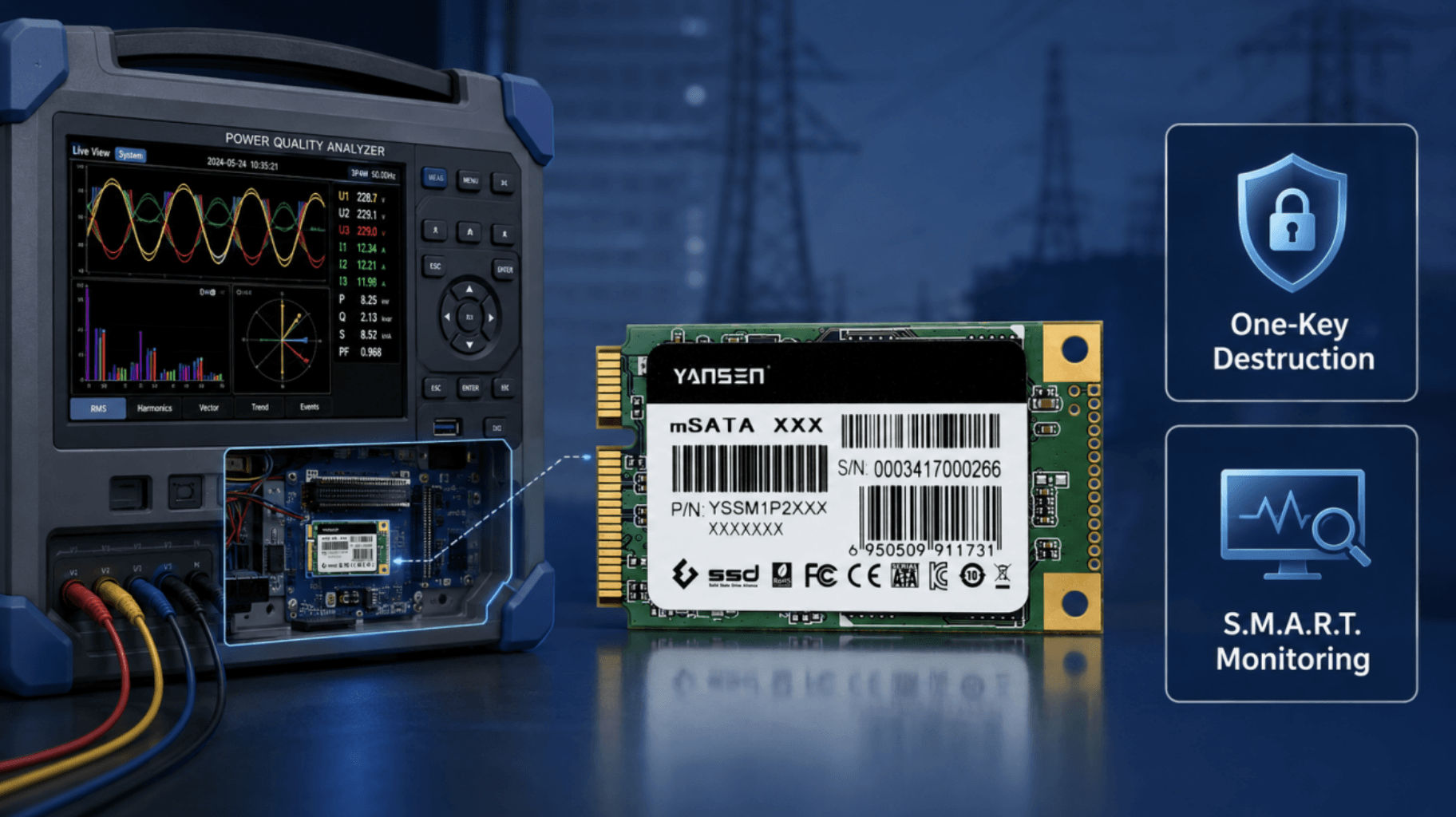
Technical Requirements and YANSEN Solution
|
Project Requirement
|
YANSEN mSATA Specification
|
Application Value
|
|
Embedded Storage
|
mSATA
|
Compact integration into measurement equipment
|
|
Capacity
|
512GB
|
Local storage for waveform and measurement data
|
|
NAND Flash
|
3D TLC
|
Balances capacity, performance and endurance
|
|
Sequential Read
|
Up to 510MB/s
|
Supports efficient data access
|
|
Sequential Write
|
Up to 460MB/s
|
Supports continuous data recording
|
|
4K Random Read
|
Up to 70K IOPS
|
Responsive access to small data blocks
|
|
4K Random Write
|
Up to 81K IOPS
|
Supports mixed recording workloads
|
|
Endurance
|
Up to 500TBW
|
Designed for repeated write-intensive operation
|
|
Operating Temperature
|
-40°C to 85°C
|
Supports demanding industrial environments
|
|
MTBF
|
2,000,000 Hours
|
Supports long-term system reliability requirements
|
|
Max. Power Consumption
|
1.66W
|
Reduces power and thermal load
|
|
Shock Resistance
|
1500G / 0.5ms
|
Supports operation in mechanically demanding environments
|
|
Vibration Resistance
|
80Hz–2000Hz / 20G
|
Improves suitability for industrial equipment
|
|
Humidity
|
5%–95% RH, Non-Condensing
|
Supports a wider range of deployment environments
|
|
Health Monitoring
|
Enables SSD health and status monitoring
|
|
|
Data Security
|
One-Key Data Destruction
|
Provides an additional option for sensitive data management
|
Additional Requirement: Storage Health and Data Security
Reliability in professional equipment also depends on the ability to monitor storage condition over time.
The SSD supports S.M.A.R.T. health monitoring, allowing the host system to access storage health information and support preventive maintenance strategies.
This can be valuable for measurement equipment expected to remain in service for extended periods.
The solution also supports a one-key data destruction function, providing an additional data management option for applications where locally recorded measurement information may need to be securely removed.
For professional monitoring and measurement systems, these functions extend the role of the SSD beyond basic storage capacity.
Why an Industrial SSD Was Necessary
For this project, using a consumer SSD would have addressed only part of the requirement.
The actual challenge was to satisfy multiple engineering constraints at the same time:
continuous recording + 500TBW endurance + -40°C to 85°C operation + shock and vibration resistance + low power consumption + compact mSATA integration + health monitoring.
This combination is what made industrial storage necessary.
The SSD was not selected simply because it could deliver 510MB/s read speeds. It was selected because its performance, endurance, environmental specifications and embedded form factor aligned with the operating requirements of the complete measurement platform.
Application Value
By integrating a YANSEN 512GB industrial mSATA SSD, the customer was able to deploy a storage solution designed around the requirements of continuous waveform recording and professional electrical measurement.
The solution combines:
512GB capacity for local data retention, 500TBW endurance for repeated recording workloads, -40°C to 85°C wide-temperature operation for environmental adaptability, and industrial shock and vibration resistance for demanding deployment conditions.
Together, these specifications make the SSD suitable for power quality analyzers, electrical recorders, data acquisition systems and other professional monitoring equipment where storage reliability is an essential part of overall system design.
Industrial Storage Built Around the Application
Industrial storage selection should begin with the workload and operating environment—not simply interface speed or capacity.
From temperature range and endurance to form factor, performance and data management features, storage configurations can be selected according to the technical requirements of the equipment.
Building equipment for a demanding industrial environment? Talk to YANSEN about the storage requirements behind your application.