CASE OVERVIEW
| Customer | Confidential |
| Customer Profile | A globally leading MDVR and vehicle telematics solution provider |
| Industry | Intelligent Transportation / Commercial Vehicles |
| Application | Freight Truck Video Surveillance & Fleet Management |
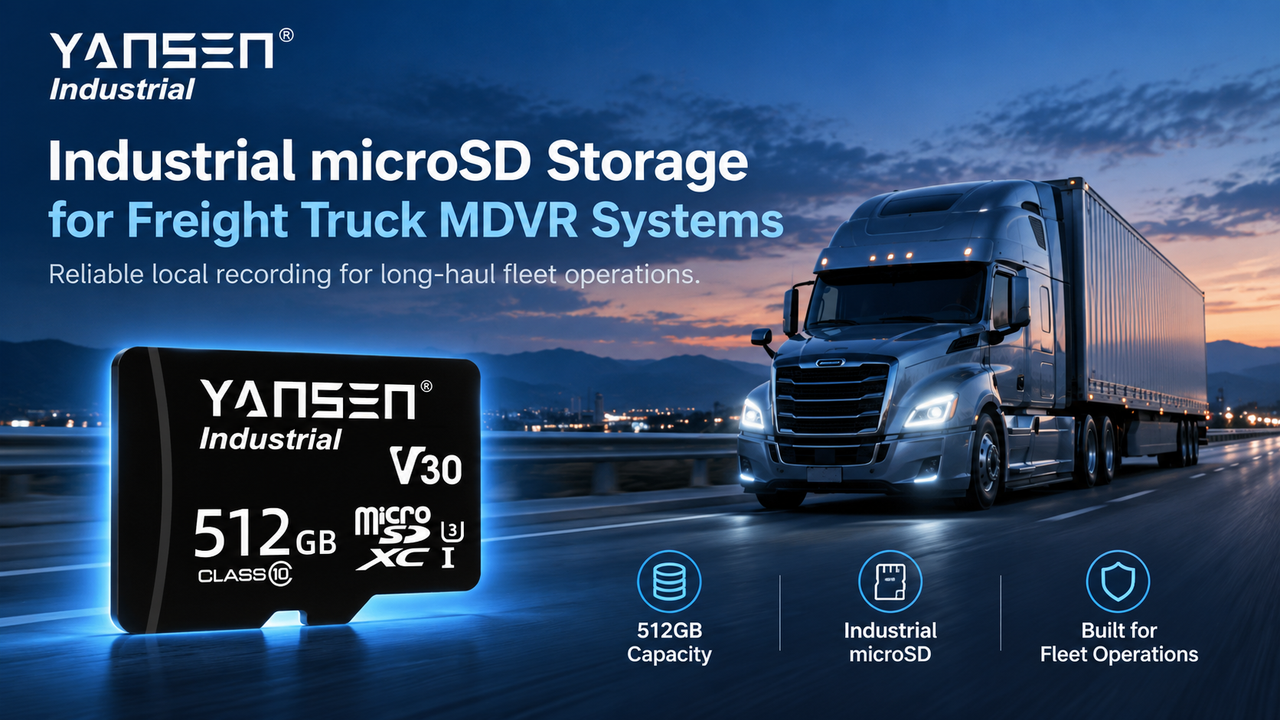
| Storage Solution | YANSEN Industrial microSD Card |
| Model / Capacity | YSDT1A3KT512INNNN / 512GB |
| Primary Workload | Multi-channel continuous video recording |
Project Background
A globally leading provider of Mobile Digital Video Recorder (MDVR) and vehicle telematics solutions was developing an intelligent in-vehicle terminal for commercial freight truck applications.
The platform integrates multiple functions within a single system, including video acquisition, real-time encoding, local recording, vehicle positioning, wireless communication and remote fleet management.
In a typical deployment, multiple cameras installed around the truck continuously capture video while the vehicle is operating. The MDVR processes these video streams and stores the footage locally before selected data is transmitted to a remote fleet management platform.
For this type of application, local storage is not simply a place to save files. It is a critical part of the vehicle’s video recording infrastructure.
The customer therefore required a compact storage solution capable of supporting long recording cycles, multi-channel video workloads and the demanding operating environment of commercial freight trucks. YANSEN provided a 512GB industrial microSD card, model YSDT1A3KT512INNNN, specifically matched to these requirements.
The Challenge: Storage That Operates as Long as the Truck Does
Freight truck MDVR systems operate very differently from consumer cameras or portable electronics. A commercial truck may remain on the road for many hours at a time, during which the onboard monitoring system continuously records video.
The storage device therefore experiences repeated and sustained write activity throughout the vehicle’s operating cycle. At the same time, it must operate inside a compact vehicle terminal exposed to temperature changes, vibration and long service hours.
For the customer, the challenge was not simply finding a memory card with sufficient capacity. The storage solution had to meet several requirements simultaneously:
- Support continuous multi-channel video recording
- Provide sufficient local recording capacity
- Maintain stable write performance over long recording periods
- Deliver adequate NAND endurance for repeated recording
- Operate under changing vehicle temperatures
- Fit within the compact architecture of the MDVR
- Support deployment across commercial fleets in different operating environments
This combination of requirements made an industrial-grade storage solution necessary.
Challenge 1: Multi-Channel Full HD Video Creates a Continuous Write Workload
The MDVR platform is designed to support multiple onboard cameras and can handle several video streams simultaneously. In freight truck applications, cameras may monitor the road ahead, the rear of the vehicle, side areas, cargo surroundings or the driver environment.
Once the vehicle begins operating, these video streams may be recorded continuously for hours. This creates a very different storage workload from typical consumer use. A consumer memory card may experience short periods of recording followed by significant idle time. In an MDVR system, the storage pattern is much closer to continuous, repeated writing.
The storage device therefore needs to maintain stable write behavior over extended periods rather than simply deliver high peak benchmark performance. For the selected 512GB industrial microSD card, sequential performance reaches up to 170MB/s read and up to 150MB/s write. The card also delivers up to 2,500 IOPS random read and up to 1,600 IOPS random write.
For this project, however, the most important factor was not maximum speed alone. It was the ability to support stable, sustained recording over long operating cycles.
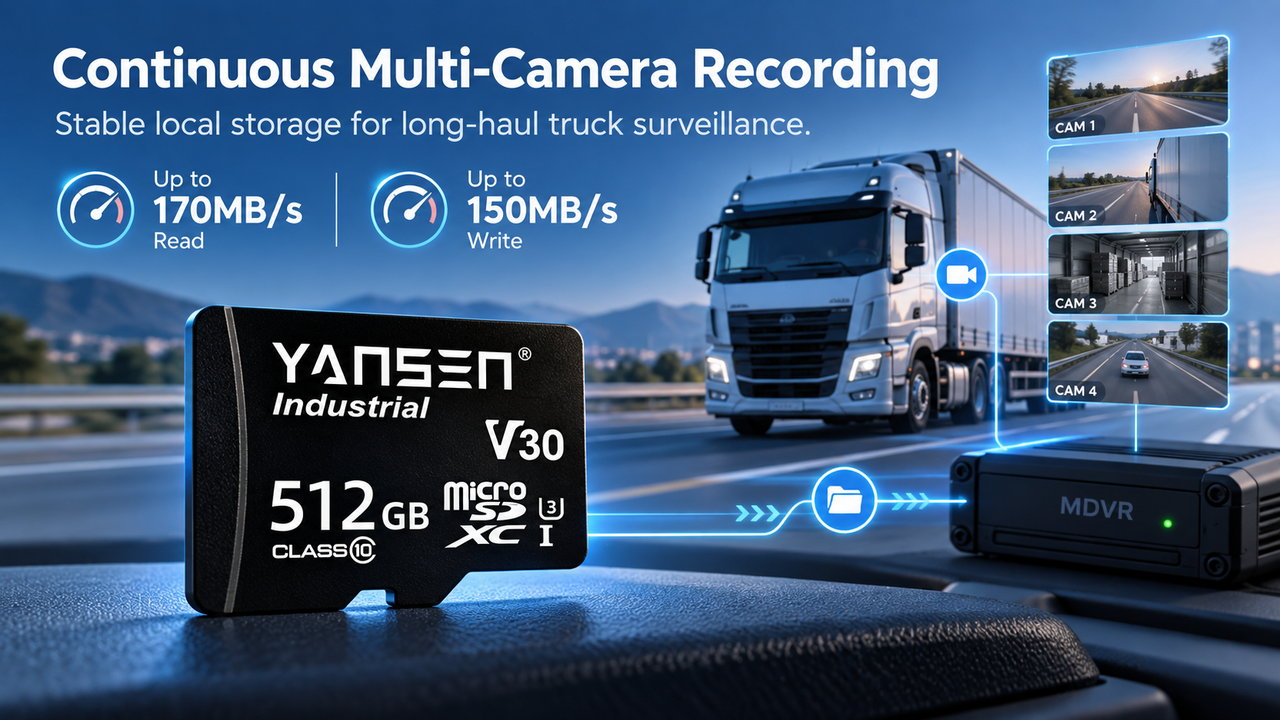
Continuous multi-channel recording: stable local storage for long-haul truck surveillance.
Challenge 2: 512GB Capacity in a Compact Embedded Format
Commercial vehicle monitoring systems need to retain sufficient video footage locally. Recording duration can be affected by several factors, including the number of cameras, video resolution, compression settings and the customer’s data retention strategy.
Increasing local storage capacity allows more video data to remain available within the vehicle before it is overwritten, transferred or archived. However, MDVR equipment is highly space constrained, and a larger storage device can increase mechanical complexity and occupy valuable internal space.
The selected YANSEN industrial microSD solution provides 512GB of storage capacity in an extremely compact form factor. This combination allows the MDVR manufacturer to increase local recording capacity without significantly changing the internal architecture of the terminal.
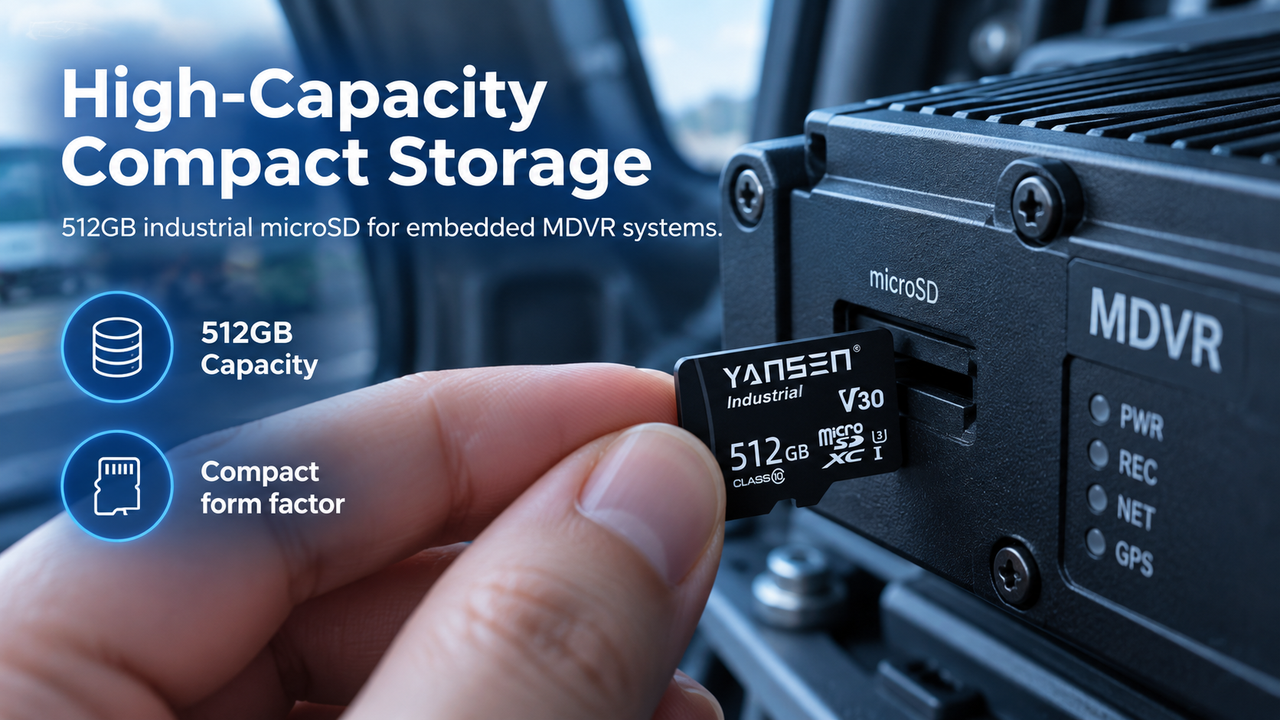
High-capacity compact storage: 512GB industrial microSD for embedded MDVR systems.
Challenge 3: Repeated Recording Requires Higher NAND Endurance
Continuous video recording also creates another challenge: NAND wear. Every recording cycle writes new data to the flash memory. Over the lifetime of a commercial vehicle monitoring system, this process is repeated again and again.
For large fleet deployments, storage endurance becomes an important consideration because the memory card may need to support continuous or near-continuous recording throughout long service cycles.
The YANSEN industrial microSD card used in this project adopts 3D TLC NAND and provides 3,000 P/E cycles. This endurance profile is designed to support repeated recording workloads more effectively than storage selected purely for occasional consumer use.
The combination of high capacity and NAND endurance is particularly important in MDVR applications. A storage device needs not only to hold large volumes of footage, but also to withstand the repeated write cycles created as old footage is overwritten by new recordings.
Challenge 4: Freight Trucks Operate Across Changing Temperature Conditions
Temperature is another major consideration in vehicle applications. Commercial freight trucks may travel across different regions and climates during a single route.
- Cold morning starts
- Significant seasonal temperature changes
- Extended operation during hot weather
- Heat accumulation inside the equipment enclosure
- Long operating periods without climate-controlled conditions
For this project, the customer required storage capable of operating reliably at temperatures down to at least -20°C. This requirement reflects the realities of commercial fleet operation, where trucks may need to start and record video even in cold outdoor environments.
YANSEN’s industrial-grade microSD solution provides the environmental capability required to satisfy this operating condition, giving the MDVR platform additional margin for deployment across varied vehicle environments. For global fleet applications, this environmental adaptability is especially important.
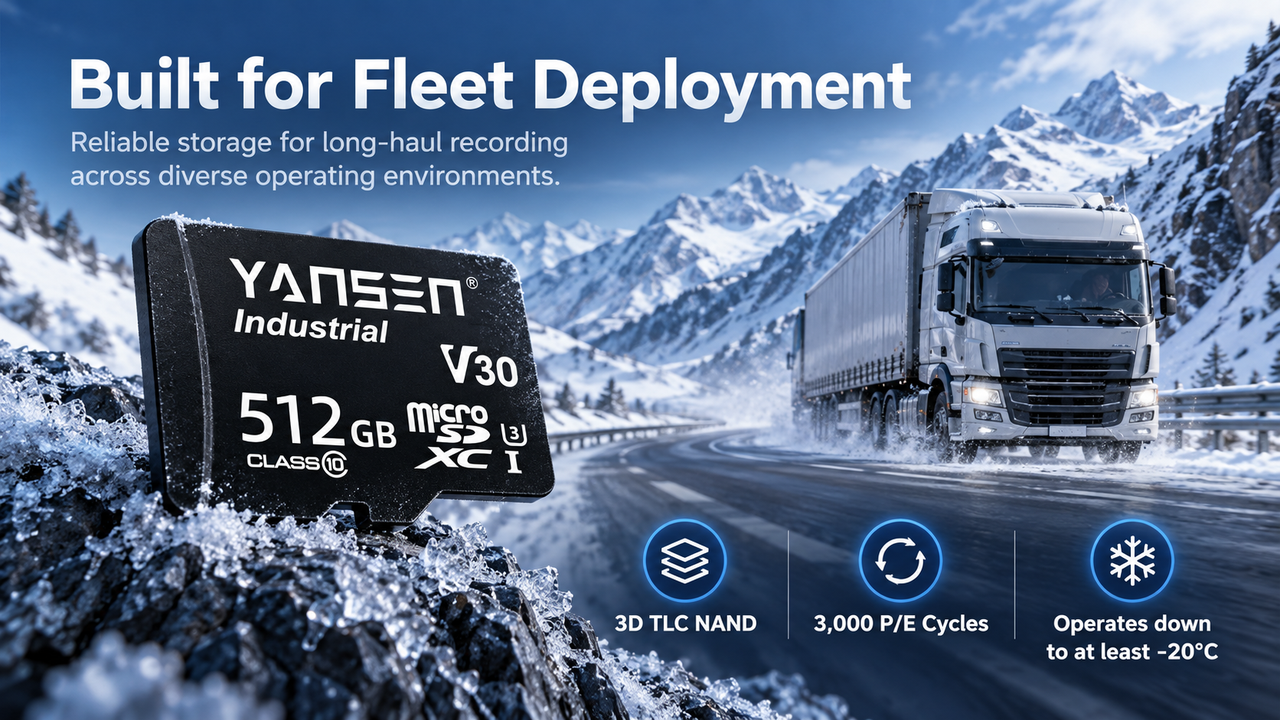
Vehicle environment adaptability: reliable storage for long-haul fleet operation in demanding climates.
YANSEN Industrial microSD Solution
To address these requirements, YANSEN supplied the YSDT1A3KT512INNNN 512GB industrial microSD card. Rather than focusing on one specification, the solution was selected because it balanced the key requirements of the complete vehicle application: performance, capacity, endurance, environmental adaptability and compact integration.
| Specification | YANSEN YSDT1A3KT512INNNN |
| Capacity | 512GB |
| NAND Flash | 3D TLC |
| Controller | SA3309 |
| Sequential Read | Up to 170MB/s |
| Sequential Write | Up to 150MB/s |
| Random Read | Up to 2,500 IOPS |
| Random Write | Up to 1,600 IOPS |
| Speed Class | U3 / A1 |
| Interface | UHS-II |
| P/E Cycles | 3,000 |
| Environmental Requirement | Meets customer’s requirement for operation down to at least -20°C |
How Storage Fits into the MDVR System
Within the freight truck monitoring platform, the industrial microSD card serves as the local recording layer between video acquisition and remote fleet management. The data flow can be simplified as:
| Vehicle Cameras | MDVR Video Acquisition & Encoding | YANSEN Industrial microSD | Cellular / Network | Fleet Management Platform |
The locally stored video can then support remote video review, event playback, vehicle incident investigation, route and fleet monitoring, driver behavior analysis and operational record keeping.
In this architecture, storage is closely connected to the availability of recorded vehicle data. A failure at the storage layer could affect the ability to retrieve footage generated during vehicle operation. That is why storage selection must be considered as part of the complete MDVR system design.
Why Industrial microSD Instead of General Consumer Storage?
Industrial and consumer storage products may share the same physical form factor, but their target workloads can be very different. Typical consumer microSD applications include smartphones, cameras and occasional video recording under relatively controlled environmental conditions.
A freight truck MDVR presents a more demanding workload: multiple cameras, long recording hours, repeated write cycles, temperature changes, vehicle vibration and long service life.
Industrial storage is not simply about higher speed. It is about matching the storage device to the actual workload and operating environment.
For vehicle surveillance, this means balancing sustained recording performance, capacity, NAND endurance and environmental adaptability.
From a Single Vehicle to Global Fleet Deployment
Storage requirements become even more important when a system moves from a single vehicle to large-scale fleet deployment. A single microSD card may appear to be only a small component inside an MDVR, but when the same platform is deployed across hundreds or thousands of commercial vehicles in different markets, consistency becomes critical.
The storage device must perform reliably not only in one truck, but across different vehicle models, route conditions, climates, operating schedules and fleet configurations. For a globally deployed MDVR platform, storage therefore becomes part of the overall system reliability strategy.
YANSEN’s industrial microSD solution helps provide the customer with a consistent storage platform for commercial vehicle applications across varied operating environments.
Application Value
By integrating the YANSEN 512GB industrial microSD card, the customer gained a storage solution designed around the realities of commercial vehicle video recording.
| High-Capacity Local Recording 512GB supports extended video retention within a compact form factor. |
Stable Recording Performance Up to 150MB/s sequential write performance supports continuous video workloads. |
| Endurance for Repeated Recording 3D TLC NAND and 3,000 P/E cycles address repeated write requirements. |
Environmental Adaptability Meets the customer’s requirement for reliable operation down to at least -20°C. |
Industrial Storage for Intelligent Transportation
As commercial vehicles become increasingly connected, onboard storage must handle more than simple video files. Modern MDVR and telematics systems continuously generate video, location information, event records and operational data.
Selecting the right storage solution therefore requires an understanding of both the workload and the environment in which the device operates. YANSEN provides industrial storage solutions for intelligent transportation applications including freight trucks, public transportation, school buses, taxis and ride-hailing vehicles, construction vehicles, special-purpose vehicles, fleet telematics terminals and in-vehicle video surveillance systems.
From compact industrial microSD cards to SSD solutions for higher-capacity vehicle computing systems, YANSEN supports storage configurations designed around different recording workloads and operating environments.
Looking for reliable storage for your MDVR or vehicle telematics system?
Talk to YANSEN about your recording workload, capacity requirements and operating environment.