For years, AI infrastructure planning has centered on one scarce resource: GPUs. In 2026, another resource is rapidly entering the capacity-planning equation—enterprise storage.
The shift is already visible in the NAND market. In Q2 2026, enterprise SSDs accounted for 48% of global NAND bit shipments, compared with approximately 26% a year earlier. The growing demand for AI infrastructure, particularly as workloads move from model training toward large-scale inference, is becoming an important driver of enterprise SSD consumption.
At the same time, NAND supply is tightening as AI server demand continues to grow. Cloud infrastructure providers are responding accordingly. CoreWeave, for example, signed a multi-year agreement with Solidigm to secure priority access to enterprise SSD capacity, describing storage as a critical constraint in capacity planning.
These developments point to a broader change in how AI infrastructure should be designed. AI infrastructure is entering an era in which storage capacity must increasingly be planned alongside GPU capacity.
But why is AI inference creating so much demand for enterprise flash? And what should data center operators consider when selecting SSD infrastructure for AI workloads?
From Training-Centric AI to Always-On Inference
The infrastructure requirements of AI are changing because the way AI systems are used is changing.
Training Is Intensive—but Temporary
Traditional AI infrastructure discussions have largely focused on model training. Training clusters require enormous computational resources and fast access to datasets, checkpoints, HBM, networking infrastructure and storage. A large training run may continue for weeks or even months, creating extremely demanding but relatively concentrated infrastructure requirements.
The central objective is often straightforward: feed the GPUs fast enough to keep expensive compute resources busy.
Storage certainly matters during training, particularly for datasets, checkpoints and intermediate data, but the GPU cluster remains the primary focus of capacity planning.
Inference Changes the Operating Model
Once an AI model moves into production, the infrastructure faces a fundamentally different workload. Instead of running a limited number of training jobs, it may need to support:
-
Continuous user requests
-
Thousands or millions of concurrent sessions
-
Longer context windows
-
Multi-turn conversations
-
Retrieval-augmented generation (RAG)
-
AI agents
-
Multimodal workloads
The system therefore needs to serve AI continuously at production scale.
This changes the storage equation. Training is primarily concerned with feeding GPUs efficiently. Inference increasingly requires the infrastructure to keep the right data close enough to the compute layer, for enough users, at an acceptable cost.
That is where memory hierarchy, context data and KV cache become increasingly important.
Why AI Inference Is Increasing Demand for Enterprise SSDs
Modern inference workloads are becoming more data-intensive. Long-context LLMs, enterprise copilots, AI agents, multimodal models and persistent conversations all require systems to maintain and access more information during inference.
KV Cache Is Changing the AI Memory Hierarchy
When an LLM processes a prompt, it generates a Key-Value (KV) cache that stores information from previously processed tokens. This allows subsequent token generation to reuse previously calculated context rather than repeatedly performing the same computation.
As three variables increase, the KV cache footprint can also grow:
More users → More concurrent inference sessions → Larger KV caches → Greater memory pressure → Greater need for additional storage tiers
This does not mean SSDs are replacing HBM or DRAM. Instead, the different memory technologies are increasingly serving different roles within a broader AI memory hierarchy:
-
GPU HBM: Highest-performance active data
-
System DRAM: Working memory and intermediate data
-
Enterprise NVMe SSD: Larger context data, active datasets and additional KV-cache tiers
-
Capacity storage: Models, datasets and longer-term data
This architecture is already becoming visible in new AI infrastructure designs. NVIDIA has introduced CMX Context Memory Storage for long-context and agentic AI inference, positioning shared storage as an additional context tier beyond GPU memory.
The implication is important: storage is becoming part of the inference memory architecture—not simply a place where data is saved after computation.
HBM Cannot Economically Hold Everything
HBM provides extremely high bandwidth, but using the highest-performance memory tier for every model, dataset and context workload would be inefficient from a system-cost and capacity perspective.
Enterprise NVMe SSDs provide a much larger capacity tier while still offering substantially lower latency than conventional storage architectures. As AI systems handle larger context windows and more concurrent sessions, SSD capacity can therefore become an important part of the overall memory and data-access strategy.
Why AI Storage Is No Longer Just About SSD Speed
Traditional SSD specifications tend to emphasize sequential read/write speeds, random IOPS and latency. These metrics remain important, but they do not fully describe what AI infrastructure operators need.
AI storage planning is becoming a multidimensional problem.
Capacity
AI infrastructure needs to accommodate models, embeddings, datasets, checkpoints, inference data and cached context. The relevant question is increasingly not simply how fast one SSD can operate, but how much usable flash capacity can be deployed per drive and per server.
Density
Data center space, server chassis and rack capacity are all limited. Higher-capacity drives can reduce the physical footprint required for a given amount of flash storage, making capacity per rack and capacity per server important infrastructure metrics.
Sustained Performance
Peak benchmark numbers can be useful for comparison, but AI infrastructure operates continuously. Operators should also evaluate how an enterprise NVMe SSD performs under sustained workloads rather than focusing exclusively on short benchmark bursts.
Endurance
AI environments may generate repeated writes through cache updates, metadata operations, data movement and high-concurrency services. DWPD and TBW should therefore be evaluated against the actual workload rather than treated as isolated specification numbers.
Higher endurance is not automatically better if the workload does not require it. The objective is to match SSD endurance to the expected write profile and deployment lifetime.
Power and Thermal Efficiency
AI data centers already operate under significant rack-level power constraints because GPUs and networking equipment consume substantial energy. Storage must fit within the available power envelope.
At the same time, increasing storage density can create additional thermal challenges:
More drives → More heat → Greater cooling requirements
For this reason, performance per watt, capacity per watt and thermal behavior under sustained workloads are becoming increasingly relevant alongside raw performance.
AI storage planning is becoming a multidimensional optimization problem involving capacity, performance, endurance, power, thermal management and physical density.
The NAND Market Is Already Reflecting the AI Storage Shift
The growing importance of enterprise storage is not simply a theoretical infrastructure trend. It is already affecting the NAND market.
Enterprise SSDs Are Consuming a Growing Share of NAND
48%
That is the share of global NAND bit shipments represented by enterprise SSDs in Q2 2026, according to the market data referenced in this analysis. A year earlier, the figure was approximately 26%.
In other words, nearly one out of every two NAND bits shipped globally in Q2 2026 went into enterprise SSDs.
Counterpoint Research also expects server enterprise SSD demand to remain a major source of NAND consumption, with server eSSD demand potentially absorbing more than half of NAND bits by the end of 2026.
Supply Is Tightening
AI server demand is occurring while NAND manufacturers face constraints on how quickly supply can expand. TrendForce has identified AI server eSSD demand as a contributor to NAND supply shortages and expects AI server demand for enterprise SSDs to remain strong in Q3 2026.
The situation is further complicated by semiconductor manufacturers allocating investment toward other high-value memory opportunities, including DRAM and HBM. NAND capacity therefore cannot simply expand without considering broader semiconductor economics.
AI Cloud Providers Are Securing Supply Directly
The procurement behavior of major infrastructure operators is also changing. CoreWeave’s multi-year agreement with Solidigm is significant not merely because of the SSD supplier involved, but because of what the agreement represents.
Enterprise storage capacity can increasingly become something infrastructure operators secure through long-term strategic agreements rather than treating SSDs as ordinary server components purchased only when individual systems are built.
The enterprise SSD is evolving from a server component into an infrastructure planning resource.
Why Storage Capacity Must Scale Alongside GPU Capacity
Traditional AI infrastructure expansion can be simplified as:
More AI demand → Add GPUs → Add networking → Add compute nodes
Inference infrastructure introduces another layer:
More AI users → More inference instances → More concurrent context → Larger KV-cache footprint → More active datasets → More storage bandwidth → More SSD capacity
This is why adding GPUs without scaling the surrounding data infrastructure can simply move the bottleneck elsewhere.
If GPU capacity grows significantly faster than storage infrastructure, several problems can emerge. GPUs may spend more time waiting for data, the storage layer may become a bottleneck, systems may need to recompute context more frequently, and overall infrastructure utilization can decline. Ultimately, these inefficiencies can affect the economics of serving AI tokens.
Storage should therefore be included in Day-0 AI infrastructure planning, rather than treated purely as a Day-2 capacity expansion problem.
For data center operators, this means estimating not only how many GPUs will be deployed, but also how much enterprise flash capacity will be required as user concurrency, model count, context length and inference traffic increase.
Six Enterprise SSD Requirements for AI Infrastructure
As enterprise SSDs become a strategic part of AI infrastructure, procurement decisions should move beyond sequential speed and unit price.
-
High Capacity
AI datasets and context workloads continue to grow. Higher-capacity enterprise SSDs can reduce the number of drives required for a given storage target.
Evaluate both capacity per drive and capacity per server, because the latter determines how efficiently the storage layer fits into the overall infrastructure.
-
High Storage Density
Data centers have finite rack space and power budgets. High-density storage allows operators to deploy more terabytes within a limited server chassis or rack footprint.
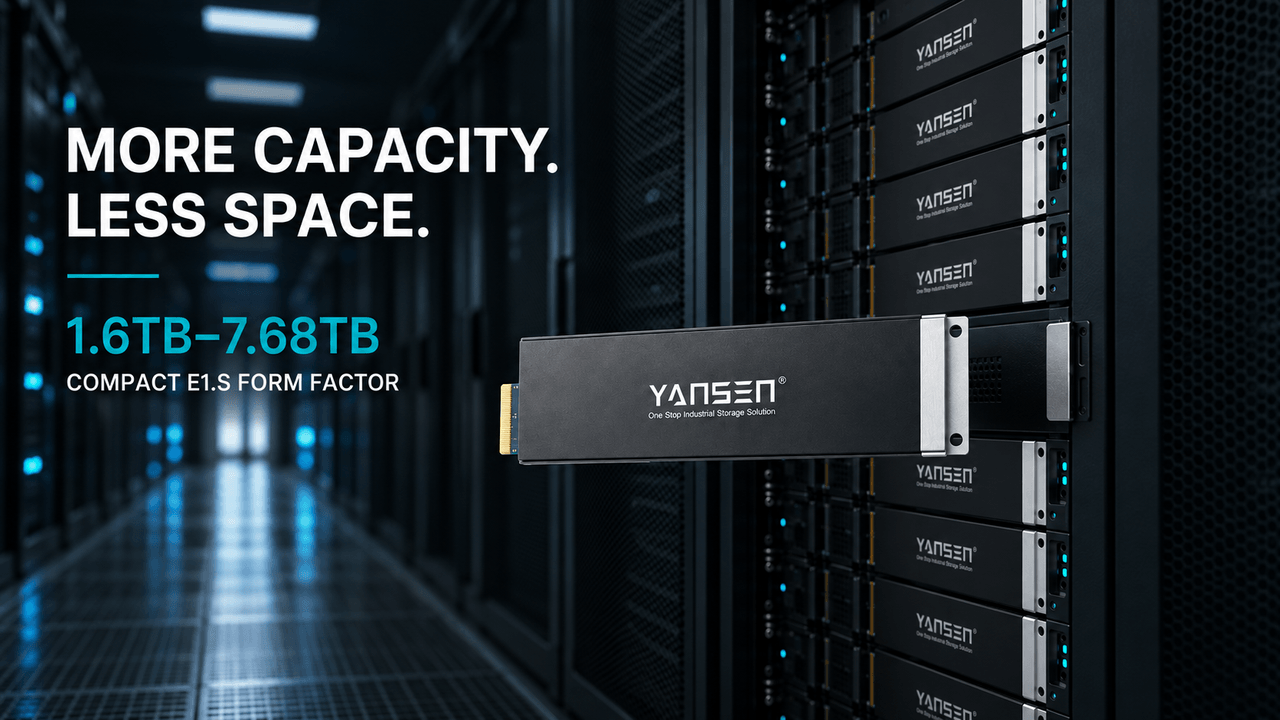
This is one reason modern enterprise form factors such as E1.S are gaining attention in high-density server architectures.
-
Consistent NVMe Performance
Do not select an enterprise NVMe SSD solely because its maximum benchmark number is higher.
For AI infrastructure, sustained performance under real-world enterprise workloads can be more meaningful than short-duration peak results. Thermal behavior, workload consistency and latency stability should also be considered.
-
Endurance
Inference environments can involve repeated writes, cache updates, metadata operations and high concurrency. SSD endurance should therefore be evaluated against the expected workload profile.
Consider daily writes, workload patterns, deployment duration and write amplification when determining the appropriate DWPD or TBW requirement.
Endurance should be matched to the actual workload profile.
-
Power Efficiency
Storage has to operate within the data center’s rack-level power budget. When comparing high-capacity drives, consider not only performance but also the amount of usable storage capacity delivered for the available power envelope.
Capacity per watt can become an important metric as AI storage density increases.
-
Thermal Management and Reliability
High-density AI servers require careful consideration of airflow, SSD temperature, thermal throttling and sustained workloads. A drive that delivers impressive peak performance but frequently throttles under continuous operation may not provide the expected system-level performance.
Reliability should therefore be evaluated together with thermal design and the intended operating environment.
Choosing the Right Enterprise SSD Form Factor
Capacity and performance are only part of the storage architecture. The physical form factor also affects server density, thermal management, serviceability and deployment flexibility.
E1.S: Designed for High-Density Modern Servers
E1.S is part of the EDSFF family developed for modern data center architectures. Its compact enterprise form factor, NVMe architecture and hot-service-oriented design make it well suited to high-density server environments.
For AI infrastructure, the key advantages to evaluate include:
-
High storage density
-
Efficient use of server space
-
Modern NVMe architecture
-
Thermal management options
-
Serviceability
-
Compatibility with modern server platforms
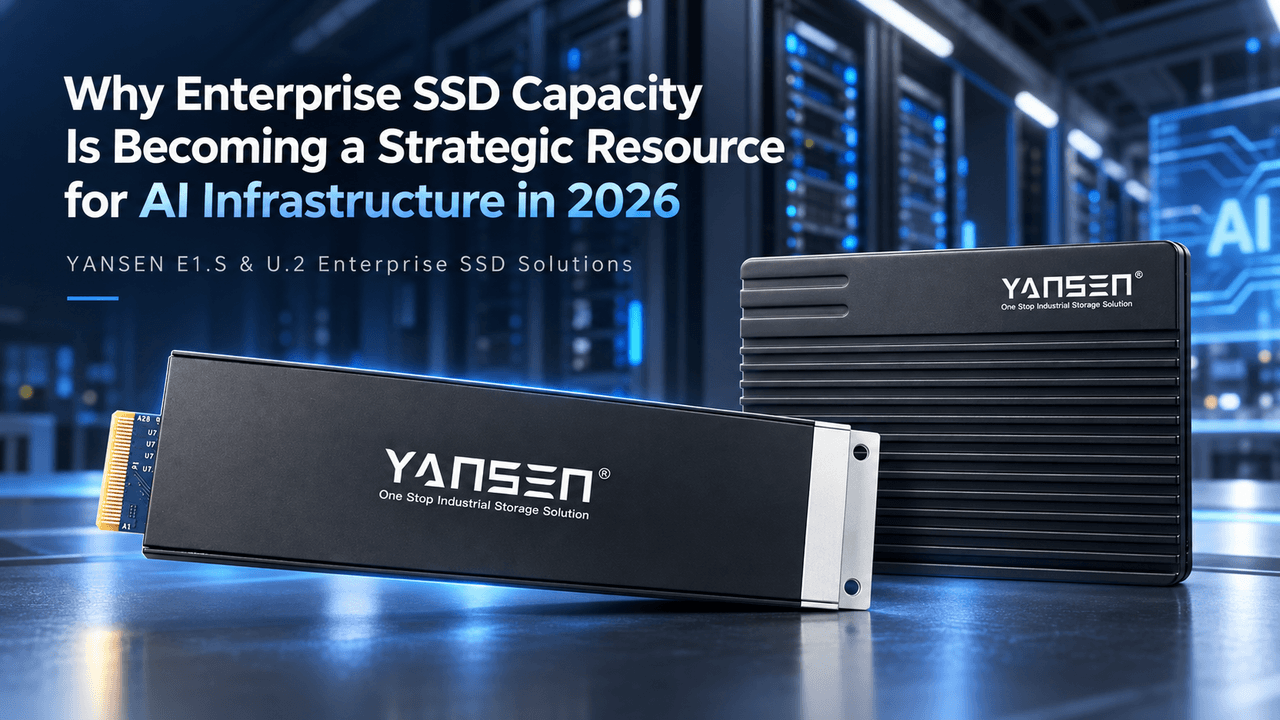
YANSEN E1.S Enterprise SSD
YANSEN’s E1.S enterprise SSD platform is positioned for modern high-density storage applications where capacity, reliability and deployment flexibility are important considerations.
Depending on the specific configuration, buyers should verify the final product specifications for:
-
Capacity: Verified YANSEN configuration
-
Interface: PCIe / NVMe
-
Sequential performance: Verified product specification
-
Random performance: Verified product specification
-
Endurance: Verified product specification
-
Power and thermal characteristics: Verified product specification
Potential applications include AI inference infrastructure, cloud servers, high-density servers, data centers and HPC systems.
U.2: A Proven Enterprise Form Factor
U.2 remains an established choice for enterprise storage. Its familiar 2.5-inch deployment format, PCIe NVMe interface and compatibility with existing server architectures make it practical for organizations that want to integrate enterprise SSDs into proven infrastructure.
U.2 can be appropriate for enterprise servers, AI storage nodes, database infrastructure, cloud platforms and data centers where existing server compatibility is an important consideration.
The decision should not be framed as E1.S versus U.2. The appropriate form factor depends on server architecture, density requirements, thermal design and existing infrastructure.
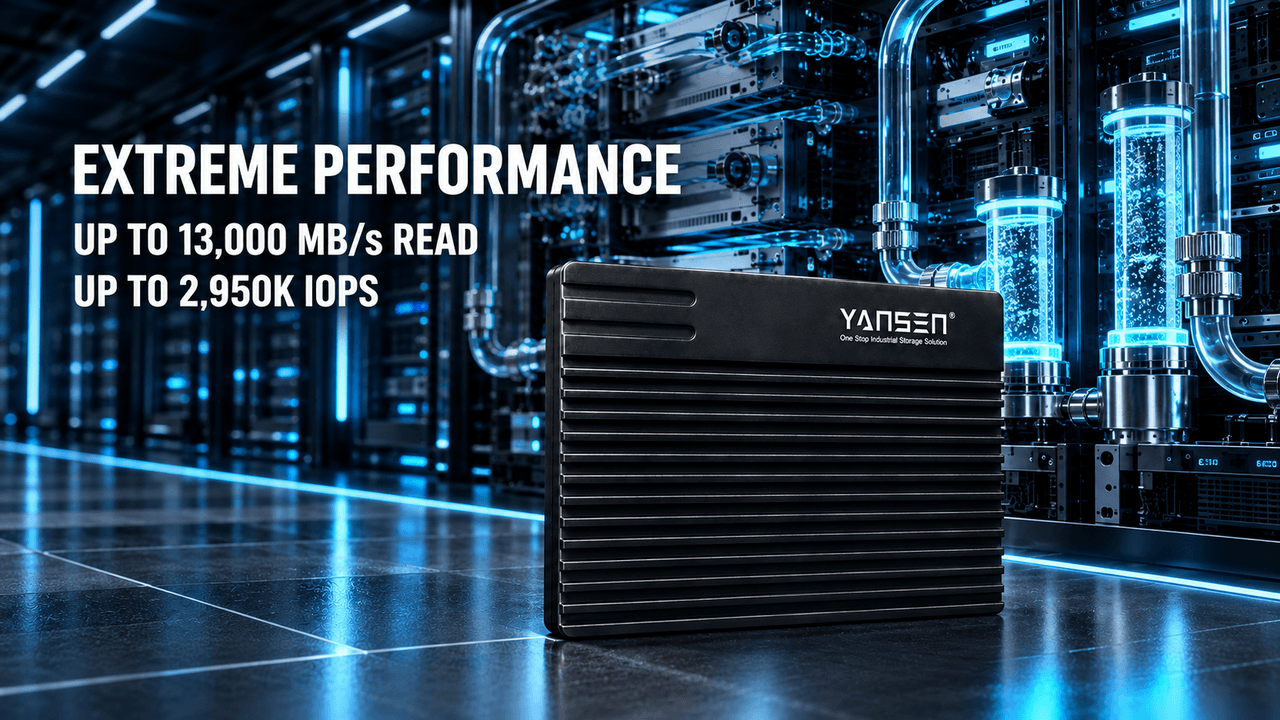
YANSEN U.2 Enterprise SSD
YANSEN’s U.2 enterprise SSD solutions are designed for enterprise storage environments where PCIe NVMe performance, capacity and deployment compatibility are required.
For infrastructure planners, the key consideration is not simply which form factor is newer, but which one provides the best balance of capacity, density, thermal behavior and compatibility for the target server platform.
AI Is Changing How Data Centers Buy Storage
Enterprise storage procurement traditionally revolved around three basic questions:
Capacity + Performance + Price
AI infrastructure requires a broader procurement framework that also considers:
-
Supply availability
-
Long-term capacity planning
-
Qualification cycles
-
Consistent product availability
-
Firmware stability
-
Lifecycle management
-
Technical support
-
Customization requirements
-
Supply-chain resilience
The multi-year SSD supply agreement signed by CoreWeave illustrates why storage availability itself can become a strategic consideration. For AI infrastructure operators, securing predictable access to enterprise storage may become almost as important as selecting the drive itself.
YANSEN focuses on industrial and enterprise storage solutions designed for customers that require stable performance, deployment flexibility and long-term storage availability. Depending on project requirements, the product portfolio can be evaluated around enterprise SSD configurations, form factors, endurance, qualification and application-specific requirements.
For AI infrastructure projects, this approach is particularly relevant when storage must be integrated into a broader server platform rather than purchased as an isolated component.
The Next AI Infrastructure Bottleneck May Not Be the GPU
The most important change in 2026 is not that SSDs are replacing GPUs. It is that AI infrastructure is becoming a system-level problem.
The AI stack increasingly depends on the coordinated scaling of:
GPU → Memory → Networking → Storage → Software
As inference workloads expand, storage capacity must grow alongside compute capacity. Longer contexts, higher concurrency, larger datasets and increasingly sophisticated AI applications are turning enterprise flash into an active part of the infrastructure rather than a passive storage layer.
As inference workloads scale, the question for data center operators is no longer simply how many GPUs they can deploy. It is whether the entire data infrastructure—including enterprise flash—can scale with them.
YANSEN enterprise NVMe SSD solutions, including E1.S and U.2 form factors, are designed to support the capacity, performance and reliability requirements of modern enterprise and AI infrastructure.
Talk to YANSEN about enterprise storage solutions for your next AI infrastructure deployment.