In 2026, several leading technology companies, including Unitree Robotics, Dreame Technology, MagicLab, Galaxy General Robotics, and Songyan Dynamics, were featured during the CCTV Spring Festival Gala, highlighting the rapid advancement of China’s humanoid robot technology and robotics industry ecosystem.
Among the highlights was the widely discussed “WuBot” performance, where multiple humanoid robots executed high-precision, synchronized martial arts routines.
Beyond the visual spectacle, the show was a powerful demonstration of cutting-edge robotics engineering, raising an essential question: what technical systems enable humanoid robots to execute complex actions with such precision? At the heart of this innovation lies massive data processing and high-performance storage infrastructure, turning robots into fully functional, mobile data centers.

1. Understanding the Technology Behind Humanoid Robots
1.1 Hardware Layer: Mechanics Meets Sensing Systems
Humanoid robots are far more than moving machines. Their hardware architecture combines mechanical components with sophisticated sensing systems to process real-world stimuli in real time. Key elements include:
- Multi-degree-of-freedom joint systems for fluid, human-like movement
- IMU (Inertial Measurement Units) and vision cameras for real-time perception
- Force feedback sensors to monitor and adjust movement dynamics
- Edge computing units embedded for local processing and decision-making
These systems generate terabytes of data every second. To maintain balance, execute dynamic movements, and interact with the environment, robots rely on ultra-fast data processing. The speed of this data pipeline is critical: milliseconds of delay can result in movement errors or failed synchronization. This is where storage for robotics systems and edge computing SSD solutions play a pivotal role.
1.2 Software Layer: Algorithms, Models, and AI-Driven Decisions
Humanoid robots operate on complex software frameworks that integrate reinforcement learning, pre-trained action databases, real-time balance algorithms such as MPC (Model Predictive Control) and ZMP (Zero Moment Point), and collaborative synchronization protocols for group performances. The process follows a continuous loop:
- AI-based training generates motion models
- Data is stored and indexed in high-speed storage
- Models are retrieved locally during execution
- Real-time adjustments occur based on sensory input
This data-driven workflow demands high-performance storage for AI robotics infrastructure, ensuring that model retrieval, caching, and logging happen without bottlenecks.
2. Three Core Storage Scenarios in Humanoid Robotics

2.1 AI Model Training — Data Center Storage Requirements
Developing humanoid robot AI models requires massive datasets, including:
- Terabytes of video recordings for motion capture
- Tens of terabytes of simulation and environmental data
- Frequent read/write operations for iterative model training
Traditional storage interfaces are insufficient to handle this scale. Modern AI training clusters increasingly adopt PCIe NVMe SSDs, particularly:
- PCIe 4.0 SSDs: Offering 16 GT/s per lane and read speeds around 7 GB/s
- PCIe 5.0 SSDs: Delivering up to 32 GT/s per lane and over 12 GB/s
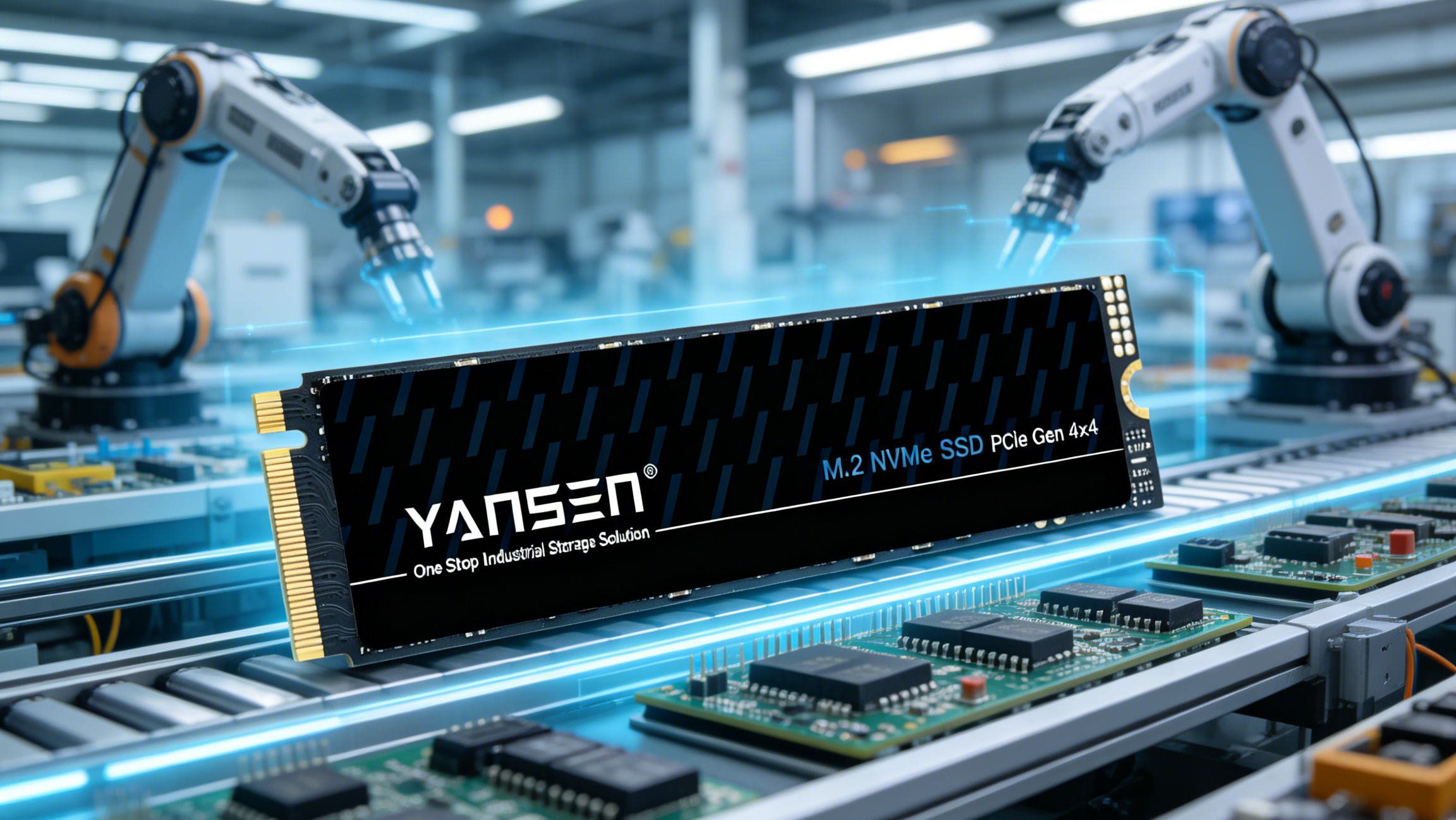
These high-speed SSDs enable faster data loading, accelerated AI model iteration, and optimal GPU utilization. For robotics R&D enterprises, storage bandwidth is no longer secondary—it directly impacts AI training efficiency. Products like YANSEN enterprise-grade NVMe SSDs in EDSFF E1.S form factor offer dense, reliable storage for AI training infrastructure.
2.2 Onboard Robot Storage — Industrial Edge SSDs
Once deployed, humanoid robots operate in environments that require resilient edge computing storage solutions. Onboard tasks include:
- Storing action libraries and behavioral datasets
- Caching AI models for low-latency decision-making
- Logging sensory data continuously
- Writing operational metrics for performance analysis
Challenges for edge storage include vibration, high-frequency writes, wide temperature ranges, and sudden power losses. Industrial-grade SSDs provide:
- High Total Bytes Written (TBW) for long-term endurance
- Wide temperature operation ranges for reliable field performance
- Power-loss protection to safeguard data integrity
- Stable firmware for deterministic behavior in autonomous systems
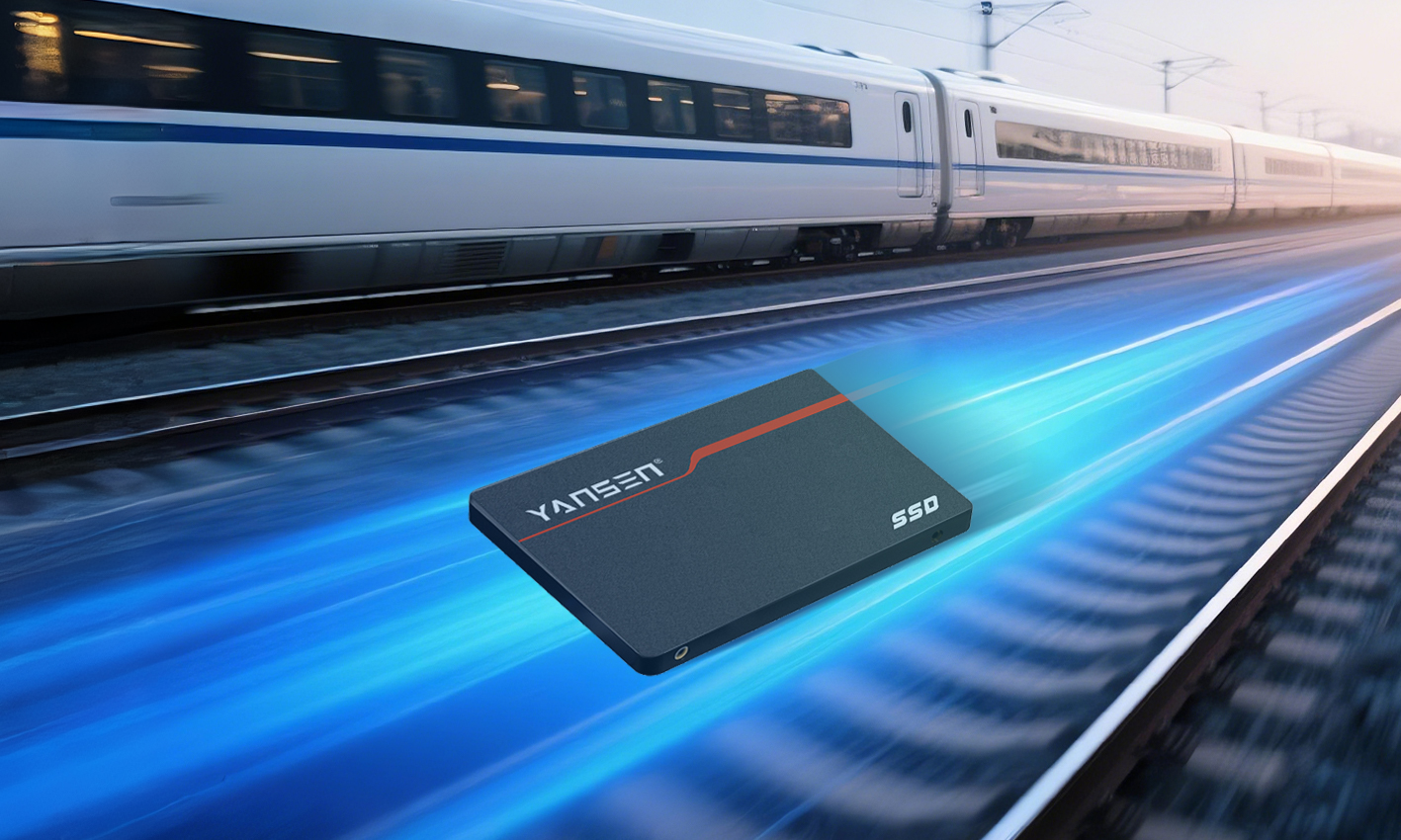
YANSEN industrial NVMe and SATA SSDs are specifically engineered for these robotic and automation applications, ensuring the integrity of real-time data processing and control.
2.3 Real-Time Collaborative Systems — Low-Latency Caching
During performances like “WuBot,” multiple robots must execute perfectly synchronized actions. Storage latency can directly affect:
- Frame-level motion synchronization
- Timely network data distribution
- Real-time corrective feedback loops
Even minor delays can disrupt choreography, highlighting the need for low-latency edge computing SSDs. Consistency and fast data access are crucial, especially when robots operate as a coordinated swarm or collaborative system.
3. How Humanoid Robotics Drives Storage Industry Trends
The next five years will see humanoid robots adopted in diverse sectors:
- Manufacturing and automation
- Commercial services and customer engagement
- Healthcare and caregiving
- Education, entertainment, and interactive learning
- Logistics and warehouse operations
Each robot functions as a local AI terminal and continuous data-writing node. This evolution leads to storage trends such as:
- Growing demand for industrial-grade SSDs
- Rapid expansion of edge AI storage solutions
- Increased enterprise storage capacity for training clusters
- Replacement of consumer-grade storage with robust, high-reliability industrial solutions
Humanoid robotics is reshaping the requirements for storage infrastructure, driving innovation and adoption of high-performance SSDs.
4. Lessons from “WuBot”: Upgrading Infrastructure for the AI Era

“WuBot” represents more than entertainment—it signals the arrival of an AI-driven robotics era. The foundation of all intelligent machines lies in:
- High-compute power for AI processing
- Reliable enterprise and industrial-grade storage
- Real-time, low-latency data pipelines
Without a robust storage backbone, humanoid robotics cannot achieve full operational potential. In this context, enterprise NVMe SSDs, industrial SSDs, and edge computing storage solutions are no longer optional—they are mission-critical.
5. Conclusion & Call to Action
As humanoid robots evolve, the importance of reliable, high-performance storage becomes undeniable. From AI training clusters to edge robotic systems, enterprise-grade and industrial-grade SSDs form the backbone of intelligent automation.
Businesses and developers looking to integrate high-performance humanoid robots into their operations should consider:
- Exploring enterprise-grade storage solutions for AI and robotics
- Leveraging industrial SSD products for edge computing applications
- Engaging technical teams to optimize storage infrastructure for robotics deployments
With cutting-edge storage solutions, the robotics industry can unlock unprecedented capabilities, driving innovation across research, industrial, and consumer applications.
6. FAQ
Q1: What is humanoid robot technology and why is storage important for it?
A1: Humanoid robot technology refers to robots designed to mimic human movements and behaviors. These robots generate massive amounts of data every second from sensors, cameras, and motion systems. High-performance storage, such as industrial SSDs and edge computing SSDs, is critical for real-time data processing, AI model execution, and reliable operation.
Q2: How does NVMe SSD improve AI robotics infrastructure?
A2: NVMe SSDs, particularly PCIe 4.0 NVMe SSDs and PCIe 5.0 SSDs, offer ultra-high bandwidth and low latency. This allows AI training clusters to process terabytes of video, simulation, and model data efficiently, boosting GPU utilization and reducing AI model training time in robotics applications.
Q3: Why do robots need edge computing in robotics?
A3: Robots rely on edge computing to process data locally, enabling real-time responses without waiting for cloud communication. Edge computing storage solutions, including industrial NVMe SSDs, store AI models, motion databases, and sensor data, ensuring low-latency decision-making for humanoid robots in dynamic environments.
Q4: What types of storage are used in robotics data storage systems?
A4: Robotics data storage systems use high-performance storage for AI, such as enterprise SSDs for AI training, industrial NVMe SSDs for edge devices, and high-reliability SSDs to handle vibration, temperature fluctuations, and frequent writes. These storage solutions maintain stability and ensure continuous operation of robotics systems.
Q5: How does high-performance storage support real-time collaboration among robots?
A5: In scenarios like synchronized humanoid robot performances, low-latency storage ensures data frames and action commands are distributed and cached in real time. Edge computing SSDs provide consistent, high-speed access, preventing delays or synchronization errors across multiple robots.
Q6: What trends in the robotics industry are driving storage demand?
A6: As humanoid robots enter manufacturing, healthcare, education, logistics, and entertainment, demand for high-capacity, industrial-grade, and low-latency SSDs increases. Storage requirements expand for AI training, edge computing, and collaborative robot systems, driving adoption of PCIe 4.0 and PCIe 5.0 NVMe SSDs in the robotics industry.
Q7: Why choose YANSEN industrial SSDs for robotics applications?
A7: YANSEN industrial NVMe and SATA SSDs are designed for edge robotics applications. They offer high TBW, power-loss protection, wide operating temperature ranges, and stable firmware, making them ideal for humanoid robots that operate under high vibration, frequent writes, and real-time computing requirements.