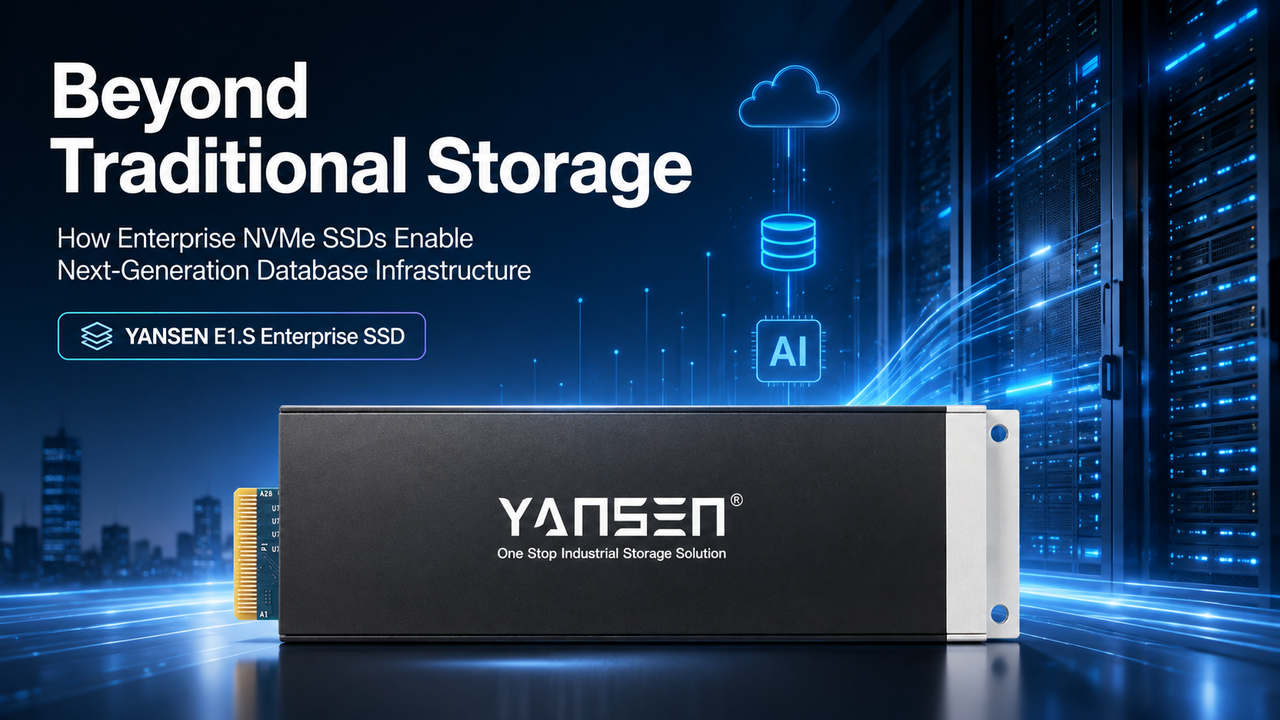
When selecting an enterprise Solid-State Drive (SSD) for critical infrastructure such as databases, high-performance computing, or surveillance systems, understanding core parameters is essential. Beyond factors like interface types and capacity, it is the performance metrics and endurance parameters—such as DWPD (Drive Writes Per Day), TBW (Total Bytes Written), PBW (Petabytes Written), and P/E (Program/Erase Cycles)—that dictate an SSD’s suitability for specific enterprise workloads.
This article provides a comprehensive guide to these parameters, how they affect the performance and lifespan of enterprise SSDs, and how you can leverage them to make informed purchasing decisions.

1. Understanding the Core Parameters of Enterprise SSDs
1.1 DWPD (Drive Writes Per Day)
① Definition and Explanation:
Drive Writes Per Day (DWPD) is one of the most critical parameters when it comes to SSD endurance. It refers to the number of times the total capacity of an SSD can be written to per day over its entire warranty period. For example, a 1TB SSD with a DWPD rating of 1 means it can write 1TB of data every day for the entire warranty period, which is typically 3 to 5 years for enterprise drives.
DWPD is especially important for write-heavy enterprise applications where the SSD is required to process large amounts of data. If an SSD has a low DWPD, it may degrade more quickly under intense workloads, making it less reliable for certain business-critical environments.
② Factors That Affect DWPD:
DWPD can be influenced by the workload the SSD will handle. For instance, high write-intensive workloads—such as those seen in databases, financial systems, and real-time analytics—generate far more data writes than read-intensive workloads like media streaming or content delivery networks (CDNs).
- Write-Intensive Applications: Workloads such as database transactions, online transaction processing (OLTP), and high-performance computingtend to demand SSDs with higher DWPD ratings due to constant read and write operations. SSDs designed for these tasks typically offer 3 or more DWPD to ensure long-term reliability.
- Read-Intensive Applications: Workloads where data is primarily read, such as cloud storageand VDI (Virtual Desktop Infrastructure), can manage with SSDs rated for lower DWPD since there are fewer data writes.
③ Real-World Application of DWPD:
DWPD is particularly crucial in enterprise scenarios like data centers, cloud infrastructure, and virtualization environments. Take the example of a database server—with constant updates and transactions, the write load is high, so a DWPD rating of 3 or more ensures the SSD will last for years without compromising data integrity. In contrast, a content delivery system that primarily serves static content might only need an SSD with a DWPD of 0.5 or 1.
1.2 TBW (Total Bytes Written) / PBW (Petabytes Written)
① Definition and Role in SSD Longevity:
Total Bytes Written (TBW) and Petabytes Written (PBW) are metrics that define the total amount of data that can be written to an SSD before it reaches the end of its usable life. TBW is typically used for consumer and mid-range enterprise SSDs, while PBW is used for high-capacity, high-end enterprise drives.
For example, an SSD with a TBW rating of 1,500TB can have up to 1,500 terabytes of data written to it over its lifespan before the NAND flash memory cells begin to wear out. PBW is simply a larger scale measurement, where 1PB equals 1,000TB.
② Calculating TBW/PBW:
The TBW or PBW of an SSD is directly linked to the Drive Writes Per Day (DWPD), its storage capacity, and the length of the warranty period. The calculation can be done with the following formula:
TBW=DWPD×SSD Capacity (TB)×Warranty Period (in years)×365
For instance, if an SSD has a capacity of 2TB, a DWPD of 2, and a warranty period of 5 years, its TBW would be:
TBW=2×2×5×365=7,300 TBW
This means the SSD can handle up to 7,300 terabytes of writes before it reaches the end of its rated lifespan.
③ Real-World Application of TBW/PBW:
In applications such as video surveillance or financial data logging, where large amounts of data are written continuously, having an SSD with a high TBW or PBW rating is essential. For example, an SSD with a PBW rating of 5PB would be capable of handling petabytes of data over the course of its lifetime, making it suitable for heavy-duty data processing and long-term data storage.

1.3 P/E (Program/Erase Cycles)
① Basic Definition:
Program/Erase (P/E) cycles are another measure of SSD endurance. They represent the number of times an SSD’s flash memory cells can be written to and erased before they start to wear out. Each time data is written or erased, a certain amount of wear is applied to the NAND flash memory cells, and over time, this wear accumulates, reducing the SSD’s lifespan.
② Flash Types and P/E Cycle Ratings:
Different types of NAND flash memory have varying endurance levels, which are measured in terms of P/E cycles:
- SLC (Single-Level Cell): SLC stores one bit per cell, providing the highest endurance with up to 100,000 P/E cycles. SLC-based SSDs are typically found in high-end enterprise drives where durability and performance are paramount.
- MLC (Multi-Level Cell): MLC stores two bits per cell and offers around 3,000 to 10,000 P/E cycles. MLC is a good balance between endurance and cost, often used in enterprise SSDsfor moderate workloads.
- TLC (Triple-Level Cell): TLC stores three bits per cell and has a lower endurance of 500 to 1,000 P/E cycles. TLC is commonly found in consumer-grade SSDsbut is also used in enterprise environments with lighter workloads.
- QLC (Quad-Level Cell): QLC stores four bits per cell and has the lowest endurance at around 300 P/E cycles. This type of flash is primarily used for archive storageor other low-write applications due to its lower endurance.
③ Application of P/E Cycles:
Understanding P/E cycles is crucial when selecting SSDs for enterprise use. If an SSD with TLC NAND is used in a write-heavy environment where SLC or MLC would be more appropriate, the drive will wear out more quickly, leading to potential data loss or performance degradation.
For example, cloud service providers managing vast amounts of user data might prefer MLC or eMLC SSDs, which offer a balance of cost and endurance, whereas financial institutions managing real-time trading platforms may opt for SLC to ensure maximum durability and minimal downtime.
2. Case Study: YANSEN Surveillance SATA SSD
Let’s now explore a real-world example of how these parameters come into play with YANSEN’s Surveillance SATA SSD. This enterprise-grade SSD is specifically designed for surveillance applications, where large volumes of video data are constantly written and stored.
2.1 Product Overview:
YANSEN’s Surveillance SATA SSD integrates TLC NAND technology, which has been optimized with advanced features like end-to-end data protection and intelligent firmware to ensure data integrity, even in the event of power loss. The SSD also incorporates dynamic thermal throttling to prevent overheating, which is essential for maintaining stable performance during continuous write operations.

2.2 Key Product Parameters:
- TBW (Total Bytes Written):The TBW rating for YANSEN’s Surveillance SATA SSD reaches 8,000TB. This means that over the SSD’s 5-year warranty period, it can handle up to 8,000 terabytes of writes, making it suitable for long-term video recording and storage in surveillance systems.
- DWPD Calculation:Using the formula mentioned earlier, we can calculate the DWPD for YANSEN’s Surveillance SSD:

This indicates that the drive can handle 2.19 full drive writes per day, which is ideal for continuous video surveillance systems where large volumes of data are written frequently.
- P/E Cycles:YANSEN’s Surveillance SATA SSD uses TLC NAND, with an endurance of around 1,000 P/E cycles. Given the drive’s high TBW, the P/E cycles are well-suited for long-term operation in surveillance environments where both capacity and write endurance are critical.
3. How to Choose the Right Enterprise SSD
Selecting the right enterprise SSD goes beyond just choosing the highest capacity or fastest drive. It requires a careful balance of several key factors, including performance, endurance, workload type, and budget.
3.1 Balancing Performance and Longevity
For enterprise systems, striking the right balance between performance and longevity is crucial. Workloads such as high-performance computing (HPC) or database applications require SSDs with high DWPD and TBW ratings, ensuring that the drives can handle continuous write operations without degrading quickly. On the other hand, read-heavy workloads or archival storage may benefit from SSDs with lower DWPD but higher capacities.
3.2 Capacity vs. Cost
SSDs with higher DWPD, TBW, or PBW ratings tend to cost more, so it’s essential to weigh the long-term reliability of the drive against the initial cost. For example, if an application requires constant writes, a drive with a high TBW will offer better long-term value even if the upfront cost is higher. However, for environments with light data writes, a more cost-effective SSD with a lower DWPD may suffice.
3.3 Workload-Specific Recommendations
- High-Performance Computing:These systems benefit from SSDs with low latency, high IOPS, and high DWPD. SSDs with SLC or eMLC NAND are often preferred.
- Database Applications:Consistency and endurance are essential in databases. SSDs with high TBW and end-to-end data protection features should be prioritized.
- Virtualization and Cloud Computing:For virtual environments, read and write performance, DWPD, and scalability are important considerations.
4. Conclusion
Choosing the right enterprise SSD requires a thorough understanding of the core parameters that define its performance and longevity. DWPD, TBW, and P/E cycles are crucial metrics that determine how well an SSD will perform in various enterprise environments. By taking into account the specific workload requirements, businesses can make informed decisions that optimize their infrastructure’s performance while ensuring long-term reliability.
With solutions like YANSEN’s Surveillance SATA SSD, enterprises can confidently address the demands of write-heavy applications, ensuring data security, reliability, and optimal performance over extended periods.