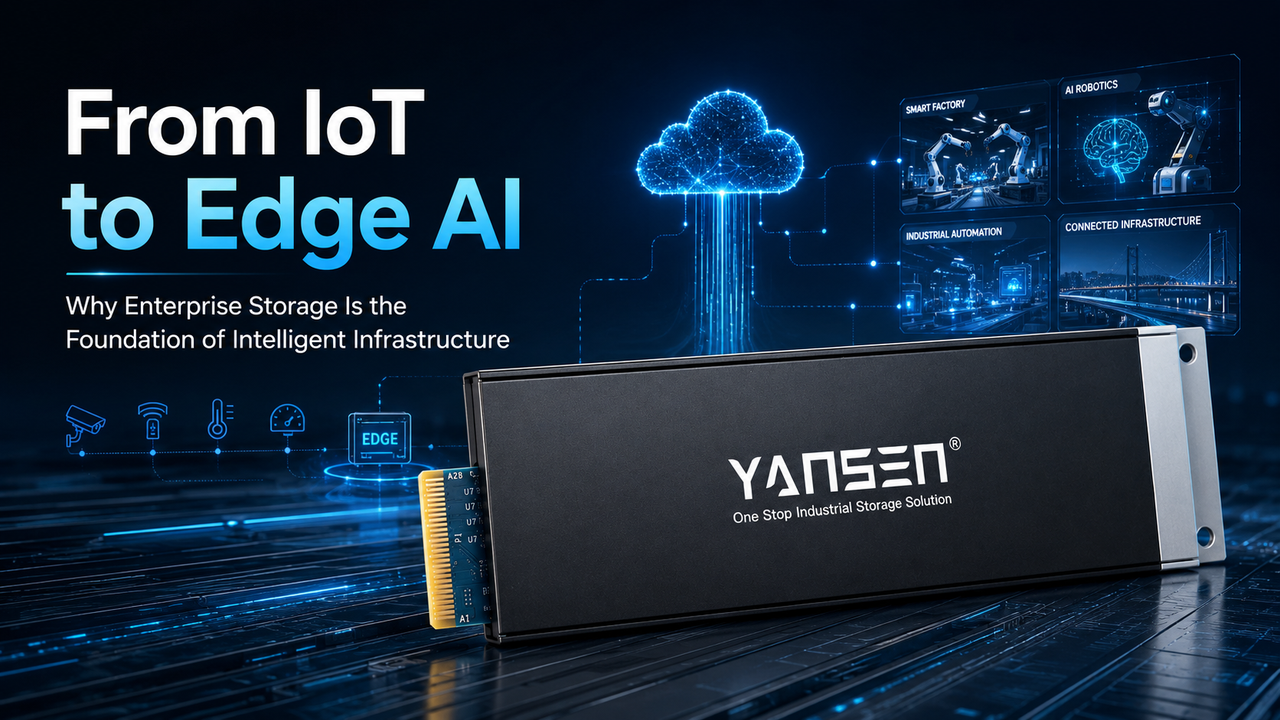
Over the past decade, the Internet of Things (IoT) has fundamentally changed how devices communicate, collect information, and interact with the physical world. From smart factories and autonomous machines to intelligent robots, smart transportation systems, and connected cities, more devices are becoming equipped with sensors, cameras, AI capabilities, and real-time communication technologies.
However, as IoT continues to expand, the value of connected devices is no longer determined only by connectivity. The real challenge is how quickly, securely, and reliably the massive amount of generated data can be processed.
Modern IoT devices continuously produce different types of data, including machine operation records, sensor information, video streams, and AI inference data. Traditional cloud-based architectures are increasingly facing limitations when applications require immediate responses and continuous data processing.
This is why Edge Computing is becoming a critical part of next-generation intelligent infrastructure. By moving computing and storage closer to where data is generated, edge systems can reduce latency, improve efficiency, and support real-time decision-making.
The Shift from Cloud Computing to Edge Intelligence
Traditional IoT architectures usually follow a centralized model:
-
Device collects data
-
Network transfers information
-
Cloud processes and analyzes data
-
Applications receive results
This architecture works well for many traditional applications. However, as IoT evolves toward AI-driven systems, the limitations of cloud-only processing are becoming more obvious.
-
Low Latency Requirements for Real-Time Applications
Many modern intelligent applications require immediate responses. Industrial robots, autonomous systems, and automated production lines cannot always wait for data to travel between devices and distant cloud servers.
For example, an industrial vision system inspecting products on a manufacturing line may need to identify defects and make decisions within milliseconds. Any delay in data transmission can affect production efficiency and system accuracy.
Edge Computing solves this challenge by processing critical data closer to the source, enabling:
-
Faster response times
-
Reduced network delays
-
Real-time decision-making
-
Increasing Bandwidth Pressure from Massive Data Generation
The growth of cameras, sensors, and AI-enabled devices has created unprecedented data volumes. A single industrial camera system can generate large amounts of image and video data every day, while smart machines continuously produce operational information.
Sending all of this data to the cloud is not always practical. It increases network costs, consumes bandwidth resources, and may reduce system efficiency.
Edge computing allows organizations to process and filter data locally, transmitting only valuable information to centralized systems. This approach improves both performance and infrastructure efficiency.
-
Data Security and Local Processing Requirements
For many industries, data security has become a major concern. Manufacturing data, medical information, transportation records, and enterprise operational data often contain sensitive information that cannot always be transferred to external cloud environments.
By storing and processing data locally, edge computing provides organizations with greater control over their information while maintaining fast access for intelligent applications.
Why Storage Becomes Critical in Edge Computing
While computing power and network connectivity remain important components of edge infrastructure, storage has become another key factor affecting system performance.
An edge AI system must not only calculate results but also continuously manage:
-
Large volumes of sensor data
-
AI model files
-
Historical operation records
-
Video and image datasets
-
System logs
Without reliable and high-performance storage, even powerful processors may not achieve their full potential.
Edge AI Requires More Than Computing Power
In the early stages of AI development, most attention was focused on computing performance. Companies invested heavily in CPUs, GPUs, AI accelerators, and network infrastructure to improve model training and inference capabilities.
However, as AI applications move from centralized data centers into real-world environments, another challenge is becoming increasingly important: how efficiently data can be stored, accessed, and processed.
For Edge AI systems, storage is no longer just a place to keep files. It has become an active component that connects data collection, AI processing, and intelligent decision-making.
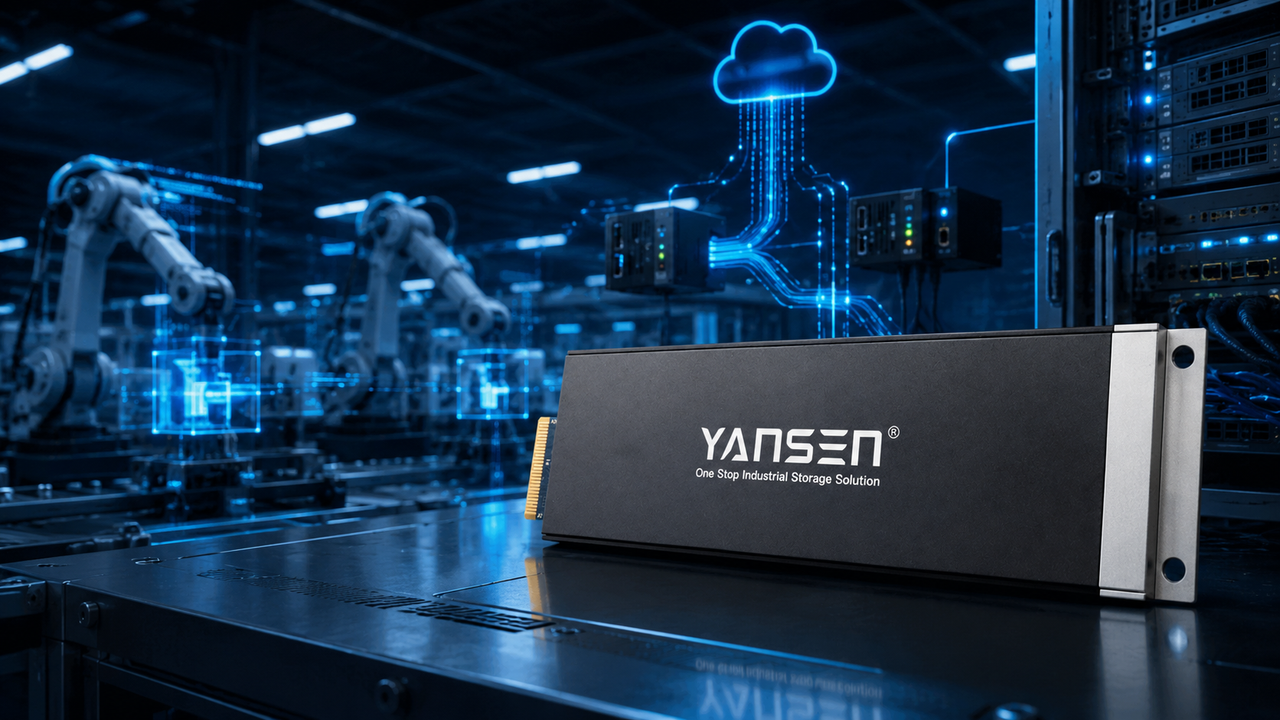
The Role of Storage in the Edge AI Workflow
A typical Edge AI workflow includes several key stages:
-
Data Collection
-
Local Storage
-
AI Inference
-
Real-Time Decision Making
Each stage creates specific storage requirements. Unlike traditional IoT devices that mainly record simple sensor information, modern AI-enabled systems must handle much larger and more complex datasets.
-
High-Speed Data Writing for Real-Time Data Collection
The first challenge for Edge AI storage is handling continuous data generation.
Smart factories, autonomous machines, and intelligent robots may collect data from multiple sources, including:
-
High-resolution images
-
Video streams
-
Sensor information
-
Machine operation records
-
Environmental monitoring data
These data streams often require fast and stable writing performance. If storage cannot process incoming data efficiently, important information may be delayed, lost, or require additional buffering resources.
For industrial AI applications, storage performance directly affects the reliability of the entire system.
-
Fast Data Access for AI Model Inference
After data collection, Edge AI systems need to load AI models and process information locally. Unlike traditional applications, AI workloads frequently access large model files and related datasets.
The storage system needs to provide:
-
Fast model loading
-
Low access latency
-
Stable random read performance
-
Reliable operation under continuous workloads
For example, an industrial vision inspection system may need to quickly load a trained AI model and analyze images from production equipment in real time. Slow storage can increase inference latency and reduce overall system efficiency.
-
Long-Term Reliability for Continuous Edge Operation
Many Edge AI devices are deployed in locations where maintenance is difficult, including:
-
Factory production lines
-
Transportation infrastructure
-
Outdoor monitoring systems
-
Remote industrial environments
Unlike consumer devices that may operate only several hours per day, industrial edge systems often need to run continuously for years.
Therefore, storage solutions used in these environments must focus on more than peak performance. They need:
-
High endurance
-
Stable long-term performance
-
Data protection capability
-
Resistance to demanding operating conditions
This is why enterprise and industrial SSDs are becoming increasingly important in Edge AI infrastructure.
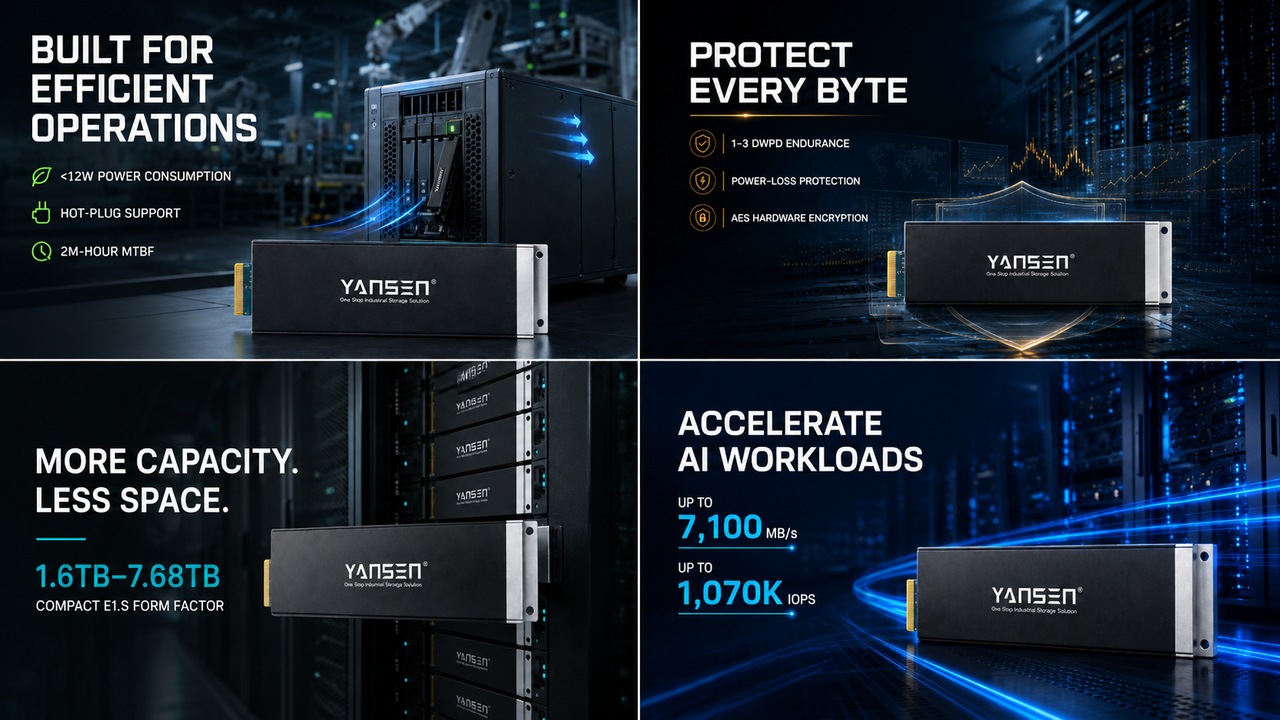
Why E1.S SSD Is Becoming a Future Storage Choice for Edge Infrastructure
As AI computing moves closer to the edge, storage architectures also need to evolve. Traditional storage solutions may face challenges related to performance, thermal management, and deployment density in modern intelligent systems.
The E1.S SSD form factor, developed as part of the Enterprise and Data Center Standard Form Factor (EDSFF) family, was designed specifically for next-generation computing environments.
Compared with traditional 2.5-inch enterprise SSDs, E1.S provides a more flexible design approach for high-density servers, AI infrastructure, and edge computing platforms.
YANSEN E1.S SSD: Designed for the Future of Edge Infrastructure
YANSEN E1.S Enterprise SSD is designed to support demanding AI, edge computing, and intelligent infrastructure applications where performance, reliability, and long-term stability are equally important.
By combining NVMe performance with enterprise-grade reliability, YANSEN E1.S SSD helps organizations build storage systems capable of supporting next-generation intelligent workloads.
-
High-Speed NVMe Performance for Real-Time AI Applications
AI and IoT applications depend on rapid data movement. Whether processing machine vision data, loading AI models, or analyzing sensor information, storage latency can directly influence system responsiveness.
YANSEN E1.S SSD adopts an enterprise NVMe architecture to provide:
-
High data throughput
-
Low access latency
-
Efficient data processing
-
Stable performance under demanding workloads
This makes it suitable for applications such as:
-
AI inference servers
-
Smart robotics
-
Industrial edge gateways
-
Intelligent manufacturing systems
By reducing storage bottlenecks, high-performance NVMe SSDs allow edge systems to process more data with faster response times.
-
Enterprise Reliability for 24/7 Edge Operation
Performance is only one part of the equation for Edge AI storage. In many real-world deployments, reliability is even more critical because edge devices are often installed in environments where maintenance opportunities are limited.
A failure in an industrial AI system, smart transportation platform, or remote monitoring device can lead to production interruptions, data loss, and increased maintenance costs. Therefore, storage devices used in these applications must be designed for continuous operation.
Compared with consumer SSDs, enterprise and industrial SSDs are optimized for demanding workloads through technologies and design considerations such as:
-
High endurance NAND flash selection
-
Advanced error correction mechanisms
-
Firmware optimization for stable operation
-
Long-term data integrity management
YANSEN E1.S SSD is designed to support mission-critical environments that require reliable storage performance over extended periods. It helps reduce the risks associated with unexpected downtime and provides a stable storage foundation for intelligent systems.
For applications such as industrial automation, AI servers, and edge computing nodes, the goal is not only achieving maximum benchmark performance, but maintaining predictable performance throughout the entire product lifecycle.
-
Compact E1.S Form Factor for High-Density Computing Environments
As AI infrastructure continues to evolve, computing systems are becoming smaller, denser, and more specialized. Traditional storage designs may face limitations when more processing power and storage capacity need to be integrated into limited physical space.
The E1.S form factor was developed to address these challenges by providing a storage solution optimized for modern server and edge computing architectures.
Compared with traditional 2.5-inch SSDs, E1.S SSDs offer several advantages:
-
Smaller physical footprint
-
Improved airflow management
-
Better thermal efficiency
-
Higher storage density potential
These characteristics make E1.S particularly suitable for next-generation platforms where space utilization and thermal control are important design considerations.
For AI edge servers, industrial computing systems, and high-density infrastructure, efficient storage design helps organizations achieve better system integration and long-term scalability.
Supporting the Next Generation of Intelligent Applications
The transition from IoT to Edge AI is creating new requirements across multiple industries. Intelligent systems are no longer limited to collecting data; they must analyze information, make decisions, and respond instantly.
Reliable enterprise storage plays an important role in enabling these applications by ensuring that data can be captured, processed, and accessed efficiently.
Smart Manufacturing: Enabling Real-Time Industrial Intelligence
Manufacturing is one of the industries where Edge AI adoption is accelerating rapidly. Modern factories use intelligent systems to improve production efficiency, quality control, and equipment management.
Industrial AI systems continuously collect:
-
Machine operation data
-
Production information
-
Quality inspection images
-
Sensor measurements
For example, AI-powered vision inspection systems analyze product images in real time to identify defects during manufacturing. These systems require storage that can handle continuous data recording while providing fast access for AI processing.
YANSEN E1.S SSD helps industrial computing platforms maintain stable data access performance, supporting more efficient and reliable smart manufacturing operations.
AI Robotics: Supporting Intelligent Machines
Robots are becoming increasingly intelligent as AI technologies improve. Modern robots need to process information from multiple sources, including cameras, sensors, and control systems.
A single intelligent robot may need to manage:
-
Vision data
-
Motion information
-
Environmental sensing data
-
AI decision models
Storage performance directly affects how quickly robots can understand their environment and respond to changes.
With high-speed NVMe performance and enterprise reliability, E1.S SSDs provide a strong storage foundation for AI robotics applications requiring fast response and continuous operation.
Smart Transportation: Processing Data at the Edge
Transportation systems are generating increasing amounts of data through cameras, sensors, and connected infrastructure.
Applications such as intelligent traffic management, railway monitoring, and autonomous transportation systems require local data processing to reduce response times and improve operational efficiency.
Edge storage allows these systems to analyze critical information closer to where it is generated, reducing dependence on centralized cloud processing.
For transportation applications, storage reliability is essential because many systems operate continuously in demanding environments and require long-term stability.
Healthcare Infrastructure: Reliable Storage for AI-Assisted Applications
Healthcare is another field where AI and edge computing are creating new opportunities. Medical imaging analysis, intelligent diagnostic systems, and healthcare data management platforms require fast and reliable access to large amounts of information.
AI-assisted healthcare applications often process:
-
Medical images
-
Diagnostic data
-
Patient information
-
Machine-generated records
In these environments, storage reliability and data protection are essential to maintaining system availability and supporting accurate analysis.
Building a Reliable Storage Foundation for the Intelligent Era
IoT is entering a new stage of development. The future is moving from connected devices toward intelligent systems powered by AI and edge computing.
As more devices gain sensing, computing, and decision-making capabilities, storage will become a critical foundation connecting data collection, AI processing, and real-world applications.
High-performance storage is no longer only a component for saving data. It has become an essential infrastructure element that determines how efficiently intelligent systems can operate.
YANSEN provides enterprise storage solutions designed for AI, edge computing, and intelligent infrastructure, helping businesses build faster, more reliable, and scalable systems for the future.
Explore YANSEN enterprise storage solutions for AI, edge computing, and intelligent infrastructure.
Frequently Asked Questions (FAQ)
-
Why does Edge AI require enterprise-grade storage?
Edge AI systems process large amounts of data locally, including images, sensor information, and AI model files. Enterprise-grade storage provides higher reliability, endurance, and consistent performance compared with standard consumer SSDs, making it suitable for long-term industrial and commercial deployments.
-
What are the advantages of E1.S SSD compared with traditional SSD formats?
E1.S SSDs are designed specifically for modern data centers and edge computing environments. Compared with traditional 2.5-inch SSDs, E1.S provides a more compact form factor, improved thermal management, and better suitability for high-density server architectures.
-
Is E1.S SSD suitable for industrial applications?
Yes. E1.S SSDs can be deployed in industrial computing environments where high-speed data access, long-term reliability, and continuous operation are required. Typical applications include smart manufacturing, industrial AI systems, robotics, and edge servers.
-
How does storage performance affect AI inference speed?
AI inference requires frequent access to AI models, datasets, and temporary processing data. Slow storage can increase model loading time and create delays during data processing. High-performance NVMe SSDs help reduce latency and improve overall system responsiveness.
-
How should enterprises choose storage for Edge AI applications?
Enterprises should evaluate several factors, including:
-
Read and write performance requirements
-
Data retention and workload intensity
-
Operating temperature conditions
-
Storage endurance and reliability
-
Long-term product availability and technical support
The right storage solution should match both current workloads and future system expansion requirements.