When selecting SSDs for industrial or enterprise systems, the question of hot-swap capability often arises. Unlike consumer devices, where SSD selection is usually price-driven and straightforward, industrial and enterprise systems operate under mission-critical constraints. Downtime can lead to production halts, project delays, or even loss of customer trust. This guide helps procurement teams and system designers evaluate when hot-swap is necessary, when enhanced reliability features like PLP are more valuable, and how to match SSD capabilities to operational needs.
1. Understanding Hot-Swap SSDs
Hot-swap allows replacing or installing an SSD without powering down the system, and is a standard feature in many enterprise servers, data center storage arrays, and edge computing nodes. Typical hot-swap environments rely on:
- RAID architecturesfor redundancy
- NVMe backplaneswith PCIe hot-plug support
- Redundant power systems
For example, enterprise servers from Dell Technologies or Hewlett Packard Enterprise almost always feature hot-swappable drive bays. Hot-swap SSDs are essential in continuous operation environments where maintenance windows are minimal.
2. Hot-Swap in Enterprise SSDs
Enterprise data centers operate 24/7, with high-availability architectures where any downtime can be costly.
|
Feature |
Hot-Swap SSD Benefits |
Without Hot-Swap SSD |
|
Maintenance Efficiency |
Replace drives online without downtime |
Requires planned downtime |
|
System Risk |
Lower operational risk during drive failure |
Higher risk of service disruption |
|
Typical Use Case |
Cloud servers, enterprise storage arrays |
Rarely applicable |
|
Cost |
Slightly higher upfront |
Lower upfront |
In such cases, hot-swap is practically mandatory to maintain operational continuity.

3. Hot-Swap in Industrial SSDs: It Depends
Industrial environments are more diverse. Hot-swap is not always needed; the decision depends on the application.
3.1 When Hot-Swap is Valuable
- Railway control systems
- Industrial edge servers
- Smart manufacturing data acquisition
- 5G edge computing nodes
Key traits:
- Systems cannot be easily powered down
- Maintenance windows are short
- Redundant design is often present
3.2 When Hot-Swap is Less Critical
- Industrial cameras
- Robotic controllers
- Embedded motherboards
Key traits:
- Use M.2, mSATA, or BGA SSDs
- System may not support hot-swap physically
- Primary priorities:
- Wide temperature range
- Shock and vibration resistance
- Power-loss protection (PLP)
|
Industrial Scenario |
Hot-Swap Needed? |
Priority Feature |
|
Edge server in factory floor |
Yes |
Hot-swap + redundancy |
|
Embedded controller / robot |
No |
PLP + wide-temperature SSD |
|
Industrial camera |
No |
Vibration-resistant SSD |
|
Rail control system |
Yes |
Hot-swap + PLP |
Hot-swap is only strategic if system design supports it; otherwise, focusing on reliability features like PLP and wide-temperature operation is more effective.
4. Technical Requirements Behind Hot-Swap
Hot-swap is not just an SSD feature, it is a system-level requirement:
- Motherboard must support PCIe hot-plug
- Backplane must be designed for hot-swap
- Power management ICs must handle transient events
- Firmware must recover gracefully from unexpected detach/attach
Without these, a “hot-swap SSD” can cause:
- Voltage spikes
- File system corruption
- Unexpected drive drop
Industrial customers often choose reinforced PLP SSDs and firmware-level recovery over hot-swap in embedded systems.
5. Cost, Complexity, and Risk Trade-Off
|
Dimension |
Hot-Swap SSD |
Reinforced PLP / Non-Hot-Swap SSD |
|
System Complexity |
High |
Moderate |
|
Upfront Cost |
Higher |
Lower / predictable |
|
Maintenance Efficiency |
High (online replacement) |
Requires planned downtime |
|
Operational Risk |
Lower if implemented correctly |
High if no redundancy |
|
Suitable Environment |
Data centers, enterprise servers |
Embedded industrial systems |
Key question for procurement teams:
“Is the additional complexity justified for our operational scenario?”
This evaluation helps industrial clients align SSD selection with long-term project reliability, rather than chasing features they do not need.
6. Future Trend: NVMe & EDSFF in Industrial Environments
- S / E3.S NVMe form factorsand modular designs are increasingly adopted in industrial edge computing.
- Micro data centersand remote industrial nodes blur the line between enterprise and industrial storage.
- Standards like Open Compute Project EDSFFemphasize modularity, serviceability, and hot-swap readiness.
For certain high-availability industrial deployments, hot-swap may become relevant, especially when paired with redundant power and backplane design.

7. YANSEN Industrial SSD Solutions
YANSEN offers a system-aware SSD portfolio:
7.1 Enterprise Clients
l Standard hot-swap architectures compatible with NVMe backplanes and RAID
l Focused on high availability and redundancy
7.2 Industrial Embedded Clients
- Reinforced PLPfor unexpected power loss
- Wide-temperature SSDs(-40℃ to +85℃)
- Custom firmware support tailored to edge, robotics, and industrial automation workloads
- Long-term supply and lifecycle consistency, ensuring project continuity
YANSEN’s approach: not just selling SSDs, but delivering solutions matched to real-world system reliability requirements.
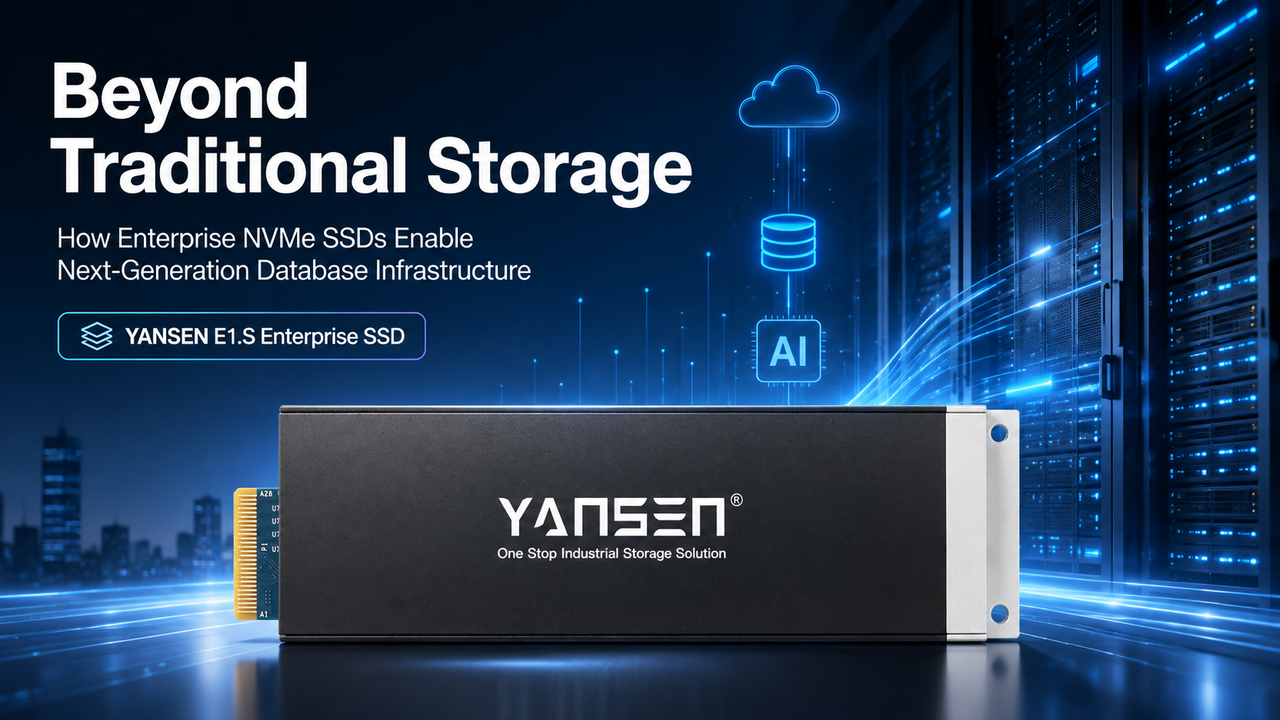
7.3 YANSEN Enterprise-grade SSD
|
Dimension |
2.5-INCH U.2 |
E1.S |
|
NAND Flash |
eTLC |
eTLC |
|
Interface |
U.2 |
E1.S PCIe Gen4*4 |
|
Capacity |
1.6TB~7.68TB |
1.6TB~7.68TB |
|
Sequential Read |
Up to 7100MB/s |
Up to 7100MB/s |
|
Sequential Write |
Up to 4300MB/s |
Up to 4300MB/s |
|
Hot-Swappable |
Support |
Support |
|
Power Loss Protection (PLP) |
Support |
Support |
|
AES 256 Encryption |
Support |
Support |
|
S.M.A.R.T. |
Support |
Support |
U.2 SSD – YSNU2V3MTXXXEPNNX – YANSEN
E1.S SSD – YSNE1V3MTXXXEPNNX – YANSEN
8. Conclusion
- Enterprise SSDs:Hot-swap is essential for continuous operation and high availability.
- Industrial SSDs:Hot-swap is application-driven, valuable in some cases, but not universally required.
- Procurement Insight:Choose SSDs based on risk control, reliability, and system compatibility, not just feature checklists.
By selecting YANSEN industrial-grade SSDs, customers gain the confidence of hot-swap-ready enterprise solutions or reinforced PLP, wide-temperature SSDs for embedded industrial applications, ensuring operational continuity, reduced downtime, and predictable lifecycle performance.
9. FAQ: Industrial and Enterprise SSD Hot-Swap
Q1: What is the difference between hot-swap SSDs and non-hot-swap industrial SSDs?
A1: Hot-swap SSDs can be replaced or installed without powering down the system, which is essential for enterprise servers and data center applications where uptime is critical. Non-hot-swap industrial SSDs focus on long-term reliability, wide-temperature support (-40℃ to +85℃), shock resistance, and power-loss protection (PLP). They are ideal for embedded systems or industrial devices where the system design does not support hot-plugging.
Q2: Do all industrial SSDs require hot-swap capability?
A2: No. Hot-swap is application-specific. For embedded controllers, industrial cameras, or robotics, hot-swap is usually unnecessary. Instead, features like reinforced PLP, firmware-level error recovery, and wide-temperature operation are more critical to prevent system downtime and data loss.
Q3: How does YANSEN ensure reliable hot-swap performance in SSDs?
A3: YANSEN industrial and enterprise SSDs are validated with system-level testing, including PCIe hot-plug scenarios, backplane compatibility, and firmware recovery under transient events. For embedded industrial SSDs, YANSEN emphasizes enhanced PLP, temperature cycling tests, and long-term reliability verification, ensuring predictable performance in real-world industrial environments.
Q4: Can hot-swap SSDs withstand harsh industrial conditions?
A4: Only if the system is designed properly. Hot-swap SSDs must be combined with robust backplanes, redundant power, and industrial-grade motherboard support. Without these, hot-swap may cause voltage spikes or data corruption. For environments like robotics or rail control, YANSEN recommends wide-temperature SSDs with PLP over relying solely on hot-swap.
Q5: How should I decide between hot-swap and reinforced PLP SSDs for my project?
A5: Evaluate your system requirements:
- Continuous uptime with redundant power and maintenance constraints:choose hot-swap SSDs.
- Embedded systems with harsh temperatures, vibrations, or limited maintenance windows:prioritize PLP SSDs with wide-temperature and industrial-grade testing.
YANSEN provides both options, tailored to enterprise and industrial applications, and can advise on the optimal solution based on your operational environment.
Q6: Does supporting hot-swap increase SSD cost significantly?
A6: Yes, integrating hot-swap requires system-level design support, including backplane design, power management, and firmware. For enterprise servers, the cost is justified by reduced downtime and high availability. In industrial embedded systems, hot-swap is often unnecessary, and reinforced PLP SSDs provide a more cost-effective solution with long-term reliability.