Skip to content

Products

from Industrial SSD Solution Provider

Product Category

Filter: Industrial SSD (YANSEN)

Contact Us

Feel free to reach out and we’ll respond promptly.

Frequently Asked Questions

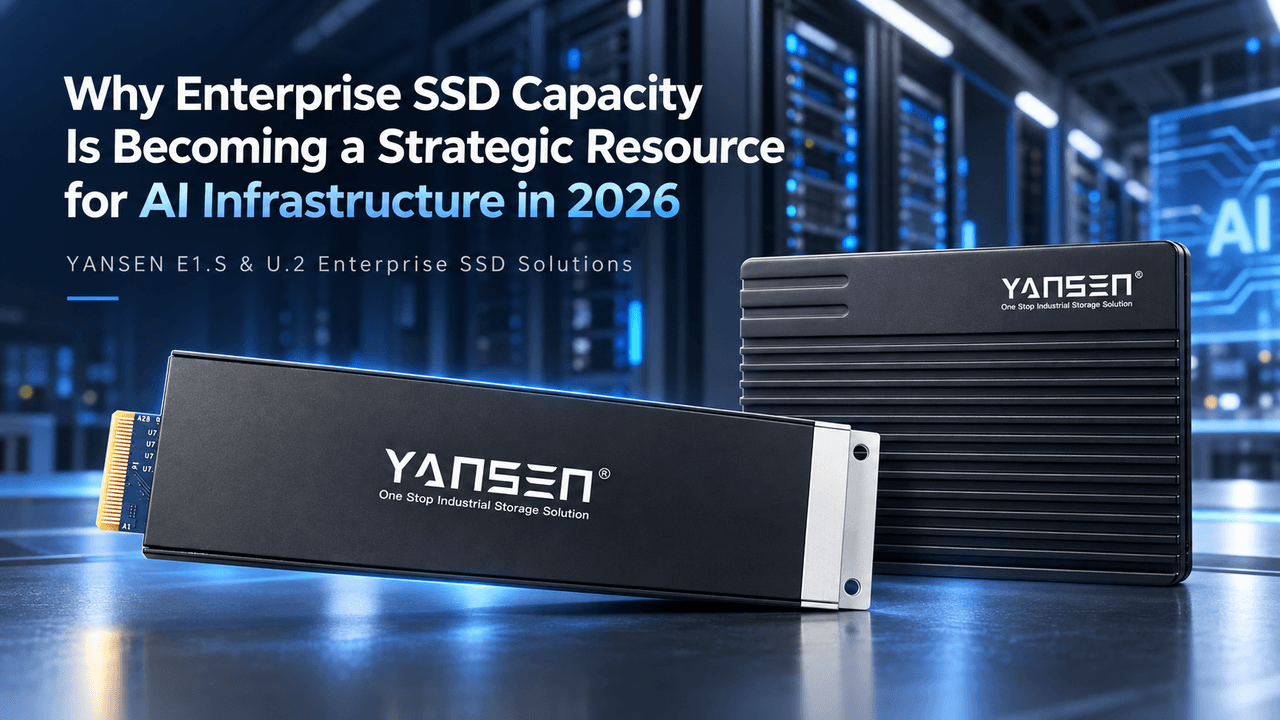
Why Enterprise SSD Capacity Is Becoming a Strategic Resource for AI Infrastructure in 2026

Enterprise SSD
For years, AI infrastructure planning has centered on one scarce resource: GPUs. In 2026, another resource is rapidly entering the capacity-planning equation—enterprise storage.
The shift is already visible in the NAND market. In Q2 2026, enterprise SSDs accounted for 48% of global NAND bit shipments, compared with approximately 26% a year earlier. The growing demand for AI infrastructure, particularly as workloads move from model training toward large-scale inference, is becoming an important driver of enterprise SSD consumption.
At the same time, NAND supply is tightening as AI server demand continues to grow. Cloud infrastructure providers are responding accordingly. CoreWeave, for example, signed a multi-year agreement with Solidigm to secure priority access to enterprise SSD capacity, describing storage as a critical constraint in capacity planning.
These developments point to a broader change in how AI infrastructure should be designed. AI infrastructure is entering an era in which storage capacity must increasingly be planned alongside GPU capacity.
But why is AI inference creating so much demand for enterprise flash? And what should data center operators consider when selecting SSD infrastructure for AI workloads?

From Training-Centric AI to Always-On Inference

The infrastructure requirements of AI are changing because the way AI systems are used is changing.

Training Is Intensive—but Temporary

Traditional AI infrastructure discussions have largely focused on model training. Training clusters require enormous computational resources and fast access to datasets, checkpoints, HBM, networking infrastructure and storage. A large training run may continue for weeks or even months, creating extremely demanding but relatively concentrated infrastructure requirements.
The central objective is often straightforward: feed the GPUs fast enough to keep expensive compute resources busy.
Storage certainly matters during training, particularly for datasets, checkpoints and intermediate data, but the GPU cluster remains the primary focus of capacity planning.

Inference Changes the Operating Model

Once an AI model moves into production, the infrastructure faces a fundamentally different workload. Instead of running a limited number of training jobs, it may need to support:
  • Continuous user requests
  • Thousands or millions of concurrent sessions
  • Longer context windows
  • Multi-turn conversations
  • Retrieval-augmented generation (RAG)
  • AI agents
  • Multimodal workloads
The system therefore needs to serve AI continuously at production scale.
This changes the storage equation. Training is primarily concerned with feeding GPUs efficiently. Inference increasingly requires the infrastructure to keep the right data close enough to the compute layer, for enough users, at an acceptable cost.
That is where memory hierarchy, context data and KV cache become increasingly important.

Why AI Inference Is Increasing Demand for Enterprise SSDs

Modern inference workloads are becoming more data-intensive. Long-context LLMs, enterprise copilots, AI agents, multimodal models and persistent conversations all require systems to maintain and access more information during inference.

KV Cache Is Changing the AI Memory Hierarchy

When an LLM processes a prompt, it generates a Key-Value (KV) cache that stores information from previously processed tokens. This allows subsequent token generation to reuse previously calculated context rather than repeatedly performing the same computation.
As three variables increase, the KV cache footprint can also grow:
More users → More concurrent inference sessions → Larger KV caches → Greater memory pressure → Greater need for additional storage tiers
This does not mean SSDs are replacing HBM or DRAM. Instead, the different memory technologies are increasingly serving different roles within a broader AI memory hierarchy:
  • GPU HBM: Highest-performance active data
  • System DRAM: Working memory and intermediate data
  • Enterprise NVMe SSD: Larger context data, active datasets and additional KV-cache tiers
  • Capacity storage: Models, datasets and longer-term data
This architecture is already becoming visible in new AI infrastructure designs. NVIDIA has introduced CMX Context Memory Storage for long-context and agentic AI inference, positioning shared storage as an additional context tier beyond GPU memory.
The implication is important: storage is becoming part of the inference memory architecture—not simply a place where data is saved after computation.

HBM Cannot Economically Hold Everything

HBM provides extremely high bandwidth, but using the highest-performance memory tier for every model, dataset and context workload would be inefficient from a system-cost and capacity perspective.
Enterprise NVMe SSDs provide a much larger capacity tier while still offering substantially lower latency than conventional storage architectures. As AI systems handle larger context windows and more concurrent sessions, SSD capacity can therefore become an important part of the overall memory and data-access strategy.

Why AI Storage Is No Longer Just About SSD Speed

Traditional SSD specifications tend to emphasize sequential read/write speeds, random IOPS and latency. These metrics remain important, but they do not fully describe what AI infrastructure operators need.
AI storage planning is becoming a multidimensional problem.

Capacity

AI infrastructure needs to accommodate models, embeddings, datasets, checkpoints, inference data and cached context. The relevant question is increasingly not simply how fast one SSD can operate, but how much usable flash capacity can be deployed per drive and per server.

Density

Data center space, server chassis and rack capacity are all limited. Higher-capacity drives can reduce the physical footprint required for a given amount of flash storage, making capacity per rack and capacity per server important infrastructure metrics.

Sustained Performance

Peak benchmark numbers can be useful for comparison, but AI infrastructure operates continuously. Operators should also evaluate how an enterprise NVMe SSD performs under sustained workloads rather than focusing exclusively on short benchmark bursts.

Endurance

AI environments may generate repeated writes through cache updates, metadata operations, data movement and high-concurrency services. DWPD and TBW should therefore be evaluated against the actual workload rather than treated as isolated specification numbers.
Higher endurance is not automatically better if the workload does not require it. The objective is to match SSD endurance to the expected write profile and deployment lifetime.

Power and Thermal Efficiency

AI data centers already operate under significant rack-level power constraints because GPUs and networking equipment consume substantial energy. Storage must fit within the available power envelope.
At the same time, increasing storage density can create additional thermal challenges:
More drives → More heat → Greater cooling requirements
For this reason, performance per watt, capacity per watt and thermal behavior under sustained workloads are becoming increasingly relevant alongside raw performance.
AI storage planning is becoming a multidimensional optimization problem involving capacity, performance, endurance, power, thermal management and physical density.

The NAND Market Is Already Reflecting the AI Storage Shift

The growing importance of enterprise storage is not simply a theoretical infrastructure trend. It is already affecting the NAND market.

Enterprise SSDs Are Consuming a Growing Share of NAND

48%
That is the share of global NAND bit shipments represented by enterprise SSDs in Q2 2026, according to the market data referenced in this analysis. A year earlier, the figure was approximately 26%.
In other words, nearly one out of every two NAND bits shipped globally in Q2 2026 went into enterprise SSDs.
Counterpoint Research also expects server enterprise SSD demand to remain a major source of NAND consumption, with server eSSD demand potentially absorbing more than half of NAND bits by the end of 2026.

Supply Is Tightening

AI server demand is occurring while NAND manufacturers face constraints on how quickly supply can expand. TrendForce has identified AI server eSSD demand as a contributor to NAND supply shortages and expects AI server demand for enterprise SSDs to remain strong in Q3 2026.
The situation is further complicated by semiconductor manufacturers allocating investment toward other high-value memory opportunities, including DRAM and HBM. NAND capacity therefore cannot simply expand without considering broader semiconductor economics.

AI Cloud Providers Are Securing Supply Directly

The procurement behavior of major infrastructure operators is also changing. CoreWeave’s multi-year agreement with Solidigm is significant not merely because of the SSD supplier involved, but because of what the agreement represents.
Enterprise storage capacity can increasingly become something infrastructure operators secure through long-term strategic agreements rather than treating SSDs as ordinary server components purchased only when individual systems are built.
The enterprise SSD is evolving from a server component into an infrastructure planning resource.

Why Storage Capacity Must Scale Alongside GPU Capacity

Traditional AI infrastructure expansion can be simplified as:
More AI demand → Add GPUs → Add networking → Add compute nodes
Inference infrastructure introduces another layer:
More AI users → More inference instances → More concurrent context → Larger KV-cache footprint → More active datasets → More storage bandwidth → More SSD capacity
This is why adding GPUs without scaling the surrounding data infrastructure can simply move the bottleneck elsewhere.
If GPU capacity grows significantly faster than storage infrastructure, several problems can emerge. GPUs may spend more time waiting for data, the storage layer may become a bottleneck, systems may need to recompute context more frequently, and overall infrastructure utilization can decline. Ultimately, these inefficiencies can affect the economics of serving AI tokens.
Storage should therefore be included in Day-0 AI infrastructure planning, rather than treated purely as a Day-2 capacity expansion problem.
For data center operators, this means estimating not only how many GPUs will be deployed, but also how much enterprise flash capacity will be required as user concurrency, model count, context length and inference traffic increase.
Six Enterprise SSD Requirements for AI Infrastructure

As enterprise SSDs become a strategic part of AI infrastructure, procurement decisions should move beyond sequential speed and unit price.
  1. High Capacity

AI datasets and context workloads continue to grow. Higher-capacity enterprise SSDs can reduce the number of drives required for a given storage target.
Evaluate both capacity per drive and capacity per server, because the latter determines how efficiently the storage layer fits into the overall infrastructure.
  1. High Storage Density

Data centers have finite rack space and power budgets. High-density storage allows operators to deploy more terabytes within a limited server chassis or rack footprint.
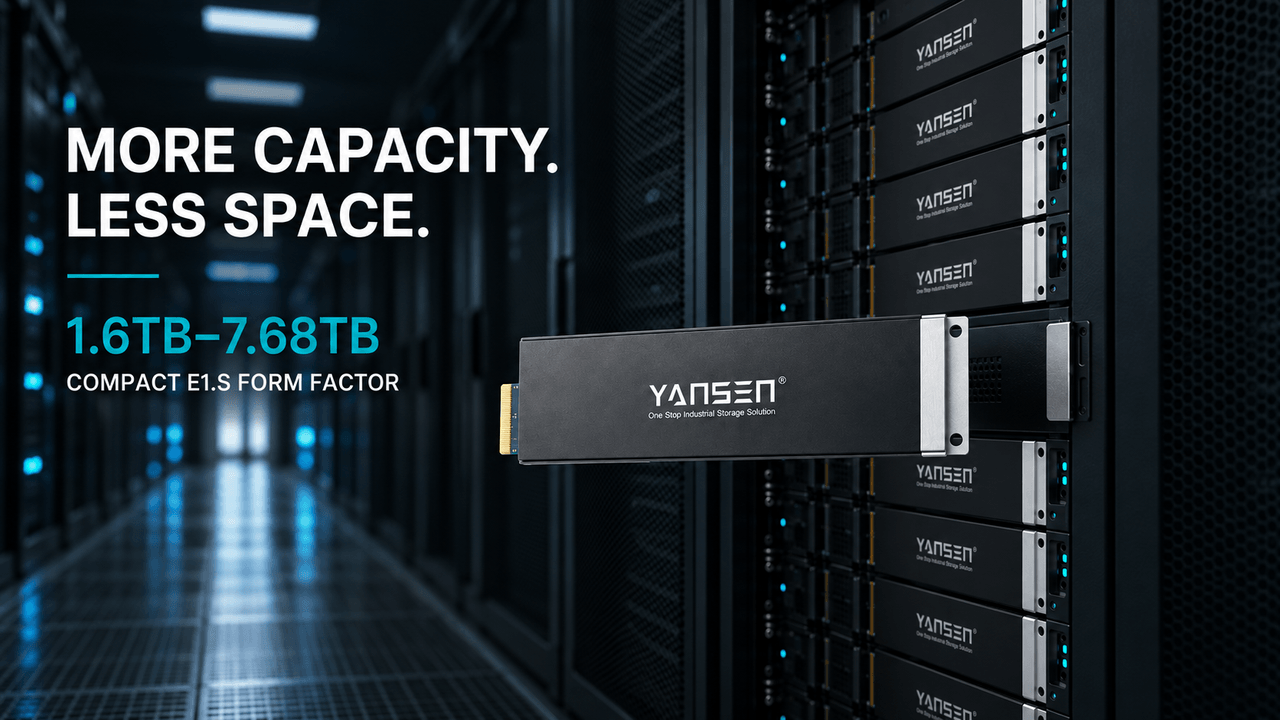
This is one reason modern enterprise form factors such as E1.S are gaining attention in high-density server architectures.
  1. Consistent NVMe Performance

Do not select an enterprise NVMe SSD solely because its maximum benchmark number is higher.
For AI infrastructure, sustained performance under real-world enterprise workloads can be more meaningful than short-duration peak results. Thermal behavior, workload consistency and latency stability should also be considered.
  1. Endurance

Inference environments can involve repeated writes, cache updates, metadata operations and high concurrency. SSD endurance should therefore be evaluated against the expected workload profile.
Consider daily writes, workload patterns, deployment duration and write amplification when determining the appropriate DWPD or TBW requirement.
Endurance should be matched to the actual workload profile.
  1. Power Efficiency

Storage has to operate within the data center’s rack-level power budget. When comparing high-capacity drives, consider not only performance but also the amount of usable storage capacity delivered for the available power envelope.
Capacity per watt can become an important metric as AI storage density increases.
  1. Thermal Management and Reliability

High-density AI servers require careful consideration of airflow, SSD temperature, thermal throttling and sustained workloads. A drive that delivers impressive peak performance but frequently throttles under continuous operation may not provide the expected system-level performance.
Reliability should therefore be evaluated together with thermal design and the intended operating environment.

Choosing the Right Enterprise SSD Form Factor

Capacity and performance are only part of the storage architecture. The physical form factor also affects server density, thermal management, serviceability and deployment flexibility.

E1.S: Designed for High-Density Modern Servers

E1.S is part of the EDSFF family developed for modern data center architectures. Its compact enterprise form factor, NVMe architecture and hot-service-oriented design make it well suited to high-density server environments.
For AI infrastructure, the key advantages to evaluate include:
  • High storage density
  • Efficient use of server space
  • Modern NVMe architecture
  • Thermal management options
  • Serviceability
  • Compatibility with modern server platforms

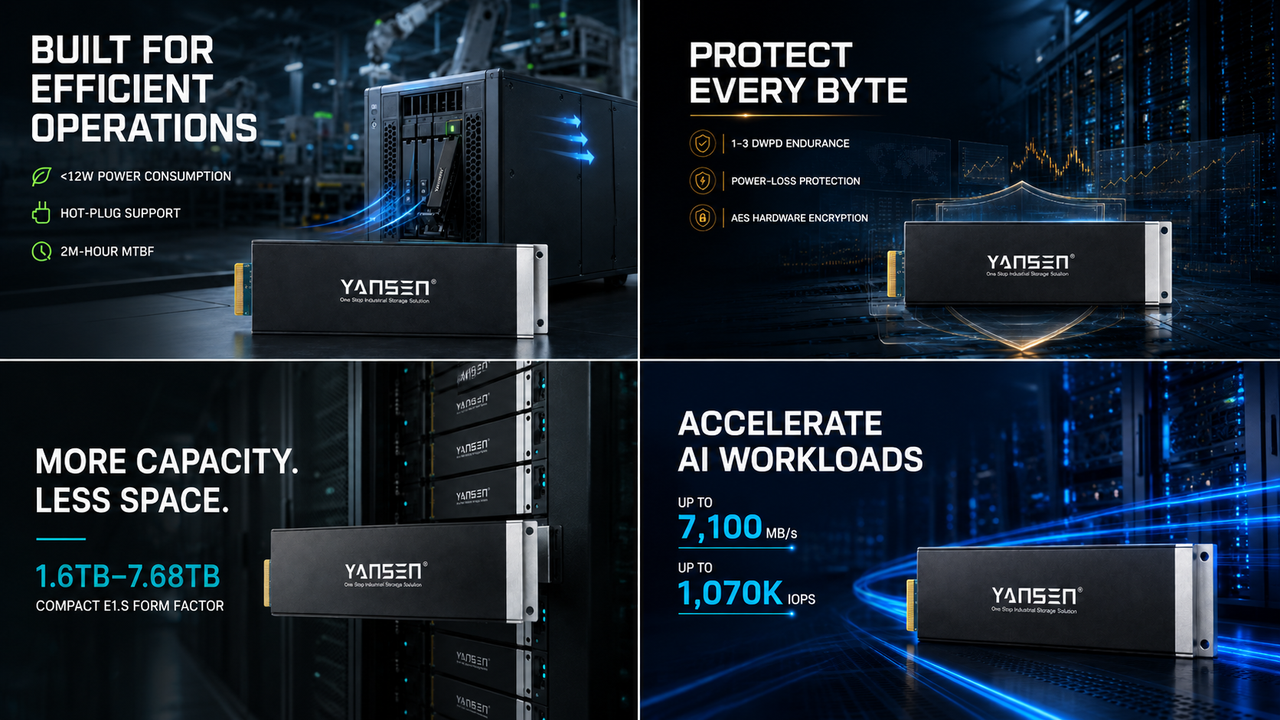
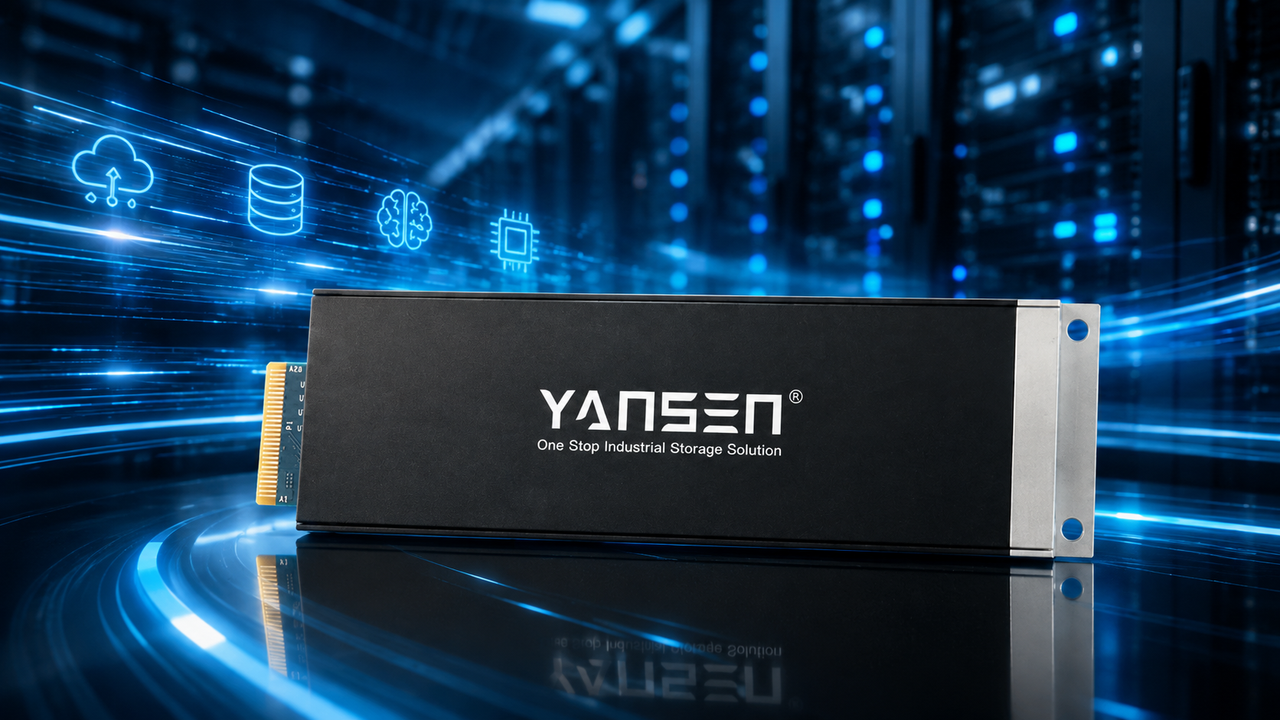
YANSEN E1.S Enterprise SSD

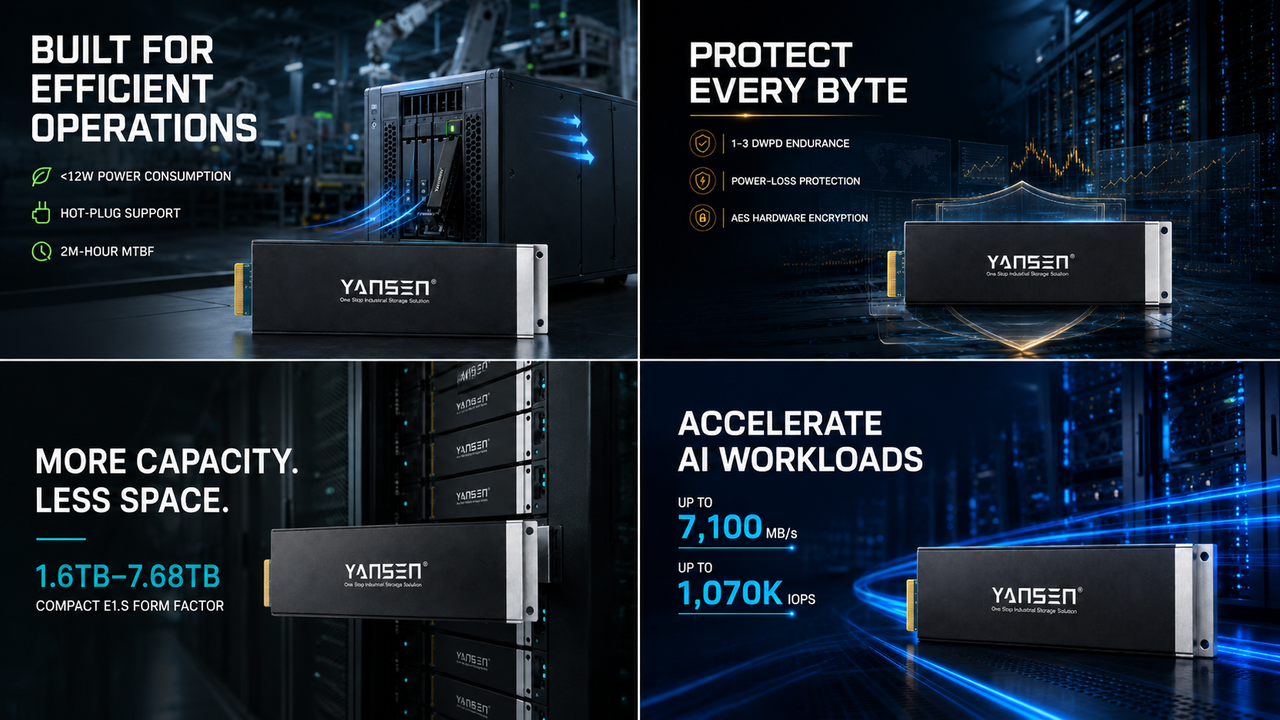
YANSEN’s E1.S enterprise SSD platform is positioned for modern high-density storage applications where capacity, reliability and deployment flexibility are important considerations.
Depending on the specific configuration, buyers should verify the final product specifications for:
  • Capacity: Verified YANSEN configuration
  • Interface: PCIe / NVMe
  • Sequential performance: Verified product specification
  • Random performance: Verified product specification
  • Endurance: Verified product specification
  • Power and thermal characteristics: Verified product specification
Potential applications include AI inference infrastructure, cloud servers, high-density servers, data centers and HPC systems.

U.2: A Proven Enterprise Form Factor

U.2 remains an established choice for enterprise storage. Its familiar 2.5-inch deployment format, PCIe NVMe interface and compatibility with existing server architectures make it practical for organizations that want to integrate enterprise SSDs into proven infrastructure.
U.2 can be appropriate for enterprise servers, AI storage nodes, database infrastructure, cloud platforms and data centers where existing server compatibility is an important consideration.
The decision should not be framed as E1.S versus U.2. The appropriate form factor depends on server architecture, density requirements, thermal design and existing infrastructure.
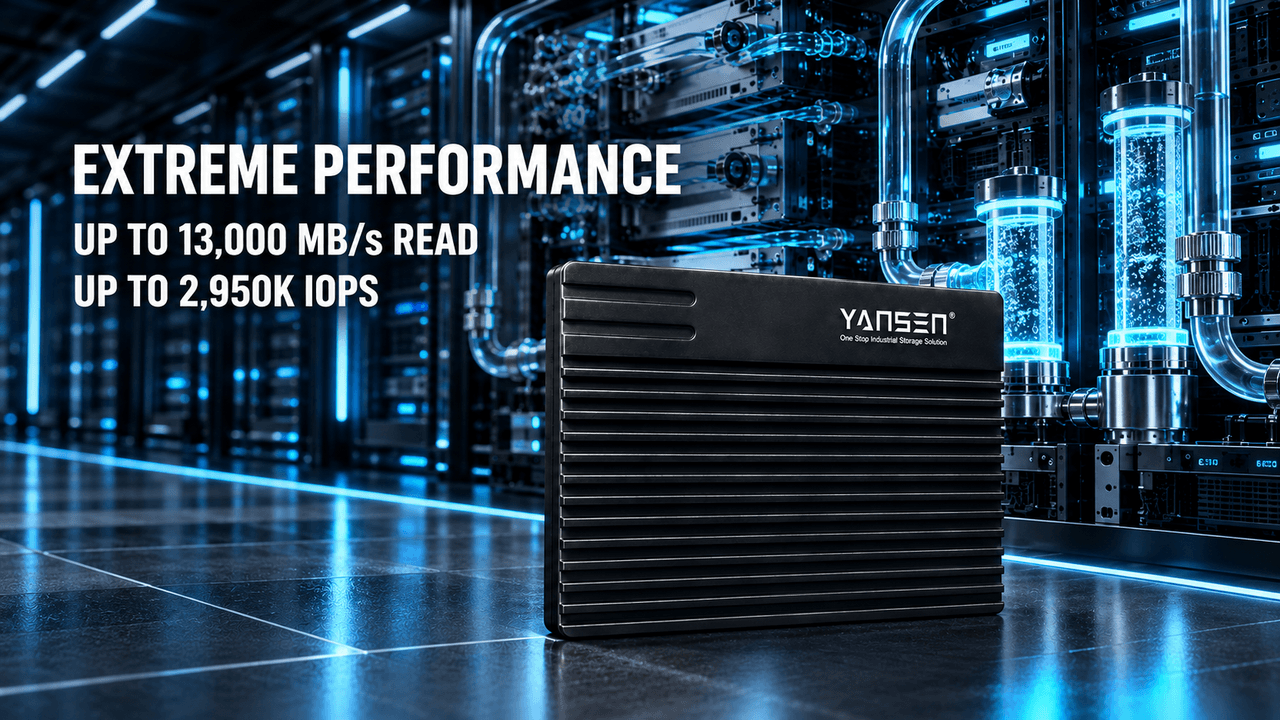
YANSEN U.2 Enterprise SSD

YANSEN’s U.2 enterprise SSD solutions are designed for enterprise storage environments where PCIe NVMe performance, capacity and deployment compatibility are required.
For infrastructure planners, the key consideration is not simply which form factor is newer, but which one provides the best balance of capacity, density, thermal behavior and compatibility for the target server platform.

AI Is Changing How Data Centers Buy Storage

Enterprise storage procurement traditionally revolved around three basic questions:
Capacity + Performance + Price
AI infrastructure requires a broader procurement framework that also considers:
  • Supply availability
  • Long-term capacity planning
  • Qualification cycles
  • Consistent product availability
  • Firmware stability
  • Lifecycle management
  • Technical support
  • Customization requirements
  • Supply-chain resilience
The multi-year SSD supply agreement signed by CoreWeave illustrates why storage availability itself can become a strategic consideration. For AI infrastructure operators, securing predictable access to enterprise storage may become almost as important as selecting the drive itself.
YANSEN focuses on industrial and enterprise storage solutions designed for customers that require stable performance, deployment flexibility and long-term storage availability. Depending on project requirements, the product portfolio can be evaluated around enterprise SSD configurations, form factors, endurance, qualification and application-specific requirements.
For AI infrastructure projects, this approach is particularly relevant when storage must be integrated into a broader server platform rather than purchased as an isolated component.

The Next AI Infrastructure Bottleneck May Not Be the GPU

The most important change in 2026 is not that SSDs are replacing GPUs. It is that AI infrastructure is becoming a system-level problem.
The AI stack increasingly depends on the coordinated scaling of:
GPU → Memory → Networking → Storage → Software
As inference workloads expand, storage capacity must grow alongside compute capacity. Longer contexts, higher concurrency, larger datasets and increasingly sophisticated AI applications are turning enterprise flash into an active part of the infrastructure rather than a passive storage layer.
As inference workloads scale, the question for data center operators is no longer simply how many GPUs they can deploy. It is whether the entire data infrastructure—including enterprise flash—can scale with them.
YANSEN enterprise NVMe SSD solutions, including E1.S and U.2 form factors, are designed to support the capacity, performance and reliability requirements of modern enterprise and AI infrastructure.
Talk to YANSEN about enterprise storage solutions for your next AI infrastructure deployment.
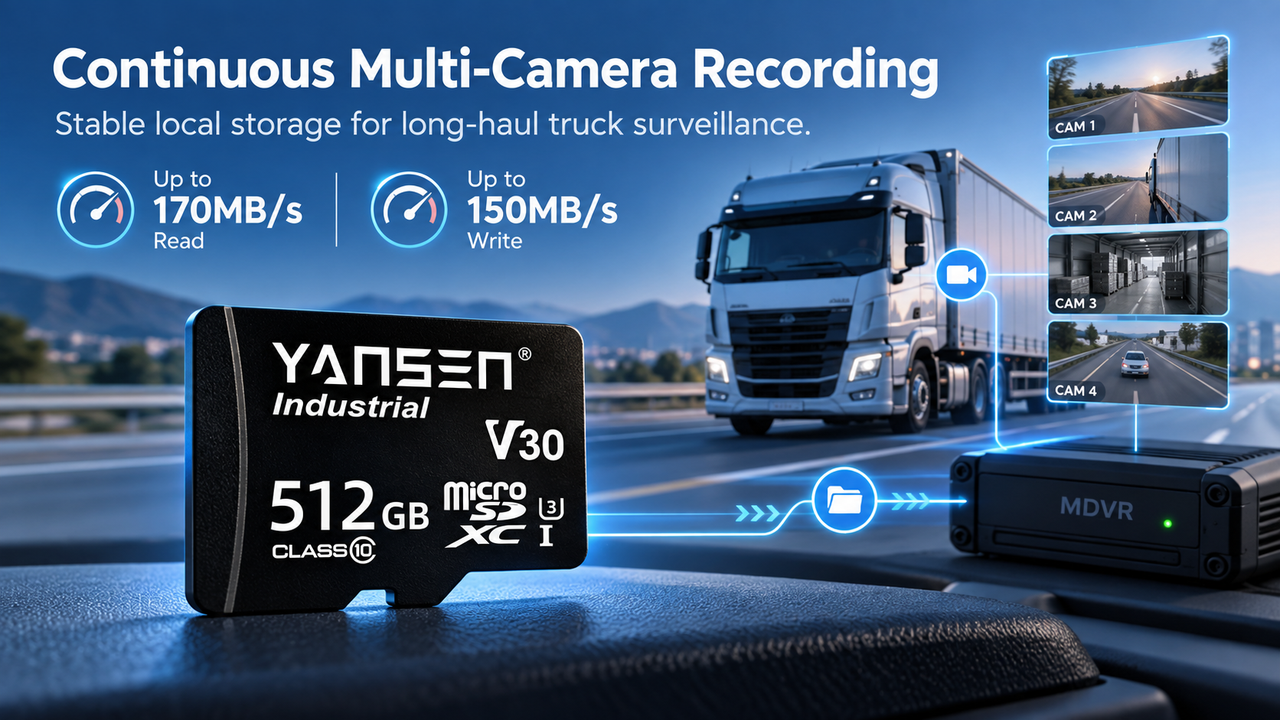
YANSEN Freight Truck MDVR Customer Case

industrial ssd

CASE OVERVIEW

Customer Confidential
Customer Profile A globally leading MDVR and vehicle telematics solution provider
Industry Intelligent Transportation / Commercial Vehicles
Application Freight Truck Video Surveillance & Fleet Management
Storage Solution YANSEN Industrial microSD Card
Model / Capacity YSDT1A3KT512INNNN / 512GB
Primary Workload Multi-channel continuous video recording

Project Background

A globally leading provider of Mobile Digital Video Recorder (MDVR) and vehicle telematics solutions was developing an intelligent in-vehicle terminal for commercial freight truck applications.

The platform integrates multiple functions within a single system, including video acquisition, real-time encoding, local recording, vehicle positioning, wireless communication and remote fleet management.

In a typical deployment, multiple cameras installed around the truck continuously capture video while the vehicle is operating. The MDVR processes these video streams and stores the footage locally before selected data is transmitted to a remote fleet management platform.

For this type of application, local storage is not simply a place to save files. It is a critical part of the vehicle’s video recording infrastructure.

The customer therefore required a compact storage solution capable of supporting long recording cycles, multi-channel video workloads and the demanding operating environment of commercial freight trucks. YANSEN provided a 512GB industrial microSD card, model YSDT1A3KT512INNNN, specifically matched to these requirements.

The Challenge: Storage That Operates as Long as the Truck Does

Freight truck MDVR systems operate very differently from consumer cameras or portable electronics. A commercial truck may remain on the road for many hours at a time, during which the onboard monitoring system continuously records video.

The storage device therefore experiences repeated and sustained write activity throughout the vehicle’s operating cycle. At the same time, it must operate inside a compact vehicle terminal exposed to temperature changes, vibration and long service hours.

For the customer, the challenge was not simply finding a memory card with sufficient capacity. The storage solution had to meet several requirements simultaneously:

  • Support continuous multi-channel video recording
  • Provide sufficient local recording capacity
  • Maintain stable write performance over long recording periods
  • Deliver adequate NAND endurance for repeated recording
  • Operate under changing vehicle temperatures
  • Fit within the compact architecture of the MDVR
  • Support deployment across commercial fleets in different operating environments

This combination of requirements made an industrial-grade storage solution necessary.

Challenge 1: Multi-Channel Full HD Video Creates a Continuous Write Workload

The MDVR platform is designed to support multiple onboard cameras and can handle several video streams simultaneously. In freight truck applications, cameras may monitor the road ahead, the rear of the vehicle, side areas, cargo surroundings or the driver environment.

Once the vehicle begins operating, these video streams may be recorded continuously for hours. This creates a very different storage workload from typical consumer use. A consumer memory card may experience short periods of recording followed by significant idle time. In an MDVR system, the storage pattern is much closer to continuous, repeated writing.

The storage device therefore needs to maintain stable write behavior over extended periods rather than simply deliver high peak benchmark performance. For the selected 512GB industrial microSD card, sequential performance reaches up to 170MB/s read and up to 150MB/s write. The card also delivers up to 2,500 IOPS random read and up to 1,600 IOPS random write.

For this project, however, the most important factor was not maximum speed alone. It was the ability to support stable, sustained recording over long operating cycles.

industrial ssd

Continuous multi-channel recording: stable local storage for long-haul truck surveillance.

Challenge 2: 512GB Capacity in a Compact Embedded Format

Commercial vehicle monitoring systems need to retain sufficient video footage locally. Recording duration can be affected by several factors, including the number of cameras, video resolution, compression settings and the customer’s data retention strategy.

Increasing local storage capacity allows more video data to remain available within the vehicle before it is overwritten, transferred or archived. However, MDVR equipment is highly space constrained, and a larger storage device can increase mechanical complexity and occupy valuable internal space.

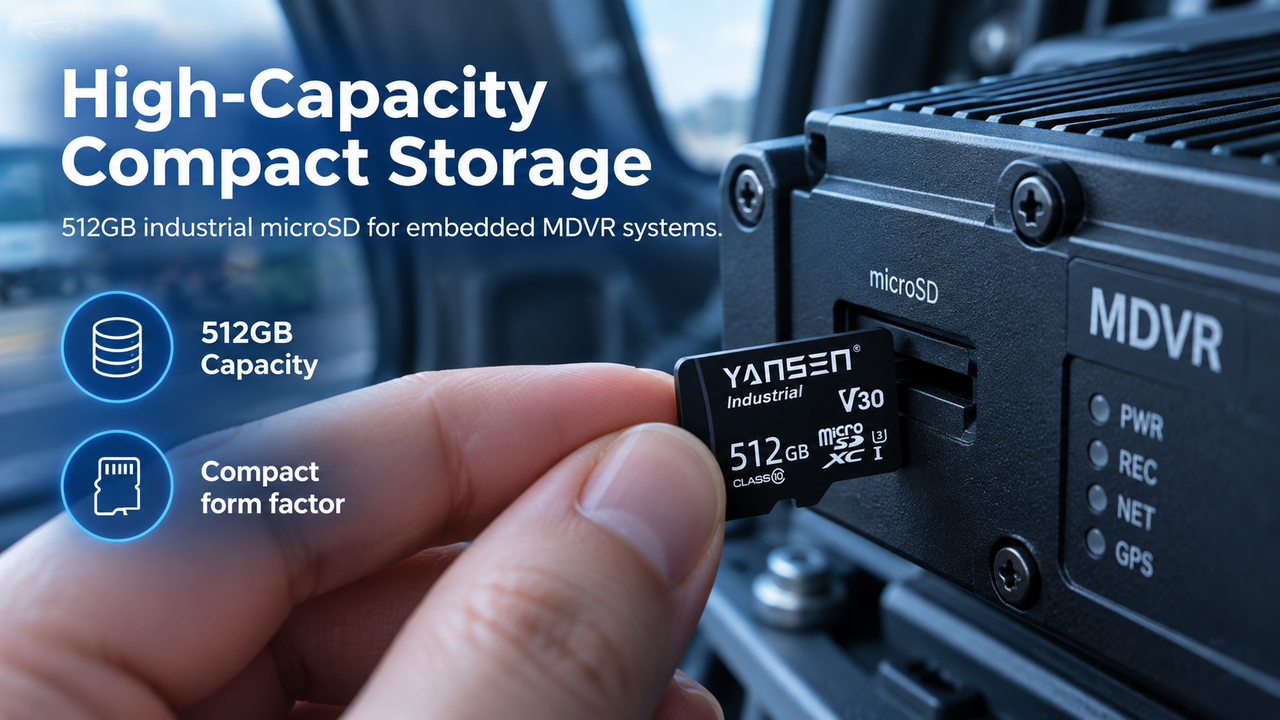
The selected YANSEN industrial microSD solution provides 512GB of storage capacity in an extremely compact form factor. This combination allows the MDVR manufacturer to increase local recording capacity without significantly changing the internal architecture of the terminal.

industrial ssd

High-capacity compact storage: 512GB industrial microSD for embedded MDVR systems.

Challenge 3: Repeated Recording Requires Higher NAND Endurance

Continuous video recording also creates another challenge: NAND wear. Every recording cycle writes new data to the flash memory. Over the lifetime of a commercial vehicle monitoring system, this process is repeated again and again.

For large fleet deployments, storage endurance becomes an important consideration because the memory card may need to support continuous or near-continuous recording throughout long service cycles.

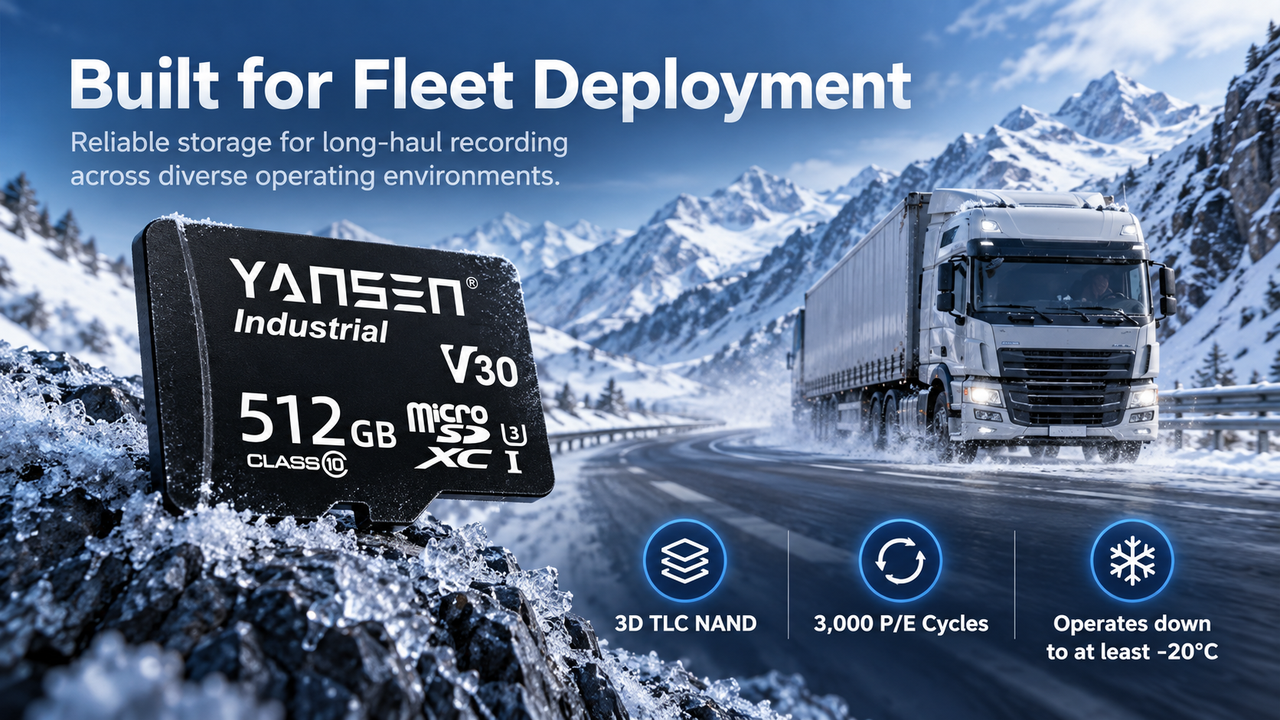
The YANSEN industrial microSD card used in this project adopts 3D TLC NAND and provides 3,000 P/E cycles. This endurance profile is designed to support repeated recording workloads more effectively than storage selected purely for occasional consumer use.

The combination of high capacity and NAND endurance is particularly important in MDVR applications. A storage device needs not only to hold large volumes of footage, but also to withstand the repeated write cycles created as old footage is overwritten by new recordings.

Challenge 4: Freight Trucks Operate Across Changing Temperature Conditions

Temperature is another major consideration in vehicle applications. Commercial freight trucks may travel across different regions and climates during a single route.

  • Cold morning starts
  • Significant seasonal temperature changes
  • Extended operation during hot weather
  • Heat accumulation inside the equipment enclosure
  • Long operating periods without climate-controlled conditions

For this project, the customer required storage capable of operating reliably at temperatures down to at least -20°C. This requirement reflects the realities of commercial fleet operation, where trucks may need to start and record video even in cold outdoor environments.

YANSEN’s industrial-grade microSD solution provides the environmental capability required to satisfy this operating condition, giving the MDVR platform additional margin for deployment across varied vehicle environments. For global fleet applications, this environmental adaptability is especially important.

industrial ssd

Vehicle environment adaptability: reliable storage for long-haul fleet operation in demanding climates.

YANSEN Industrial microSD Solution

To address these requirements, YANSEN supplied the YSDT1A3KT512INNNN 512GB industrial microSD card. Rather than focusing on one specification, the solution was selected because it balanced the key requirements of the complete vehicle application: performance, capacity, endurance, environmental adaptability and compact integration.

Specification YANSEN YSDT1A3KT512INNNN
Capacity 512GB
NAND Flash 3D TLC
Controller SA3309
Sequential Read Up to 170MB/s
Sequential Write Up to 150MB/s
Random Read Up to 2,500 IOPS
Random Write Up to 1,600 IOPS
Speed Class U3 / A1
Interface UHS-II
P/E Cycles 3,000
Environmental Requirement Meets customer’s requirement for operation down to at least -20°C

How Storage Fits into the MDVR System

Within the freight truck monitoring platform, the industrial microSD card serves as the local recording layer between video acquisition and remote fleet management. The data flow can be simplified as:

Vehicle Cameras MDVR Video Acquisition & Encoding YANSEN Industrial microSD Cellular / Network Fleet Management Platform

The locally stored video can then support remote video review, event playback, vehicle incident investigation, route and fleet monitoring, driver behavior analysis and operational record keeping.

In this architecture, storage is closely connected to the availability of recorded vehicle data. A failure at the storage layer could affect the ability to retrieve footage generated during vehicle operation. That is why storage selection must be considered as part of the complete MDVR system design.

Why Industrial microSD Instead of General Consumer Storage?

Industrial and consumer storage products may share the same physical form factor, but their target workloads can be very different. Typical consumer microSD applications include smartphones, cameras and occasional video recording under relatively controlled environmental conditions.

A freight truck MDVR presents a more demanding workload: multiple cameras, long recording hours, repeated write cycles, temperature changes, vehicle vibration and long service life.

Industrial storage is not simply about higher speed. It is about matching the storage device to the actual workload and operating environment.

For vehicle surveillance, this means balancing sustained recording performance, capacity, NAND endurance and environmental adaptability.

From a Single Vehicle to Global Fleet Deployment

Storage requirements become even more important when a system moves from a single vehicle to large-scale fleet deployment. A single microSD card may appear to be only a small component inside an MDVR, but when the same platform is deployed across hundreds or thousands of commercial vehicles in different markets, consistency becomes critical.

The storage device must perform reliably not only in one truck, but across different vehicle models, route conditions, climates, operating schedules and fleet configurations. For a globally deployed MDVR platform, storage therefore becomes part of the overall system reliability strategy.

YANSEN’s industrial microSD solution helps provide the customer with a consistent storage platform for commercial vehicle applications across varied operating environments.

Application Value

By integrating the YANSEN 512GB industrial microSD card, the customer gained a storage solution designed around the realities of commercial vehicle video recording.

High-Capacity Local Recording
512GB supports extended video retention within a compact form factor.
Stable Recording Performance
Up to 150MB/s sequential write performance supports continuous video workloads.
Endurance for Repeated Recording
3D TLC NAND and 3,000 P/E cycles address repeated write requirements.
Environmental Adaptability
Meets the customer’s requirement for reliable operation down to at least -20°C.

Industrial Storage for Intelligent Transportation

As commercial vehicles become increasingly connected, onboard storage must handle more than simple video files. Modern MDVR and telematics systems continuously generate video, location information, event records and operational data.

Selecting the right storage solution therefore requires an understanding of both the workload and the environment in which the device operates. YANSEN provides industrial storage solutions for intelligent transportation applications including freight trucks, public transportation, school buses, taxis and ride-hailing vehicles, construction vehicles, special-purpose vehicles, fleet telematics terminals and in-vehicle video surveillance systems.

From compact industrial microSD cards to SSD solutions for higher-capacity vehicle computing systems, YANSEN supports storage configurations designed around different recording workloads and operating environments.

Looking for reliable storage for your MDVR or vehicle telematics system?
Talk to YANSEN about your recording workload, capacity requirements and operating environment.

Industrial mSATA SSD for Continuous Waveform Recording in Power Quality Measurement Equipment

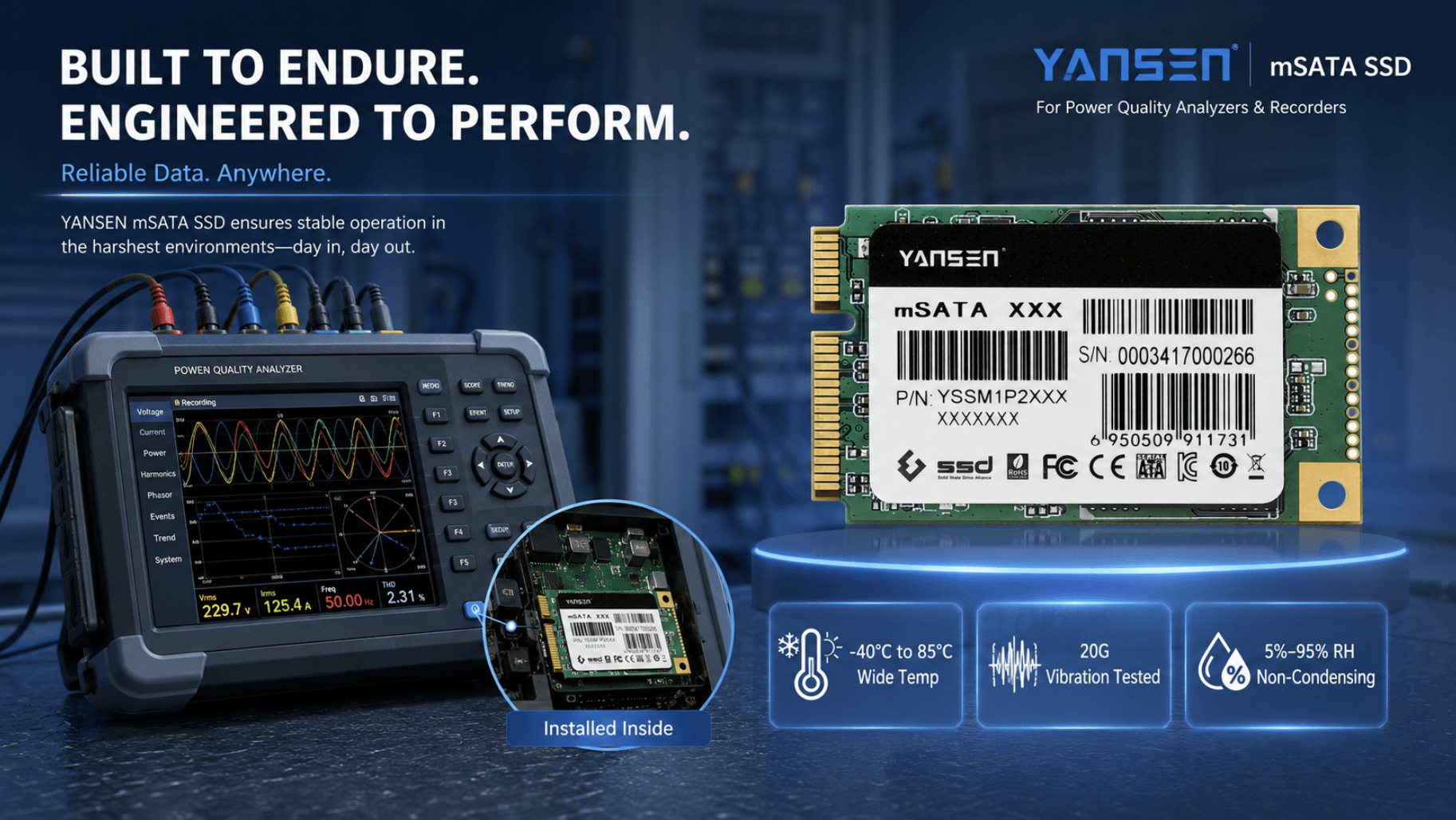
Region: Southern Africa Industry: Power & Energy / Electrical Measurement Application: Multifunction Waveform-Synchronised Power Quality Analyzer, Recorder and Measurement Device Storage Solution: YANSEN Industrial mSATA SSD Capacity: 512GB NAND Flash: 3D TLC Operating Temperature: -40°C to 85°C

Project Background

A professional electrical measurement equipment manufacturer in Southern Africa was developing a new multifunction, waveform-synchronised power quality analyzer, recorder and measurement device.
The system is designed to acquire, process and record electrical measurement data and waveform information over extended operating periods.
For this type of equipment, storage is not simply used for operating system files or occasional data transfer. It becomes part of the continuous data acquisition chain.
The customer therefore required a compact embedded SSD that could combine continuous recording capability, high endurance, wide-temperature operation, low power consumption and strong resistance to environmental stress.
This created a significantly more demanding storage requirement than a conventional PC or general-purpose embedded application.

Project Challenge: Reliable Storage Under Continuous Measurement Workloads

Power quality monitoring systems may continuously generate waveform records, measurement data and event information.
Unlike consumer workloads, where storage activity often occurs in short bursts, professional measurement equipment may perform sustained data acquisition for long operating periods.
The main challenge was therefore not simply achieving a high peak transfer speed.
The SSD had to deliver a balanced combination of:
  • Stable continuous read and write performance
  • High write endurance
  • Wide-temperature operation
  • Resistance to shock and vibration
  • Low power consumption
  • Compact embedded integration
  • Storage health monitoring
  • Reliable long-term operation
Each of these requirements directly affects the reliability of the complete measurement system.

Challenge 1: Continuous Waveform Recording Requires Stable Storage Performance

Waveform-synchronised measurement can generate a continuous stream of data.
During long-duration monitoring, the storage subsystem needs to receive and retain measurement information consistently without becoming a weak point in the acquisition process.
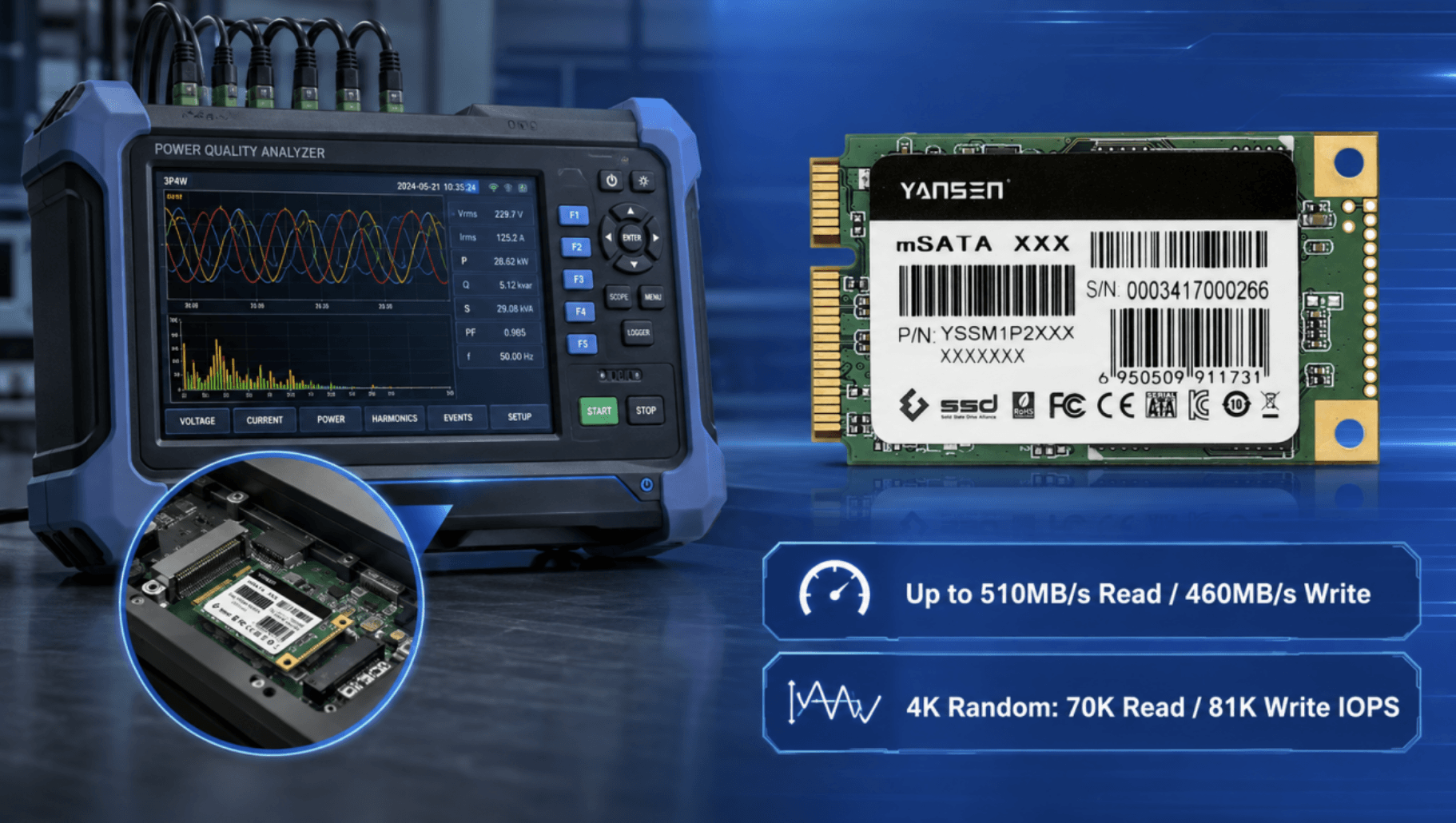
For this application, YANSEN supplied a 512GB industrial mSATA SSD delivering sequential read speeds of up to 510MB/s and sequential write speeds of up to 460MB/s.
Its 4K random performance reaches up to 70,000 IOPS read and 81,000 IOPS write, providing responsive access to both sequential recording workloads and smaller data operations generated by the system.
However, performance alone was not the primary design consideration.
For professional measurement equipment, predictable and dependable operation over extended periods is more important than pursuing benchmark numbers that exceed the actual requirements of the application.

Challenge 2: High Write Endurance for Long-Term Data Recording

Continuous measurement means continuous data generation.
Over the operating life of the equipment, this can create a substantial cumulative write workload on the SSD.
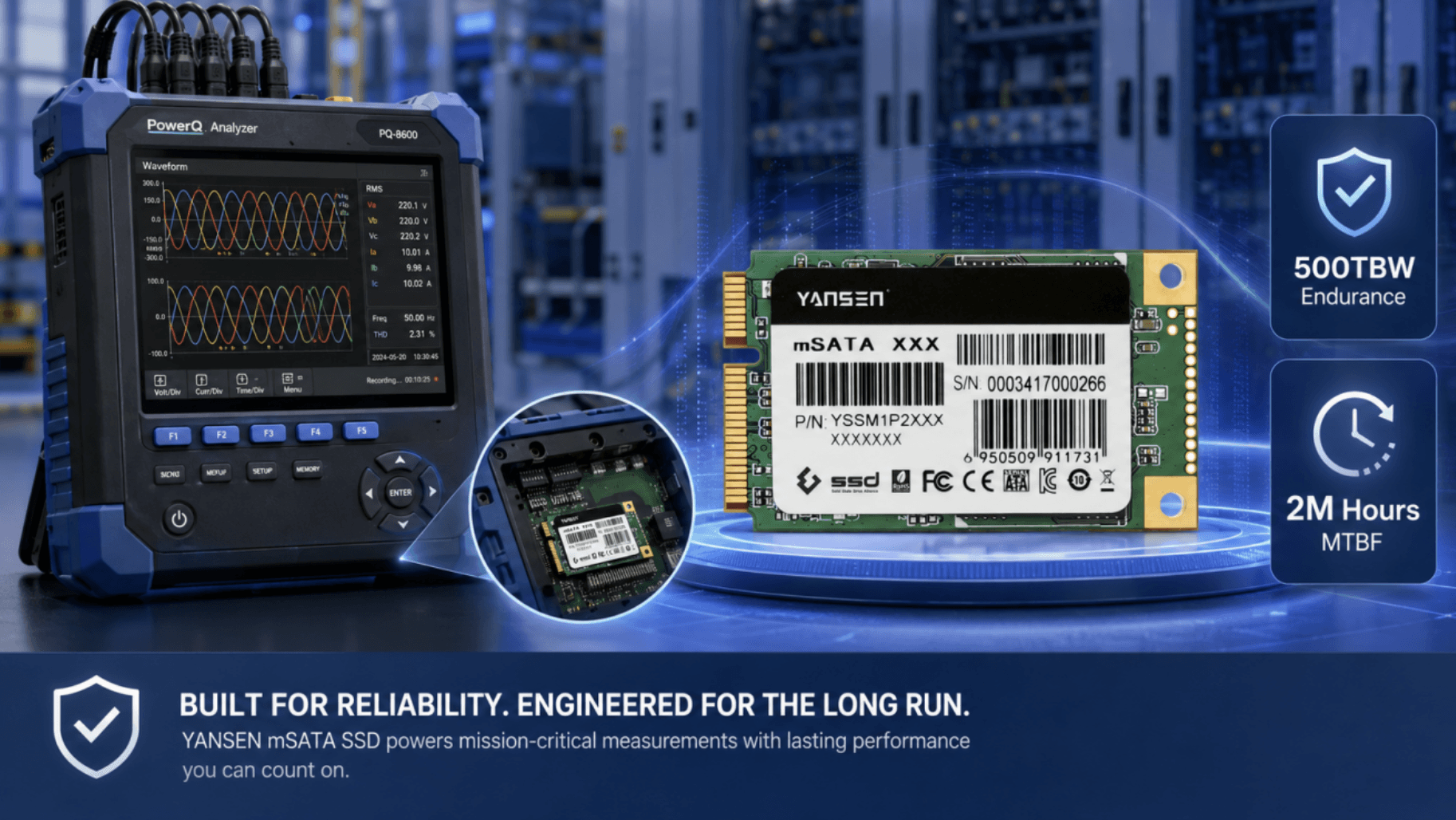
To address this requirement, the selected industrial mSATA SSD provides an endurance rating of up to 500TBW.
This gives the system a storage platform better suited to repeated data recording than solutions designed mainly around lighter consumer workloads.
For power quality analyzers, recorders and other data acquisition systems, endurance is a particularly important design consideration because the storage device may be required to write data day after day throughout the equipment lifecycle.

Challenge 3: Operating Reliably from -40°C to 85°C

Professional electrical measurement equipment may be deployed in locations where ambient temperatures cannot be controlled as precisely as in an office or data center.
Depending on the installation environment, equipment may experience cold starts, elevated enclosure temperatures or significant temperature variations during operation.
For this reason, the project required a storage solution capable of operating across an industrial temperature range.
The YANSEN mSATA SSD supports operation from -40°C to 85°C, enabling it to function in a much broader range of environmental conditions than typical commercial-temperature storage products.
This wide-temperature capability was one of the key reasons the industrial SSD was suitable for the project.

Challenge 4: Mechanical Reliability in Industrial Environments

Temperature was not the only environmental consideration.
Equipment installed in industrial, energy or field environments may also be exposed to mechanical shock or continuous vibration during transportation, installation or operation.
The selected mSATA SSD is designed to withstand:
  • Shock: up to 1500G / 0.5ms
  • Vibration: 80Hz to 2000Hz / 20G
  • Humidity: 5% to 95% RH, non-condensing
These characteristics provide additional protection for the storage subsystem when used in environments that are more demanding than conventional desktop computing conditions.
Because the mSATA SSD contains no moving mechanical components, it is also well suited to embedded equipment where resistance to vibration is an important consideration.

Challenge 5: Compact Integration Without Sacrificing Capacity

The measurement device also imposed mechanical constraints.
The storage solution needed to fit into an embedded system without taking up the space required by a conventional 2.5-inch drive.
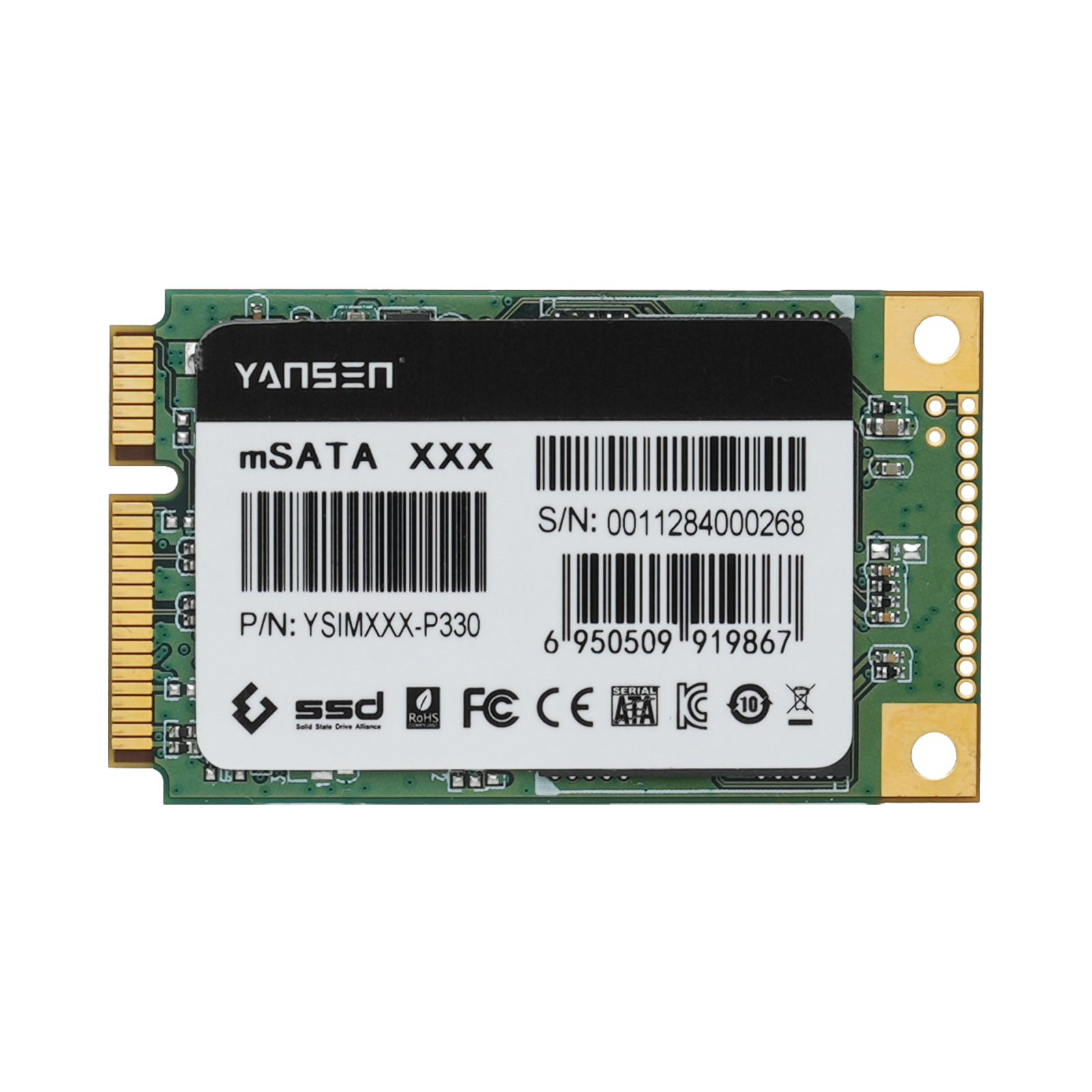
The mSATA form factor provides a compact PCB-level storage solution while retaining the mature SATA interface.
With 512GB of capacity, the SSD gives the system sufficient local storage for waveform data, event records, measurement results and other device-generated information while maintaining a compact physical footprint.
For embedded equipment manufacturers, this balance between capacity and form factor can simplify system design and help reduce internal space requirements.

Challenge 6: Low Power Consumption for Embedded Equipment

Power efficiency is another important consideration in professional embedded systems.
Storage is only one component within the complete device, which may also contain processors, data acquisition modules, communication interfaces and measurement circuitry.
The YANSEN industrial mSATA SSD has a maximum power consumption of approximately 1.66W, helping limit the power and thermal contribution of the storage subsystem.
Lower storage power consumption can be particularly valuable in compact enclosures where thermal design margins are limited.

Technical Requirements and YANSEN Solution

Project Requirement
YANSEN mSATA Specification
Application Value
Embedded Storage
mSATA
Compact integration into measurement equipment
Capacity
512GB
Local storage for waveform and measurement data
NAND Flash
3D TLC
Balances capacity, performance and endurance
Sequential Read
Up to 510MB/s
Supports efficient data access
Sequential Write
Up to 460MB/s
Supports continuous data recording
4K Random Read
Up to 70K IOPS
Responsive access to small data blocks
4K Random Write
Up to 81K IOPS
Supports mixed recording workloads
Endurance
Up to 500TBW
Designed for repeated write-intensive operation
Operating Temperature
-40°C to 85°C
Supports demanding industrial environments
MTBF
2,000,000 Hours
Supports long-term system reliability requirements
Max. Power Consumption
1.66W
Reduces power and thermal load
Shock Resistance
1500G / 0.5ms
Supports operation in mechanically demanding environments
Vibration Resistance
80Hz–2000Hz / 20G
Improves suitability for industrial equipment
Humidity
5%–95% RH, Non-Condensing
Supports a wider range of deployment environments
Health Monitoring
Enables SSD health and status monitoring
Data Security
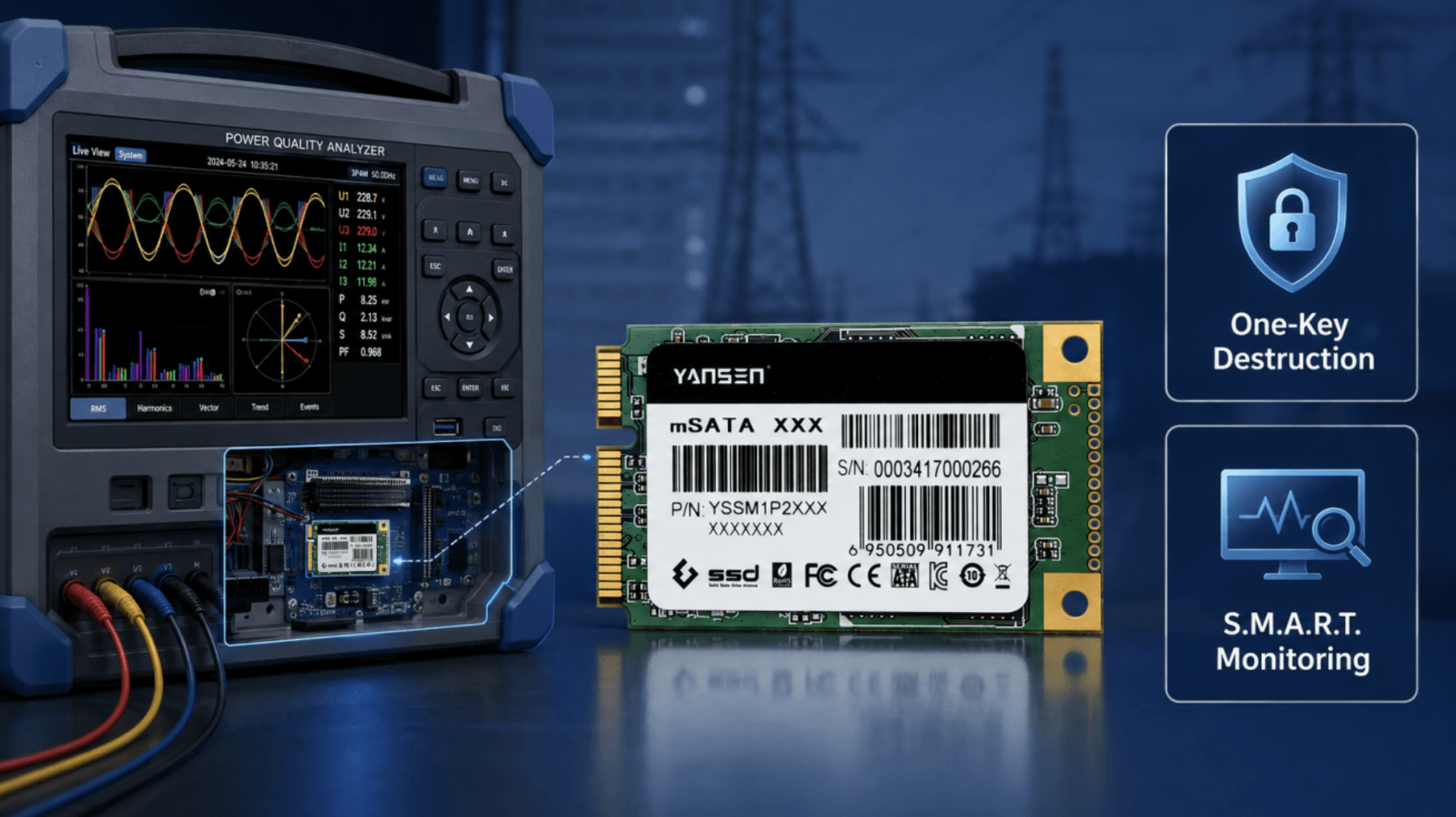
One-Key Data Destruction
Provides an additional option for sensitive data management

Additional Requirement: Storage Health and Data Security

Reliability in professional equipment also depends on the ability to monitor storage condition over time.
The SSD supports S.M.A.R.T. health monitoring, allowing the host system to access storage health information and support preventive maintenance strategies.
This can be valuable for measurement equipment expected to remain in service for extended periods.
The solution also supports a one-key data destruction function, providing an additional data management option for applications where locally recorded measurement information may need to be securely removed.
For professional monitoring and measurement systems, these functions extend the role of the SSD beyond basic storage capacity.

Why an Industrial SSD Was Necessary

For this project, using a consumer SSD would have addressed only part of the requirement.
The actual challenge was to satisfy multiple engineering constraints at the same time:
continuous recording + 500TBW endurance + -40°C to 85°C operation + shock and vibration resistance + low power consumption + compact mSATA integration + health monitoring.
This combination is what made industrial storage necessary.
The SSD was not selected simply because it could deliver 510MB/s read speeds. It was selected because its performance, endurance, environmental specifications and embedded form factor aligned with the operating requirements of the complete measurement platform.

Application Value

By integrating a YANSEN 512GB industrial mSATA SSD, the customer was able to deploy a storage solution designed around the requirements of continuous waveform recording and professional electrical measurement.
The solution combines:
512GB capacity for local data retention, 500TBW endurance for repeated recording workloads, -40°C to 85°C wide-temperature operation for environmental adaptability, and industrial shock and vibration resistance for demanding deployment conditions.
Together, these specifications make the SSD suitable for power quality analyzers, electrical recorders, data acquisition systems and other professional monitoring equipment where storage reliability is an essential part of overall system design.

Industrial Storage Built Around the Application

Industrial storage selection should begin with the workload and operating environment—not simply interface speed or capacity.
From temperature range and endurance to form factor, performance and data management features, storage configurations can be selected according to the technical requirements of the equipment.
Building equipment for a demanding industrial environment? Talk to YANSEN about the storage requirements behind your application.

From the Robot Arena to the Real World: Why Industrial Storage Matters for Humanoid Robots

Industrial Storage
The second World Humanoid Robot Games held in Beijing in August 2026 offered a glimpse of this transition. Beyond athletic competitions, robots were increasingly tested in scenarios closer to real industrial and commercial environments.
From logistics and manufacturing to inspection, hospitality, emergency response, and autonomous navigation, robots are being asked to operate in environments that demand more than mechanical movement.
As robots become more intelligent, they also need to process and store increasing amounts of data. Cameras generate images and video, sensors continuously collect environmental information, AI models need to be loaded and accessed, and operating systems must record logs and diagnostic data. This creates a storage requirement that is easy to overlook when most attention is focused on processors, GPUs, and AI algorithms.
For robots operating in real-world environments, storage is no longer simply a place to keep files. It is part of the computing infrastructure that helps the system access data quickly, operate reliably, and maintain performance over its service life.

Modern Robots Are Becoming Mobile Edge AI Systems

A modern humanoid robot is much more than a mechanical platform. It can be viewed as a mobile edge AI system that continuously senses its environment, processes information, makes decisions, and performs physical actions.
A simplified data path may look like this:
Camera / LiDAR / Sensors → CPU / GPU / AI Accelerator → Memory → Local SSD
During operation, the robot may need to handle computer vision data, navigation maps, AI models, sensor information, system logs, diagnostic records, and task history. These workloads are different from those of a conventional office computer because data is generated and consumed continuously while the machine is performing physical tasks.
The storage system may therefore be responsible for loading AI models, accessing local datasets, saving sensor information, recording system events, and supporting application software at the same time.
This makes storage performance and reliability important parts of the overall robotics architecture. A processor or AI accelerator can only work efficiently when the required data can be delivered to it in a timely and consistent manner.

Why Storage Performance Matters for Real-Time Robotics

In robotics applications, high SSD performance is not simply about making a specification sheet look impressive. The practical objective is to reduce storage-side bottlenecks when the system needs to access large amounts of local data.
For example, a robot may need to load AI models during startup, access navigation maps while moving, read image or video data during inspection, and continuously write system and sensor logs. When several of these workloads occur simultaneously, storage latency and throughput can affect how efficiently the computing platform handles data.
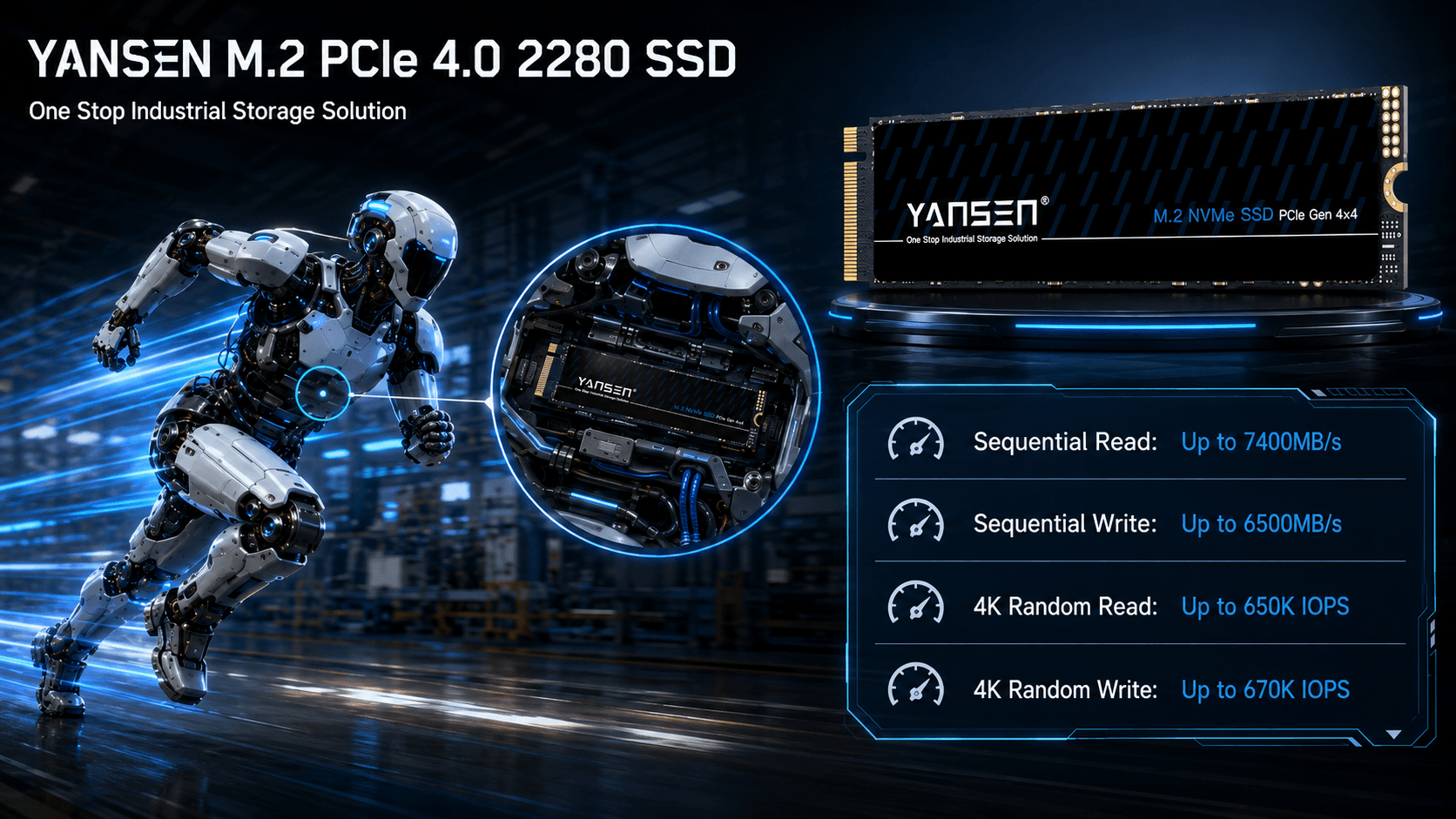
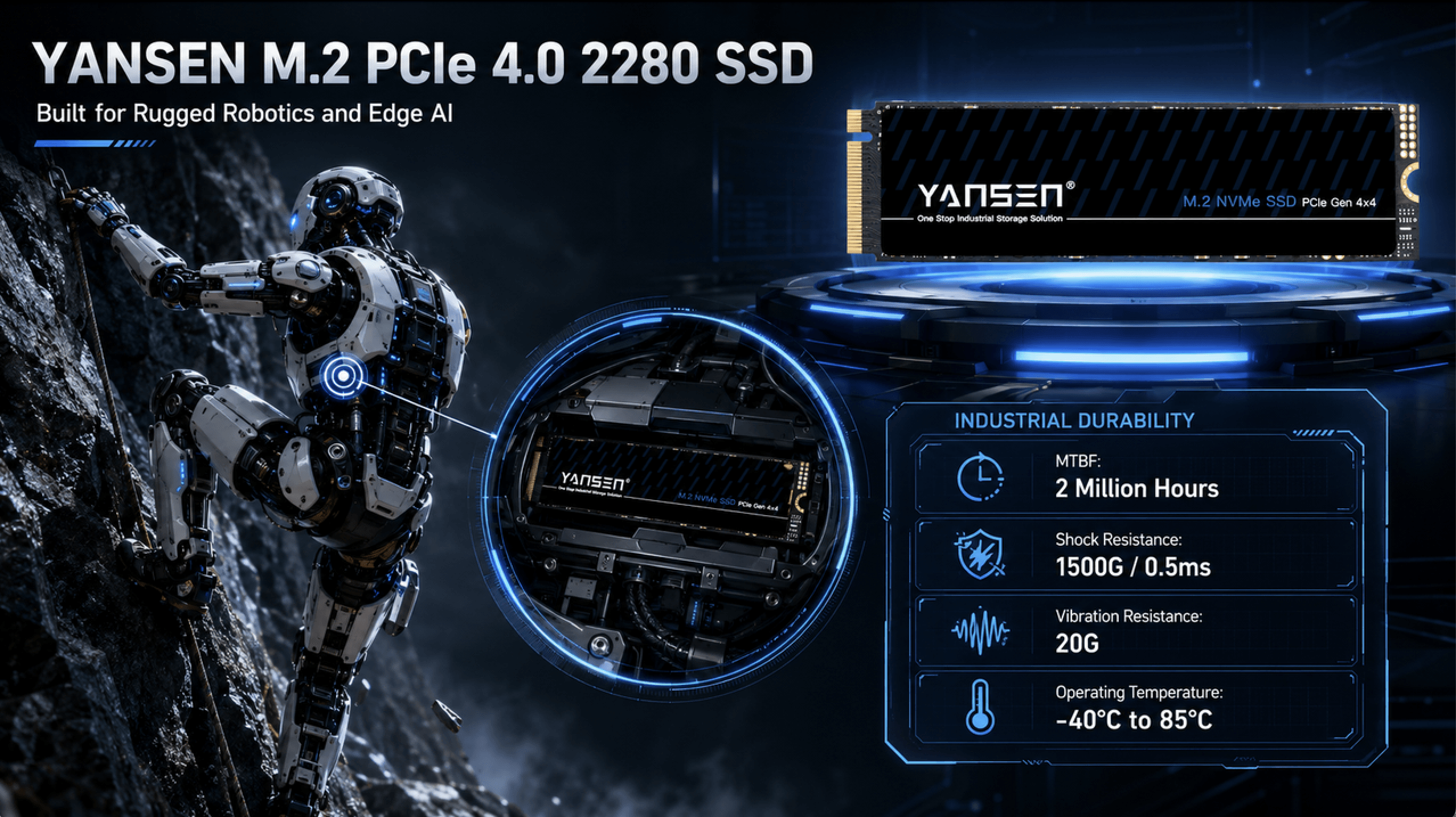
This is where high-speed NVMe storage becomes useful. YANSEN M.2 PCIe 4.0 SSDs use a PCIe Gen4 x4 interface and NVMe protocol to provide high-speed local data access. Selected TLC configurations offer sequential read speeds of up to 7,400 MB/s and sequential write speeds of up to 6,500 MB/s, with 4K random read and write performance of up to 650K and 670K IOPS respectively.
These figures should not be interpreted as a guarantee that a robot itself will operate at a corresponding speed. The actual system performance also depends on the processor, AI accelerator, software, memory, thermal design, and application workload.
The more relevant benefit is that high-performance storage can help edge systems access models, datasets, maps, and other local information efficiently when multiple workloads are running simultaneously.

Industrial Robots Need More Than High Speed

Performance is only one part of the storage equation. A robot working in a factory, warehouse, transportation system, or outdoor environment can face conditions that are very different from those of a desktop PC or a controlled data center.
Industrial and mobile robotic systems may experience temperature changes, mechanical shock, vibration, continuous operation, and frequent read/write activity. If the storage device is not suitable for the deployment environment, a high-speed interface alone cannot guarantee reliable operation.
This is why engineers evaluating storage for robotics should consider environmental specifications alongside performance.
Storage Requirement Why It Matters in Robotics
Wide-temperature operation Supports deployment in changing or demanding environmental conditions
Shock resistance Helps the storage device withstand mechanical impact and movement
Vibration resistance Important for mobile robots and industrial equipment with continuous mechanical movement
Thermal monitoring Helps monitor SSD temperature under demanding workloads
Data management functions Wear leveling and bad block management support long-term storage reliability
Selected YANSEN PCIe 4.0 SSD configurations support an operating temperature range of -40°C to +85°C, with up to 1,500G shock resistance, 20G vibration resistance, and an MTBF of up to 2 million hours. Features such as thermal sensors, S.M.A.R.T., wear leveling, and bad block management further support reliable operation in demanding applications.
For robotics, storage reliability is not only about protecting data. It can also affect overall system availability. When a robot is deployed as part of a production line or other critical process, unexpected storage problems can result in downtime, maintenance work, or interrupted operations.

Continuous Robot Operation Makes Endurance a Key Consideration

Robots can generate data throughout their entire operating lifecycle. Depending on the application, this may include sensor logs, camera data, navigation history, error records, system status information, and application-generated data.
For an industrial robot operating for many hours every day, the accumulated write workload can be substantially higher than that of a typical office computer. As a result, SSD selection should consider not only capacity and speed, but also write endurance.
Two commonly used indicators are TBW and DWPD. TBW, or Terabytes Written, describes the total amount of data an SSD is rated to write over its specified lifetime. DWPD, or Drive Writes Per Day, describes how many times the drive’s full capacity can theoretically be written each day over a defined warranty period.
YANSEN offers different NAND configurations for different workload requirements. Selected TLC models provide capacities from 256GB to 4TB and up to 4,000TBW. eTLC configurations are available from 400GB to 3.84TB, with options supporting 1 DWPD or 3 DWPD.
The appropriate endurance level should be selected according to the robot’s actual write workload, operating pattern, capacity requirement, and expected service life rather than simply choosing the highest available specification.
Different NAND configurations allow system designers to balance performance, capacity, endurance, and project cost according to the requirements of the specific robotics application.

Why M.2 2280 Fits Compact Edge Robotics

Robotic systems face another constraint that is sometimes overlooked: physical space. A robot’s internal electronics must accommodate processors, AI accelerators, memory, communication modules, power components, cooling systems, and other control hardware. PCB space and thermal headroom are therefore often limited.
This makes a compact storage form factor valuable. YANSEN M.2 PCIe 4.0 SSDs use the M.2 2280 form factor, measuring approximately 80 × 22 mm, while providing PCIe Gen4 NVMe connectivity.
The combination of a compact footprint and high-speed interface makes M.2 storage suitable for space-constrained edge computing platforms, including robotics controllers, industrial PCs, machine vision systems, and AI-enabled equipment.
However, form factor selection should always be based on the host platform. Engineers should verify mechanical dimensions, interface compatibility, power requirements, thermal conditions, and available PCIe lanes before selecting an SSD.

Choosing an SSD for Robotics: What Should Engineers Consider?

There is no single SSD specification that is ideal for every robot. A warehouse robot, industrial vision system, autonomous machine, and humanoid robot may have very different storage workloads.
For procurement teams and system integrators, the following factors provide a practical starting point:
Selection Factor What to Consider
Interface PCIe generation, available lanes, and NVMe compatibility
Capacity AI models, operating system, local datasets, logs, and application data
NAND type TLC or higher-endurance options according to workload requirements
Endurance TBW or DWPD based on expected daily write volume and service life
Temperature Required operating temperature range for the deployment environment
Shock and vibration Important for mobile robots and industrial machinery
Reliability MTBF, S.M.A.R.T., wear leveling, bad block management, and other features
Form factor M.2 2280 or another form factor required by the host platform
Lifecycle support Long-term availability, firmware support, and supplier stability
One common mistake is choosing an SSD primarily by its maximum sequential read speed. Sequential performance is important for some workloads, but robotics systems can also involve random access, sustained writes, thermal constraints, and continuous operation.
A more practical evaluation should consider the complete combination of performance, endurance, environmental reliability, capacity, compatibility, and lifecycle support.

From Competition Robots to Commercial Robots

Robot competitions are useful demonstrations of what robotic systems can achieve, but commercial deployment introduces a different set of requirements.
In a competition or laboratory environment, one fundamental question is:
Can the robot perform the task?
In commercial and industrial environments, the question becomes more demanding:
Can the robot perform the task reliably every day?
This difference changes how engineers evaluate the entire system. Intelligence and computing performance remain essential, but reliability, maintainability, operating environment, and service lifecycle become equally important.
The same principle applies to storage. Instead of looking only at capacity, system designers increasingly need to evaluate performance, endurance, environmental reliability, and long-term availability together.
For a robot deployed on a production line or in an industrial facility, storage should be treated as part of the system architecture rather than as an interchangeable commodity component.

YANSEN Industrial SSD for Robotics and Edge AI

For robotics and edge AI applications, storage requirements vary according to workload intensity, operating environment, capacity, and expected deployment lifecycle. A storage supplier therefore needs to provide more than a standard consumer SSD specification.
YANSEN provides industrial and enterprise storage solutions for industrial computing, embedded systems, edge AI, and other demanding applications. Its M.2 PCIe 4.0 2280 SSD family combines PCIe Gen4 NVMe performance with different NAND configurations, capacities, and endurance options.
For robotics applications, available configurations can help system integrators address different priorities. TLC models provide a balance between performance, capacity, endurance, and cost, while eTLC options can be considered for applications with more demanding write workloads.
Selected configurations also support wide-temperature operation, shock and vibration resistance, and storage management features designed for long-term operation.
More importantly, storage selection can be matched to the actual application. A robotics system integrator may need to evaluate AI model size, sensor data volume, daily write workload, operating temperature, mechanical conditions, required service life, and available storage space before finalizing the SSD configuration.
YANSEN’s role is not simply to provide a storage device, but to help customers select a suitable storage configuration according to performance, endurance, environmental, and lifecycle requirements.

Conclusion: The Next Challenge for Robots Is Reliable Real-World Operation

The first challenge for humanoid robots was learning how to move. The next challenge is learning how to work reliably in the real world.
As robots move into factories, warehouses, commercial facilities, transportation systems, and other edge AI environments, their success will depend on more than mechanical design and AI algorithms. Computing, memory, networking, and storage must work together to support continuous data processing.
For this reason, industrial SSDs are becoming an important component of modern robotics infrastructure. High-speed NVMe connectivity can support demanding local data workloads, while appropriate endurance, environmental protection, and long-term reliability help prepare robots for sustained operation.
Explore YANSEN industrial SSD solutions for robotics, edge computing, industrial PCs, and intelligent systems.

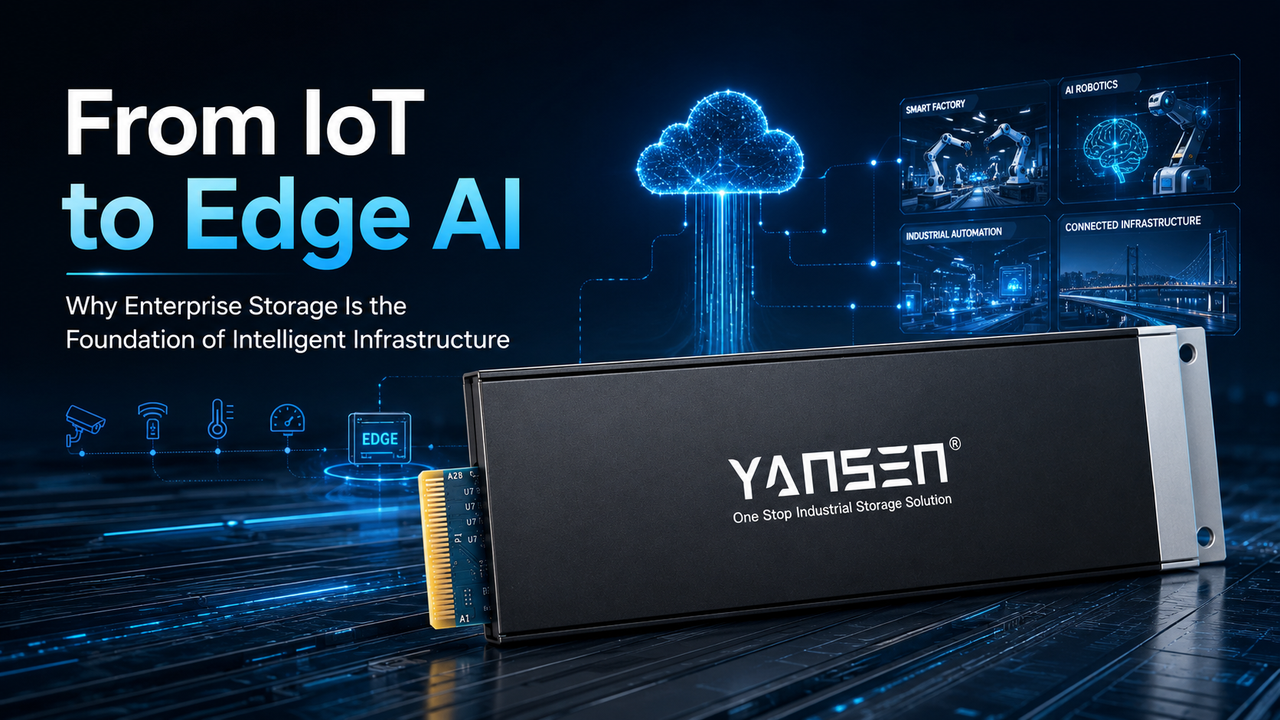
From IoT to Edge AI: Why Enterprise Storage Is the Foundation of Intelligent Infrastructure

Enterprise Storage
Over the past decade, the Internet of Things (IoT) has fundamentally changed how devices communicate, collect information, and interact with the physical world. From smart factories and autonomous machines to intelligent robots, smart transportation systems, and connected cities, more devices are becoming equipped with sensors, cameras, AI capabilities, and real-time communication technologies.
However, as IoT continues to expand, the value of connected devices is no longer determined only by connectivity. The real challenge is how quickly, securely, and reliably the massive amount of generated data can be processed.
Modern IoT devices continuously produce different types of data, including machine operation records, sensor information, video streams, and AI inference data. Traditional cloud-based architectures are increasingly facing limitations when applications require immediate responses and continuous data processing.
This is why Edge Computing is becoming a critical part of next-generation intelligent infrastructure. By moving computing and storage closer to where data is generated, edge systems can reduce latency, improve efficiency, and support real-time decision-making.

The Shift from Cloud Computing to Edge Intelligence

Traditional IoT architectures usually follow a centralized model:
  • Device collects data
  • Network transfers information
  • Cloud processes and analyzes data
  • Applications receive results
This architecture works well for many traditional applications. However, as IoT evolves toward AI-driven systems, the limitations of cloud-only processing are becoming more obvious.
  1. Low Latency Requirements for Real-Time Applications

Many modern intelligent applications require immediate responses. Industrial robots, autonomous systems, and automated production lines cannot always wait for data to travel between devices and distant cloud servers.
For example, an industrial vision system inspecting products on a manufacturing line may need to identify defects and make decisions within milliseconds. Any delay in data transmission can affect production efficiency and system accuracy.
Edge Computing solves this challenge by processing critical data closer to the source, enabling:
  • Faster response times
  • Reduced network delays
  • Real-time decision-making
  1. Increasing Bandwidth Pressure from Massive Data Generation

The growth of cameras, sensors, and AI-enabled devices has created unprecedented data volumes. A single industrial camera system can generate large amounts of image and video data every day, while smart machines continuously produce operational information.
Sending all of this data to the cloud is not always practical. It increases network costs, consumes bandwidth resources, and may reduce system efficiency.
Edge computing allows organizations to process and filter data locally, transmitting only valuable information to centralized systems. This approach improves both performance and infrastructure efficiency.
  1. Data Security and Local Processing Requirements

For many industries, data security has become a major concern. Manufacturing data, medical information, transportation records, and enterprise operational data often contain sensitive information that cannot always be transferred to external cloud environments.
By storing and processing data locally, edge computing provides organizations with greater control over their information while maintaining fast access for intelligent applications.

Why Storage Becomes Critical in Edge Computing

While computing power and network connectivity remain important components of edge infrastructure, storage has become another key factor affecting system performance.
An edge AI system must not only calculate results but also continuously manage:
  • Large volumes of sensor data
  • AI model files
  • Historical operation records
  • Video and image datasets
  • System logs
Without reliable and high-performance storage, even powerful processors may not achieve their full potential.

Edge AI Requires More Than Computing Power

In the early stages of AI development, most attention was focused on computing performance. Companies invested heavily in CPUs, GPUs, AI accelerators, and network infrastructure to improve model training and inference capabilities.
However, as AI applications move from centralized data centers into real-world environments, another challenge is becoming increasingly important: how efficiently data can be stored, accessed, and processed.
For Edge AI systems, storage is no longer just a place to keep files. It has become an active component that connects data collection, AI processing, and intelligent decision-making.

The Role of Storage in the Edge AI Workflow

A typical Edge AI workflow includes several key stages:
  • Data Collection
  • Local Storage
  • AI Inference
  • Real-Time Decision Making
Each stage creates specific storage requirements. Unlike traditional IoT devices that mainly record simple sensor information, modern AI-enabled systems must handle much larger and more complex datasets.
  1. High-Speed Data Writing for Real-Time Data Collection

The first challenge for Edge AI storage is handling continuous data generation.
Smart factories, autonomous machines, and intelligent robots may collect data from multiple sources, including:
  • High-resolution images
  • Video streams
  • Sensor information
  • Machine operation records
  • Environmental monitoring data
These data streams often require fast and stable writing performance. If storage cannot process incoming data efficiently, important information may be delayed, lost, or require additional buffering resources.
For industrial AI applications, storage performance directly affects the reliability of the entire system.
  1. Fast Data Access for AI Model Inference

After data collection, Edge AI systems need to load AI models and process information locally. Unlike traditional applications, AI workloads frequently access large model files and related datasets.
The storage system needs to provide:
  • Fast model loading
  • Low access latency
  • Stable random read performance
  • Reliable operation under continuous workloads
For example, an industrial vision inspection system may need to quickly load a trained AI model and analyze images from production equipment in real time. Slow storage can increase inference latency and reduce overall system efficiency.
  1. Long-Term Reliability for Continuous Edge Operation

Many Edge AI devices are deployed in locations where maintenance is difficult, including:
  • Factory production lines
  • Transportation infrastructure
  • Outdoor monitoring systems
  • Remote industrial environments
Unlike consumer devices that may operate only several hours per day, industrial edge systems often need to run continuously for years.
Therefore, storage solutions used in these environments must focus on more than peak performance. They need:
  • High endurance
  • Stable long-term performance
  • Data protection capability
  • Resistance to demanding operating conditions
This is why enterprise and industrial SSDs are becoming increasingly important in Edge AI infrastructure.

Why E1.S SSD Is Becoming a Future Storage Choice for Edge Infrastructure

As AI computing moves closer to the edge, storage architectures also need to evolve. Traditional storage solutions may face challenges related to performance, thermal management, and deployment density in modern intelligent systems.
The E1.S SSD form factor, developed as part of the Enterprise and Data Center Standard Form Factor (EDSFF) family, was designed specifically for next-generation computing environments.
Compared with traditional 2.5-inch enterprise SSDs, E1.S provides a more flexible design approach for high-density servers, AI infrastructure, and edge computing platforms.

YANSEN E1.S SSD: Designed for the Future of Edge Infrastructure

YANSEN E1.S Enterprise SSD is designed to support demanding AI, edge computing, and intelligent infrastructure applications where performance, reliability, and long-term stability are equally important.
By combining NVMe performance with enterprise-grade reliability, YANSEN E1.S SSD helps organizations build storage systems capable of supporting next-generation intelligent workloads.
  1. High-Speed NVMe Performance for Real-Time AI Applications

AI and IoT applications depend on rapid data movement. Whether processing machine vision data, loading AI models, or analyzing sensor information, storage latency can directly influence system responsiveness.
YANSEN E1.S SSD adopts an enterprise NVMe architecture to provide:
  • High data throughput
  • Low access latency
  • Efficient data processing
  • Stable performance under demanding workloads
This makes it suitable for applications such as:
  • AI inference servers
  • Smart robotics
  • Industrial edge gateways
  • Intelligent manufacturing systems
By reducing storage bottlenecks, high-performance NVMe SSDs allow edge systems to process more data with faster response times.
  1. Enterprise Reliability for 24/7 Edge Operation

Performance is only one part of the equation for Edge AI storage. In many real-world deployments, reliability is even more critical because edge devices are often installed in environments where maintenance opportunities are limited.
A failure in an industrial AI system, smart transportation platform, or remote monitoring device can lead to production interruptions, data loss, and increased maintenance costs. Therefore, storage devices used in these applications must be designed for continuous operation.
Compared with consumer SSDs, enterprise and industrial SSDs are optimized for demanding workloads through technologies and design considerations such as:
  • High endurance NAND flash selection
  • Advanced error correction mechanisms
  • Firmware optimization for stable operation
  • Long-term data integrity management
YANSEN E1.S SSD is designed to support mission-critical environments that require reliable storage performance over extended periods. It helps reduce the risks associated with unexpected downtime and provides a stable storage foundation for intelligent systems.
For applications such as industrial automation, AI servers, and edge computing nodes, the goal is not only achieving maximum benchmark performance, but maintaining predictable performance throughout the entire product lifecycle.
  1. Compact E1.S Form Factor for High-Density Computing Environments

As AI infrastructure continues to evolve, computing systems are becoming smaller, denser, and more specialized. Traditional storage designs may face limitations when more processing power and storage capacity need to be integrated into limited physical space.
The E1.S form factor was developed to address these challenges by providing a storage solution optimized for modern server and edge computing architectures.
Compared with traditional 2.5-inch SSDs, E1.S SSDs offer several advantages:
  • Smaller physical footprint
  • Improved airflow management
  • Better thermal efficiency
  • Higher storage density potential
These characteristics make E1.S particularly suitable for next-generation platforms where space utilization and thermal control are important design considerations.
For AI edge servers, industrial computing systems, and high-density infrastructure, efficient storage design helps organizations achieve better system integration and long-term scalability.

Supporting the Next Generation of Intelligent Applications

The transition from IoT to Edge AI is creating new requirements across multiple industries. Intelligent systems are no longer limited to collecting data; they must analyze information, make decisions, and respond instantly.
Reliable enterprise storage plays an important role in enabling these applications by ensuring that data can be captured, processed, and accessed efficiently.

Smart Manufacturing: Enabling Real-Time Industrial Intelligence

Manufacturing is one of the industries where Edge AI adoption is accelerating rapidly. Modern factories use intelligent systems to improve production efficiency, quality control, and equipment management.
Industrial AI systems continuously collect:
  • Machine operation data
  • Production information
  • Quality inspection images
  • Sensor measurements
For example, AI-powered vision inspection systems analyze product images in real time to identify defects during manufacturing. These systems require storage that can handle continuous data recording while providing fast access for AI processing.
YANSEN E1.S SSD helps industrial computing platforms maintain stable data access performance, supporting more efficient and reliable smart manufacturing operations.

AI Robotics: Supporting Intelligent Machines

Robots are becoming increasingly intelligent as AI technologies improve. Modern robots need to process information from multiple sources, including cameras, sensors, and control systems.
A single intelligent robot may need to manage:
  • Vision data
  • Motion information
  • Environmental sensing data
  • AI decision models
Storage performance directly affects how quickly robots can understand their environment and respond to changes.
With high-speed NVMe performance and enterprise reliability, E1.S SSDs provide a strong storage foundation for AI robotics applications requiring fast response and continuous operation.

Smart Transportation: Processing Data at the Edge

Transportation systems are generating increasing amounts of data through cameras, sensors, and connected infrastructure.
Applications such as intelligent traffic management, railway monitoring, and autonomous transportation systems require local data processing to reduce response times and improve operational efficiency.
Edge storage allows these systems to analyze critical information closer to where it is generated, reducing dependence on centralized cloud processing.
For transportation applications, storage reliability is essential because many systems operate continuously in demanding environments and require long-term stability.

Healthcare Infrastructure: Reliable Storage for AI-Assisted Applications

Healthcare is another field where AI and edge computing are creating new opportunities. Medical imaging analysis, intelligent diagnostic systems, and healthcare data management platforms require fast and reliable access to large amounts of information.
AI-assisted healthcare applications often process:
  • Medical images
  • Diagnostic data
  • Patient information
  • Machine-generated records
In these environments, storage reliability and data protection are essential to maintaining system availability and supporting accurate analysis.

Building a Reliable Storage Foundation for the Intelligent Era

IoT is entering a new stage of development. The future is moving from connected devices toward intelligent systems powered by AI and edge computing.
As more devices gain sensing, computing, and decision-making capabilities, storage will become a critical foundation connecting data collection, AI processing, and real-world applications.
High-performance storage is no longer only a component for saving data. It has become an essential infrastructure element that determines how efficiently intelligent systems can operate.
YANSEN provides enterprise storage solutions designed for AI, edge computing, and intelligent infrastructure, helping businesses build faster, more reliable, and scalable systems for the future.
Explore YANSEN enterprise storage solutions for AI, edge computing, and intelligent infrastructure.

Frequently Asked Questions (FAQ)

  1. Why does Edge AI require enterprise-grade storage?

Edge AI systems process large amounts of data locally, including images, sensor information, and AI model files. Enterprise-grade storage provides higher reliability, endurance, and consistent performance compared with standard consumer SSDs, making it suitable for long-term industrial and commercial deployments.
  1. What are the advantages of E1.S SSD compared with traditional SSD formats?

E1.S SSDs are designed specifically for modern data centers and edge computing environments. Compared with traditional 2.5-inch SSDs, E1.S provides a more compact form factor, improved thermal management, and better suitability for high-density server architectures.
  1. Is E1.S SSD suitable for industrial applications?

Yes. E1.S SSDs can be deployed in industrial computing environments where high-speed data access, long-term reliability, and continuous operation are required. Typical applications include smart manufacturing, industrial AI systems, robotics, and edge servers.
  1. How does storage performance affect AI inference speed?

AI inference requires frequent access to AI models, datasets, and temporary processing data. Slow storage can increase model loading time and create delays during data processing. High-performance NVMe SSDs help reduce latency and improve overall system responsiveness.
  1. How should enterprises choose storage for Edge AI applications?

Enterprises should evaluate several factors, including:
  • Read and write performance requirements
  • Data retention and workload intensity
  • Operating temperature conditions
  • Storage endurance and reliability
  • Long-term product availability and technical support
The right storage solution should match both current workloads and future system expansion requirements.

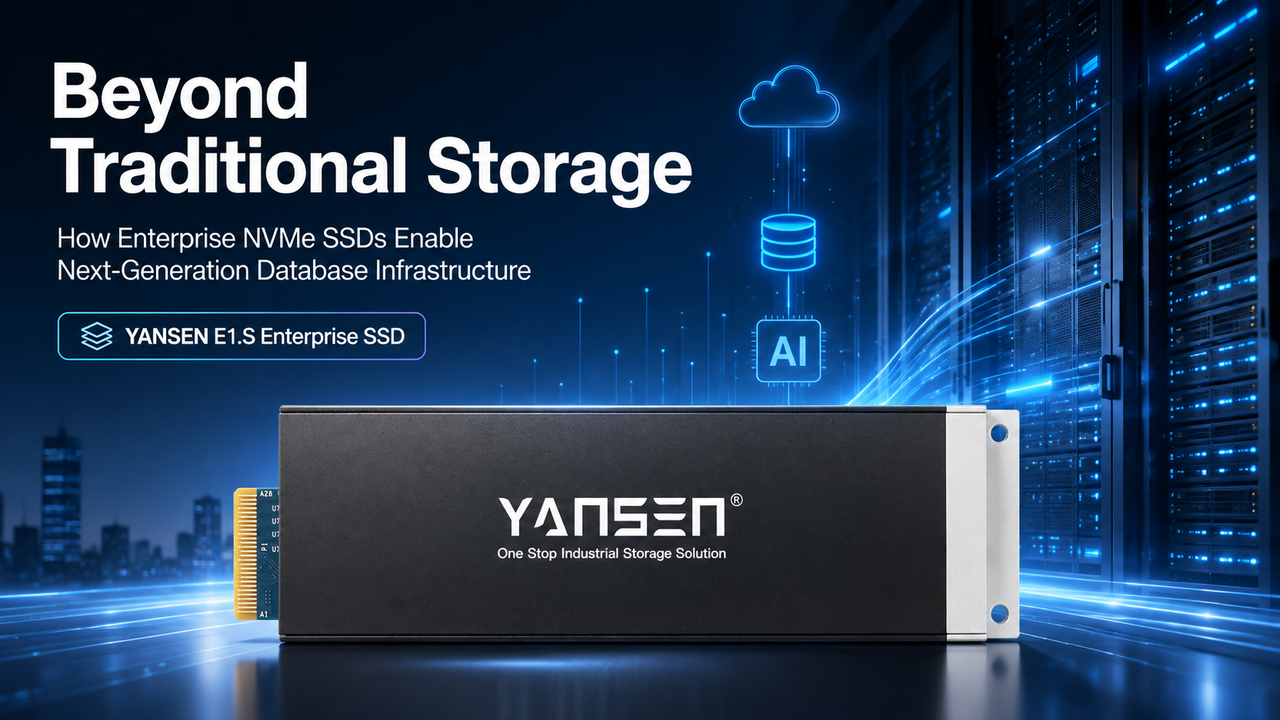
Beyond Traditional Storage: How Enterprise NVMe SSDs Enable Next-Generation Database Infrastructure

E1.S Enterprise SSD
Modern enterprises are generating and processing more data than ever before. From business applications and cloud services to real-time analytics and AI-driven workloads, databases have become the foundation supporting critical digital operations.
Platforms such as Microsoft SQL Server, Oracle Database, and other enterprise database systems are responsible for managing massive amounts of structured information while maintaining fast response times, reliable transactions, and continuous availability.
However, database performance is not determined only by CPU power, memory capacity, or software optimization. The underlying storage infrastructure plays an equally important role.
As database workloads become more complex, traditional storage solutions are increasingly challenged by:
  • Higher transaction volumes
  • More concurrent user requests
  • Larger datasets
  • Real-time data processing requirements
When storage cannot deliver data quickly enough, even powerful processors may remain underutilized. Query response times increase, transaction processing slows down, and overall application performance can suffer.
This is why modern database environments are moving toward enterprise-grade storage solutions designed for:
  • High-speed data access
  • Consistent performance under heavy workloads
  • Long-term reliability
  • Future scalability
Enterprise NVMe SSDs are becoming a critical component in next-generation database infrastructure, helping organizations remove storage bottlenecks and build faster, more reliable data platforms.

Why Storage Performance Matters for Database Workloads

Database systems generate different types of storage workloads. Unlike simple file storage applications, databases require extremely responsive storage to handle frequent reads, writes, and random access operations.
A well-designed database storage architecture must consider the different roles of database components, including data files, transaction logs, and temporary processing areas.
  1. Database Files: Faster Data Access Improves Query Performance

Database files store the core information required by applications, including:
  • Tables
  • Indexes
  • Application data
  • Metadata information
When users search information, generate reports, or access business applications, the database engine frequently reads data from storage.
For these operations, storage performance directly affects:
  • Query response time
  • Application responsiveness
  • User experience
Traditional storage devices may struggle when databases perform large numbers of random read operations simultaneously.
Enterprise SSD solutions improve this situation by providing:
  • Lower access latency
  • Higher random read performance
  • Faster data delivery to the database engine
  1. Transaction Logs: Stable Write Performance Protects Data Operations

Transaction logs are one of the most important parts of database systems. They record changes before data is permanently written, helping maintain consistency and support recovery processes.
For example, in financial systems, e-commerce platforms, and enterprise applications, thousands of transactions may occur every second.
Transaction log storage requires:
  • Continuous write capability
  • Stable latency
  • High endurance
A storage device that performs well only during short benchmark tests may not provide consistent performance during long-term database operation.
This is why enterprise database environments focus on sustained performance rather than only peak speed.

Why Enterprise NVMe SSD Is Becoming Essential for Modern Databases

For many years, database systems were built around traditional storage architectures. Hard disk drives (HDDs) were widely used because of their large capacity and relatively low cost, while SATA SSDs later became a popular upgrade option due to their significantly better performance.
However, modern enterprise databases face very different challenges compared with traditional applications. Today’s systems must support thousands of concurrent users, real-time analytics, cloud applications, and increasingly complex data processing tasks. Under these conditions, storage performance is no longer only about maximum capacity. It is about how quickly and consistently data can be accessed.

From HDD to SATA SSD: Performance Improvements and Remaining Limitations

HDD technology relies on mechanical components, including spinning platters and moving read/write heads. While HDDs remain useful for large-scale archival storage, their mechanical design creates higher latency and limits random access performance.
For database workloads that involve frequent small data requests, such as index searches, transaction processing, and query execution, HDD latency can significantly impact application responsiveness.
SATA SSDs solve many of these problems by replacing mechanical storage with NAND flash memory. Compared with HDDs, SATA SSDs provide:
  • Lower access latency
  • Higher random read/write performance
  • Improved application response time
  • Better reliability due to the absence of moving parts
However, SATA SSDs still rely on the SATA interface and AHCI protocol, which were originally designed for hard disk technology. As database workloads continue to grow, SATA-based storage may become a performance limitation, especially in environments with high concurrency and intensive data processing requirements.

Why Enterprise NVMe SSD Provides a Better Foundation for Database Systems

Enterprise NVMe SSDs are designed specifically for modern high-performance computing environments. Instead of using the older SATA/AHCI architecture, NVMe SSDs communicate directly through PCIe lanes, allowing storage devices to process data more efficiently.
This architecture provides several advantages for database infrastructure.
  1. Lower Latency for Faster Database Response

Latency is one of the most important factors affecting database performance. Even small delays in storage response can accumulate when thousands of database operations occur simultaneously.
NVMe technology reduces unnecessary communication layers between the storage device and the CPU. This shorter data path helps databases achieve:
  • Faster query execution
  • Lower transaction response time
  • Improved application performance
For applications such as online transaction processing (OLTP), financial platforms, and enterprise management systems, lower storage latency can directly improve user experience and operational efficiency.
  1. Sustained Performance for 24/7 Enterprise Operations

Consumer SSDs are often optimized for short bursts of high performance. Enterprise database environments, however, require storage devices that can maintain stable performance over long periods.
A database server may continuously handle:
  • Transaction records
  • User requests
  • Data analytics workloads
  • Background database maintenance tasks
For these applications, consistent performance is more valuable than temporary peak speed.
Enterprise NVMe SSDs are designed with features such as higher endurance ratings, optimized firmware, advanced error correction, and power loss protection (PLP). These technologies help maintain data integrity and stable operation during continuous workloads.
  1. Scalability for Future Data Growth

Enterprise databases are continuing to expand due to digital transformation, AI analytics, and increasing data generation from connected devices. A storage architecture that works today must also support future growth.
Enterprise NVMe SSDs provide a scalable foundation by offering:
  • Higher throughput for increasing workloads
  • Support for larger database environments
  • Better performance when multiple applications run simultaneously
  • Compatibility with next-generation server platforms
As businesses move toward AI-driven analytics and real-time decision-making, storage infrastructure needs to evolve from simply storing data to actively supporting data processing.

Building an Optimized Storage Architecture for Database Workloads

Choosing a high-performance SSD is only one part of database optimization. The way storage resources are organized also has a significant impact on system stability and performance.
Enterprise database systems usually contain different types of data with different storage requirements. Separating database components onto appropriate storage resources can help reduce storage contention and improve overall reliability.
Database Component Recommended Storage Characteristics Primary Requirement
Database Files High-performance NVMe SSD Fast random read/write access and low latency
Transaction Logs Enterprise SSD with high endurance Stable continuous write performance
TempDB Low-latency SSD storage High IOPS for temporary processing
For example, placing frequently accessed database files, transaction logs, and temporary processing data on the same storage device may create unnecessary competition for resources. During peak workloads, this can lead to performance fluctuations.
A properly designed storage architecture helps databases achieve:
  • More predictable performance
  • Improved system availability
  • Better resource utilization
  • Easier future expansion

YANSEN E1.S Enterprise SSD: Designed for Next-Generation Database Infrastructure

As enterprise infrastructure continues to evolve, storage architecture must adapt to new requirements from cloud computing, artificial intelligence, and high-performance databases. Traditional storage solutions based on older form factors may face limitations in density, thermal management, and scalability when deployed in modern data centers.
The E1.S form factor, part of the Enterprise and Data Center Standard Form Factor (EDSFF) family, was developed specifically for next-generation server environments. Compared with traditional 2.5-inch enterprise SSDs, E1.S SSDs are optimized for higher storage density, improved airflow, and more efficient thermal management.
For enterprises building database platforms, AI infrastructure, or large-scale computing environments, E1.S provides a future-oriented storage option that balances performance, reliability, and deployment flexibility.

High-Speed NVMe Performance for Data-Intensive Applications

Modern databases increasingly handle workloads that require rapid data access and continuous processing. Whether it is real-time analytics, enterprise applications, or AI-assisted database operations, storage latency can directly influence overall system efficiency.
YANSEN E1.S Enterprise SSD adopts the NVMe PCIe architecture to provide:
  • High-speed data transfer capability
  • Low storage latency
  • Efficient parallel data processing
  • Stable performance under demanding workloads
This makes E1.S SSD suitable for applications such as:
  • Database acceleration
  • Enterprise application platforms
  • AI data pipelines
  • Cloud computing infrastructure
  • Big data analytics systems
Compared with traditional storage interfaces, NVMe allows enterprise servers to handle more intensive workloads by reducing storage communication bottlenecks and improving data accessibility.

Enterprise Reliability for 24/7 Mission-Critical Operations

For enterprise databases, performance alone is not enough. A storage failure can affect business continuity, data availability, and operational efficiency. Therefore, reliability is one of the most important considerations when selecting enterprise SSD solutions.
YANSEN E1.S Enterprise SSD is designed for mission-critical environments that require long-term stable operation. It focuses on key enterprise storage requirements, including:
  • High endurance for intensive write workloads
  • Stable performance during continuous operation
  • Data integrity protection mechanisms
  • Optimized firmware for enterprise applications
These capabilities help support demanding environments such as:
  • Enterprise database servers
  • Cloud service platforms
  • Industrial computing systems
  • AI infrastructure
In enterprise environments, storage devices are expected to operate reliably for years rather than simply deliver short-term benchmark performance. This is why factors such as endurance, error management, and firmware stability are critical during SSD selection.

Optimized Thermal Efficiency for High-Density Server Deployment

As data centers increase computing density, thermal management has become a major challenge. High-performance processors, GPUs, and storage devices generate significant heat, making airflow optimization essential for maintaining system stability.
Compared with traditional SSD designs, E1.S provides advantages in server thermal management through its optimized form factor. Its design allows better airflow integration and more efficient heat dissipation in dense server environments.
This helps enterprises maintain:
  • More stable operating temperatures
  • Consistent storage performance
  • Higher server utilization
  • Improved infrastructure efficiency
For AI servers, cloud platforms, and high-performance database systems, thermal efficiency is not only a hardware design consideration but also an important factor affecting long-term reliability.

Flexible Deployment for Future Enterprise Infrastructure

The role of enterprise storage is expanding beyond traditional database applications. As organizations adopt AI workloads, machine learning platforms, virtualization, and large-scale analytics, storage systems need to support a wider range of applications.
YANSEN E1.S Enterprise SSD is designed to support future infrastructure development, including:
  • AI computing platforms
  • Cloud infrastructure
  • Enterprise database environments
  • High-performance data analytics
  • Industrial computing applications
By combining NVMe performance, enterprise-grade reliability, and modern server compatibility, E1.S SSD provides a scalable storage foundation for organizations preparing for future data growth.

Beyond SQL Server: Enterprise SSD for Future Data-Driven Workloads

Although SQL Server represents a typical enterprise database application, modern businesses rely on many other data-intensive workloads, including artificial intelligence, machine learning, virtualization, and real-time analytics.
These applications share common requirements:
  • Large-scale data processing
  • Fast and consistent data access
  • Reliable long-term operation
  • Scalable storage architecture
As enterprises continue moving toward intelligent and data-driven operations, storage infrastructure will play an increasingly important role in overall system performance. Enterprise NVMe SSDs are becoming a key component for organizations that need to process, analyze, and protect growing volumes of critical data.

How to Choose the Right Enterprise SSD for Database Infrastructure

Selecting an enterprise SSD for database applications requires more than comparing sequential read and write speeds. In real-world deployments, database performance depends on multiple factors, including workload characteristics, endurance requirements, reliability features, and future scalability.
Before choosing an SSD solution, enterprise IT teams and system integrators should evaluate several key factors.
  1. Understand the Database Workload Type

Different database workloads create different storage demands. A transactional database handling thousands of user requests per second requires different SSD characteristics compared with a data warehouse focused on large-scale analytics.
Workload Type Storage Requirement Recommended SSD Characteristics
Online Transaction Processing (OLTP) Frequent small data operations Low latency, high random IOPS, stable write performance
Data Analytics Large-scale data scanning and processing High throughput and strong parallel performance
AI Database Applications Large datasets and continuous data access High capacity, low latency, enterprise endurance
Virtualized Database Environment Multiple workloads sharing resources Consistent performance under mixed workloads
Understanding the actual workload is the first step toward selecting a storage solution that delivers practical value rather than only impressive benchmark numbers.
  1. Pay Attention to Endurance and Data Protection

Enterprise databases often run continuously and generate large amounts of write operations. Unlike consumer applications where occasional performance peaks may be sufficient, enterprise systems require predictable performance over years of operation.
Important SSD specifications include:
  • DWPD (Drive Writes Per Day): Indicates how much data can be written to the SSD every day during its warranty period.
  • TBW (Terabytes Written): Represents the total amount of data that can be written during the SSD lifetime.
  • Power Loss Protection (PLP): Helps protect important data during unexpected power interruptions.
  • ECC and Firmware Optimization: Improve data accuracy and long-term stability.
For mission-critical database systems, these reliability features are often more valuable than peak benchmark performance.
  1. Consider Future Infrastructure Expansion

Database environments rarely remain unchanged. As business data grows, companies may need to support more users, additional applications, AI analytics, and larger datasets.
A suitable enterprise SSD should provide enough scalability for future requirements, including:
  • Higher storage capacity options
  • Compatibility with next-generation servers
  • Support for high-performance computing environments
  • Long product lifecycle availability
This is especially important for enterprises that invest heavily in infrastructure deployment. Replacing storage hardware frequently can increase maintenance costs and create unnecessary system migration risks.
Why Enterprise Storage Is Becoming a Strategic Infrastructure Investment

In the past, storage was often considered a passive component responsible only for saving data. However, modern enterprise environments have changed this perspective.
Today, storage directly affects:
  • Application response time
  • Database transaction efficiency
  • AI workload performance
  • Business continuity
As organizations adopt cloud services, artificial intelligence, and real-time analytics, storage infrastructure has become a critical part of overall computing performance.
The future of enterprise computing will not depend on CPU, memory, or storage alone. Instead, it will rely on how efficiently these components work together to process increasingly complex workloads.

Conclusion: Building Faster and More Reliable Data Infrastructure

Modern database optimization is no longer limited to software configuration or server upgrades. The underlying storage architecture plays an equally important role in determining system performance, reliability, and scalability.
Enterprise NVMe SSD solutions, such as YANSEN E1.S Enterprise SSD, provide organizations with a powerful foundation for next-generation workloads by combining high-speed data access, enterprise reliability, and future-ready scalability.
For businesses managing critical databases, AI applications, cloud platforms, and industrial computing systems, choosing the right storage technology is not simply a hardware decision—it is a long-term investment in infrastructure performance and business continuity.
Explore YANSEN enterprise storage solutions designed for demanding database environments, AI workloads, and next-generation data infrastructure.

Frequently Asked Questions (FAQ)

  1. Why is NVMe SSD better than SATA SSD for enterprise databases?

NVMe SSDs use the PCIe interface and NVMe protocol, which provide lower latency and higher parallel processing capability compared with SATA SSDs. For databases with high concurrency and intensive workloads, NVMe SSDs can improve query response time and transaction processing efficiency.
  1. Is E1.S SSD suitable for SQL Server databases?

Yes. E1.S SSDs are designed for enterprise server environments and can support database workloads that require high performance, reliability, and continuous operation. They are suitable for SQL Server, cloud databases, analytics platforms, and other data-intensive applications.
  1. What is the difference between consumer SSD and enterprise SSD?

Enterprise SSDs are designed for continuous workloads and mission-critical applications. Compared with consumer SSDs, enterprise SSDs typically provide higher endurance, optimized firmware, stronger data protection features, and better stability under long-term operation.
  1. Why does database storage need Power Loss Protection (PLP)?

During unexpected power failures, data stored in SSD cache may be lost or corrupted. PLP technology helps ensure that important data is safely written to NAND flash memory, improving database reliability and data integrity.
  1. What applications can benefit from YANSEN E1.S Enterprise SSD?

YANSEN E1.S Enterprise SSD is designed for demanding applications including enterprise databases, AI infrastructure, cloud computing platforms, big data analytics, and industrial computing systems that require high-speed, reliable storage.

AI Is Reshaping the Storage Industry: KingSpec Expands Manufacturing Capacity for the Next Wave of Demand

KingSpec Vice President Interviewed by CCTV News
Artificial intelligence is changing not only how data is processed, but also how much data must be generated, moved, cached, and retained. As AI evolves from simple chatbots to reasoning systems and autonomous agents, storage is becoming a core part of the computing stack—and the market is beginning to feel the pressure.

From Chatbots to Agents: A Step Change in Storage Demand

Industry presentation data illustrates the scale of the shift. A conventional chatbot may process about 1,000 tokens per task and require roughly 10 MB of peak KV cache per user. A standard agent can consume around 40,000 tokens for a task, use 100 MB to 1 GB of peak KV cache, and call tools repeatedly. Long-running agents may consume millions of tokens and require several to tens of gigabytes of KV cache per user.
In practical terms, estimated token consumption rises from 1× for chatbots to 4–15× for agents and 10–100× for long-running agents. Persistent memory, user preferences, conversation history, intermediate reasoning, and tool outputs all add to the amount of data that must be stored and accessed quickly.

The NAND Market Is Moving into Deficit

The supply outlook points in the same direction. Industry estimates show global NAND demand slightly exceeding supply in 2025, with the gap widening in 2026 before remaining negative in 2027. Demand is forecast to reach 1,130 EB in 2026, compared with 1,071 EB of supply—a projected deficit of 5.22%.
Year
NAND Supply
NAND Demand
Supply Gap
2024
839 EB
778 EB
+7.84%
2025E
986 EB
988 EB
−0.20%
2026E
1,071 EB
1,130 EB
−5.22%
2027E
1,447 EB
1,501 EB
−3.60%

China’s Export Data Adds a Market-Side Signal

China Customs data provides further evidence of the shift toward higher-value storage products. In the first quarter of 2026, China exported USD 72.47 billion of integrated circuits, up 77.5% year over year. Export volume, however, increased by only 13.4%, indicating a sharp rise in the average export value and a more valuable product mix.
Memory products were the standout category: exports reached USD 45.99 billion, accounting for 63.3% of China’s total integrated-circuit export value and rising 174.2% year over year. Memory was the only category to outpace the overall growth rate of integrated-circuit exports. Industry observers attribute this surge to both the cyclical tightening of global memory supply and structural changes, including faster domestic substitution and rising market share for Chinese suppliers.
This does not mean every product category will face the same conditions, but it does indicate a tighter market in which capacity planning, procurement visibility, and supply resilience become more important.

KingSpec Is Preparing for the Next Demand Cycle

Against this backdrop, KingSpec is optimizing production-line configurations, increasing automation, and strengthening supply chain coordination. The goal is to improve manufacturing efficiency, delivery reliability, and the flexibility to support different order volumes, product specifications, and schedules.
The broader supply side is also accelerating. The same industry materials forecast that China’s equipment demand across NAND, DRAM, and advanced logic could rise from approximately USD 21.1 billion in 2025 to USD 70 billion in 2028. For advanced storage alone, projected equipment demand increases from USD 9.85 billion to USD 46 billion over the same period. These figures are forecasts rather than customs statistics, but they signal strong investment expectations across the domestic semiconductor ecosystem.

Storage Built Around Real-World Workloads

KingSpec continues to develop solid-state drives, memory modules, and industrial storage around the needs of specific applications:
  • AI servers and enterprise systems — high throughput, large capacity, consistent performance, and dependable supply.
  • Industrial and edge applications — stable operation under vibration, temperature variation, electromagnetic interference, and unstable power.
  • AI PCs and workstations — faster local access and greater capacity for content creation, analytics, and local model deployment.

Turning Market Pressure into Long-Term Value

AI is making storage a strategic resource. As workloads become longer, more stateful, and more data-intensive, customers will judge suppliers not only by product specifications, but also by quality management, lifecycle support, capacity readiness, and delivery performance.
By investing in manufacturing capabilities and application-oriented storage solutions, KingSpec aims to help customers navigate a tighter market and build the reliable data infrastructure required for the intelligent era.

Apple Raised Mac & iPad Prices—Here’s a Smarter Way to Get More Storage

Apple Raised Mac & iPad Prices—Here's a Smarter Way to Get More Storage
Apple products have long been known for their premium design, powerful performance, and seamless ecosystem. But recently, another thing has caught users’ attention—the higher price tags.
As Apple adjusts the pricing of several Mac and iPad models in multiple markets, many buyers are once again facing a familiar dilemma:
Should you spend hundreds of dollars upgrading Apple’s internal storage, or is there a smarter alternative?
Take the 14-inch MacBook Pro as an example. Upgrading from 1TB to 2TB of internal storage can cost hundreds of dollars more. For students, photographers, creators, and professionals, that extra expense often feels difficult to justify.
The good news is that more storage doesn’t necessarily mean paying Apple’s premium.
Today, an increasing number of Mac users are choosing a more flexible workflow:
A powerful Mac + a high-speed portable SSD.
Let’s explore why.
Why Rising Memory Costs Make a Portable SSD the Smarter Upgrade
Rising NAND flash and DRAM prices are pushing up the cost of higher-capacity Macs and iPads. Because both memory and internal storage are built into the device, buyers cannot simply replace or expand these components later.
That makes the purchase decision more expensive: moving up just one internal-storage tier can add $500 or more to the price of the entire device, while increasing both storage and memory can widen the gap even further.
By comparison, the same budget can often buy a high-capacity portable SSD—and leave money available for other accessories or software. Instead of paying a premium for storage permanently tied to one device, users gain capacity that can move between a Mac, iPad, iPhone, and Windows PC.
For anyone working with large photos, 4K video, project files, or media libraries, the value difference is clear: keep macOS, apps, and active files on the internal drive, then move large or completed projects to a portable SSD.
This approach reduces the upfront cost of buying a new computer, expands available storage more affordably, and gives that investment a useful life beyond a single device.
Do You Really Need More Internal Storage?
Here’s something many people overlook:
Most of your largest files don’t actually need to stay on your Mac’s internal SSD.
Think about what occupies the most space:
  • 4K and 8K video footage
  • ProRes recordings
  • Lightroom photo libraries
  • RAW camera files
  • Final Cut Pro projects
  • Adobe Premiere assets
  • DaVinci Resolve cache files
  • Large game installations
  • Archived project folders
These files are often accessed during active work, then archived for future reference.
That makes them perfect candidates for external storage.
Instead of paying Apple’s premium for internal capacity you’ll rarely need every day, you can keep your operating system, applications, and current projects on your Mac while storing large media libraries on a high-speed external SSD.
It’s a workflow already adopted by countless photographers, filmmakers, designers, and content creators.
Why a Portable SSD Makes More Sense
A modern portable SSD offers far more than just extra capacity.
It gives you flexibility.
1. Work Across Multiple Devices
Unlike internal storage, a portable SSD isn’t tied to one computer.
The same drive can move effortlessly between:
  • MacBook
  • iPad Pro
  • Windows PC
  • USB-C smartphones
  • Creative workstations
  • Gaming handhelds
Your files travel with you—not your computer.
 
2. Perfect for Creative Workflows
Today’s creators generate enormous amounts of data.
A single day of shooting can easily produce hundreds of gigabytes of footage.
Instead of constantly deleting files or carrying multiple flash drives, one high-speed portable SSD can become the center of your workflow.
Whether you’re:
  • Editing on location
  • Traveling between clients
  • Working remotely
  • Backing up footage after a shoot
A portable SSD keeps your projects organized and always within reach.
A Smarter Storage Companion: KingSpec MemoStone US5 Portable SSD
If you’re looking for an affordable storage upgrade without replacing your Mac, the KingSpec MemoStone US5 Portable SSD is designed precisely for modern creators.
Rather than simply adding storage, it enhances the way you work.
Ultra-Fast 20Gbps USB-C Performance
The MemoStone US5 features a high-speed USB 3.2 Gen 2×2 Type-C interface, delivering up to 20Gbps of bandwidth.
That means transferring large photo libraries, 4K video projects, or design assets takes significantly less time, allowing you to focus more on creating and less on waiting.
Whether you’re importing footage from your camera or backing up finished projects, speed matters.
Built for Today’s Apple Ecosystem
Modern Apple devices have fully embraced USB-C.
The MemoStone US5 integrates naturally into that ecosystem, making it easy to connect with:
  • MacBook Air
  • MacBook Pro
  • iPad Pro
  • USB-C iPhone models
  • Mac Studio
  • Mac mini
No complicated setup.
Just plug in and start working.
Up to 2TB of Portable Storage
Creative projects grow quickly.
High-resolution photography, drone footage, cinematic video, and large design files can consume storage in no time.
With capacities of up to 2TB, the MemoStone US5 gives you room for:
  • Thousands of RAW photos
  • Hundreds of hours of HD video
  • Massive 4K editing projects
  • Large creative asset libraries
Instead of constantly managing free space, you can simply keep creating.
Lightweight Enough to Take Anywhere
The MemoStone US5 is compact enough to fit easily into a pocket, camera bag, or laptop sleeve, making it an ideal companion for travel, business trips, and outdoor shoots.
A Better Workflow for Apple Users
No cloud upload.
No repeated file transfers.
No worrying about running out of internal space.
Just one drive supporting your entire workflow.
Who Should Consider a Portable SSD?
While nearly every Mac user can benefit from additional storage, portable SSDs are particularly valuable for:
Content Creators
Large video files, editing software, and media assets demand fast storage that travels with you.
Photographers
RAW images accumulate quickly. Portable SSDs make backups fast and reliable, especially during events or travel.
Students
Instead of paying Apple’s upgrade premium, students can expand storage more affordably while carrying coursework, media, and projects between devices.
Remote Professionals
Working across multiple locations often means accessing files from different computers. A portable SSD simplifies that process.
Everyday Mac Users
Even if you don’t create content professionally, photo libraries, family videos, and large downloads eventually consume available storage.
External storage provides room to grow without replacing your device.
 
Spend Smarter, Not More
Apple builds exceptional devices, and for many users, they’re worth every dollar.
But paying a premium for additional internal storage isn’t always the most practical investment.
For creators, professionals, students, and anyone working within Apple’s ecosystem, the KingSpec MemoStone US5 Portable SSD is a smarter, more versatile way to expand your storage without expanding your budget.

Why AI Robots Need a New Storage Foundation

Why AI Robots Need a New Storage Foundation
Artificial Intelligence is entering a new stage of development. While early AI competition focused mainly on model size, GPU performance, and computing power, the industry is now moving toward a more complex question: how can AI systems operate efficiently, reliably, and continuously in real-world environments?
At the World Artificial Intelligence Conference (WAIC) 2026, discussions around AI infrastructure, intelligent agents, embodied intelligence, and industrial AI applications highlighted a clear trend: AI is moving from experimental models toward large-scale deployment.
This shift is accelerating the development of industrial robots, autonomous mobile robots, service robots, inspection systems and other intelligent machines. Yet every improvement in perception and autonomy brings a corresponding increase in data. Cameras, depth sensors, LiDAR, microphones and motion controllers continuously generate information that must be captured, processed and retained. For robot manufacturers and system integrators, storage is therefore becoming a core part of the AI architecture rather than a secondary hardware component.

Robots Create a Continuous, Complex Data Cycle

An AI robot does not simply read a model and execute a fixed command. It operates through a continuous cycle of sensing, interpretation, action and learning. High-resolution video may be used for object recognition and navigation; depth maps and point clouds help the machine understand space; telemetry records component status; and event logs preserve the decisions made by the system. In fleet deployments, these records may also be uploaded for centralized analysis, model refinement and predictive maintenance.
The volume grows quickly. A single robot may operate for many hours each day, while a warehouse, factory or logistics center may deploy dozens or hundreds of units. Not all of this data can be sent immediately to the cloud. Network bandwidth, latency, privacy requirements and intermittent connectivity often make local or edge processing essential. Storage must keep data close to the processor so that the robot can respond quickly while retaining the information needed for diagnostics, compliance or future training.

What AI Robotics Requires from Storage

First, robotic systems need fast and consistent access to data. AI models, map files, sensor streams and databases must reach processors without creating avoidable delays. Peak speed is useful, but stable performance under sustained workloads is often more important. A storage bottleneck can slow perception pipelines, extend response times or prevent costly accelerators from being fully utilized.
Second, robots need sufficient capacity and write endurance. Operational logs, video, checkpoints and temporary inference data can produce frequent writes. Capacity planning must cover not only the current model and application, but also software updates, expanding datasets and the retention window required by the business. Endurance becomes especially important for equipment expected to operate continuously over several years.
Third, data integrity cannot be treated as optional. Unexpected power interruption may occur during maintenance, battery switching or an electrical fault. If data in transit is lost or corrupted, a robot may lose critical logs, configuration information or task progress. Error correction, health monitoring and power-loss protection help reduce these risks.
Finally, AI systems must fit within real physical constraints. Edge servers and robot control cabinets often have limited space and thermal headroom. Storage therefore needs an efficient form factor, predictable power consumption and manageable cooling characteristics. It should also support practical serviceability as fleets grow and maintenance teams need to replace or upgrade components.
Requirement Why It Matters
High Throughput Enables faster movement of large AI datasets and reduces computing idle time.
Low Latency Improves response speed for AI inference and real-time applications.
High Endurance Supports continuous write workloads such as AI training checkpoints and data logging.
Data Protection Prevents data corruption caused by unexpected power interruption or system failures.
Long-Term Reliability Ensures stable operation for enterprise and industrial deployments.

Why the E1.S Form Factor Fits Edge AI Infrastructure

E1.S was developed for modern enterprise and data-center environments where density, thermal management and serviceability matter. Compared with storage formats originally designed for client devices, its server-oriented design provides a better foundation for compact edge systems, robot fleet controllers and localized AI nodes. It can help system designers build higher-capacity storage pools without consuming excessive space, while supporting a more structured approach to cooling and maintenance.
The YANSEN E1.S enterprise SSD is designed for these demanding data environments. It uses a PCIe Gen4 x4 interface and is available from 1.6TB to 7.68TB using eTLC NAND. Sequential read performance reaches up to 7,100 MB/s, while sequential write performance reaches up to 3,000 MB/s, depending on capacity. This combination supports rapid model loading, high-volume data transfer and the parallel data access required by AI and edge-computing applications.
Reliability features are equally important. The drive includes hardware power-loss protection, two-million-hour MTBF, S.M.A.R.T., TRIM, wear leveling and power management. For system builders, these capabilities provide a more dependable basis for applications involving continuous operation, repeated logging and valuable machine-generated data.

YANSEN Storage Solutions for AI and Intelligent Applications

As AI infrastructure continues to develop, enterprises need storage partners that understand both performance requirements and real-world deployment challenges.
YANSEN focuses on providing enterprise and industrial storage solutions designed for data-intensive applications, including AI servers, edge computing platforms, industrial automation systems, and intelligent devices.

Enterprise Storage for AI Servers and Data Centers

AI servers and data centers require storage devices capable of handling intensive workloads over long periods.
YANSEN enterprise SSD solutions are designed to support demanding environments with features including:
  • High-speed data access for AI workloads
  • Stable continuous read and write performance
  • High endurance for intensive data operations
  • Power Loss Protection (PLP) for improved data security
  • Enterprise-grade reliability for 24/7 operation
These capabilities help organizations build more efficient AI infrastructure by reducing storage bottlenecks and improving overall system stability.

Industrial Storage for Edge AI and Smart Manufacturing

While cloud-based AI continues to grow, many intelligent applications require local processing and storage closer to the data source.
Industrial environments such as smart factories, transportation systems, and intelligent monitoring platforms often operate under conditions that are very different from traditional data centers.
YANSEN industrial SSD solutions are designed for applications requiring:
  • Wide-temperature operation
  • Resistance to vibration and shock
  • Stable long-term performance
  • High write endurance
  • Long product lifecycle support
These features make industrial SSDs suitable for machine vision systems, industrial robots, edge AI gateways, transportation infrastructure, and other mission-critical applications.

The Future of AI Depends on More Than Computing Power

AI systems will continue generating larger datasets, handling more complex workloads, and expanding into more industries. This evolution will require storage infrastructure that can deliver:
  • Fast data access for AI workloads
  • Stable performance under continuous operation
  • Reliable protection for critical data
  • Flexible deployment across cloud, enterprise, and edge environments
Computing power determines how quickly AI models can process information, but storage determines whether that information can be delivered efficiently and reliably.
For enterprises preparing for the next generation of AI applications, choosing the right storage architecture is becoming an important strategic decision.
YANSEN provides enterprise and industrial storage solutions designed to support data-intensive AI workloads, from AI servers and data centers to intelligent edge and industrial applications.
Explore YANSEN storage solutions and build a more reliable foundation for your AI infrastructure.

Frequently Asked Questions About AI Storage Infrastructure

  1. Why is storage becoming more important in AI infrastructure?

AI workloads require continuous access to large amounts of data. During model training, storage provides datasets and saves checkpoints. During inference, storage supports fast data retrieval and real-time application response.
As AI models become larger and applications become more complex, storage performance, latency, and reliability directly influence overall system efficiency.
  1. Can high-performance GPUs solve AI storage bottlenecks?

No. GPUs provide powerful computing capabilities, but they still depend on storage systems to deliver data efficiently.
If storage performance cannot keep up with AI workloads, GPUs may spend time waiting for data instead of performing calculations. This reduces resource utilization and increases operational costs.
  1. What type of SSD is suitable for AI applications?

The ideal SSD depends on the application scenario.
  • AI data centers often require enterprise NVMe SSDs with high throughput, low latency, and strong endurance.
  • AI inference servers require stable performance for frequent data access.
  • Industrial AI systems require SSDs with features such as wide-temperature support, shock resistance, and long-term reliability.
Enterprise and industrial workloads usually require SSDs designed specifically for continuous operation rather than standard consumer SSDs.
  1. Why do AI and industrial applications need industrial-grade SSDs?

Industrial environments often involve challenges that consumer devices are not designed to handle, including temperature fluctuations, vibration, unstable power conditions, and long deployment cycles.
Industrial SSDs are optimized with technologies such as higher endurance NAND, firmware optimization, power loss protection, and environmental testing to improve long-term reliability.
  1. How does edge AI change storage requirements?

Edge AI moves data processing closer to where information is generated, such as factories, vehicles, cameras, and intelligent devices.
Because these systems cannot always rely on cloud connectivity, local storage must provide fast access, reliable operation, and the ability to handle continuous data collection and processing.
  1. What should enterprises consider when selecting storage for AI projects?

Enterprises should evaluate storage based on workload requirements rather than only focusing on capacity or peak speed.
Key factors include:
  • Read and write performance
  • Latency requirements
  • Endurance and expected workload intensity
  • Data protection features
  • Operating environment
  • Product lifecycle and supplier support
A suitable storage solution should match the actual AI application scenario and provide reliable performance throughout the system lifecycle.
Choosing the right storage infrastructure will help enterprises unlock the full potential of AI—from centralized data centers to the intelligent edge.

Related News

Our Advantage

Industrial Storage Solutions

YANSEN's industrial storage solutions are designed for extreme environments, offering high durability and reliability under harsh conditions. With advanced error correction, data protection and extended wide temperature support, they ensure consistent performance in demanding industrial applications.

Enterprise Storage Solutions

YANSEN's enterprise storage solutions deliver exceptional speed and scalability, tailored for data-intensive workloads. Optimized for reliability and security, they are ideal for mission-critical applications in modern data centers.

Embedded Storage Solutions

YANSEN's embedded storage solutions are compact, efficient, and highly customizable, perfect for integration into various devices. With low power consumption and high endurance, they ensure optimal performance and longevity in embedded systems.

SmartKit

coming soon

FAQ of Industrial SSD (YANSEN)

Related News of Industrial SSD (YANSEN)

Contact Us

Please fill out the inquiry form below to provide us with your specific requirements, and we will promptly assist you.

FAQs of Industrial SSD

YANSEN’s industrial SSD solutions are mostly applied in industries like manufacturing, aerospace, automotive, energy, and transportation, where extreme environments are usual hence reliability crucial.

Yes, YANSEN SSDs are generally more expensive than regular consumer-grade SSDs. This is due to the specialized components, advanced features, and rigorous testing required to meet strict industrial standards.

Using a normal SSD in an industrial environment is generally not recommended due to the lack of necessary ruggedization, durability, and reliability features. Industrial SSDs are specifically designed to handle the extreme conditions, which are real challenges for regular SSDs.

FAQs of Enterprise SSD

An enterprise SSD (Solid State Drive) is a type of storage device specially designed for use in enterprise applications which offers high performance, reliability, and endurance, making it the most suitable choice for heavy workloads and demanding applications.

Enterprise SSDs generally offer faster data access, lower power consumption, and increased reliability compared to traditional hard disk drives. They also provide better performance for data-intensive applications and workloads.

Enterprise SSDs are designed to meet the demanding enterprise environments, with features such as higher endurance, power-loss protection, and advanced error correction. They are also required to go through tests and validations for use in critical applications and data centers.

When choosing an enterprise SSD, factors such as performance, endurance, reliability, power efficiency, and compatibility with existing infrastructure should be considered. It’s also important to consider the specific requirements of the enterprise workload and application.

Get Quote